In 2006, the contemporary American Pentecostal movement celebrated its 100th birthday. Over that time, its African American sector has been markedly influential, not only vis-à-vis other branches of Pentecostalism but also throughout the Christian church. Black Christians have been integrally involved in every aspect of the Pentecostal movement since its inception and have made significant contributions to its founding as well as the evolution of Pentecostal/charismatic styles of worship, preaching, music, engagement of social issues, and theology. Yet despite its being one of the fastest growing segments of the Black Church, Afro-Pentecostalism has not received the kind of critical attention it deserves.
Afro-Pentecostalism brings together fourteen interdisciplinary scholars to examine different facets of the movement, including its early history, issues of gender, relations with other black denominations, intersections with popular culture, and missionary activities, as well as the movement’s distinctive theology. Bolstered by editorial introductions to each section, the chapters reflect on the state of the movement, chart its trajectories, discuss pertinent issues, and anticipate future developments.
Contributors: Estrelda Y. Alexander, Valerie C. Cooper, David D. Daniels III, Louis B. Gallien, Jr., Clarence E. Hardy III, Dale T. Irvin, Ogbu U. Kalu, Leonard Lovett, Cecil M. Robeck, Jr., Cheryl J. Sanders, Craig Scandrett-Leatherman, William C. Turner, Jr., Frederick L. Ware, and Amos Yong
eBook - ePub
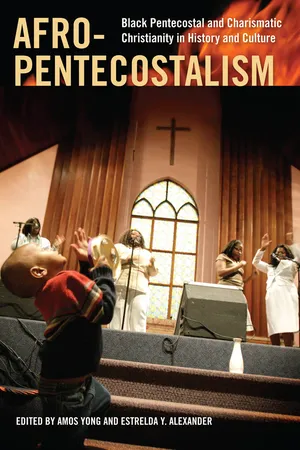
Afro-Pentecostalism
Black Pentecostal and Charismatic Christianity in History and Culture
- 271 pages
- English
- ePUB (mobile friendly)
- Available on iOS & Android
eBook - ePub
Afro-Pentecostalism
Black Pentecostal and Charismatic Christianity in History and Culture
About this book
Information
Topic
Theology & ReligionSubtopic
Christian Denominations1
Introduction
Black Tongues of Fire: Afro-Pentecostalism’s Shifting Strategies and Changing Discourses
African American Pentecostalism: Entering the Field
In 2006, the contemporary American Pentecostal movement passed a milestone, celebrating its one hundredth birthday. Over that time, its African American sector has been markedly influential, not only vis-à-vis other branches of Pentecostalism but also throughout the Christian church. Still, this segment of Pentecostalism has not received the kind of critical attention it has deserved. As a central contributor to historic Pentecostalism and as one of the fastest growing segments of the Black Church, the African American Pentecostal movement increasingly clamors for scholarly assessment.
Perhaps part of the reason for the neglect derives from overlooking African American agency at the origins of the movement. Even today, debates remain over who was at the forefront of the nascent modern Pentecostal movement—the white Charles Fox Parham, who is credited with laying its foundations by formulating its central doctrine of the baptism of the Holy Spirit being accompanied with the initial evidence of speaking in tongues; the black William Seymour, the leader of the 1906 Azusa Street Revival to which many, if not most, American Pentecostal denominations trace their roots; or simply the Holy Spirit, who used a variety of personalities, events, and locations to bring about the advent of the movement.1 As Seymour’s founding role has been increasingly recognized, so has the role of many other African Americans in the ongoing development of modern Pentecostalism. After a century of expansion, from a movement once considered by many as a marginalized cult to one that has come to have far-reaching global influence throughout the church and society, we are now at the point at which the important contribution of African Americans cannot be overlooked. Throughout this relatively short period within Christian history, African Americans have been involved in every aspect of the Pentecostal movement’s development: forging its worship and music styles, framing and carrying out strategies to mold its public presence, shaping its theological discourse, and contributing to the variety of deliberations, schisms, and controversies that have shaped its structure.2
This recovery of and emphasis on the African American contribution must acknowledge the role of black Christians in laying the groundwork for the Pentecostal revival. The nineteenth-century Holiness movement, which focused on calling the church back to personal piety through the experience of sanctification, produced such black leaders as the evangelists Jarena Lee and Amanda Berry Smith, and pastors like Charles Price Jones and William Christian, and saw the founding of several black denominations including the Church of Christ Holiness and the Church of the Living God (Christian Workers for Fellowship). Members of this movement laid the foundations for twentieth-century Pentecostalism by reincorporating John Wesley’s concept of entire sanctification into a personal spirituality and piety, which they sensed was missing in their churches. These Holiness folk, who were already employing camp-meeting style revivalism and language of Holy Spirit “fire” baptism as endowment with power for service and piety, eventually made their way into the Pentecostal movement. For their part, the Pentecostals incorporated the initial sign of speaking in tongues as an indication that one had truly received the Spirit, and by so doing, made a significant shift in Holiness beliefs about practices regarding the Holy Spirit. A number of denominations that had roots in the black Holiness movement, including the United Holy Church of America and the Fire Baptized Holiness Church of America, would ultimately become Pentecostal.
From out of these late nineteenth-century Holiness movements, it is now widely accepted that blacks made up a substantial portion of William Seymour’s Azusa Street congregation, which fueled the spread of the Pentecostal movement across the country beginning in 1906.3 Once their tongues were touched by the fires of Azusa Street, blacks left Los Angeles, serving with others of every race and culture as missionaries at home and abroad, to take the message of the Spirit being poured out on them in a new way. The movement was decidedly multiracial, and black Pentecostals founded churches and denominations—some of them interracially constituted—which at first dotted the West and the South, where they were largely confined. Then they moved with the Great Migration to major urban centers in the North and East and to every town and hamlet in between, establishing predominantly black congregations. Within twenty years, no part of the American landscape and very little of the world remained untouched by the revival that emerged from Azusa Street.
This book is one of the first scholarly volumes to cover the spectrum of this African American Pentecostal—Afro-Pentecostal, for short—world. We should note that just as there is no one black Baptist denomination, or one exclusively black Methodist denomination, there is also no one black Pentecostal movement—no one type of black Pentecostal discourse, and no one form of black Pentecostal life. Instead, Afro-Pentecostals can be found in more than one hundred large and small bodies, which extend from regional groups with a handful of congregations and a few hundred members to those with international constituencies. For purposes of classification, we can identify at least four types of Afro-Pentecostal groups: classical Wesleyan-Holiness Trinitarian Pentecostals, classical Apostolic (Jesus’ name or “Oneness”), charismatic independent congregations or networks, and recent neo-Pentecostal currents within the wider black church tradition.
In brief, classical Afro-Pentecostal groups involve denominations that have links to the first generation of the modern Pentecostal movement, in some way tracing their roots back to the Azusa Street revival. Included among these are denominations such as the Church of God in Christ (COGIC), with several thousand congregations and several million members in North America and around the world; the Mount Sinai Holy Church of America; the Fire Baptized Holiness Church of God of America; and the United Holy Church of America. Many of these are connected to black Holiness churches and traditions.
Apostolic or oneness churches are those who hold to the necessity of baptism by immersion “in the name of Jesus” and who, more importantly, reject the Trinitarian conception of the Godhead in lieu of a concept of God as one person who is expressed in three modes. These include the Pentecostal Assemblies of the World, the Church of Our Lord Jesus Christ of the Apostolic Faith, the Church of the Lord Jesus Christ of the Apostolic Faith, and Bible Way Church World Wide. We will mention more about these churches later.
Since the 1960s the development of the charismatic tradition has seen the rapid spread of Pentecostal theology, which incorporates a expanded pneumatology and a distinctive appreciation for the operation of spiritual gifts in the life of the individual and in corporate worship—without the strict personal piety or rigid insistence on speaking in tongues as a necessary evidence of Holy Spirit baptism—into mainline congregations and independent networks. Black charismatic churches include the Full Gospel Baptist Church Fellowship International and a number of Word-of-Faith congregations and denominations that focus on teaching that those who are favored by God and who tap into the potential of the Holy Spirit will be materially successful. Representative of these are such churches, congregations, and networks as Creflo Dollar’s World Changers Church International in Atlanta, and Frederick Price’s Crenshaw Christian Center in Los Angeles.
More recently, neo-Pentecostal spirituality has impacted many classically black denominations including large segments of the African Methodist Episcopal (AME) Church. Black neo-Pentecostals have generally thus remained in their classical denominational churches and may not even go by that label, but they have incorporated Pentecostal style worship practices without making major changes in theology.
This typology provides a convenient, albeit rough and provisional, framework for understanding the broad scope of Afro-Pentecostalism, at least as the term is used in the remainder of this book. In reality, however, Pentecostal spirituality has so influenced the Black Church that in many instances—perhaps with the exception of the emphasis on speaking in tongues—there is little noticeable difference in the worship styles of contemporary African American congregations, regardless of which denominations are involved.
These various churches, organizations, and networks are all bound together in part by their distinctive Pentecostal belief that the “baptism” or “outpouring” of the Holy Spirit on the believer is a distinct work of grace, subsequent to the indwelling of the Holy Spirit given at initial conversion, and is an essential aspect of the Christian experience. This experience of Spirit baptism is understood as a direct fulfillment of the prophecy of the Old Testament book of Joel, in which the Spirit would be poured out on all flesh (Joel 2:28) and, among other signs, individuals would speak with other tongues as the Spirit makes its presence known. (Acts 2:4). Pentecostal believers thus have always been marked by a sense of personal communion with God established through ecstatic religious experience, including glossolalia or “speaking in tongues” as initial objective evidence of the Holy Spirit’s presence in an individual. For them, the corporate experience of this manifestation has been thought to signal the arrival of the reign of Christ. These palpable religious manifestations are also perceived as divine urgings to earnestly redouble evangelistic efforts to reach every soul with the salvation message in view of the impending end of the age. To Pentecostals, this “in-filling” of the Holy Spirit is a supernatural enablement to live a holy life and to accomplish works of righteousness on behalf of the kingdom of God.
But Holy Spirit empowerment alone was not enough to ensure that black Pentecostals would be able to overcome the social realities of American race politics in the first half of the twentieth century, within which they suffered the double indignity of racial discrimination and religious persecution. Despite Seymour’s early leadership and the uncontestable contribution of other blacks such as Charles Harrison Mason, founder of the Church of God in Christ, and Garfield T. Haywood, early leader and first General Secretary of the Pentecostal Assemblies of the World,4 blacks were denied access to positions of influence or leadership by white Pentecostals, who quickly forsook the Azusa Street ideal of interracial fellowship to embrace the existing racial status quo of the broader society. Black Pentecostals were also scorned as ignorant and uncouth by their mainline black brother and sisters, who wrote them off as members of a mysterious cult under the leadership of unscrupulous charlatans.5 Black Pentecostals were thus forced to frame and live out a distinct self-understanding. They had to forge a particular set of strategies and peculiar set of discourses for being the “sanctified church” in an unsanctified world.6
Shifting Strategies and Changing Discourses
While they share a common openness to the immanent work of the Spirit within their lives and congregations, the African Americans who make up otherwise very diverse black Pentecostal groups have had to deal with the same variety of modern issues—economic and political realities, spirituality, ethics, and the like—that are of concern to other members of society. Further, black Pentecostal church leaders have historically had to wrestle with the same concerns—mission strategies, gender roles, and theological relevance—as leaders within other contexts and have employed a variety of strategies to do both. Notwithstanding common depictions of Pentecostals—black and white—as almost entirely otherworldly, what is noteworthy about Afro-Pentecostalism is the variety of modes of expressions found within it—the various ways in which its adherents were able to shift the discourse about race and social ethics and incorporate tactics to enable adequate engagement with the realities of this world. Far from being simply the monolithic, otherworldly, “tongues movement” (this terminology was used by detractors to call attention to what they saw as an overemphasis on the practice of speaking tongues in Pentecostal personal devotions and public worship) that many have depicted, Afro-Pentecostalism exhibits a wide range of responses that has informed the movement’s coping with modern issues and realities.
The diversity within Afro-Pentecostalism reflects at least in part the changing dynamics of the North American socio-political, cultural, and religious context. During the Jim Crow era of the first half of the twentieth century, blacks were marginalized from engaging with the dominant structures of the nation. In this context Afro-Pentecostals were forced to form their own cultural institutions, to create their own social spaces and niches, and to articulate their own version of Pentecostal and Christian beliefs. While it is reductionistic to think that the earliest Afro-Pentecostals derived homogeneously from the lower classes, it is also undeniable that Pentecostalism made its most substantive inroads among this social stratum of the black community.7 But the phenomenon of the emerging black middle class since the civil rights movement has transformed the shape of the Afro-Pentecostal church over the last forty years. Whereas storefront Pentecostal and Holiness black churches have not disappeared, there are now established, solidly middle-class Afro-Pentecostal congregations as well as megachurches like those of T. D. Jakes’s The Potter’s House in Dallas, Charles Blake’s West Angeles Church of God in Christ, and John Cherry’s From the Heart Ministries in suburban Washington, D.C., among many others. Afro-Pentecostalism is now televised across the continent—and around the world—in mainstream and cable TV channels, with the result that few are uninformed about African American forms of Pentecostal life.
This shift from the margins of North American society to the more-orless mainstream has brought with it changes in Afro-Pentecostals beliefs and practices. While among the generation of Seymour the emphasis was on ecstatic worship, the current generation has tempered this with professional worship teams. While the earlier Afro-Pentecostals were more sectarian in nature in terms of their avowed apolitical or antipolitical stances and countercultural practices, the recent Pentecostals have become bolder in the public square, more willing to engage both the polis and the world, even while wrestling with what that means for their Pentecostal identity. These changes can be understood in terms of the social dynamics of twentieth-century American life viewed through the lens of race and ethnicity, but doing so without recognizing the agency of Afro-Pentecostal people would be to tell only one side of the story.
The shifting strategies of Afro-Pentecostal agency, for example, can be observed in the dynamics of the movement’s interface with the wider society. Because of the earlier sectarian posture, interaction with the “world” outside the church was never overtly sanctioned. Afro-Pentecostal congregations, however, have always found ways to deal with the challenges besetting their parishioners and communities: poverty, homelessness, substance abuse, domestic and community violence, and, more recently, teen pregnancy and HIV/AIDS.8 With the advent of the civil rights movement more and more Afro-Pentecostal pastors and leaders have been motivated to enter directly into the social and political limelight, adding their voices to the prophetic activity long characteristic of the Black Church tradition. Simultaneously, African American Pentecostal congregations have cultivated virtues of honesty, ethical character, industry, and modest living that have assisted many of their members to gain middle-class status. Many larger, more successful Afro-Pentecostal congregations—especially megachurch congregations—have combined spiritual formation/discipleship, life-skills training and education, community service, social activism, and political engagement—all under the rubric of a much more sophisticated theological understanding of holistic ministry.9
Herein we can also observe the changing theological and doctrinal discourses of Afro-Pentecostalism. Ecclesially, whereas early Afro-Pentecostals were predominantly shaped by the Holiness movement, contemporary Afro-Pentecostalism is much more diverse, and much less denominationally linked or constrained. Theologically, the traditional doctrinal emphasis on sanctification, understood as separation from the world, has given way to an implicit theology of cultural affirmation, framed in terms of contextualization or the cultural relevance of the gospel. Such an overall theological adjustment has more often than not been implicit, rather than explicit. These theological revisions exist at the oral and lived levels of African American Pentecostal pastoral and congregational life, rather than in the formally crafted manuals, handbooks, or theological texts. Indeed, there has only been slight revision of long-held doctrines that have been handed down from generation to generation, particularly in churches that are and remain denominationally affiliated.
This trend—of a fairly conservative official theological platform—is not peculiar to African American Pentecostalism. The wider Pentecostal movement, both in North America and elsewhere, remains theologically conservative. But if other Pentecostals can attend their denominationally sponsored (and accredited) colleges, universities, and seminaries, Afro-Pentecostals do not usually have such options. There are a handful of Afro-Pentecostal institutions of higher education such as the All Saints Bible College and Charles H. Mason Theological Seminary under the auspices of the Church of God in Christ, Aenon Bible College of the Pentecostal Assemblies of the World, and the Church of Our Lord Jesus Christ’s Bonner Bible College. The majority of theologically trained African American Pentecostals receive their formative academic education in non-Pentecostal settings either in historically black colleges and universities such as Howard University, Morehouse College, or Spellman College, or in institutions friendly to the Black Church and with programs that address the concerns of black Christians such as Candler School of Theology, Duke, Vanderbilt, or Crozer Divinity Schools, or Princeton Theological Seminary.
The result of increasing matriculation of African American Pentecostals in such programs has been the gradual emergence of the Afro-Pentecostal academy. Whereas a strong anti-intellectual strain existed in earlier generations who often rejected the “higher learnin...
Table of contents
- Cover Page
- Title Page
- Copyright Page
- Dedication
- Contents
- Acknowledgments
- 1 Introduction: Black Tongues of Fire: Afro-Pentecostalism’s Shifting Strategies and Changing Discourses
- Part I: Origins
- Part II: Gender and Culture
- Part III: Prophetic Ethics
- Part IV: Pneumatology
- Part V: Afro-Pentecostalism in Global Context
- Select Bibliography
- Contributors
- Index
Trusted by 375,005 students
Access to over 1.5 million titles for a fair monthly price.
Study more efficiently using our study tools.
Frequently asked questions
Yes, you can cancel anytime from the Subscription tab in your account settings on the Perlego website. Your subscription will stay active until the end of your current billing period. Learn how to cancel your subscription
No, books cannot be downloaded as external files, such as PDFs, for use outside of Perlego. However, you can download books within the Perlego app for offline reading on mobile or tablet. Learn how to download books offline
Perlego offers two plans: Essential and Complete
- Essential is ideal for learners and professionals who enjoy exploring a wide range of subjects. Access the Essential Library with 800,000+ trusted titles and best-sellers across business, personal growth, and the humanities. Includes unlimited reading time and Standard Read Aloud voice.
- Complete: Perfect for advanced learners and researchers needing full, unrestricted access. Unlock 1.5M+ books across hundreds of subjects, including academic and specialized titles. The Complete Plan also includes advanced features like Premium Read Aloud and Research Assistant.
We are an online textbook subscription service, where you can get access to an entire online library for less than the price of a single book per month. With over 1.5 million books across 990+ topics, we’ve got you covered! Learn about our mission
Look out for the read-aloud symbol on your next book to see if you can listen to it. The read-aloud tool reads text aloud for you, highlighting the text as it is being read. You can pause it, speed it up and slow it down. Learn more about Read Aloud
Yes! You can use the Perlego app on both iOS and Android devices to read anytime, anywhere — even offline. Perfect for commutes or when you’re on the go.
Please note we cannot support devices running on iOS 13 and Android 7 or earlier. Learn more about using the app
Please note we cannot support devices running on iOS 13 and Android 7 or earlier. Learn more about using the app
Yes, you can access Afro-Pentecostalism by Amos Yong,Estrelda Y Alexander, Amos Yong,Estrelda Y. Alexander in PDF and/or ePUB format, as well as other popular books in Theology & Religion & Christian Denominations. We have over 1.5 million books available in our catalogue for you to explore.