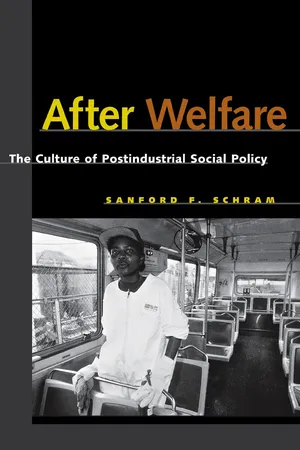
Do contemporary welfare policies reflect the realities of the economy and the needs of those in need of public assistance, or are they based on outdated and idealized notions of work and family life? Are we are moving from a "war on poverty" to a "war against the poor?" In this critique of American social welfare policy, Sanford F. Schram explores the cultural anxieties over the putatively deteriorating "American work ethic," and the class, race, sexual and gender biases at the root of current policy and debates.
Schram goes beyond analyzing the current state of affairs to offer a progressive alternative he calls "radical incrementalism," whereby activists would recreate a social safety net tailored to the specific life circumstances of those in need. His provocative recommendations include a series of programs aimed at transcending the prevailing pernicious distinction between "social insurance" and "public assistance" so as to better address the needs of single mothers with children. Such programs could include "divorce insurance" or even some form of "pregnancy insurance" for women with no means of economic support. By pushing for such programs, Schram argues, activists could make great strides towards achieving social justice, even in today's reactionary climate.
- 244 pages
- English
- ePUB (mobile friendly)
- Available on iOS & Android
eBook - ePub
About this book
Information
1
Contracting America
The Cycle of Representation and the Contagion of Policy Discourse
Since I took office, I have worked to craft a new social contract.—President Bill Clinton, July 14, 1999
The “Contract with America” was proposed by Republican congressional candidates during the 1994 elections. A superficial campaign device, this conservative document became the basis for rewriting the liberal social contract that has served as the foundation of the social welfare state since the New Deal of the 1930s. Within the framework of the ephemeral “Contract,” Congress passed and President Clinton signed into law the Personal Responsibility and Work Opportunity Reconciliation Act of 1996. This law abolished the federal entitlement for poor families by repealing the Aid to Families with Dependent Children program that was originally enacted with the Social Security Act of 1935.1
While the significance of the 1996 welfare reform law is not to be underestimated, in many important respects the problems of the conservative Contract lie not with the fact that it promoted legislation that rescinded a program of sixty years’ standing but rather with the way it has reinscribed the relations of power implicit in liberal discourse more generally. As reproduced in the New York Times shortly after the November 1994 elections, the “Contract with America” put forth ten promises made by Republican congressional candidates concerning legislative action they would undertake during the first hundred days of the 104th Congress. Here are the Republicans’ promises “in their own words,” to quote the New York Times:
1. The Fiscal Responsibility Act: A balanced budget/tax limitation amendment and a legislative line-item veto to restore fiscal responsibility to an out-of-control Congress, requiring them to live under the same budget constraints as families and business.
2. The Taking Back Our Streets Act: An anti-crime package including stronger truth-in-sentencing, “good faith” exclusionary rule exemptions, effective death penalty provisions, and cuts in social spending from this summer’s “crime” bill to fund prison construction and additional law enforcement to keep people secure in their neighborhoods and kids safe in their schools.
3. The Personal Responsibility Act: Discourage illegitimacy and teen pregnancy by prohibiting welfare to minor mothers and denying increased AFDC for additional children while on welfare, cut spending for welfare programs, and enact a tough two-years-and-out provision with work requirements to promote individual responsibility.
4. The Family Reinforcement Act: Child support enforcement, tax incentives for adoption, strengthening rights of parents in their children’s education, stronger child pornography laws, and an elderly dependent care tax credit to reinforce the central role of families in American society.
5. The American Dream Restoration Act: A $5,000 per child tax credit, begin repeal of the marriage tax penalty, and creation of American Dream Savings Accounts to provide middle-class tax relief.
6. The National Security Restoration Act: No U.S. troops under U.N. command and restoration of the essential parts of our national security funding to strengthen our national defense and maintain our credibility around the world.
7. The Senior Citizens Fairness Act: Raise the Social Security earnings limit which currently forces seniors out of the work force, repeal the 1993 tax hikes on Social Security benefits and provide tax incentives for private long-term care insurance to let older Americans keep more of what they have earned over the years.
8. The Job Creation and Wage Enhancement Act: Small business incentives, capital gains cut and indexation, neutral cost recovery, risk assessment/ cost-benefit analysis, strengthening the Regulatory Flexibility Act and unfunded mandate reform to create jobs and raise worker wages.
9. The Common Sense Legal Reform Act: “Loser pays” laws, reasonable limits on punitive damages and reform of product liability laws to stem the endless tide of litigation.
10. The Citizen Legislature Act: A first ever vote on term limits to replace career politicians with citizen legislators.2
The Republicans stressed that these measures would impose standards of “common sense,” “business,” “family,” and “personal responsibility” on some future “out-of-control Congress” in order to reinforce and restore the “American Dream.” By the end of 1996, parts of the Contract had become law, including welfare reform, which was enacted in full force. Yet, as the rhetoric surrounding the ten points suggests, the ultimate power of the Contract may be determined by more than its limited policy success.
The Contract was probably more successful in terms of what it represented—whether as electoral politics or policy agenda, as symbolic or material practice. Although there may have been a time when such distinctions were meaningful, the Contract’s ambiguous status as a “hybrid imagined agreement” highlights the way binaries such as politics/policy, symbolic/ material, and the like fail to adequately represent what they describe.3 In fact, the Contract’s ambiguous representational status as something between elite political posturing and popular policy agenda highlights the problem of representation in politics. In the case of the Contract, its politics lie in the terms it used to represent a policy agenda.
The Contract’s power and therefore its politics were to be found most especially in its relationship to the term “contract” as used in liberal policy, as well as legal and business, discourses. In what follows, I focus in particular on the “Contract with America” as a prime example of what J. M. Balkin calls “cultural software.”4 My discussion illustrates Balkin’s argument that a culture develops by borrowing key metaphors and other interpretive practices and that these key devices arise out of and establish the ground for categorical distinctions. I suggest that the process of mimetic transmission in the Contract with America operates like a virus infecting one area with the biases associated with the metaphors and interpretive practices of another area.5 I emphasize how the “contract” in the Contract with America has operated as a contagion of policy discourse.6 I examine how the “contract” in the Contract with America has reinforced the idea that welfare recipients have failed to meet the basic threshold requirement of personal responsibility expected of full citizens of the contractual order.7
In particular, the concept of contract was especially important because it reinscribed a distinctive self as the kind of person assumed by a liberal society to be needed in so many settings: the contractual person.8 The contractual person was the implicit standard used to enforce the idea of “personal responsibility” upon welfare recipients. The preoccupation with personal responsibility in turn has led to punitive results for welfare recipients, such as requiring all employable recipients, including even single mothers of young children, to find work and cutting off aid to families after five years regardless of how young their children are. The Contract has narrowed down the meaning of personal responsibility to not taking welfare and having paid employment instead, regardless of mitigating circumstances.
Therefore, irrespective of its inability to achieve its entire agenda, the Contract is an important contemporary illustration of how liberal theory has become the “common sense” of the United States and how this common sense operates as a lexicon of signs, symbols, and images used to reinforce prevailing relationships of power. The liberal “common sense” of the conservative Contract, therefore, becomes a political subtext that needs to be questioned. This is not an apolitical literary exercise. Anne Norton has emphasized the political value of such analysis in her examination of liberalism’s unquestioned authority as the common sense of the contemporary United States:
Silence concerning the authority of language over the constitution of the self, the realization and expression of the will, permits liberal regimes to maintain the myth of the word, particularly the spoken word, as a neutral instrument for the utterance and realization of the individual will. It enables liberal regimes to maintain established hierarchies by predicating the achievement of equality and the establishment and maintenance of cultural difference on involvement in practices that obstruct or preclude these ends.9
The following analysis seeks to break that silence about the liberal politics of allegedly neutral contractual language by discussing its role in the conservative Contract with America. In the process, we can begin to see that even the conservative Contract with America has strengthened liberal contractual discourse and that that discourse has perpetuated biased notions of personal responsibility that reinforce the marginalization of people in need of public assistance.
Contracts and Diaries: Linguistic Dispatches to the Self
April 7, 1995: Dear Diary, I promised you (or did I promise myself?) that I would log in the status of the Contract with America after the United States House of Representatives had voted on all its components.10 Before I do that I cannot help but relay my reactions to this idea of “the contract.” I am struck by the many meanings of “contract,” especially for Americans living in the late twentieth century. “Contracting America,”11 as the activity engendered by the contract, is unavoidably a multidimensional practice. Once we start contracting America, the question immediately arises as to whether we will go all the way: privatize the country to subcontractors, retrench to a “two-thirds society,” or contract the disease that the contagion of policy discourse spreads.12
“Contracting America” is at least trebled in meaning—legally binding exchange, welfare state rollback, or disease.13 The idea of contract serves the politics of today in various convenient ways: (1) the reassurances that come with business transactions between ostensibly free and equal parties; (2) the insistences derived from persistent political pressures to reduce the welfare state; and (3) the anxieties attached to contagious diseases, given the decline of immunology in a postantibiotic age. At a time when the modernist impulse to insist on airtight distinctions between nature and culture has broken down, contract becomes a hybrid simultaneously implying the symbolic and the material, if not the cultural and the natural.14 It is a multipurpose term whose multiple resonances suggest a variety of possible responses, each of which can be said to “process” the idea of contract in a distinctive way.15
“Contract” in America, therefore, is a potent if unstable metaphor. In the United States contract is the metaphor of choice for legitimating much of what we do publicly and privately, in marriage, business, law, and social policy. Contract is a live metaphor (i.e., is used so often) because it is a dead metaphor (i.e., it has lost its figurative character and is seen as literal). Yet the power of contract lies in its articulation—that is, the extent to which it can be connected with so many different things as an expressed representation.16 In the contractual society so much is about contract, even if diversely so, and the Contract with America is a quintessentially American discursive practice.
From campaign spectacle to policy agenda, this act of contracting America becomes, then, a paradigmatic example of the dangers associated with borrowing a metaphor across the overlapping, discontinuous discourses of business, law, and politics. Contracting America underscores how one discourse must of necessity invoke another, given the pervasive impossibility of getting beyond intertextuality. In the quest to use discourse as an attempt to make coherent the incoherences of public life or of life generally, one discourse trades on another, borrowing metaphors for justification, creating an inevitable layering of meaning. Contractarians would probably prefer the formulation that one discourse must inevitably contract with other discourses in order to create meaning. The “metaphors of contract” highlight the “contracts of metaphor.” Meaning becomes contingent upon the deferred promise of representation.
To “Contract with America” is therefore also unavoidably vexed as a linguistic act. The “Contract with America” is not just what J. L. Austin calls a “constative” (i.e., a descriptive) statement.17 Constatives include descriptive statements even if they are dramatic declarations of fact, as in “You are guilty of murder and are sentenced to death.” In name and deed, the “Contract with America” would also be for Austin a “performative” statement (i.e., a statement that is itself an act). Performatives include commands and proclamations, as in “I hereby pronounce you guilty of murder and sentence you to death.” A performative can have more than what Austin calls the “locutionary” force of referencing the world beyond itself. It can have the greater “illocutionary” force of being something that in the act of being spoken becomes a deed. Illocutionary acts, for Austin, are statements that are also deeds.18 To make the statement is to enact the deed, as in a judge “pronouncing a sentence.” Performatives can also have what Austin calls “perlocutionary force,” whereby the statement has consequences. Here the statement is not itself the deed but is a condition that leads to “certain effects that are not the same as the speech act itself,”19 as in a judge pronouncing a death sentence that leads to the convicted person’s execution. This example highlights how speech acts can have both a performative and a constative dimension and be locutionary, illocutionary, and perlocutionary all at the same time.
So it is with the “Contract with America.” In the case of the term “Contract with America,” the simultaneity of speech acts leads to multiple confusions, because “Contract with America” can mean many different things depending on how this speech act is interpreted. If it is a constative, then it is a representation of some previously agreed upon arrangement. But this would be a dangerous position to take because it would suggest that there was some other process by which the people of the country and the House Republicans made an agreement. Beyond the low-turnout elections of 1994, which brought Republican majorities to both houses of Congress, there seems to be no process, other than perhaps the massaging of polling data, for suggesting mass support for the Contract. And in hindsight that seems exactly how the Contract was to be challenged as a false constative that failed to register what the “real” American people would endorse.20
The Contract’s linguistic confusion points to the fact that it provided the background for its own creation. The Contract concealed how it constructed its signatories, rather than the other way around.21 The opening lies in the idea of signature itself. Signature connotes an absent authorizing agent whose signature is thereby required. The idea of signature has proved to be a historic problem for the liberal social contract. Whether founding the American or other liberal political systems, the contract had to construct the “People” of that nation-state ahead of time, and they were then posthoc taken to comprise the consenting parties to the agreement.22 The state constructs the nation rather than the people constructing the state—as when the leaders of the American Revolution claimed to be acting in the name of the “American People” who had yet to consent to the formation of a new government. The Contract with America trades on the social contract of liberal political discourse with its assumptions of signature and consent as well as related notions of fiduciary responsibility and reciprocal rights and obligations associated with business and marriage contracts.
The way “contract” operates in the Contract with America therefore demonstrates that contagion rather than communication best characterizes liberal policy discourse today.23 Borrowing the contractual metaphors of catachresis (i.e., metaphors about contract that make the dissimilar similar) from business practice to legal document to policy prescription results in its own linguistic subversion.24 The Contract with America undermined the critical subject position that was its central object of inquiry—“personal responsibility.” The Contract with America sought to legislate personal responsibility, especially for people in need of public assistance, while denying the extent to which the people represented by the symbol of “America” actually got to be real signatories responsible for a contract made in their name. In the parlance of liberal political discourse, “contracting America” inevitably means converting America into a form of property to be bought and sold on the open market.25 The commodity sold here is the reified, repackaged, already preprocessed entity known as the “American People.” Accepting this transaction would imply condoning a form of property theft—the stealing of the American people for the purpose of “forging” national public policy in the name of the people who are alleged to have made those policies. Of necessity, then, resisting the theft associated with the Contract with America involves interpretive practices that challenge in particular how the Contract appropriates the “American People” for its own political purposes.
Contesting the Contract with America therefore starts by challenging the way it operates as a conservative discursive practice whose liberal silences are tied t...
Table of contents
- Cover Page
- Title Page
- Copyright Page
- Dedication
- Contents
- Acknowledgments
- Introduction
- 1 Contracting America: The Cycle of Representation and the Contagion of Policy Discourse
- 2 Where the Welfare Queen Resides: The Subtext of Personal Responsibility
- 3 In the Clinic: The Medicalization of Welfare
- 4 Deconstructing Devolution: Racing to the Bottom and Other Ironies of Welfare Reform
- 5 Redefining the Family, Redefining the State: The Politics of Incorporation and the Case of Same-Sex Marriage
- 6 A New Space for Welfare Policy Research: Benefit Decline on the Internet
- 7 After Social Security: Searching for a Postindustrial Ethic
- Notes
- Index
- About the Author
Trusted by 375,005 students
Access to over 1.5 million titles for a fair monthly price.
Study more efficiently using our study tools.
Frequently asked questions
Yes, you can cancel anytime from the Subscription tab in your account settings on the Perlego website. Your subscription will stay active until the end of your current billing period. Learn how to cancel your subscription
No, books cannot be downloaded as external files, such as PDFs, for use outside of Perlego. However, you can download books within the Perlego app for offline reading on mobile or tablet. Learn how to download books offline
Perlego offers two plans: Essential and Complete
- Essential is ideal for learners and professionals who enjoy exploring a wide range of subjects. Access the Essential Library with 800,000+ trusted titles and best-sellers across business, personal growth, and the humanities. Includes unlimited reading time and Standard Read Aloud voice.
- Complete: Perfect for advanced learners and researchers needing full, unrestricted access. Unlock 1.5M+ books across hundreds of subjects, including academic and specialized titles. The Complete Plan also includes advanced features like Premium Read Aloud and Research Assistant.
We are an online textbook subscription service, where you can get access to an entire online library for less than the price of a single book per month. With over 1.5 million books across 990+ topics, we’ve got you covered! Learn about our mission
Look out for the read-aloud symbol on your next book to see if you can listen to it. The read-aloud tool reads text aloud for you, highlighting the text as it is being read. You can pause it, speed it up and slow it down. Learn more about Read Aloud
Yes! You can use the Perlego app on both iOS and Android devices to read anytime, anywhere — even offline. Perfect for commutes or when you’re on the go.
Please note we cannot support devices running on iOS 13 and Android 7 or earlier. Learn more about using the app
Please note we cannot support devices running on iOS 13 and Android 7 or earlier. Learn more about using the app
Yes, you can access After Welfare by Sanford F. Schram in PDF and/or ePUB format, as well as other popular books in Politics & International Relations & Social Policy. We have over 1.5 million books available in our catalogue for you to explore.