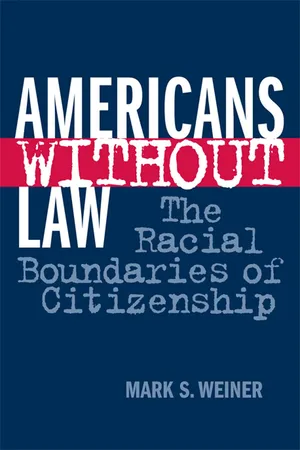
Americans Without Law shows how the racial boundaries of civic life are based on widespread perceptions about the relative capacity of minority groups for legal behavior, which Mark S. Weiner calls “juridical racialism.” The book follows the history of this civic discourse by examining the legal status of four minority groups in four successive historical periods: American Indians in the 1880s, Filipinos after the Spanish-American War, Japanese immigrants in the 1920s, and African Americans in the 1940s and 1950s.
Weiner reveals the significance of juridical racialism for each group and, in turn, Americans as a whole by examining the work of anthropological social scientists who developed distinctive ways of understanding racial and legal identity, and through decisions of the U.S. Supreme Court that put these ethno-legal views into practice. Combining history, anthropology, and legal analysis, the book argues that the story of juridical racialism shows how race and citizenship served as a nexus for the professionalization of the social sciences, the growth of national state power, economic modernization, and modern practices of the self.
- 205 pages
- English
- ePUB (mobile friendly)
- Available on iOS & Android
eBook - ePub
About this book
Information
1
Laws of Development, Laws of Land
Although ethno-legal rhetoric has deep roots in the Western tradition, the discourse of juridical racialism formed in the United States only in the wake of the Civil War, when a confluence of historical developments created the ground for its emergence. Most important, the decades following the war saw the growing professionalization of a range of scientific and social scientific fields, and for anthropology, in particular, they marked what Margaret Mead called the “golden age” or “classic period” of the discipline.1 Anthropologists active during these years helped steer their field away from its amateur roots in travel writing and collecting and toward its future as a methodologically coherent, systematic body of knowledge created by professionals who limited their ranks through formal standards of entry. These also were crucial years in American state modernization, as evidenced by the civil service reform movement and the Pendleton Act of 1883.2 Seeking to rationalize the expanding apparatus of the state, a broad class of elites sought to replace the spoils system based on party patronage with more neutral, meritocratic procedures for the staffing of government bureaucracies. Finally, these years marked the start of the so-called Gilded Age, when modern, expansive, and extractive market relations lay the foundation for the full-scale corporate capitalism of the twentieth century and modern consumer society.3 Scientific professionalization, state modernization, modern economic development—within this network of phenomena, ethno-legal rhetoric assumed a qualitatively new importance, complexity, and authority.
American Indians took central stage in each of these developments—those of the professions, the state, and political economy—and therefore in the emergence of juridical racialism. For the close of the Civil War and the presidency of Ulysses S. Grant inaugurated the “assimilationist era” of federal Indian policy, when the national government sought to force Indians to model their lives on Euro-American standards of behavior, especially by encouraging them to become independent agriculturalists.4 In this context, the newly professional social sciences turned an eager eye toward Indian myths, kinship structures, forms of government, and material culture; indeed, American anthropologists first developed their comprehensive theories of society and built their professional discipline with the raw material they found in the world of native peoples. Institutionally, moreover, the late-nineteenth century witnessed the marked expansion and modernization of the Bureau of Indian Affairs, particularly with the creation of the Board of Indian Commissioners in 1869 and the increasingly specialized and expert approach taken to Indian education beginning in the early 1880s.5 Finally, as an economic matter, the assimilationist era saw the coerced forfeiture of Indian land for government and private purposes. The assimilationist effort to destroy collective regimes of property ownership and the centrality of the tribe to Indian identity grew from the drive toward national economic expansion.6
In the following chapter, I consider the role juridical racialism played in the assimilationist era, focusing specifically on the period between 1883 and 1887. During these years, a legal exchange took place between Congress and the Supreme Court, the final outcome of which was the Dawes General Allotment Act, which subdivided communal Indian lands and allotted them to individual owners.7 The Court’s contributions to this dialogue were its decisions in Ex parte Crow Dog (1883) and United States v. Kagama (1886), two cases concerning the extension of federal jurisdiction over certain forms of Indian crime.8 Together, Crow Dog and Kagama “clear[ed] the way” for the Dawes Act by forging the Indian plenary power doctrine, which grants Congress nearly complete control over the management of Indian affairs.9 I begin my analysis, however, not with these legislative and judicial actions but with the life and work of John Wesley Powell, naturalist, geographer, and founder of the Bureau of American Ethnology. Powell constructed a developmentalist juridical racialism that drew on the anthropological writings of Lewis Henry Morgan and that would later form the conceptual and rhetorical anchor of Crow Dog and Kagama. In my analysis of Powell’s work, I thus consider how a developmentalist view of race and law became constitutive of the law itself.
John Wesley Powell and the Evolution of Property
From the presidency of Andrew Jackson until roughly the start of the 1870s, U.S. policy toward native peoples centered on moving Indians west of the Mississippi, driving them onto reservations with the threat of military force.10 This was a policy of separation, one that fortified the physical boundaries between Indians and whites. The forced removal of the Cherokee from Georgia to Oklahoma on the Trail of Tears symbolized this effort.11 In the 1870s, however, the focus of national policy began to change. Still fresh from his military success at Vicksburg, President-elect Grant announced in 1869 a “peace policy” and a new government attitude toward the “Indian question.” As Francis Paul Prucha notes, this approach to Indian affairs was less a specific statutory agenda than “a state of mind, a determination that since the old ways of dealing with the Indians had not worked, new ways which emphasized kindness and justice must be tried.”12 In this era of “conquest by kindness,” Indian affairs were increasingly shaped by an uneasy but potent political alliance between Christian social reformers and western land interests, who together argued that the segregation of natives onto semisovereign reservations was both destructive to Indians themselves and inconsistent with republican political ideals. Driven by different motives, but united by a common goal, these new Indian activists directed their efforts not toward separating Indians from whites but toward acculturating them into nineteenth-century American society.13 They hoped that this would be the age in which the “final promise” of the United States government to Indian tribes—that all indigenous peoples would “participate fully in the nation’s institutions”—would at last be fulfilled.14
This promise was not motivated by a commitment to social or cultural pluralism.15 Activists such as the participants in the celebrated Lake Mohonk Conference of the Friends of the Indian, the intellectual and organizational foundation for assimilationist-era reforms, were not interested in preserving Indian culture per se.16 A small minority of whites did seek to preserve traditional native folkways or at least to slow the pace of their destruction. But most white reformers advanced an ethnocentric program of destroying traditional native societies and imposing Euro-American institutions in their place. They were humanitarians who sought to employ the civil arm of national government to annihilate the Indian way of life. Their reigning rhetorical trope was the individual, the solitary economic self. As Indian Affairs Commissioner John Oberly asserted in 1888, the Indian must “be imbued with the exalting egotism of American civilization, so that he will say ‘I’ instead of ‘We,’ and ‘This is mine,’ instead of ‘This is ours.’”17 To foster such individualism, reformers attempted first and foremost to destroy the tribe as a presence in native experience. To this end, they sought the abolition of customary tribal law—the elimination of tribal jurisdiction over civil and criminal matters—and its replacement with American substantive and procedural principles. They further worked for the allotment of Indian tribal lands in severalty, the forced division of communal tribal property and its subsequent allocation to individuals. For Christian activists, those who called themselves “friends of the Indian,” the result of such anti-tribal policies would be the civilization and redemption of the indigenous inhabitants of North America.18 They would create an entirely new group of individualist selves from an inchoate corporeal mass of primitives. For western land interests, the result would be the opening of thousands of acres of property to new settlement and cultivation—and railroads.19 Bringing modernity to the American West, in other words, manifested both Marxian and Foucaultian conceptions of the modern, for the appropriation of wealth rested on the enclosure of the ego.
The desire to resolve the Indian problem by abolishing traditional native society was hardly unique to the 1870s. The goal of assimilation had deep roots in the American past.20 Three aspects of Indian policy in the assimilationist era, however, were specific to the late-nineteenth century. The first was the policy’s comprehensive and national scope. Although assimilationist projects had been implemented by religious and governmental organizations since the seventeenth century, these had been more or less disparate or superficial actions. By contrast, the reforms of the assimilationist period were widespread and systematic, and they brought into being a series of federal programs designed to restructure the most intimate elements of native life; they employed a full range of national government capacities to tame the savage self. These programs, moreover, relied on an increasingly professional civil service that was itself increasingly guided by social scientific expertise. Forged in the midst of a movement to create a professional managerial class that would place federal administration on a scientific foundation, assimilationist policy bore the imprint of this historical origin.21 Assimilationist reformers “looked to civil service reform as the all-encompassing panacea” as they fought for the “purification of the Indian Bureau,” finding an ally especially in Carl Schurz, secretary of the interior from 1877 to 1881.22 Finally and most important, assimilationist-era Indian policy was unique in the extent to which it was concerned with cultural-legal differences, the extent to which it attempted to assimilate native peoples socially by altering their law.23 “If the Indians are to be advanced in civilized habits,” wrote Schurz, “it is essential that they be accustomed to the government of law, with the restraints it imposes and the protection it affords.”24 “That Law is the solution of the Indian problem,” wrote one advocate in the North American Review, “would seem to be a self-evident proposition.”25 Indian policy during the late-nineteenth century was in this respect self-reflexive, a legal project that addressed the nature of law in general.
John Wesley Powell’s life, beginning in childhood, was carried forward by the modern, professional, and socio-legal commitments that also drove Indian reformers.26 Born in 1834 near Palmyra, New York, he was raised by English Methodist parents (his father was a lay minister), who inculcated in him a deep sense of religious faith and social obligation, naming him after the Methodist preacher John Wesley.27 The young Powell grew to manhood steeped in the Protestant vision of law, self, and society that would guide so many Indian reformers. When the Powell family moved to Ohio in the late 1830s and to what became the state of Wisconsin in the 1840s, he helped in the hard work of clearing the land and farming the prairie. As a son in a family whose prosperity and even survival depended on reliable knowledge of the environment, he developed the practical interest in natural history that became the driving force of his career. He became sensitive to ways settlers could control nature for their own purposes if they knew and lived within its limits, and he came to know and love the landscape, its rivers, contours, animals, and plants, with the heart of a man schooled in the practical affairs of land-use management. When it came time to choose a profession, Powell thus ignored his father’s pleas that he enter the ministry and decided instead on a life in science. Beginning in the 1850s, he took a variety of courses at Illinois College and the Illinois Institute, as well as at Oberlin College, at the time a center of Protestant social reform and anti-slavery sentiment. Powell never received a college degree, but by participating in a number of short-term scientific projects and expeditions, he developed a reputation as an excellent naturalist and geographer—capable, intellectually independent, brimming with frontier energy, and driven by an indefatigable work ethic. He soon became a school teacher in math and science; a lyceum lecturer on geology and geography; and in 1861, the director of choncology at the new Illinois State Natural History Society, where he became a curator in 1867.
When the Civil War arrived, there was no choice of sides for Powell. From both religious training and social conviction, he was ardently antislavery and pro-Union. Responding to President Lincoln’s call for troops in April 1861, the budding scientist put his skills to work as a topographer and military engineer in the Illinois Infantry. As Powell biographer William Culp Darrah shows, Powell developed the environmental understanding he had gained as a boy to an even higher level with the Twentieth Volunteers, coming to know on a grander scale how the human will could shape the natural world, and how detailed knowledge of it was necessary for that will to triumph.28 If the republic were to be victorious on the battlefield, topographers had to map the landscape, engineers had to fortify cities with local materials, soldiers had to calculate the angle of artillery fire. The Union needed men with scientific and mathematical training.29 Just as his family had cleared and farmed the Wisconsin prairie, so in the infantry Powell was required to use his natural surroundings for a human purpose, the movement, fortification, and attack of a national army at war. He did his job well, and he acted with courage. As Wallace Stegner notes, Powell “was not the kind to remain still.” He entered the army as a private. Three months later, he was a second lieutenant. After another six months, having become “something of an expert on fortifications,” he achieved the rank of captain and was “solidly enough established on Grant’s staff at Cape Girardeau to ask as a personal favor a few days leave to go to Detroit and marry his cousin Emma Dean.” Six months later, Powell “came out of the smoke and roar of Shiloh, mounted on General Wallace’s horse and with his right arm smashed by a Minie ball,” and he soon became commander of the artillery of the 17th Army Corps.30 By the time he left the service, in 1865, Powell’s right arm had been amputated (the hasty amputation caused him acute pain for the rest of his life), and he was ever after to be called Major Powell or simply “the Major.”
Powell left the military with more than a haunting wound and an esteemed title; he left with an idea. As a military officer and engineer, he had seen what expert knowledge could accomplish with the financial and bureaucratic support of a modern state, and like the many reformers who moved from the war into government and the civil service, he became an enthusiast for large-scale scientific organization.31 In this respect, Powell was representative of a generation of American intellectuals who experienced Civil War combat and strove to tame the energies of the American nation through centralized scientific and institutional control, just as military discipline and professionalism had created a wedge of force that smashed the Confederate rebels and drove through the landscape to the sea. Through their participation in public affairs, these war-seasoned men helped forge the “new ideal of the intellectual as scientific expert, practical administrator, and pragmatic reformer.”32 This was a movement at once institutional and subjective. At the institutional level, such intellectuals demanded the establishment of large-scale administrative systems that would create order and power from anarchic individual lives, just as Indian reformers hoped that agricultural land-owning and Protestant discipline would spark economic development from a dwindling race. At the subjective level, they demanded that individuals model themselves on the martial vision of Oliver Wendell Holmes, Jr., who ardently believed “that faith is true and adorable which leads a soldier to throw away his life in obedience to a blindly accepted duty, in a cause which he little understands, in a plan of campaign of which he has no notion, under tactics of which he does not see the use.”33
Soon after the Confederate surrender, Powell returned to a teaching position at Illinois State Normal University. From there, he undertook a series of daring scientific explorations of the West, especially in Utah and Colorado. These were exceptional feats of surveyorship, later glorified by Stegner in Beyond the Hundredth Meridian.34 Powell and his group of intrepid companions became some of the first white Americans to detail the marvels of the Grand Canyon, and they were the first to navigate their way down the full course of the Colorado River (Powell braved its rapids with only one arm).35 Powell’s initial trips were financed with private and collegiate funds, but he soon received appropriations for further western exploration from Congress, which recognized the importance of reliable knowledge about the western territories to continued se...
Table of contents
- Cover Page
- Title Page
- Copyright Page
- Dedication
- Contents
- Preface
- Introduction
- 1 Laws of Development, Laws of Land
- 2 Teutonic Constitutionalism and the Spanish-American War
- 3 The Biological Politics of Japanese Exclusion
- 4 Culture, Personality, and Racial Liberalism
- Conclusion
- Notes
- Index
- About the Author
Trusted by 375,005 students
Access to over 1.5 million titles for a fair monthly price.
Study more efficiently using our study tools.
Frequently asked questions
Yes, you can cancel anytime from the Subscription tab in your account settings on the Perlego website. Your subscription will stay active until the end of your current billing period. Learn how to cancel your subscription
No, books cannot be downloaded as external files, such as PDFs, for use outside of Perlego. However, you can download books within the Perlego app for offline reading on mobile or tablet. Learn how to download books offline
Perlego offers two plans: Essential and Complete
- Essential is ideal for learners and professionals who enjoy exploring a wide range of subjects. Access the Essential Library with 800,000+ trusted titles and best-sellers across business, personal growth, and the humanities. Includes unlimited reading time and Standard Read Aloud voice.
- Complete: Perfect for advanced learners and researchers needing full, unrestricted access. Unlock 1.5M+ books across hundreds of subjects, including academic and specialized titles. The Complete Plan also includes advanced features like Premium Read Aloud and Research Assistant.
We are an online textbook subscription service, where you can get access to an entire online library for less than the price of a single book per month. With over 1.5 million books across 990+ topics, we’ve got you covered! Learn about our mission
Look out for the read-aloud symbol on your next book to see if you can listen to it. The read-aloud tool reads text aloud for you, highlighting the text as it is being read. You can pause it, speed it up and slow it down. Learn more about Read Aloud
Yes! You can use the Perlego app on both iOS and Android devices to read anytime, anywhere — even offline. Perfect for commutes or when you’re on the go.
Please note we cannot support devices running on iOS 13 and Android 7 or earlier. Learn more about using the app
Please note we cannot support devices running on iOS 13 and Android 7 or earlier. Learn more about using the app
Yes, you can access Americans Without Law by Mark S. Weiner in PDF and/or ePUB format, as well as other popular books in Law & Civil Rights in Law. We have over 1.5 million books available in our catalogue for you to explore.