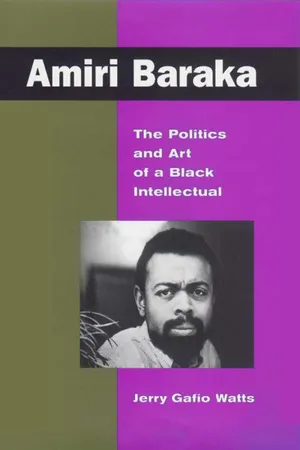
Amiri Baraka, formerly known as LeRoi Jones, became known as one of the most militant, anti-white black nationalists of the 1960s Black Power movement. An advocate of Black Cultural Nationalism, Baraka supported the rejection of all things white and western. He helped found and direct the influential Black Arts movement which sought to move black writers away from western aesthetic sensibilities and toward a more complete embrace of the black world. Except perhaps for James Baldwin, no single figure has had more of an impact on black intellectual and artistic life during the last forty years.
In this groundbreaking and comprehensive study, the first to interweave Baraka's art and political activities, Jerry Watts takes us from his early immersion in the New York scene through the most dynamic period in the life and work of this controversial figure. Watts situates Baraka within the various worlds through which he travelled including Beat Bohemia, Marxist-Leninism, and Black Nationalism. In the process, he convincingly demonstrates how the 25 years between Baraka's emergence in 1960 and his continued influence in the mid-1980s can also be read as a general commentary on the condition of black intellectuals during the same time. Continually using Baraka as the focal point for a broader analysis, Watts illustrates the link between Baraka's life and the lives of other black writers trying to realize their artistic ambitions, and contrasts him with other key political intellectuals of the time. In a chapter sure to prove controversial, Watts links Baraka's famous misogyny to an attempt to bury his own homosexual past.
A work of extraordinary breadth, Amira Baraka is a powerful portrait of one man's lifework and the pivotal time it represents in African-American history. Informed by a wealth of original research, it fills a crucial gap in the lively literature on black thought and history and will continue to be a touchstone work for some time to come.
- 592 pages
- English
- ePUB (mobile friendly)
- Available on iOS & Android
eBook - ePub
About this book
Information
1
Birth of an Intellectual Journey
AMIRI BARAKA, THE former LeRoi Jones, was born Everett LeRoy Jones in Newark, New Jersey, on October 7, 1934. The son of Coyette (“Coyt”) LeRoy Jones, a postal supervisor, and Anna Lois Russ Jones, a social worker, LeRoy was raised in a stable lower-middle-class, upper-working-class black family.1 Even though his family aspired to the bourgeoisie, Jones was fundamentally shaped throughout his early years by a rather typical American lower-middle-class socialization, with one qualification: He was born and raised black in a significantly racist society. In describing his religious upbringing, Jones provided a glimpse of the black, lower-middle-class world of his youth:
My own church in Newark, New Jersey, a Baptist church, has almost no resemblance to the older more traditional Negro Christian churches. The music, for instance, is usually limited to the less emotional white church music, and the choir usually sings Bach or Handel during Christmas and Easter. In response to some of its older “country” members, the church, which was headed by a minister who is the most respected Negro in Newark, has to import gospel groups or singers having a more traditional “Negro” church sound.2
Despite the limited musical offerings of his status-conscious church, Jones was undoubtedly exposed to robust, “traditional Negro” secular music. The Newark of Jones’s early years was a hub of black night life. In Swing City, author Barbara Kukla claims that between 1925 and 1950, Newark was a “thriving mecca of entertainment.”3 A center for jazz, musicians going into and out of New York City performed regularly in Newark. One testimony to this vibrant black musical culture was a black girl born in Newark in 1924 who performed in local night clubs before professionally emerging on the national scene as “the Divine One,” Sarah Vaughan. Certainly, the young Jones must have been exposed to some aspects of this rich musical tradition. Perhaps his love of black music dated from these earliest encounters.
For much, if not most, of LeRoy’s youth, the Jones family resided either in black neighborhoods located on the fringe of Italian American neighborhoods or in black enclaves in Italian American neighborhoods. Jones attended predominantly white public schools. When recalling his days at the McKinley and Barringer Schools, Baraka mentions that he was not prepared for the racism there, and he responded to being called nigger by learning curse words in Italian. His outsider status led to the development of a split life between the black playground worlds of his buddies and the hostile white surroundings of these schools. Concerning this dual existence, Baraka surmised, “It must be true, maybe obvious, that the schizophrenic tenor of some of my life gets fielded from these initial sources.”4
After graduating from high school, Jones enrolled in the Newark branch of Rutgers University. He once again found himself in a predominantly white environment. In explaining his year-long stay at Rutgers, one biographer wrote, “The effort to prove himself in an ‘essentially mediocre situation’ and the experience of always being an outsider in any school social activities made him transfer to Howard University.”5
Howard University proved critical to the development of Baraka’s ethnically marginal identity, for at Howard he was exposed to the world of the Negro elite, the authentic “black bourgeoisie.” Long considered the “capstone” of Negro education, Howard University was the national centerpiece for the education of the black bourgeoisie. Founded in 1866 by General Oliver Howard (head of the Freedman’s Bureau) to educate the former slaves, Howard University was, and continues to be, the best-funded, predominantly black center of higher education because of its direct subsidies from the federal government. By the early twentieth century, Howard had become specifically endowed with the mission of educating the black professional class.6 Through this university came a disproportionate share of the country’s black lawyers, doctors, dentists, ministers, teachers, social workers, and scholars.
Except for the sporadic intellectual exchanges in classes taught by Sterling Brown, Nathan Scott, and E. Franklin Frazier, Jones strongly disliked Howard. He considered it anti-intellectual.7 Howard students appeared to be more interested in acquiring the “proper” black bourgeois weltanschauung than in obtaining a serious education. Jones was disgusted by what he thought to be Howard’s educational philosophy. “The Howard thing let me understand the Negro sickness. They teach you to pretend to be white.”8 Theodore Hudson, author of From LeRoi Jones to Amiri Baraka, mentions Jones’s involvement in a “watermelon episode” that has almost become a legend. Though somewhat imaginary, the episode captured Jones’s disenchantment with Howard and, more precisely, his disillusionment with the black middle class. As the story goes, Jones and a buddy bought a watermelon and sat down to eat it on a bench in front of one of the college halls. Shortly thereafter, his buddy left to attend a class. Now sitting alone, Jones was approached by a university administrator, the dean of men, who asked Jones just what he thought he was doing sitting outside a campus building eating watermelon. Jones claims to have nonchalantly answered that he was simply eating the melon, whereupon the insulted dean ordered Jones to discard it. Rather mischievously, Jones replied that he could chuck only his half of the melon for the other half belonged to his friend. According to Jones, the agitated dean’s response was shocking: “Do you realize that you’re sitting right in front of the highway where white people can see you? Do you realize that this school is the capstone of Negro higher education? Do you realize that you are compromising the Negro?”9
Jones’s story may have been apocryphal, for as Hudson discovered, several key details were incorrect.10 In any case, the story’s facts are less important than its unstated premise. The story portrays Howard University as situated in a victim-status ideology. Because the dean wanted black students to convey to whites an image of themselves that was deserving of white acceptance, black students were not taught to innately value themselves. Instead, the properly socialized bourgeois Howard student should internalize this “white gaze” in his or her psyche. White persons did not have to be physically present. Jones realized that Howard’s inability to redefine itself in a non–victim-status manner led to and reinforced a disrespect for the artistic expressions and cultural artifacts of black folk culture, particularly those art forms that had yet to acquire an acceptable status in white artistic and intellectual circles. More important, though, such attitudes embodied and/or reinforced a disrespect for black people.
Jones recalled several other incidents at Howard that manifested the victim-status syndrome. After a Howard student production of James Baldwin’s play The Amen Corner, a professor of English stated that the production of this play about the lives of poor blacks in a storefront church had “set the speech department back ten years.”11 On another occasion, upon being informed that Sterling Brown and others wanted to sponsor a jazz concert, the dean of the music school told them that jazz would never be performed in the Music and Art Building.12 Humorously, Baraka later noted, “When they finally did let jazz in, it was Stan Kenton.”13
Concerning the victim status and Howard University, Jones wrote:
Howard University shocked me into realizing how desperately sick the Negro could be, how he could be led into self-destruction and how he would not realize that it was the society that had forced him into a great sickness. . . . These are all examples of how American society convinces the Negro that he is inferior, and then he starts conducting his life that way.14
Jones flunked out of Howard in 1954. This was no surprise, insofar as Jones was never able to discipline himself academically. Not quite willing to embrace bourgeois black achievement norms yet sufficiently “Americanized” to value a college degree, Jones felt ambivalent during his Howard years. This sense of personal anomie was compounded once outside the imposed constraints of college life. Describing his lack of direction upon flunking out of college, Jones observed:
I was completely unslung. Disconnected . . . Like how could I flunk out of school, who had never had any problems in school? I was supposed to be some kind of prodigy. . . . I came back home but didn’t go out. I had to do something. I didn’t think I could be walking Newark’s streets when I was supposed to be in school and I couldn’t even explain it.15
MILITARY LIFE: ESCAPING THE BOURGEOIS LOGIC
Baraka enlisted in the U.S. Air Force as a way of reimposing order in his life. The military, with its strong tradition of discipline, would provide Jones with the externally imposed volition that he could not generate on his own. Military service has historically functioned as an agent of discipline for many young men and women and, as such, has often been seen as a socializing mechanism for upward mobility. But Jones was not seeking upward mobility; he had entered the military after having failed at upward mobility. Evidently he perceived the disciplined life of the military as a negation of the undisciplined life of the black bourgeoisie. It was no accident that in later life when Jones attempted to fashion a revolutionary posture, he did so by adapting a highly ordered, paramilitary lifestyle.16
Jones claimed that he left Howard because he was repulsed by the anti-intellectual ethos of the black bourgeoisie. He referred to Howard as an “employment agency,” implying that it was in the business of training people for the workforce, as opposed to educating them.17 But Jones did not leave Howard radicalized. To what extent was he authentically alienated from bourgeois black life when he left Howard? It is hard to imagine a self-proclaimed radical student or an estranged college dropout seeking haven in the U.S. Air Force, unless the alienation stemmed less from opposition to the broader American social order than from not succeeding in it. Jones was obviously at odds with his bourgeois aspirations, but this rejection of bourgeois black society did not necessarily extend to bourgeois white America. Several years later, when he became disaffected from white “middle America” (as embodied in the military), it was not surprising that this alienation lacked an explicit political content. He emerged then as a Beat poet. However, when Jones entered military service after having flunked out of college, he was a young man experiencing the pangs of status dislocation.
Baraka has interpreted his days in the air force as his introduction to the sickness of white America.18 Howard University, he claims, had exposed him only to the sickness of black America.
When I went into the Army it shocked me into realizing the hysterical sickness of the oppressors and the suffering of my own people. When I went into the Army I saw how the oppressors suffered by virtue of their oppressions—by having to oppress, by having to make believe that the weird, hopeless fantasy that they had about the world was actually true. They actually do believe that. And this weight is something that deforms them and finally, makes them even more hopeless than lost black men.19
While in the air force, or “error farce” as he called it, Jones began to consider seriously the realm of ideas. No longer subjected to lists of disaffiliated required readings as he had been in the university, Jones for the first time in his adult life let his inquisitiveness dictate his reading matter. Although this inevitably made for eclectic reading, the variety of texts nourished his curiosity.
In his autobiography, Baraka describes a trip to Chicago while on weekend leave from the air force. While walking near the University of Chicago, he went into a bookstore and saw books there that grabbed his attention, including some that he had read before. He recognized Portrait of the Artist as a Young Man but was fascinated by the eccentric opening lines of Joyce’s Ulysses, “Stately plump Buck Mulligan.” Unsure at that moment just what was happening to him, he was aware, however, that he was in the midst of a cataclysmic occasion.
I suddenly understood that I didn’t know a hell of a lot about anything. What it was that seemed to me then was that learning was important. I’d never thought that before. The employment agency I’d last gone to college at, the employment agency approach of most schools I guess, does not emphasize the beauties, the absolute joy of learning. . . . I vowed, right then, to learn something new everyday. . . . That’s what I would do. Not just as a pastime, something to do in the service, but as a life commitment. . . . I needed to learn. I wanted to study. But I wanted to learn and study stuff I wanted to learn and study. Serious, uncommon, weird stuff! At that moment my life was changed.20
Once shielded from the “education-as-a-means-of-upward mobility” ethos and its powerful reinforcements in the broader social order and black subculture (i.e., careerism, economic self-sufficiency, church, family), Jones became freer to engage in “impractical” tasks such as reading poetry and writing essays. But Jones was not completely free to become an intellectual, for he still held to some of those social beliefs defining a successful life as the acquisition of economic and social status.
The influence of the military on Baraka’s intellectual development cannot be overstated. Insofar as his military service seemingly placed him in a bounded social strata, suspended in time and divorced from the mores and mobility norms of mainstream society, it provided Jones with a necessary social space in which he could pursue intellectual interests without concern for their utility. That is, the military functioned as a social marginality facilitator for the young Baraka. Not seeking to make a career in the military, Baraka’s enlistment in the air force as a lowly private after three years of college must be considered, according to middle-class norms, as a deliberate effort at downward mobility.21 Jones’s enlistment was the second indication that he was guided by norms different from those expected of him. His rejection of the bourgeois achievement norms that ultimately resulted in his forced departure from Howard was followed by a social marginality facilitator, military life, that shielded him from the logic of black bourgeois, social-status acquisition.
Like most black intellectuals, Jones could not write about an early childhood spent in intense study, as described in Sartre’s The Words or as chronicled in Flaubert’s letters. Most blacks have entered the intellectual life through emotionally uprooting acts of commitment undertaken at a mature age rather than through the seemingly natural progression of individuals nurtured from the crib on poetry, classical music, and belles lettres. This manifestation of personal dislocation as a result of the decision to become an artist/intellectual is not limited to blacks, for many working-class white intellectuals have also experienced similar degrees of dislocation/alienation on their journey to bourgeois intellectualism.22
Jones’s decision to enter the world of ideas seems not to have been definitive, although we can now see that the young LeRoi constantly risked adversity to begin his intellectual journey. Not only did he have doubts about the utility and validity of the intellectual and artistic life, but he also could not necessarily rely on encouragement and understanding from those closest to him. For Jones and numerous other blacks, the decision to become an intellectual was a very lonely one. Like many black intellectuals, Jones began his intellectual journey burdened with guilt for betraying the crude economic mobility expectations of those who supported him and for “selfishly” participating in a bourgeois pursuit that seemed unrelated to improving the lives of those to whom he felt an attachment.
Ba...
Table of contents
- Cover Page
- Title Page
- Copyright Page
- Dedication
- Contents
- Acknowledgments
- Preface
- Introduction
- 1 Birth of an Intellectual Journey
- 2 Bohemian Immersions
- 3 An Alien among Outsiders
- 4 Rejecting Bohemia: The Politicization of Ethnic Guilt
- 5 The Quest for a Blacker Art
- 6 Toward a Black Arts Infrastructure
- 7 Black Arts Poet and Essayist
- 8 Black Revolutionary Playwright
- 9 Kawaida: Totalizing the Commitment
- 10 The Slave as Master: Black Nationalism, Kawaida, and the Repression of Women
- 11 New-Ark and the Emergence of Pragmatic Nationalism
- 12 Pan-Africanism
- 13 National Black Political Convention
- 14 Ever Faithful: Toward a Religious Marxism
- 15 The Artist as Marxist / The Marxist as Artist
- Conclusion
- Notes
- Bibliography
- Index
- About
Trusted by 375,005 students
Access to over 1.5 million titles for a fair monthly price.
Study more efficiently using our study tools.
Frequently asked questions
Yes, you can cancel anytime from the Subscription tab in your account settings on the Perlego website. Your subscription will stay active until the end of your current billing period. Learn how to cancel your subscription
No, books cannot be downloaded as external files, such as PDFs, for use outside of Perlego. However, you can download books within the Perlego app for offline reading on mobile or tablet. Learn how to download books offline
Perlego offers two plans: Essential and Complete
- Essential is ideal for learners and professionals who enjoy exploring a wide range of subjects. Access the Essential Library with 800,000+ trusted titles and best-sellers across business, personal growth, and the humanities. Includes unlimited reading time and Standard Read Aloud voice.
- Complete: Perfect for advanced learners and researchers needing full, unrestricted access. Unlock 1.5M+ books across hundreds of subjects, including academic and specialized titles. The Complete Plan also includes advanced features like Premium Read Aloud and Research Assistant.
We are an online textbook subscription service, where you can get access to an entire online library for less than the price of a single book per month. With over 1.5 million books across 990+ topics, we’ve got you covered! Learn about our mission
Look out for the read-aloud symbol on your next book to see if you can listen to it. The read-aloud tool reads text aloud for you, highlighting the text as it is being read. You can pause it, speed it up and slow it down. Learn more about Read Aloud
Yes! You can use the Perlego app on both iOS and Android devices to read anytime, anywhere — even offline. Perfect for commutes or when you’re on the go.
Please note we cannot support devices running on iOS 13 and Android 7 or earlier. Learn more about using the app
Please note we cannot support devices running on iOS 13 and Android 7 or earlier. Learn more about using the app
Yes, you can access Amiri Baraka by Jerry Watts in PDF and/or ePUB format, as well as other popular books in Social Sciences & African American Studies. We have over 1.5 million books available in our catalogue for you to explore.