An in depth and scholarly report on the Kurdistan Workers' Party (PKK), an essential actor on behalf of modern-day Kurds
The Kurds, who number some 28 million people in the Middle East, have no country they can call their own. Long ignored by the West, Kurds are now highly visible actors on the world's political stage. More than half live in Turkey, where the Kurdish struggle has gained new strength and attention since the U.S. overthrow of Saddam Hussein in neighboring Iraq.
Essential to understanding modern-day Kurds—and their continuing demands for an independent state—is understanding the PKK, the Kurdistan Workers' Party. A guerilla force that was founded in 1978 by a small group of ex-Turkish university students, the PKK radicalized the Kurdish national movement in Turkey, becoming a tightly organized, well-armed fighting force of some 15,000, with a 50,000-member civilian militia in Turkey and tens of thousands of active backers in Europe. Under the leadership of Abdullah Ocalan, the war the PKK waged in Turkey through 1999 left nearly 40,000 people dead and drew in the neighboring states of Iran, Iraq, and Syria, all of whom sought to use the PKK for their own purposes. Since 2004, emboldened by the Iraqi Kurds, who now have established an autonomous Kurdish state in the northernmost reaches of Iraq, the PKK has again turned to violence to meet its objectives.
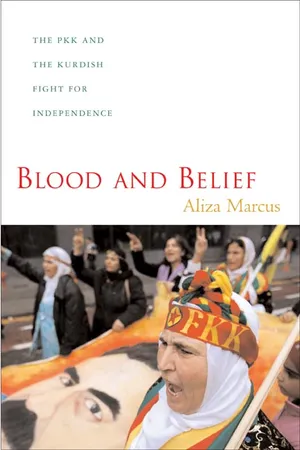
Blood and Belief combines reportage and scholarship to give the first in-depth account of the PKK. Aliza Marcus, one of the first Western reporters to meet with PKK rebels, wrote about their war for many years for a variety of prominent publications before being put on trial in Turkey for her reporting. Based on her interviews with PKK rebels and their supporters and opponents throughout the world—including the Palestinians who trained them, the intelligence services that tracked them, and the dissidents who tried to break them up—Marcus provides an in-depth account of this influential radical group.
- 363 pages
- English
- ePUB (mobile friendly)
- Available on iOS & Android
eBook - ePub
About this book
Information
Ocalan, Kurds, and the PKK’s Start
1
The Origins of the PKK, 1949–1976
ABDULLAH OCALAN WAS born in a typical farming village in Sanliurfa, a province just on the edge of the Kurdish region.1 He often said he did not know for sure the exact year of his birth. His parents registered it as 1949, but as sometimes was the case among rural people in Turkey, the registration might have been delayed a year or two due to disinterest in such official matters or to give young Abdullah a better chance once he was conscripted in the army. The area where he grew up was populated by Kurds, Turks, and Armenians and the different peoples mixed easily, going to school together, doing business, and among the Muslim villages at least, also intermarrying. Ocalan’s grandmother on his mother’s side, in fact, was a Turk, and he once claimed that his mother was as well.2 Still, for all the intermingling, Ocalan did not learn Turkish until he entered elementary school.
Life in this region was marked by grueling poverty for most everyone but the landlords. In Ocalan’s village of Omerli, men and women worked the harsh land, harvesting what they could and in summer supplementing the meager income by picking cotton in the fields of the wealthy landowners. It was a tough life with little money for anything but the basics and little hope that things would get better. Later on, Ocalan’s supporters would make much of the fact that he came from as depressed surroundings as his followers, unlike many of the earlier leading Kurdish figures, who often were linked to large tribal or wealthy landowning families.
The seemingly inescapable cycle of poverty of such villages was captured more than 30 years after Ocalan’s birth in an article in the French newspaper Le Monde, which looked at life in one typical Kurdish village in the Mardin province near the Syrian border: “Each family had a few chickens and possibly five or six goats. The agha [local landlord] would visit occasionally to reaffirm his authority and assign work. This consisted mainly of labor on the cotton plantations of the Mesopotamian plain two hundred metres below. All except the very old or very young would descend to the plain daily, to work an eleven-hour day. For this the rates of pay were US$1 for a child, $1.50 for a woman, and $2 for a man. Villagers reckoned they had a 30 percent mortality rate among the children.”3
Ocalan, the oldest of seven children, grew up in an environment dominated by disappointment and violence. “Ever since I was conscious, in my family there was always fighting,” he once said. “There was an overwhelming unhappiness.”4 One psychological profile of him attempted to understand his later militant nationalism in terms of his simultaneous desire for respect from his father and latent anger at his parents.5 Although the reasoning is speculative, Ocalan often did refer to his childhood experiences in interviews and speeches to explain how he learned the importance of revenge and the uses of violence.
Ocalan’s father was not only poorer than most others in the village, but he also apparently was weak-willed and felt humiliated by both the villagers and his own wife. “Not even his relatives took him seriously, and he was hurt by them. It was as if he did not exist, he was gone,”6 Ocalan said in one wide-ranging interview in the early 1990s.
Ocalan’s mother, in comparison, was a tough, angry woman who held nothing back, publicly humiliating her husband for being unable to support his family. Both parents pushed their first-born to be aggressive. Once when Ocalan was beaten badly by some other boys and he ran crying home to his mother, she threw him out of the house, warning him not to return until he had exacted revenge. Ocalan always claimed this went against his shy nature, but he quickly developed a reputation for being a wild, bold child. “Even though it was forced on me this first time, my tendency for action [toward taking revenge] had started. I began to be an attacker; I cracked the heads of many children,”7 he recalled.
One of his major disappointments as a child was the marriage of his favorite sister, Havva, to a man from another village. Love did not play a role in such marriages and the bride-to-be rarely had any say. Havva herself was essentially “sold” for a few sacks of wheat and an unspecified amount of money. Ocalan later explained he saw such marriages as a type of death for women, and former PKK ideologue and scribe Mehmet Can Yuce cited Havva’s marriage as a major influence on Ocalan’s theories on the need to liberate women from the repressive roles inherent in traditional Kurdish male-female relations.
“I recall having a sense of regret,” noted Ocalan, referring back to that period when his sister was married. “[I was thinking that] if I were a revolutionary, then I would not let this happen. They would not be able to take her away.”8
Like many small settlements, Omerli did not have its own elementary school. Kurds saw this as an attempt to keep them ignorant, but it was to Ankara’s advantage to offer schooling—and with it Turkish language and nationalism—to hasten assimilation. The truth was probably more benign. There were so many villages and even smaller hamlets that it would have been difficult to find enough money and personnel to set up schools everywhere. Instead, like many rural children, Ocalan had to trek an hour each way to attend school in a neighboring village. He was a good student and he absorbed the lessons of Turkish history and nationalism so well that he hoped to become a professional Turkish army officer. This was not an uncommon dream for a Kurdish boy schooled in the heroics of Turkey’s founder and top general, Mustafa Kemal Ataturk. But Ocalan failed the exam for military high school and instead registered at a vocational high school in Ankara that trained students to work in the state’s land registry offices.
Ocalan’s arrival in Ankara in 1966 coincided with the quiet growth of a defiant Kurdish identity in the big cities. Teenagers purposefully smoked “Bitlis” cigarettes, whose name referred to the city where the tobacco was grown in the southeast.9 In that Kurdish region, meanwhile, frustrated students and workers were soon staging mass meetings calling for democratic rights and protesting oppression of their identity. It was impossible for Ocalan not to notice. “These meetings affected me, even if it was just in a small way,”10 he later explained.
In this, he was not much different from other young Kurdish men and women who began to explore their identity while in high school or university. Some fell under the sway of a teacher or youth leader who was a secret Kurdish nationalist, others came to see the contradiction between their personal lives—in which they were raised in a Kurdish-speaking village, listening to Kurdish radio emanating from across the borders—and the public ideology that insisted that Kurds were actually Turks. Like Ocalan, many were simply swept up in the leftist movements and Kurdish radicalism that burgeoned in the late 1960s.
When Ocalan graduated vocational school in 1969, he found work in the Diyarbakir government office responsible for measuring land for title deeds in the Kurdish region. After one year, Ocalan transferred to an office in Istanbul. The end of the 1960s were a period of great political upheaval in Turkey and Ocalan, like many other young men and women, was unclear where to turn. Not yet a Kurdish nationalist, he was beginning to recognize that there was a Kurdish problem and that something needed to be done about it. After reading a book entitled The Alphabet of Socialism, he decided that he was a socialist.11
But Ocalan was unsure how to combine his developing Kurdish political identity with his socialist ideals. In Istanbul, he started to follow the actions of the radical student-led movement, which believed Turkey needed to free itself from U.S. domination and capitalist servitude. It was hard to remain apart from the campus fervor even if, like Ocalan, one was actually not a student but instead a low-level state employee working in an office that handled title deeds.
History
The fact that Ocalan was nearly 20 years old before he started to think about his Kurdish identity in any political way was hardly unusual for a Kurdish man or woman growing up in Turkey during this period.12 Shortly after the Turkish republic was formed in 1923, Kurdish nationalists rebelled against the state’s authority. The uprisings were harshly put down and a host of laws were enacted to wipe out Kurdish history and identity. Kurdish village names were changed to Turkish ones, the word Kurdistan—until then used to denote a geographical region—was expunged from books and the language itself was essentially banned.
Turkey’s repression of Kurdish ethnic identity was so complete and Kurdish fear and exhaustion so high after the failed rebellions that a British diplomat traveling through the Kurdish region in 1956 noted: “I did not catch the faintest breath of Kurdish nationalism which the most casual observer in Iraq cannot fail to notice.”13
But Turkey could not close itself off from Kurdish nationalist activities in other countries nor from domestic shifts that encouraged a new, liberal approach to civil and political rights. These factors helped spark change in Kurdish views of themselves, their demands, and the best methods to reach their goals.
In 1960, the Turkish military staged a coup to halt what was seen as Prime Minister Adnan Menderes’s increasingly autocratic rule. Ironically, the coup, which had the backing of the educated elite, ushered in the most liberal period the people had known. A group of academics was invited to draw up a new constitution. The resulting document enshrined broad freedoms to form associations, publish, organize trade unions, and call strikes—all limited since the founding of the republic.14
This expansion of Turkey’s democracy coincided with the rise of a more educated and cosmopolitan Kurdish population. The first generation born after the Kurdish rebellions had come of age, and they did not carry with them the same fears and memories of the army’s harsh put-down of the uprisings that helped silence their parents. More Kurds were attending university, where they were exposed both to new ideas and other Kurdish youth. At the same time, Kurdish peasants seeking a way out of economic hardship were moving to the cities, where they were more likely to hear grumbling about economic inequality between Kurds and Turks and whispers of a new Kurdish political agitation at home and in Iraq.
A legal socialist party, the Turkish Workers Party (TIP), was founded in 1961. Not surprisingly, it gained strong support among Kurds, who were attracted to its message of social and economic equality and justice. But in a sign of just how sensitive the Kurdish issue remained, the party did not tackle the issue for almost a decade. Some Kurdish activists tried to test the new liberal atmosphere directly but they were disappointed. The state moved quickly to shut down cultural magazines and Kurdish-language newspapers, charging the editors and writers with communism or separatism.15 It seemed the liberalization of Turkey only went so far.
But soon, as Turkey always feared, the Iraqi Kurdish struggle spilled over the border. After the Iraqi monarchy was overthrown in 1958, the new Iraqi government had invited Iraqi Kurdish leader Mulla Mustafa Barzani home from exile in the Soviet Union. Barzani was a famed fighter and nationalist figure who led a revolt in Iraq in the early 1940s and helped defend the 1946 Kurdish Republic of Mahabad in Iran. Never mind that the revolt failed and the Soviet-backed Mahabad republic did not even last a year: Barzani was the closest Kurds had to a real hero and his return to Iraq reinvigorated Kurdish nationalists everywhere. But within three years, Barzani’s relations with Baghdad collapsed over Kurdish demands for autonomy and he launched a new rebellion.
This uprising caught the imagination of Turkish Kurds; in 1965, some Kurds formed the underground Kurdistan Democratic Party of Turkey (TKDP). This was the first nationalist Kurdish party inside Turkey since the state crushed the last of the rebellions in 1938.16 It called for a Kurdish federation within Turkey’s borders and, in theory at least, supported armed action to reach its goal. Ideologically, the party was close to Barzani’s party, but the difficulties of Kurdish unity immediately showed. A letter sent by the Turkish party offering to assist Barzani went unanswered. Members took it as a sign that Barzani was unwilling to cross swords with Turkey.
“But despite this,” insisted Serafettin Elci, a Kurdish lawyer who was sympathetic to the party, “the TKDP saw helping the Barzani movement as a national responsibility.”17
The party also was not very popular with Kurds even inside Turkey. Kurdish youth were attracted to the leftist ideas promoted by TIP and spreading through the universities. The TKDP, however, reflected the same traditional, conservative approach that Barzani held and the Turkish Kurdish party’s general secretary, Faik Bucak, was from a wealthy, landowning family in southeast Turkey. The murder of Bucak in 1966—he was killed in a blood feud, but many Kurds believe state forces were behind it—also weakened the party’s ability to function effectively and garner support.
Kurds who wanted to take a closer look at their own situation remained bereft of outlets. The Turkish left, which was growing stronger, was vocally opposed to many of the state’s policies, but on the Kurdish issue it was relatively silent. Kurds hoping to work through the left were dissatisfied yet there was nowhere else to turn.
“At that time we didn’t think of having a separate organization,” explained Kemal Burkay, a thoughtful Kurdish activist who started with the socialist party TIP. “The goal of making changes in Turkey, of winning democracy, of winning Kurdish rights was tied to the struggle of the two peoples working together. In time we understood that the Turkish left did not have a real Kurdish program.”
Kurds Strike Out on Their Own
At the end of the decade, just as the student-led left began its turn to violence, Kurdish students and intellectuals formed their own organization. The Revolutionary Eastern Cultural Hearths (DDKO), which substituted the word “eastern” for the word “Kurdish” to avoid being shut down by the state, wanted to address social and cultural issues of concern to Kurds. The group blended the Marxism so popular at the time with a Kurdishness, thus marking a new step in development of a Kurdish political identity in Turkey.
Despite the organization’s attempt to bypass bans on Kurdish activism, the state was suspicious. In October 1970, the group’s leaders were arrested and charged with trying to establish a separate state. Although some members may have dreamed of an independent Kurdistan, other Kurds saw it as too timid in its veiled calls for Kurdish cultural rights. Still, the state’s message to the first legal Kurdish group was telling: Political liberalization aside, bans on Kurdish activism would not be eased.
But even if the state’s policy was stagnant, the politicization of Kurdish ethnic identity was not. By now Kurds were very active in the socialist TIP and at the Fourth Congress at the end of October 1970, delegates voted in favor of resolutions that reflected their nationalist interests and frustrations.18 The resolutions started off with the simple yet controversial statement acknowledging the existence of Kurds in eastern Turkey. They then went on to condemn Turkey for imposing a policy of “repression, terror and assimilation”19 against the Kurds.
Kurds were not the only ones unhappy with the pace of reform. Toward the end of the 1960s, the socialist movements sweeping across Europe took hold in Turkey. University students adapted the models and theories to their own situation and held large and rowdy demonstrations to vent their criticisms and demands. The focus was on Turkey’s close ties to the United States, the dangers of capitalism and imperialism, and the need for radical change. U.S. intervention in Vietnam—and the guerrilla resistance—helped strengthen the anti-American feelings.
Gradually, leftist views hardened and spread. Student leaders went to Palestinian guerrilla camps in Lebanon for armed training. Trade unions became more radical in their demands. Universities had played an important part in demanding the end to the Menderes government and this boosted the student-led movement’s belief that its role was to change society. The radical thinking was aided by what was seen as a shrinking space for democratic, legal activism. A 1968 election law aimed at limiting the growth of the socialist party TIP gave credence to the argument that nothing could be gained by working through the legal, political system.20
Early in 1970, the Turkish left spawned two armed groups, each espousing slightly different theories of violent socialist revolution. The groups turned to robbing banks to finance their activities and kidnappings to publicize their goals. Such actions underscored the government’s loss of control. The militants made plans to take their struggles to the mountains, from where they would lead the revolution.
The combination of outspoken Kurdish organizations and violent leftist movements—along with attacks by armed rightists—plunged the country into a political chaos ...
Table of contents
- Cover Page
- Title Page
- Copyright Page
- Contents
- A Note to Readers
- Acronyms
- Introduction
- Prologue
- PART I Ocalan, Kurds, and the PKK’s Start
- PART II The PKK Consolidates Power
- PART III PKK Militants Fight for Control
- PART IV Ocalan’s Capture and After
- Conclusion
- Timeline
- Notes
- Bibliography
- Index
- About the Author
Trusted by 375,005 students
Access to over 1.5 million titles for a fair monthly price.
Study more efficiently using our study tools.
Frequently asked questions
Yes, you can cancel anytime from the Subscription tab in your account settings on the Perlego website. Your subscription will stay active until the end of your current billing period. Learn how to cancel your subscription
No, books cannot be downloaded as external files, such as PDFs, for use outside of Perlego. However, you can download books within the Perlego app for offline reading on mobile or tablet. Learn how to download books offline
Perlego offers two plans: Essential and Complete
- Essential is ideal for learners and professionals who enjoy exploring a wide range of subjects. Access the Essential Library with 800,000+ trusted titles and best-sellers across business, personal growth, and the humanities. Includes unlimited reading time and Standard Read Aloud voice.
- Complete: Perfect for advanced learners and researchers needing full, unrestricted access. Unlock 1.5M+ books across hundreds of subjects, including academic and specialized titles. The Complete Plan also includes advanced features like Premium Read Aloud and Research Assistant.
We are an online textbook subscription service, where you can get access to an entire online library for less than the price of a single book per month. With over 1.5 million books across 990+ topics, we’ve got you covered! Learn about our mission
Look out for the read-aloud symbol on your next book to see if you can listen to it. The read-aloud tool reads text aloud for you, highlighting the text as it is being read. You can pause it, speed it up and slow it down. Learn more about Read Aloud
Yes! You can use the Perlego app on both iOS and Android devices to read anytime, anywhere — even offline. Perfect for commutes or when you’re on the go.
Please note we cannot support devices running on iOS 13 and Android 7 or earlier. Learn more about using the app
Please note we cannot support devices running on iOS 13 and Android 7 or earlier. Learn more about using the app
Yes, you can access Blood and Belief by Aliza Marcus in PDF and/or ePUB format, as well as other popular books in Politics & International Relations & Global Politics. We have over 1.5 million books available in our catalogue for you to explore.