Dissects the politics of commemoration of soldiers, veterans, and relatives from WWI
The United States lost thousands of troops during World War I, and the government gave next-of-kin a choice about what to do with their fallen loved ones: ship them home for burial or leave them permanently in Europe, in makeshift graves that would be eventually transformed into cemeteries in France, Belgium, and England. World War I marked the first war in which the United States government and military took full responsibility for the identification, burial, and memorialization of those killed in battle, and as a result, the process of burying and remembering the dead became intensely political. The government and military attempted to create a patriotic consensus on the historical memory of World War I in which war dead were not only honored but used as a symbol to legitimize America's participation in a war not fully supported by all citizens.
The saga of American soldiers killed in World War I and the efforts of the living to honor them is a neglected component of United States military history, and in this fascinating yet often macabre account, Lisa M. Budreau unpacks the politics and processes of the competing interest groups involved in the three core components of commemoration: repatriation, remembrance, and return. She also describes how relatives of the fallen made pilgrimages to French battlefields, attended largely by American Legionnaires and the Gold Star Mothers, a group formed by mothers of sons killed in World War I, which exists to this day. Throughout, and with sensitivity to issues of race and gender, Bodies of War emphasizes the inherent tensions in the politics of memorialization and explores how those interests often conflicted with the needs of veterans and relatives.
eBook - ePub
Bodies of War
World War I and the Politics of Commemoration in America, 1919-1933
- 336 pages
- English
- ePUB (mobile friendly)
- Available on iOS & Android
eBook - ePub
About this book
Information
Topic
HistoriaSubtopic
Historia militar y marítimaPART I
Repatriation
1
The Journey’s End
On a warm morning in late May 1933, Mrs. Estella Kendall of Shenandoah, Iowa, walked anxiously through the Meuse-Argonne American Cemetery in northern France. Many summers had passed since that day in 1918 when she first learned of her son’s death: as a member of the 168th Infantry, 42nd Division, First Sergeant Harry N. Kendall had been attempting to move his men to a safer position during the opening hours of the Champagne sector battle; before they could find shelter, a shell exploded, killing him instantly.1 Now, on row 12, grave 16, mother and son were reunited as she knelt before his white marble headstone.
Mrs. Kendall’s choice to leave her son buried overseas had not been an easy one. Like thousands of families across the United States, she struggled with this thorny decision offered by the War Department in 1919. The choice had been unexpected because the government had assured her that once the war was over, the remains of all American soldiers who died abroad would be returned to their homes.2 The pledge was followed by consoling letters, including one from the regimental chaplain, offering solace during her dark hour. The chaplain encouraged Estella Kendall not to think of Harry as dead but rather as having given his life for his country and the “Great Cause.” “His body only lies buried,” he claimed with certainty. “I believe that he is with God.” The chaplain described the dignified wooden cross that marked Harry’s temporary grave and the honor that had been bestowed on him during the initial battlefield burial service. “Such courage and disdain of death’s toll when in line of duty can point to but one thing, that such dauntless spirit is immortal. When it was needed your son gave his body for his country. His spirit is safe in the everlasting arms.”3
The chaplain’s well-intentioned expressions echoed those written to thousands of other families during the eighteen months America participated in the Great War, as it became known. The rhetorical phrases celebrated the glory of victory and sacrifice for democratic ideals and aimed to solace the grief of the bereaved. in the process, each of the deceased became a cult figure, an embodiment of national identity, thus deserving of preservation and honor by its citizens.
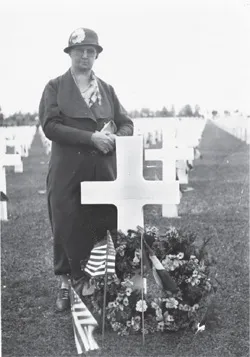
Estella Kendall of Shenandoah, Iowa, at her son’s grave during her pilgrimage to the Meuse-Argonne cemetery at Romagnesous-Montfaucon, France, in May 1933. First Sergeant Harry N. Kendall, 168th Infantry, 42nd Division, was killed in 1918. (Courtesy of Liberty Museum, Kansas City, Missouri)
So it must have been surprising to Mrs. Kendall when, in the war’s aftermath, the government asked her to decide whether Harry’s final resting place should be in her hometown or at Arlington National Cemetery or on the former battlefield in France.4 Despite the options presented and the chaplain’s previous attempts to assuage her grief, in April 1919, Estella Kendall requested that the body of her son be sent home to Iowa, rather than remain in an overseas American cemetery.5 Here, she believed she could care for his grave as only a mother could.
Then, in June 1921, nearly three years after Harry’s death, Estella Kendall mysteriously reversed her decision and wired the army’s Quartermaster Corps’ Graves Registration Service that he was to rest instead within one of the new national military cemeteries constructed thousands of miles from American shores. Two full years passed before the summer of 1923, when she received word that her son had finally been laid to rest in a permanent grave at the Meuse-Argonne American Cemetery, Romagnesous-Montfaucon, France.6
Perhaps it was the interminable wait for the return of her son’s body that convinced Estella Kendall to leave him buried overseas, or it may have been the perpetual care and reverence promised by the American government. Either way, nearly twenty-five thousand other families made a similar additional sacrifice that seemed to guarantee everlasting remembrance. Like Mrs. Kendall’s, their choice was not made without further pain and indecision. The weight this sacred burden represented to many families is apparent from the steady stream of cable dispatches from Washington, DC, to France, when, by 1921, thousands of families had changed their minds regarding the final disposition of their deceased. Ultimately, more than thirty thousand American dead of this war were buried in U.S. cemeteries overseas, including those without a known identity.7
For Americans, the anxious uncertainty that accompanied the government’s immediate postwar indecision over the disposition of its war dead was a heartbreaking period for all concerned. Once resolved, the agonizing wait for the body’s return could take years. For others, the decision to leave their deceased overseas came at an equally high price. There would be no funeral service, no headstone in a local cemetery, nothing left to venerate, and no closure so necessary in the grieving process. For those whose sons or husbands were officially termed “missing” or “unknown,” the relentless passage of time seldom offered any solace or resolution. Although the government was in the process of returning the identifiable deceased, countless bodies remained unidentifiable, and scores of others were never found. Their loved ones would receive no benefit from the government’s offer of a personal headstone as a site of memory. In honor of approximately forty-five hundred of these American “unknowns,” political and military leaders in the United States followed the example of England and France and buried one unidentified soldier in 1921.8
While the democratic options presented to families may have appeared to be the best policy at the time, the outcome did little to promote national solidarity as intended. On the contrary, impassioned debate raged across America as to whether it was best to leave the deceased in foreign soil or to bring the bodies home for burial. Repatriation of the dead eventually proved enormously costly and divisive, and it placed an extraordinary burden on the bereaved, leaving doubts that often lingered years after the daunting choice was made.
It may have been partially due to this uncertainty that mothers and widows of loved ones buried overseas argued so persuasively during the postwar years for a government-sponsored pilgrimage to the gravesites. Gold Star mothers and widows, so named for the emblem they were urged to display on armbands and service flags in their homes, believed their sacrifice warranted a further debt of gratitude that could best be rewarded with a visit to the graves of their sons (or daughters) and husbands.9
The incomparable tale of the Gold Star Mothers and Widows pilgrimage was the result of years of effective lobbying by white, Anglo-Saxon women’s organizations, testing their budding political power in a new arena while attempting to capitalize on a unique era when mothers held the moral high ground. Their extraordinary achievement resulted in a series of unprecedented pilgrimages between 1930 and 1933, when mothers and widows traveled in luxury to cemeteries in Europe as guests of the U.S. government. Originally, the offer was intended to give women—regardless of race, color, or economic status—an opportunity to find resolution with death at the faraway graveside of their loved one. Whether the pilgrimages, as crafted by Congress, the military, and some of the more politically savvy “pilgrims,” met that objective is for the reader to decide.
But when Estella Kendall and thousands like her made their painful decision, there was no assurance of a future pilgrimage. Instead, an ocean and thousands of miles separated them from the cemeteries and monuments being erected overseas throughout the late 1920s on behalf of their nation and its heroes. As a consequence, only the more affluent could afford the long voyage to Europe. So why, then, did these families choose to leave their loved ones buried in foreign lands, and did they feel that the additional sacrifice had been worthwhile?
Fifteen years after Harry Kendall’s death, his mother sailed to France as one of more than six thousand women who accepted the government’s offer.10 Her recorded memories vividly describe the striking hat she wore most days, the luxurious accommodations aboard ship, and the cathedrals she visited, with occasional embellishments of French history gleaned from the day’s sightseeing. The former battlefields, although no longer scenes of death and devastation, still held enormous fascination for the pilgrims, as they did for many tourists. Mrs. Kendall mentions seeing the Bayonet Trench, “where 250 soldiers were buried where they fell” (in fact, there were less than one hundred),11 a British tank captured by the Germans, and plenty of barbed-wire entanglements, trenches, and shell holes. But what of her visit to the cemetery, the key purpose of her pilgrimage?
Estella Kendall’s presence at her son’s final resting place coincided with Memorial Day weekend, when “the cemetery was beautiful with its decorations of United States and French flags and poppies.” Yet, following her visit to Harry’s grave, Estella’s diary simply reads, “Went to the Meuse-Argonne cemetery where we placed large wreaths on our sons’ graves.” Nothing more. As she knelt by his headstone and looked out over the perfectly manicured gardenlike setting of this, the largest of the American World War I cemeteries, Estella must have wondered why it took more than a decade for the War Department’s invitation to arrive. Why indeed? Like the on-screen mother in the popular 1933 Hollywood film Pilgrimage, Estella Kendall had been invited to France to revisit her son’s death after spending more than ten years “remembering to forget.”12
Whereas the history of the First World War has been told repeatedly in various forms, the saga of the dead and the efforts of the living to honor their heroes has remained dormant far too long. What follows is the staggering, often-macabre tale that brought Estella Kendall and thousands of women like her on a journey steeped in the pathos and human drama of a democratic nation struggling to find meaning in war. As the political dynamics of this venture unfold, we sense that although times may change, much remains remarkably the same.
2
Origins
After more than ninety years, the First World War still evokes gruesome images of No Man’s Land, where bodies lie dead or slowly dying amid the chaos of battle as machine-gun bullets crackle and whiz across the parapets of mud-filled trenches. We think of the Western Front, a hellish place where intrepid soldiers trek across churned-up battlefields pitted with craters to assault the enemy through a barrage of rapid gunfire. Shell fire illuminates the night skies, exposing the ever-present barbed wire, and noxious chlorine or phosgene gas wafts across the battlefields, bringing the slow death of asphyxiation to countless men destined to suffer in places with familiar names such as the Somme, Ypres, Verdun, Belleau Wood, and the Meuse-Argonne.
This ghastly global conflict, responsible for the death of over nine million people, took place primarily in Europe from August 4, 1914, to November 11, 1918, and resulted chiefly from the breakdown of powerful political alliances. The Entente Powers comprised France, Russia (until 1917), Great Britain, and later Italy (from 1915). These nations were joined by the United States on April 6, 1917 (as an “associate” power, according to President Woodrow Wilson, rather than as an ally), in the defeat of the Central Powers of the Austro-Hungarian, German, and Ottoman empires.
The Great War undoubtedly had a devastating impact on the history of the twentieth century in that millions of individuals suffered fatal or often disabling wounds and injuries. Moreover, each belligerent nation bore immeasurable and long-term social, financial, and psychological costs and scars; pervasive disillusionment among people of all combatant nations endured for generations.
The Treaty of Versailles in 1919 severely punished Germany as the alleged instigator of the war and required its people to pay enormous war reparations while awarding vast territory to the victors. Despite the passage of time since the armistice, historians have continued to argue persuasively over countless aspects of the war, including its causes, the effectiveness of commanders and operations, and even the outcome. Nevertheless, one indisputable consequence was the depth and intensity of grief that engulfed the bereaved, who struggled to find meaning from their painful and often questionable loss.
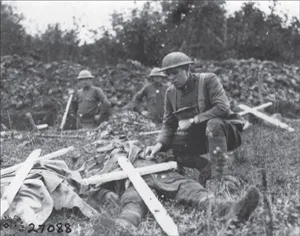
Lieutenant Finnel, chaplain of the 124th Machine Gun Battalion, identifying the dead of the 33rd Division. Bois de Chaume, southeast of Sivry-sur-Meuse, France, October 14, 1918. (SC Photo 111, No. 27088, RG 92, NA)
In the United States, war losses were substantially less than those suffered by other nations. For example, by 1919, there were approximately 722,785 British war dead, compared with U.S. figures well under 100,000, and many of the American dead were actually flu victims. In May 1919, the Graves Registration Service (GRS) stated with unreserved precision that 34,063 had been killed in action, 14,215 had died of wounds, 23,210 had died of disease, and another 4,588 had died of “other causes.” With a further 4,102 noted as “missing in action,” total overseas losses for the American Expeditionary Forces (AEF) were documented at that time at 80,178.1 This relatively low number cannot compare to other nations’ figures for the First World War, or to the over 600,000 dead of the Civil War, when the United States had a population a third of its 1918 size.2 Yet, after the cessation of hostilities in the First World War, the War Department found itself with no defined policy for the disposition of its war dead.
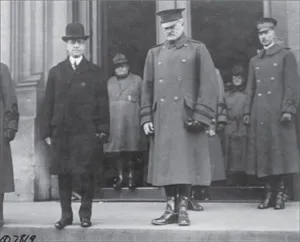
General John J. Pershing, commander of the American Expeditionary Forces, and Secretary of War Newton D. Baker begin their inspection tour at Bordeaux, France, February, 1918. (SC Photo 111, No. 7819, RG 92, NA)
Because of the scarcity of shipping space aboard transports crossing the Atlantic, General John J. Pershing, the AEF commander, and Major General Henry G. Sharpe, the U.S. Army’s quartermaster general, agreed that it was “impracticable” to use valuable shipping space for coffins and burial equipment. Thus, it was decided that Americans who died in Europe would be interred there, and no attempt would be made to bring them back until after the close of hostilities.3 This directive was the extent of the War Department’s prewar planning concerning the disposition of American remains.
Then, in early September 1918, just as General Persh...
Table of contents
- Cover Page
- Title Page
- Copyright Page
- Dedication
- Contents
- PILGRIMS
- Preface
- Acknowledgments
- Abbreviations
- Introduction
- PART I Repatriation
- PART II Remembrance
- PART III Return
- Epilogue
- Notes
- Selected Bibliography
- Index
- About the Author
Trusted by 375,005 students
Access to over 1.5 million titles for a fair monthly price.
Study more efficiently using our study tools.
Frequently asked questions
Yes, you can cancel anytime from the Subscription tab in your account settings on the Perlego website. Your subscription will stay active until the end of your current billing period. Learn how to cancel your subscription
No, books cannot be downloaded as external files, such as PDFs, for use outside of Perlego. However, you can download books within the Perlego app for offline reading on mobile or tablet. Learn how to download books offline
Perlego offers two plans: Essential and Complete
- Essential is ideal for learners and professionals who enjoy exploring a wide range of subjects. Access the Essential Library with 800,000+ trusted titles and best-sellers across business, personal growth, and the humanities. Includes unlimited reading time and Standard Read Aloud voice.
- Complete: Perfect for advanced learners and researchers needing full, unrestricted access. Unlock 1.5M+ books across hundreds of subjects, including academic and specialized titles. The Complete Plan also includes advanced features like Premium Read Aloud and Research Assistant.
We are an online textbook subscription service, where you can get access to an entire online library for less than the price of a single book per month. With over 1.5 million books across 990+ topics, we’ve got you covered! Learn about our mission
Look out for the read-aloud symbol on your next book to see if you can listen to it. The read-aloud tool reads text aloud for you, highlighting the text as it is being read. You can pause it, speed it up and slow it down. Learn more about Read Aloud
Yes! You can use the Perlego app on both iOS and Android devices to read anytime, anywhere — even offline. Perfect for commutes or when you’re on the go.
Please note we cannot support devices running on iOS 13 and Android 7 or earlier. Learn more about using the app
Please note we cannot support devices running on iOS 13 and Android 7 or earlier. Learn more about using the app
Yes, you can access Bodies of War by Lisa M. Budreau in PDF and/or ePUB format, as well as other popular books in Historia & Historia militar y marítima. We have over 1.5 million books available in our catalogue for you to explore.