- 260 pages
- English
- ePUB (mobile friendly)
- Available on iOS & Android
eBook - ePub
About this book
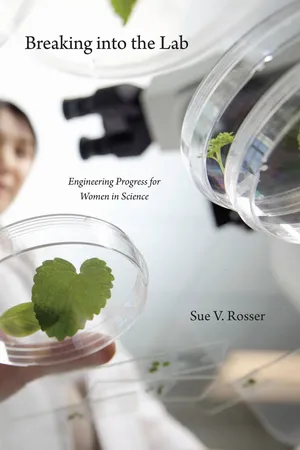
Why are there so few women in science? In Breaking into the Lab, Sue Rosser uses the experiences of successful women scientists and engineers to answer the question of why elite institutions have so few women scientists and engineers tenured on their faculties. Women are highly qualified, motivated students, and yet they have drastically higher rates of attrition, and they are shying away from the fields with the greatest demand for workers and the biggest economic payoffs, such as engineering, computer sciences, and the physical sciences. Rosser shows that these continuing trends are not only disappointing, they are urgent: the U.S. can no longer afford to lose the talents of the women scientists and engineers, because it is quickly losing its lead in science and technology. Ultimately, these biases and barriers may lock women out of the new scientific frontiers of innovation and technology transfer, resulting in loss of useful inventions and products to society.
Information
1
Introduction
Why Women in Science Are Still Controversial after Thirty Years
In 1968, when I applied to four graduate schools and was accepted to all but Harvard, I wondered why Stanford had failed to provide me with support, since both Berkeley and Madison had. When I called the chair of the department to inquire about this, I was told that they had accepted me only because of my very high grades and GRE scores, since normally they did not offer a place to a married woman who was likely just to have children and “waste” her graduate education.
In 1971, I was directed toward a dissertation topic on fossil rodents based primarily at the Field Museum in Chicago because my major professor assumed that, since I was pregnant with my first child, I would not want to go to Africa for dissertation field research as most of his other students did. In 1975, when I became pregnant with my second child, my postdoctoral advisor suggested that I get an abortion. He said the timing for having another child at that point was not good for the research; he said we needed to collect more data to improve our chances of getting the grant renewed.
Despite these and other obstacles, I did go on to have a successful career in academia, culminating in my serving as a dean of liberal arts at a research I institution for ten years before attaining my current position as provost at a large comprehensive university. The types of barriers, obstacles, and discrimination that women scientists, engineers, and I faced 30 or 40 years ago, and some that slightly younger women faced 10 or 20 years ago, now appear overt and obvious. While today’s obstacles seem covert and less clear, my junior colleagues continue to face similar issues, just manifested now in different forms. This volume explores these similarities and differences and their impacts upon the careers of women scientists and engineers.
The Impact of Summers’ Remarks
On January 14, 2005, I was an invited speaker at the National Bureau of Economic Research at Harvard University where President Larry Summers delivered his now infamous speech. Summers drew on anecdotes and popular outdated or pseudo-science to make three points explaining the paucity of women scientists and engineers: (1) women are unwilling or unable to work the 80-hour weeks required for success in science at top-flight academic institutions; (2) innate or biological factors, rather than socialization, probably account for sex differences in mathematical aptitude and also for adult preferences for choice of academic study and occupational field; (3) discrimination, which he defined as a “taste” for hiring people like oneself, does not exist in academia because that would be eliminated through market forces by lesser institutions hiring highly qualified women and minorities, thereby gaining a competitive advantage.
The following quotation from the transcript of Summers’ remarks captures the essence of his argument: “So my best guess, to provoke you, of what’s behind all of this is that the largest phenomenon, by far, is the general clash between people’s legitimate family desires and employer’s current desire for high power and high intensity, that in the special case of science and engineering, there are issues of intrinsic aptitude, and particularly of the variability of aptitude, and that those considerations are reinforced by what are in fact lesser factors involving socialization and continuing discrimination” (Summers 2005).
Of the some 40 people present at the closed, invitational meeting, most of us, individuals who had worked and conducted substantial research on women in science for more than two decades, were appalled and shocked by his remarks. From the media accounts, some of the Harvard faculty at the meeting, and a few other individuals, mostly economists, agreed with the remarks he made during his prepared presentation that lasted more than one hour.
Despite his resignation from the Harvard presidency and appointment as head of the National Economic Council in the Obama administration, Larry Summers’ comments generated a firestorm which continued for several months and still persists. On June 7, 2010, John Tierney began his New York Times article, “Daring to Discuss Women in Science,” in the following way:
The House of Representatives has passed what I like to think of as Larry’s Law. The official title of this legislation is “Fulfilling the potential of women in academic science and engineering,” but nothing did more to empower its advocates than the controversy over a speech by Lawrence H. Summers when he was president of Harvard. (Tierney 2010a)
Hundreds of editorials, op-ed pieces, and TV interviews, as well as articles in professional journals, have excoriated Summers for faulty logic, use of dated studies, and political naïveté. Equally large numbers, including John Tierney, also praised him for his courage, for defying political correctness to tell the truth about why relatively few women hold senior positions in science and engineering, especially at elite institutions.
I’m all in favor of women fulfilling their potential in science, but I feel compelled, at the risk of being shipped off to one of these workshops, to ask a couple of questions: (1) Would it be safe during the “interactive discussions” for someone to mention the new evidence supporting Dr. Summers’s controversial hypothesis about differences in the sexes’ aptitude for math and science? (2) How could these workshops reconcile the “existence of gender bias” with careful studies that show that female scientists fare as well as, if not better than, their male counterparts in receiving academic promotions and research grants? (Tierney 2010a)
The one point on which all agreed is that President Larry Summers focused significant attention on the issue of women and science. His announcement on May 16, 2005, of the decision to designate $50 million over the next decade at Harvard to support initiatives to recruit and support women faculty and minorities in pursuing academic careers provided increased focus and the promise of action on the issues. His comments have extended attention outside of academia to the situation for women scientists in industry as well (Weiss 2008). Many believe that his comments on women and science became the final straw that led to his resignation and the appointment of Drew Gilpin Faust as Harvard’s first woman president.
Summers’ remarks and the national debate spurred Congress to find a way to determine whether discrimination occurs against women in science and engineering. The legislation “fulfilling the potential of women in academic science and engineering” that passed the House represents one example of such action. Continuing reports from the National Academy of Sciences (2007), the Council on Competitiveness (2005), the National Science Board (2008), and the National Academies (2010) suggest that the United States lags behind other countries in producing scientists and engineers needed for our increasingly technological society. The events of September 11, 2001, as well as the improving educational systems in developing countries such as China and India, mean that the United States can no longer depend on individuals from other countries to staff its academic and industrial workforce in science and technology. The United States cannot afford to lose the talents of women and other under-represented groups in science, technology, engineering, and medicine because of discrimination.
As President Obama has emphasized, the United States needs to increase the percentages of Americans graduating from college overall, and especially needs to increase the numbers of scientists and engineers it graduates to compete economically in the global market. After sitting at the technological frontier for decades, the United States now faces increasing competition in science and technology. At one time the primary source of the world’s high technology, the country has become a consistent net importer of high technology, with new competition from high-tech firms in Israel, Taiwan, Finland, Ireland, and even parts of the developing world. Since the dot-com bust, the annual U.S. productivity growth has slowed, and U.S. high-tech small business formation has dropped in every sector (National Science Board 2008). These shifts are especially troubling since economists attribute half of America’s economic growth since World War II to new technology.
Although gaps in science funding may be partially responsible for the decline, the main source of the problem appears to be the drastic reductions in graduation of competitive scientists and engineers. Fewer U.S. college students pursued engineering degrees in 2005 than in 1985, despite a rising undergraduate population (National Science Foundation 2010). In 2000, more than 25 countries had higher percentages of 24-year-olds with degrees in science and engineering than did the United States. At the PhD level, U.S. production of scientists and engineers peaked in 1997. As a result, even top U.S. high-tech firms now look abroad for talent and move their research and development to India, Israel, and Ireland. As an Intel spokesperson said, “We go where the smart people are” (National Academy of Sciences 2007). A 2006 Duke University survey of American firms that outsource science and technology jobs found that approximately 40 percent considered the U.S. supply of engineers inadequate, suggesting a strong correlation between the recent relative decline in U.S. technological competitiveness and the drop in the U.S. science and technology workforce (Wadhwa, Rissing and Gereffi 2006). The U.S. scientific workforce needs to change from being predominately white and male to reflect the diversity of the demographics of the population as a whole. Individuals from groups currently underrepresented in the science, engineering, technology, and mathematics (STEM) workforce will not be the only ones to reap the benefits of the relatively good salaries obtained by scientists and engineers. Increasing the diversity in the STEM workforce may also lead to benefits for science and engineering itself, since people from different backgrounds and experience may bring diverse approaches to problem solving and innovation. This represents one of the many reasons that the issues of women in STEM are so important to everyone, not just to women.
Statistics on Women in STEM
During the last three decades, the overall percentage of women receiving degrees in science, technology, engineering, and mathematics (STEM) has increased dramatically. This increase tends to mask at least three other aspects of the demographics of the science and technology workforce. First, when data represent U.S. and immigrant scientists only, and are not disaggregated by gender, they mask the decrease in the number of U.S. white men—the group from which the United States traditionally has drawn its STEM workforce—that has occurred during the last decades. This decrease seems to be the result of white men entering other fields such as law and business, which are perceived to command better salaries, as well as an overall decrease in the percentage of men obtaining degrees from college at all levels. Unless more men of color and women enter the science and engineering workforce, the United States will not produce the number of scientists and engineers it needs to sustain its workforce without importing them from other countries.
In the United States, women currently earn more of the bachelor’s and master’s degrees than men (see table 1.1). In 2008, women earned 57.4% of the bachelor’s degrees in all fields (NSF 2010 table C-4) and 60.6% of all master’s degrees (NSF 2010 table E-2). Beginning in 2000, women also earned more of the bachelor’s degrees in science and engineering (S&E), although they earned only 45.6% of the master’s degrees in science and engineering in 2008. In 2008, women earned 61.8% of the PhD’s in non-science and engineering fields, but only 40.7% of the PhD’s in science and engineering received by U.S. citizens and permanent residents (NSF 2010, table F-2). The many reasons for these shifts in the demographics of degree earners in the United States include more equal opportunities for women in higher education and the need for dual-career families to make ends meet financially. Predicted to continue, these trends suggest that the issues raised in this book will only become more pressing as the disconnect between those earning degrees in science and engineering and those climbing the ranks in STEM in academia and industry continues to grow.
Second, the aggregated data mask the wide variance of women’s participation among fields in STEM. Major gender differences occur in distribution of the genders across the disciplines. Overall, at the bachelor’s level, women earn the majority of the degrees in the non-science and engineering fields such as humanities, education, and fine arts, and in the S&E fields of psychology, the social sciences, and biological sciences. Men earn most of the degrees in the physical sciences, earth, atmospheric, and ocean sciences, mathematics and statistics, computer sciences and engineering (NSF 2010).
At the level of the master’s degree, women earned the majority of degrees in 2008 not only in non-science and engineering fields, but also in biological sciences, psychology, and the social sciences. Women earned less than half of the master’s degrees in earth, atmospheric, and ocean sciences, mathematics and statistics, physical sciences, computer sciences and engineering (NSF 2010).
Women still earned less than half of the science and engineering PhD degrees in 2008 in all fields except psychology, biology, and a few social sciences such as anthropology, linguistics, and sociology (NSF 2010, table F-2). Women earned 50.6% of the PhD’s in biological sciences. Unfortunately, the social and life sciences represent areas with constant or decreasing numbers of tenure-track positions and relatively tight federal funding, leading to intense competition. This does not represent the situation in other fields such as computer science and engineering, where women earn about 22 percent of the PhD’s (NSF 2010, table F-2). Many PhD’s in computer science and engineering obtain positions in industry, making the competition for tenure-track positions less severe in these fields where federal funding is also relatively plentiful. Earning more of the PhD’s in these fields would give women greater access to these positions and funding.
TABLE 1.1. Women as a Percentage of Degree Recipients in 2008 by Major Discipline and Group

Source: Calculated by author from data in NSF 2010, Women, minorities, and persons with disabilities; Table C-4 for BS, E-2 for Masters, F-2 for doctoral.
In short, in many of the social sciences and the life sciences, women have reached parity in the percentages of degrees received. In other areas such as the geosciences, as well as mathematics and physical sciences, the percentages of women continue to increase, although they have not approached parity. In contrast, in engineering and computer sciences, the percentages of women have reached a plateau or dropped during the last decade, especially at the bachelor’s degree level. Unfortunately, these STEM areas, particularly computer science and engineering, represent the fast-growing areas with the greatest workforce demand in our increasingly technological society. Industry and government hire large numbers of computer scientists and engineers with BS and MS degrees. Reaching parity in the percentage of degrees received in these fields would provide more women with opportunities to compete for these positions.
Finally, aggregated data mask the attrition of women at every phase of the educational and career STEM pipeline. Despite grades and other academic attainments equal to or surpassing those of the men who remain in STEM, more women leave science and engineering compared to their male counterparts. While the many reasons that women leave science and engineering will be explored later in the book, some of the difficulties of balancing career and children and the problem of finding satisfactory dual-career positions become particular issues for women scientists and engineers. The dual-career situation especially is an issue for academic women scientists, since a majority of them are married to, or partnered with, another scientist or engineer, often in the same field. In contrast, most men in academic science are not married to, or partnered with, another scientist or engineer. A 2001 survey of American science, technology, engineering, and mathematics (STEM) PhD’s found that single men and single women participate about equally in the STEM workforce. In contrast, a married female PhD is 13% less likely to be employed than a married male PhD. If the woman is married with young children, then she is 30% less likely than a single male to be employed (Long 2001).
The following case illustrates why women scientists with young children may leave the field.
Suzanne Lorenz never thought she’d have to choose between work and family. But in April 2001, expecting her third child, she closed up her office and walked away from a 17-year career. Years of dealing with an employer that offered minimal support for family needs, a salary that persistently lagged behind those of her male peers, and the pressure of trying to juggle her roles as both a dedicated scientist and a dedicated mother had finally worn her out. She saw little alternative but to quit. Had Lorenz been a lawyer, businesswoman, or government official, the gender bias she faced would be troubling enough. But she was an assistant professor of research medicine in a top-ranked department at a midwestern university. When she quit her job, she left behind a half-million-dollar laboratory, several hundred thousand dollars’ worth of training and experience, and a productive research program seeking a cure for blood-pressure disorders. Her story offers vivid evidence that when female scientists and engineers lose the struggle to balance career and family, scientific resources are lost as well. (Rosser and Taylor 2009, M17)
TABLE 1.2. Percentage of Women Doctoral Scientists and Engineers in Academic Institutions by Field and Rank in 2006

Source: Calculated by author from data in NSF, 2010. Women, minorities, and persons with disabilities, Table H-25.
Such losses ultimately result in very few women in senior and leadership positions in the STEM workforce. Within academia in the United States, at four-year institutions in 2006, women made up 40.2% of assistant professors, 31.2% of associate professors, and 16.2% of full professors (see table 1.2) in science and engineering. Doctoral research-extensive institutions (formerly research I institutions) as defined by the Carnegie Classification system have fewer women professors.
Several studies (Nelson 2005; Rosser, Daniels, and Wu 2006) have drawn attention to the failure of the elite research institutions to hire women faculty in general, and women science and engineering faculty in particular, at rates comparable to the PhD production of women from the science and engineering departments of those institutions. Many have sought to explain the small number of women in tenured positions relative to the percentage of qualified women with PhD’s and the reasons for their relatively larger percentages in industry (Catalyst 1999; Etzkowitz et al. 1994), small liberal arts colleges (Rosser 2004; Schneider 2000), or in non–tenure track positions s...
Table of contents
- Cover Page
- Title Page
- Copyright Page
- Dedication
- Contents
- Acknowledgments
- 1 Introduction: Why Women in Science Are Still Controversial after Thirty Years
- 2 Starting Careers: Plus Ça Change, Plus C’est la Même Chose
- 3 Positive Interventions from Mentors and Mentoring Networks
- 4 New Filters for Senior Women Scientists
- 5 Advancing Women Scientists to Senior Leadership Positions
- 6 The Gender Gap in Patents
- 7 The Impact that Women Have Made on Science and Technology
- 8 Conclusion: Women in Science Are Critical for Society
- Appendix A: Grants to Support Women Scientists Cited in This Book
- References
- Index
- About the Author
Trusted by 375,005 students
Access to over 1.5 million titles for a fair monthly price.
Study more efficiently using our study tools.
Frequently asked questions
Yes, you can cancel anytime from the Subscription tab in your account settings on the Perlego website. Your subscription will stay active until the end of your current billing period. Learn how to cancel your subscription
No, books cannot be downloaded as external files, such as PDFs, for use outside of Perlego. However, you can download books within the Perlego app for offline reading on mobile or tablet. Learn how to download books offline
Perlego offers two plans: Essential and Complete
- Essential is ideal for learners and professionals who enjoy exploring a wide range of subjects. Access the Essential Library with 800,000+ trusted titles and best-sellers across business, personal growth, and the humanities. Includes unlimited reading time and Standard Read Aloud voice.
- Complete: Perfect for advanced learners and researchers needing full, unrestricted access. Unlock 1.5M+ books across hundreds of subjects, including academic and specialized titles. The Complete Plan also includes advanced features like Premium Read Aloud and Research Assistant.
We are an online textbook subscription service, where you can get access to an entire online library for less than the price of a single book per month. With over 1.5 million books across 990+ topics, we’ve got you covered! Learn about our mission
Look out for the read-aloud symbol on your next book to see if you can listen to it. The read-aloud tool reads text aloud for you, highlighting the text as it is being read. You can pause it, speed it up and slow it down. Learn more about Read Aloud
Yes! You can use the Perlego app on both iOS and Android devices to read anytime, anywhere — even offline. Perfect for commutes or when you’re on the go.
Please note we cannot support devices running on iOS 13 and Android 7 or earlier. Learn more about using the app
Please note we cannot support devices running on iOS 13 and Android 7 or earlier. Learn more about using the app
Yes, you can access Breaking into the Lab by Sue V. Rosser in PDF and/or ePUB format, as well as other popular books in Social Sciences & Gender Studies. We have over 1.5 million books available in our catalogue for you to explore.