Shortly after winning its independence in 1804, Haiti’s leaders realized
that if their nation was to survive, it needed to build strong diplomatic bonds
with other nations. Haiti’s first leaders looked especially hard at the United
States, which had a sizeable free black population that included vocal
champions of black emigration and colonization. In the 1820s, President
Jean-Pierre Boyer helped facilitate a migration of thousands of black Americans
to Haiti with promises of ample land, rich commercial prospects, and most
importantly, a black state. His ideas struck a chord with both blacks and
whites in America. Journalists and black community leaders advertised emigration
to Haiti as a way for African Americans to resist discrimination and show the
world that the black race could be an equal on the world stage, while
antislavery whites sought to support a nation founded by liberated slaves.
Black and white businessmen were excited by trade potential, and racist whites
viewed Haiti has a way to export the race problem that plagued America.
By the end of the decade, black Americans migration to Haiti began to ebb as
emigrants realized that the Caribbean republic wasn’t the black Eden they’d
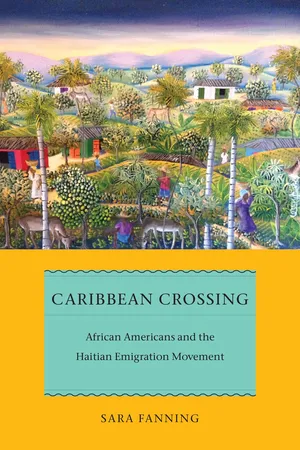
anticipated. Caribbean Crossing
documents the rise and fall of the campaign for black emigration to Haiti,
drawing on a variety of archival sources to share the rich voices of the
emigrants themselves. Using letters, diary accounts, travelers’ reports,
newspaper articles, and American, British, and French consulate records, Sara
Fanning profiles the emigrants and analyzes the diverse motivations that fueled
this unique early moment in both American and Haitian history.
- 192 pages
- English
- ePUB (mobile friendly)
- Available on iOS & Android
eBook - ePub
About this book
Trusted by 375,005 students
Access to over 1.5 million titles for a fair monthly price.
Study more efficiently using our study tools.
Information
Table of contents
- Cover
- Half title
- Title
- Copyright
- Dedication
- Contents
- Acknowledgments
- Introduction
- 1 Migration to Haiti in the Context of Other Contemporary Migrations
- 2 Haiti’s Founding Fathers
- 3 Boyer’s Recognition Project
- 4 The Marketing of Haiti
- 5 Push and Pull in Haitian Emigration
- 6 Haitian Realities and the Emigrants’ Return
- Conclusion
- Notes
- Index
- About the Author
Frequently asked questions
Yes, you can cancel anytime from the Subscription tab in your account settings on the Perlego website. Your subscription will stay active until the end of your current billing period. Learn how to cancel your subscription
No, books cannot be downloaded as external files, such as PDFs, for use outside of Perlego. However, you can download books within the Perlego app for offline reading on mobile or tablet. Learn how to download books offline
We are an online textbook subscription service, where you can get access to an entire online library for less than the price of a single book per month. With over 1.5 million books across 990+ topics, we’ve got you covered! Learn about our mission
Look out for the read-aloud symbol on your next book to see if you can listen to it. The read-aloud tool reads text aloud for you, highlighting the text as it is being read. You can pause it, speed it up and slow it down. Learn more about Read Aloud
Yes! You can use the Perlego app on both iOS and Android devices to read anytime, anywhere — even offline. Perfect for commutes or when you’re on the go.
Please note we cannot support devices running on iOS 13 and Android 7 or earlier. Learn more about using the app
Please note we cannot support devices running on iOS 13 and Android 7 or earlier. Learn more about using the app
Yes, you can access Caribbean Crossing by Sara Fanning in PDF and/or ePUB format, as well as other popular books in History & World History. We have over 1.5 million books available in our catalogue for you to explore.