"This anthology is breathtaking in its geographic and temporal sweep."—Canadian Journal of History
The American media has recently "discovered" children's experiences in present-day wars. A week-long series on the plight of child soldiers in Africa and Latin America was published in Newsday and newspapers have decried the U.S. government's reluctance to sign a United Nations treaty outlawing the use of under-age soldiers. These and numerous other stories and programs have shown that the number of children impacted by war as victims, casualties, and participants has mounted drastically during the last few decades.
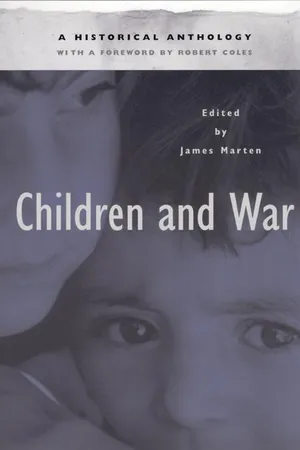
Although the scale on which children are affected by war may be greater today than at any time since the world wars of the twentieth century, children have been a part of conflict since the beginning of warfare. Children and War shows that boys and girls have routinely contributed to home front war efforts, armies have accepted under-aged soldiers for centuries, and war-time experiences have always affected the ways in which grown-up children of war perceive themselves and their societies.
The essays in this collection range from explorations of childhood during the American Revolution and of the writings of free black children during the Civil War to children's home front war efforts during World War II, representations of war and defeat in Japanese children's magazines, and growing up in war-torn Liberia. Children and War provides a historical context for two centuries of children's multi-faceted involvement with war.
- 313 pages
- English
- ePUB (mobile friendly)
- Available on iOS & Android
eBook - ePub
About this book
Information
Topic
HistoireLessons and Literature
Anyone who doubts that the writing of history books for schoolchildren—or for any audience, for that matter—is subjective, messy, and highly politicized should observe the Texas State Board of Education’s textbook review process, “an exercise,” according to a wry account of a recent round of hearings, “in the short-sighted leading the stone-blind bravely into the pitch-darkness.” The most contentious category is normally the social sciences; the public hearings, the committee’s own comments, and the media coverage surrounding the Board’s approval of the books that every school district in the state must choose from demonstrates that history, far from being a dead topic, is alive with meanings and values that can change from generation to generation. Special interest groups and amateur historians enter the fray, as do editorial writers, opportunistic politicians, and publishers desperate to tap into the potentially huge profits of the Texas textbook market. A text that finally emerges from this chaos, according to Michael King’s 1996 article in the left-leaning newsmagazine, The Texas Observer:
has less in common with, say, a real book of history, than it does with a ritualized, patriotic public relations pageant. Whatever else it includes, a social studies textbook is certain to be full of bright colors, uplifting noises, and ponderous hot-air balloons, like a hard-cover Thanksgiving Day Parade.
Although factual errors or perceived factual errors, reading levels, and other relatively objective points do enter the debate, most of the sparks fly over such issues as race—the extent to which slavery had a positive influence on its victims, for instance, or how to handle violence committed in the name of civil rights; foreign policy—the Cold War, especially in the long shadow of the Vietnam War and the arms race, tends to be a hot topic; and religion—whether or not the founding fathers were Christians and whether or not the United States is a “Christian nation.” Groups like the Daughters of the American Revolution, veterans’ organizations, and fundamentalist Christian groups are often the most vocal critics, but everyone has his or her say about the appropriate content and emphases of the textbooks.
The end result of this process is less important than the tumult it inspires and what it reveals about the ways that countries and cultures try to influence the learning of history. The books they read in and out of school can be among the greatest influences on the formation of children’s values and interests. Since the nineteenth century, with the rise of universal education and the creation of a vibrant children’s book publishing industry in most developed and developing nations, schools and literature have been potent agents of socialization and politicization of the next generation. As a result, changing interpretations of historical events are yanked out of abstract academic circles and into the hot seat of public policy. It is important what we teach our children, and how we teach our children, and what meanings those children take away from their studies.
Nowhere does the potential for bitter controversy over the content of textbooks lurk as close to the surface as in Japan, where debates over how to explain the country’s motivations and conduct during the Second World War hinge on subtle choices of words, cultural assumptions, and attitudes toward Japan’s relationships with former enemies and current allies. For instance, a 1982 report—later determined to be mistaken—that the Education Ministry had required that history textbooks change the wording in passages related to Japanese expansion into other parts of Asia prior to the Second World War from “invasion” to “advance” inspired both China and South Korea to lodge official diplomatic protests. The Tokyo government responded by adding a new requirement to future textbooks that they “show the necessary consideration for international understanding and international harmony in their treatment of the events of modern and contemporary history.” The normally internal debate over content of schoolbooks had suddenly been immersed in foreign policy. Similar controversies have arisen over coverage of the Korean “comfort women” forced to act as prostitutes for Japanese soldiers fighting in Japan.
A backlash has recently appeared against what critics call the “masochistic” version of Japanese history that has prevailed in schoolbooks ever since 1945 and was confirmed in the apology issued by a government official in 1993 regarding the use of “comfort women”: “we hereby reiterate our firm determination never to repeat the same mistake by forever engraving such issues in our memories through the study and teaching of history.” Comprised of academics, teachers, and journalists who believe that present-day textbooks ignore the conditions and realities of the past, organizations like the Society to Make New History Textbooks called for a more balanced and less condemnatory presentation of the past. They complain that modern texts present everything Japan did prior to the Second World War as aggression against the rest of Asia, and that, according to a spokesperson, the books are “full of hatred against our own country.”
Obviously, the stakes in explaining history to young people are very high. How will past actions of any country be presented to the boys and girls who will one day become voters and leaders? Laura Hein and Mark Selden are the editors of Censoring History, a recent anthology examining the textbook writing and review processes in Japan, Germany, and the United States; they argue that “Schools and textbooks are important vehicles through which contemporary societies transmit ideas of citizenship and both the idealized past and the promised future of the community.” Properly conceived, “they provide authoritative narratives of the nation, delimit proper behavior of citizens, and sketch the parameters of the national imagination.”
This section deals with schoolbooks, but also with children’s magazines and artistic representations of war and articles from parenting journals; the intended audiences are not necessarily children. Yet they all wrestle with similar questions: How should war and conflict be presented to children? What lessons can be learned from victory and defeat? How does the history of past wars relate to the present and the future? What lessons do the experiences of children in wartime hold for adults?
Chapter Eight
Representations of War and Martial Heroes in English Elementary School Reading and Rituals, 1885–1914
It is a characteristic of a healthy child’s nature to delight in action. Stirring events, such as battles at sea and on land, and adventures of all kinds, have a strong attraction for boys. Nor need we hesitate to indulge this natural taste, so long as we keep within reasonable bounds. Whatever may be thought of “drum and trumpet” history, as it is termed, its influence in giving a liking for the subject is important, and should be kept in view in school teaching.
So wrote John Landon in his teachers’ manual of 1894.1 Landon, while clearly addressing objections to this position, was certainly not alone in his views. In English elementary schools in the period 1885–1914, working-and lower-middleclass students, particularly but not exclusively the boys, were explicitly instructed in the importance of martial values. Representations of warfare and warrior heroes literally surrounded schoolchildren from a very early age: War was a central theme in the books that taught them to read; classroom decorations were often prints of famous battles, of soldiers and sailors in uniform, or of historic battleships; war games structured schoolyard play; military drill was the preferred means of physical education; and the memorializing of great wartime victories was the rationale for special celebration days and rituals in the school calendar. This short essay can only hint at the myriad ways in which a glamorous image of war saturated the reading and rituals of the English working-class elementary school at the turn of the century.2 Yet, even a cursory inspection reveals that the omnipresence of martial values in these schools was both a form of social prescription and a symptom of what John Gillis and Geoffrey Best have called the cultural militarization of British society in the three decades before World War I.3
Citizenship, Patriotism, and the Glory of the Battlefield
Although education remained class-stratified in nineteenth-century England, elementary schooling had become both compulsory and subsidized by local taxes by the 1880s.4 However, the rise of a more democratic polity caused by the Third Reform (1884) and Redistribution Acts (1885) generated concern that teaching the “three Rs” (reading, writing, and arithmetic) was insufficient education for the increasingly enfranchised masses. Classroom instruction in “good citizenship” was now advocated as a means to inculcate workingclass boys into the dictates of social respectability, national responsibility, and imperial duty. Meanwhile, instruction in domestic duties and “racial motherhood” was advocated for working-class girls.5 The advocates of using elementary schools as workshops of civic training came from all political positions and parties. Both liberals and conservatives approved of educating students in their “imperial duties,” although what this meant was debated between the liberal advocates of “national efficiency” and the more conservative proponents of aggressively advancing the empire or enacting peace-time conscription.6 Some liberals and socialists objected to the “flag-waving imperialism” and “war-mongering” in the later 1890s, and especially during and after the Boer War. However, most of the objections raised about the content of the elementary curriculum tended to focus on denominational religious issues rather than on implicit nationalism. Moreover, the objections raised by pacifist and socialist groups tended to be politely received by local school officials at public hearings, only to be totally ignored when it came to educational practice.7
For boys especially, martial values and corporatist ideals were prescribed as central to the aim of imparting these ideas of good citizenship in the elementary school.8 Fear of falling behind continental neighbors, the military security of the empire, and the possibility of the collapse of Britain’s commercial world-leadership, were all connected to the need to reform schools.9 Curriculum reform couched in militarist rhetoric was increasingly mirrored in classroom culture, which came to depict war and martial values as romantic and chivalrous in order to reinforce youthful nationalism. Although present throughout the period 1885–1914, this militarism in the classroom was especially marked in the years after the Boer War (1899–1902).
A whole spate of teachers’ instructional manuals propounded the importance of the teaching of citizenship and patriotism in the elementary classroom in the later 1880s and 1890s. The use of history, either in directed lessons, or more commonly in reading books with historical content, was advocated by educationalists as the most appropriate way to develop a civic and patriotic understanding among the young. David Salmon’s The Art of Teaching (1898) noted simply, “History fosters patriotism.” His reasoning was typical of the educational establishment’s view of the merits of history instruction: “It fills the student with admiration for his forefathers’ wisdom, heroism, and devotion to duty, which have made the nation what it is; with longings for a chance of emulating their glorious deeds; and failing that, with a firm resolve to do nothing that shall tarnish the fair fame of t...
Table of contents
- Cover Page
- Title Page
- Copyright Page
- Dedication
- Contents
- Foreword
- Acknowledgments
- Introduction
- Memory and Meaning
- Lessons and Literature
- Actors and Victims
- Epilogue
- Bibliography
- Contributors
- Index
Trusted by 375,005 students
Access to over 1.5 million titles for a fair monthly price.
Study more efficiently using our study tools.
Frequently asked questions
Yes, you can cancel anytime from the Subscription tab in your account settings on the Perlego website. Your subscription will stay active until the end of your current billing period. Learn how to cancel your subscription
No, books cannot be downloaded as external files, such as PDFs, for use outside of Perlego. However, you can download books within the Perlego app for offline reading on mobile or tablet. Learn how to download books offline
Perlego offers two plans: Essential and Complete
- Essential is ideal for learners and professionals who enjoy exploring a wide range of subjects. Access the Essential Library with 800,000+ trusted titles and best-sellers across business, personal growth, and the humanities. Includes unlimited reading time and Standard Read Aloud voice.
- Complete: Perfect for advanced learners and researchers needing full, unrestricted access. Unlock 1.5M+ books across hundreds of subjects, including academic and specialized titles. The Complete Plan also includes advanced features like Premium Read Aloud and Research Assistant.
We are an online textbook subscription service, where you can get access to an entire online library for less than the price of a single book per month. With over 1.5 million books across 990+ topics, we’ve got you covered! Learn about our mission
Look out for the read-aloud symbol on your next book to see if you can listen to it. The read-aloud tool reads text aloud for you, highlighting the text as it is being read. You can pause it, speed it up and slow it down. Learn more about Read Aloud
Yes! You can use the Perlego app on both iOS and Android devices to read anytime, anywhere — even offline. Perfect for commutes or when you’re on the go.
Please note we cannot support devices running on iOS 13 and Android 7 or earlier. Learn more about using the app
Please note we cannot support devices running on iOS 13 and Android 7 or earlier. Learn more about using the app
Yes, you can access Children and War by James Marten in PDF and/or ePUB format, as well as other popular books in Histoire & Histoire de l'armée et de la marine. We have over 1.5 million books available in our catalogue for you to explore.