eBook - ePub
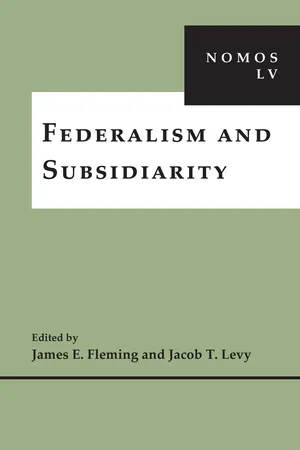
Federalism and Subsidiarity
NOMOS LV
- 464 pages
- English
- ePUB (mobile friendly)
- Available on iOS & Android
eBook - ePub
About this book
In Federalism and Subsidiarity, a distinguished interdisciplinary group of scholars in political science, law, and philosophy address the application and interaction of the concept of federalism within law and government. What are the best justifications for and conceptions of federalism? What are the most useful criteria for deciding what powers should be allocated to national governments and what powers reserved to state or provincial governments? What are the implications of the principle of subsidiarity for such questions? What should be the constitutional standing of cities in federations? Do we need to "remap" federalism to reckon with the emergence of translocal and transnational organizations with porous boundaries that are not reflected in traditional jurisdictional conceptions? Examining these questions and more, this latest installation in the NOMOS series sheds new light on the allocation of power within federations.
Information
FEDERALISM, POSITIVE BENEFITS, AND NEGATIVE LIBERTIES
1
DEFENDING DUAL FEDERALISM: A SELF-DEFEATING ACT
Dual federalism is a doctrine of American constitutional law. Defending dual federalism is a self-defeating act because of what dual federalism is and what it means to defend it. Dual federalism is states’ rights federalism. It holds that when national authorities exercise their constitutional powers they must respect the reserved powers of the states. Dual federalism is to be distinguished from national federalism, which comes in two forms, Marshallian federalism and process federalism. I concentrate on Marshallian federalism here, though I will conclude with a comment on process federalism.
Marshallian federalism holds that when the nation’s government is pursuing authorized constitutional ends it may freely disregard the reserved powers of the states. John Marshall defended this position in his best reasoned opinion, McCulloch v. Maryland (1819).1 Marshall’s federalism seems to be favored by the Supremacy Clause of Article VI, which provides that the Constitution and national laws in pursuance of the Constitution shall be the supreme law of the land, anything in the constitutions or laws of the states to the contrary notwithstanding. We may not have to give the Supremacy Clause a nationalist reading, however. The Supremacy Clause seems to presuppose that a national law can be constitutional even if it conflicts with a state law, but maybe it means that a national law that conflicts with a state law is presumptively unconstitutional for just that reason. This reformulated Supremacy Clause would provide that national laws can trump state laws only when achieving national ends (narrowly conceived) would be unlikely otherwise.2 Such a clause would border on the unworkable, of course, for any conflict between state policies and the narrowest conception of national power can provoke an arguable states’ rights claim, at least in domestic policy. But I ignore this difficulty to clear the way for my principal contention: Should there be a dual federalist as well as a national reading of the Supremacy Clause—or the Tenth Amendment, or the enumeration of powers, or the breadth of national powers, or the Framers’ intentions, or the formation of the Union, or the nature of liberty, or any other matter material to the federalism debate, including the nature of the Constitution as a whole—if there is an interpretive choice of any description, dual federalism will (or should) lose the debate.
Marshall saw the Constitution chiefly as establishing, structuring, and empowering an instrument for pursuing public goods like national security and prosperity.3 The Constitution for Marshall was chiefly a charter of positive benefits, not a charter of negative liberties. Dual federalism takes a different view; it sees the Constitution as a collection of restraints on the national government, one kind of restraint being “states’ rights.” Marshall’s was a positive constitutionalism; dual federalism belongs to a tradition of negative constitutionalism. Marshall’s positive constitutionalism makes more sense than negative constitutionalism because establishing a government to pursue good things makes sense while establishing a government mainly to prevent government from doing bad things makes no sense.4 So there’s a case for Marshallian federalism because there’s a case for the positive constitutionalism to which Marshallian federalism belongs. My question here is whether there’s a case for dual federalism. I deny this possibility for a simple reason: an argument for dual federalism would have to occur in a national forum, and the expectations of that forum make it impossible to defend dual federalism. A defense of dual federalism would have to be submitted to a national judge of some sort, like Congress or the Supreme Court.5 It would also have to appeal to a controlling national good, like national prosperity or democracy or liberty. Yet in principle, dual federalism denies the existence of both a controlling national good and an authoritative national judge.6 That’s why dual federalism is indefensible in a national forum.
1. AN AXIOM
But must dual federalism appeal to a national good of some sort? Might it appeal instead to an axiom of constitutional thought, like “the powers of the [national] government are limited, and … its limits are not to be transcended”?7 Appeal to this axiom will fail dual federalism once one realizes that (1) because the national government is limited by norms regarding its ends, structures, and available means, the national government would be “limited” in important ways even if there were no states, and (2) the dual federalist notion of limited government conflicts with other constitutional ideas. One such idea, from The Federalist No. 45, is that “the real welfare of the great body of the people is the supreme object to be pursued … and no form of Government whatever, has any other value, than as it may be fitted for the attainment of this object.”8 This is what James Madison saw as the principle of the American Revolution, and he applied it to the federalism debate when he said: “Were the plan of the Convention adverse to the public happiness, my advice would be, reject the plan. Were the Union itself inconsistent with the public happiness, it would be, abolish the Union. In like manner as far as the sovereignty of the states cannot be reconciled to the happiness of the people, the voice of every good citizen must be, let the former be sacrificed to the latter.”9 Thus, the dual federalist view of “limited government” is an option to be weighed against competing options; it’s not a conclusion compelled by constitutional language, logic, or history. The question is whether dual federalists can give a reason for their interpretation of “limited government,” and once one asks this question, the logic of the forum takes over, and dual federalism loses before its argument even begins.
Before I show how this “logic of the forum” affects traditional claims for dual federalism, let me anticipate an objection: that I’m setting up a straw man.
2. THE RECRUDESCENCE OF STATE SOVEREIGNTY
Is it true that, in principle, dual federalism denies that a national agency should have final say in state-federal conflicts? Before the Civil War dual federalists insisted that the Constitution was originally a contract between separate and independent sovereign states and that the individual states retained the ultimate right to decide whether the national government had exceeded its powers. Dual federalists realized that to submit state-federal conflicts solely to the nation’s agents would be to abandon the theory that the Constitution was a contract between separate and independent sovereigns who could nullify unconstitutional national acts and even withdraw from the Union. One might have thought that the Civil War had silenced the contract theory. But this hasn’t happened. The states’ rights bloc on the Rehnquist Court affirmed the contract theory and voided numerous national acts in the name of “state sovereignty.”10 One defender of the Reagan Revolution has located its roots in the Anti-Federalist denial that the population of the United States constitutes one political community.11 At this writing, proposals to nullify a variety of national acts are pending in state legislatures in several sections of the country. And the governor of the nation’s second-largest state has claimed its right to secede from the Union in protest of national policies, especially the Patient Protection and Affordable Care Act of 2010, “Obamacare” to its critics.
Maybe we shouldn’t take this talk of nullification and secession seriously. After all, Reaganism and the Tea Party are national movements, not separatist movements. They confirm what Walter Berns said long ago about the states’ rights debate: at bottom it’s a debate about what the nation ought to be.12 Some conservatives have acknowledged that they will need the power of the national government to achieve their own ends nationwide.13 When it serves their purposes, conservatives can be expected to deny their opponent’s rights to nullify and secede, just as their predecessors did. John C. Calhoun proved to be more of a pro-slavery nationalist than a states’ righter when he all but denied abolitionist states a right to petition Congress to ban slavery in the territories and the nation’s capital.14 And South Carolina disregarded its own past when it blamed its secession partly on free states that had effectively nullified the Fugitive Slave Act of 1850. So talk of states’ rights fluctuates with prudential considerations, and for this reason few observers expect to see states acting on doctrines of nullification and secession anytime soon.
On the other hand, one can wonder about the difference between the states’ nullifying congressional acts on their own and the Supreme Court doing it for them. If the federal courts can act on a premise of “states’ sovereignty,” why can’t the alleged sovereigns do the same? Current talk of nullification and secession may thus be a case of principle asserting itself against power—the raw power that prevailed at Appomattox and installed a regime of national supremacy, including national judicial supremacy. Madison, Jefferson, and Calhoun all denied that federal judicial supremacy was consistent with the contract theory, and today’s federal judiciary has embraced the contract theory. So maybe would-be nullifiers and secessionists have political morality on their side. This prospect should unsettle a people whose constitutional thought expresses its political morality. Maybe we should take the return to states’ rights seriously after all.
The least we can say is that if Berns was right about the states’ rights debate, dual federalism masks a substantive position. Calhoun didn’t have to come out of a closet; he was clear about what he wanted the nation to be. Should we ask for candor on the part of today’s states’ righters? I raise this as an honest question. Maybe the states’ rights debate masks issues the country can’t handle in a direct and forthright way. An obvious example from the last century and a half of American history is the wisdom of the Civil War Amendments. Did the nation know what it was doing when it embraced all of its native born as its people and promised them a government that would “lift artificial weights from all shoulders; … clear the paths of laudable pursuit for all; [and] afford all an unfettered start and a fair chance in the race of life”?15
3. LIBERTY
The basic dual federalist claim is that states’ rights exemptions from national power enhance liberty.16 This claim can serve as a paradigm for states’ rights arguments that flow from other goods, like democracy and experimentation with different means to the general welfare. These claims occur in a context in which dual federalists respond to requests from others for reasons that justify dual federalism. These responses must appeal to general and impersonal goods, as distinguished from particular conceptions of those goods. The dual federalist can say “dual federalism enhances liberty.” She can’t say “dual federalism enhanc...
Table of contents
- Cover Page
- Title Page
- Copyright Page
- Contents
- Preface
- Contributors
- Part I. Federalism, Positive Benefits, and Negative Liberties
- Part II. Constitutions, Federalism, and Subsidiarity
- Part III. The Entrenchment of Local and Provincial Autonomy, Integrity, and Participation
- Part IV. Remapping Federalism(s)
- Index
Trusted by 375,005 students
Access to over 1.5 million titles for a fair monthly price.
Study more efficiently using our study tools.
Frequently asked questions
Yes, you can cancel anytime from the Subscription tab in your account settings on the Perlego website. Your subscription will stay active until the end of your current billing period. Learn how to cancel your subscription
No, books cannot be downloaded as external files, such as PDFs, for use outside of Perlego. However, you can download books within the Perlego app for offline reading on mobile or tablet. Learn how to download books offline
Perlego offers two plans: Essential and Complete
- Essential is ideal for learners and professionals who enjoy exploring a wide range of subjects. Access the Essential Library with 800,000+ trusted titles and best-sellers across business, personal growth, and the humanities. Includes unlimited reading time and Standard Read Aloud voice.
- Complete: Perfect for advanced learners and researchers needing full, unrestricted access. Unlock 1.5M+ books across hundreds of subjects, including academic and specialized titles. The Complete Plan also includes advanced features like Premium Read Aloud and Research Assistant.
We are an online textbook subscription service, where you can get access to an entire online library for less than the price of a single book per month. With over 1.5 million books across 990+ topics, we’ve got you covered! Learn about our mission
Look out for the read-aloud symbol on your next book to see if you can listen to it. The read-aloud tool reads text aloud for you, highlighting the text as it is being read. You can pause it, speed it up and slow it down. Learn more about Read Aloud
Yes! You can use the Perlego app on both iOS and Android devices to read anytime, anywhere — even offline. Perfect for commutes or when you’re on the go.
Please note we cannot support devices running on iOS 13 and Android 7 or earlier. Learn more about using the app
Please note we cannot support devices running on iOS 13 and Android 7 or earlier. Learn more about using the app
Yes, you can access Federalism and Subsidiarity by James E. Fleming,Jacob T Levy, James E. Fleming, Jacob T Levy in PDF and/or ePUB format, as well as other popular books in Law & Public Law. We have over 1.5 million books available in our catalogue for you to explore.