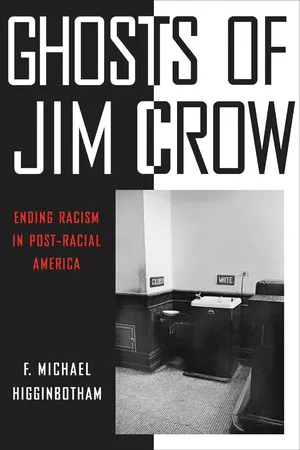
A provocative, and timely, solution for ridding America of the traces of Jim Crow policies to create a truly post-racial landscape
When America inaugurated its first African American president, in 2009, many wondered if the country had finally become a "post-racial" society. Was this the dawning of a new era, in which America, a nation nearly severed in half by slavery, and whose racial fault lines are arguably among its most enduring traits, would at last move beyond race with the election of Barack Hussein Obama?
In Ghosts of Jim Crow, F. Michael Higginbotham convincingly argues that America remains far away from that imagined utopia. Indeed, the shadows of Jim Crow era laws and attitudes continue to perpetuate insidious, systemic prejudice and racism in the 21st century. Higginbotham's extensive research demonstrates how laws and actions have been used to maintain a racial paradigm of hierarchy and separation—both historically, in the era of lynch mobs and segregation, and today—legally, economically, educationally and socially.
Using history as a roadmap, Higginbotham arrives at a provocative solution for ridding the nation of Jim Crow's ghost, suggesting that legal and political reform can successfully create a post-racial America, but only if it inspires whites and Blacks to significantly alter behaviors and attitudes of race-based superiority and victimization. He argues that America will never achieve its full potential unless it truly enters a post-racial era, and believes that time is of the essence as competition increases globally.
- 352 pages
- English
- ePUB (mobile friendly)
- Available on iOS & Android
eBook - ePub
About this book
Information
Creating the Paradigm
Racial Hierarchy
1
Constructing Racial Categories from the Nation’s Founding to the Civil War
[A]ll of them [blacks] had been brought here as articles of merchandise. The number that had been emancipated at that time were but few in comparison with those held in slavery; and they were identified in the public mind with the race to which they belonged, and regarded as a part of the slave population rather than the free.
—Chief Justice Roger Taney, 18561
RACIAL CATEGORIZATION HAS been an invaluable tool for facilitating aspects of the paradigm. Without such categorization, aspects of hierarchy and separation could not be implemented. Under the law, slaves had no personal legal rights, and free blacks received limited government protection.2
The perception of blacks as inferior has affected laws governing American citizenship and criminal jurisprudence since the colonial period. From 1619, white lawmakers have pondered the question, “What should we do with them?” When slaves went from being considered “property” to becoming free persons, the legal system failed to protect them. The transition from “property” to persons should have been supported by the Constitution, which purported to ensure the equality, freedom, and liberty of all men. The most fundamental law of the land endorsed slavery, unleashing a perception by many whites that blacks were subhuman beings of an inferior order.3 That endorsement has left America still struggling with the most intransigent issues of racial inequality today. To understand this negative perception of blacks and the desire to identify and separate them, we must first recognize what motivations preceded it.
The Beginnings of Racial Division
The first blacks taken from the west coast of Africa to North America by whites arrived in Jamestown Colony, Virginia, in 1619.4 The surviving record suggests that while some blacks in this period may have been slaves, others were treated like indentured servants who earned their freedom after converting to Christianity or laboring for a term of years.5 Many blacks during the period shared the same status as indentured whites.6
The early formation of the colonies and the use of slave labor were intertwined. Slave law developed in a piecemeal fashion, adapting to the needs and expectations of white settlers looking to build their territorial conquest with cheap, expendable labor. As slaves became more numerous, colonial legislators saw the need to regulate the terms and conditions of slavery—denying slaves the right to contract or hold property and conditioning an owner’s ability to grant freedom to a slave.7
Numerous statutory restrictions were imposed on owners who wanted to free their slaves.8 In Virginia, for example, procedural requirements for freeing one’s slave, known as manumission—typically, a signed writing, witnessed by two persons, and recorded at the local county courthouse—prevented some slaves from realizing the freedom their owners had intended to grant them.9 Slaves unlucky enough to have been manumitted orally, with unrecorded documents, or without the requisite number of witnesses were often denied their freedom by the courts.10
In some states, those slaves successfully manumitted were required to leave the state.11 There was one exception to this harsh rule. Slaves emancipated for “extraordinary merit”—generally, providing information about slave revolts—were permitted to remain in the state.12 The most severe statutory restrictions on manumission, however, concerned creditors’ rights and the children of slaves.13 These issues were especially difficult for courts because they involved the rights of third parties.14 Some state legislatures allowed manumitted slaves to be resold into slavery in order to satisfy any debts incurred by their former owner prior to the manumission, and many courts strictly enforced such legislation.15 The result was that a manumitted slave’s freedom was perpetually contingent upon the financial solvency of his owner, former owner, or former owner’s estate.16 For example, Virginia courts ordered freed slaves to be resold into slavery as long as twelve years after their manumission,17 providing the debt of the former owner had been incurred prior to the act of manumission.18
These manumission rules perfectly illustrate the absolute dichotomy of power between blacks and whites. These rules reinforced the notions of superiority in whites and inferiority in blacks, as well as the perceived need for physical separation. White slave owners were perceived as so far superior to their black slaves that they possessed the ultimate power to change slave status to free status. Black slaves were entitled to no personal privileges, except those that their owner chose to grant. Slaves manumitted were required to leave the state, for their mere presence as free blacks undermined the racial hierarchy. The presence of free blacks suggested that blacks may have been able to obtain a certain equality of status with some whites. While they may not have been as wealthy or educated as their former owners, they nonetheless were free, just like whites in general. Only those free blacks valuable to maintaining the paradigm were permitted to remain in the state, thus the exemption for those slaves who helped to prevent slave revolts. For free blacks, physical separation became critical, for if they remained in the state and prospered, the paradigm would have been jeopardized.
To what extent conditions of indentured servitude in the early colonies differed from slavery is unclear. By law, indentured servants contracted their services in exchange for transportation, food, shelter, and wages for an established period of time.19 In practice, however, indentured servants were often coerced—by force, violence, and rape—to labor under harsh conditions against their will.20 Many died in bondage.21 Life as an indentured servant thus bore many of the hallmarks of slavery, though at least it offered the prospect of eventual freedom and was experienced by both black and white servants.22 Over time, however, the system evolved into a race-based program of hereditary lifetime bondage for blacks.23 Disparate treatment became the norm, and with it, the strengthening of the attitude that blacks were inferior.
From the colonial period forward, white supporters of slavery perceived blacks as slaves, not servants. Indeed, well before the founders agreed to the “Great Compromise” at the Constitutional Convention, legally sanctioning black slavery, white colonists had already laid the groundwork by assigning social rights, responsibilities, and punishments on the basis of race. An attitude that disparate treatment was acceptable is evident in a series of cases where, in each, the severity of punishment seems directly correlated to race—blacks were punished severely and whites were not.
Such severe punishment meted out by the courts was the fate of John Punch, a black indentured servant from Virginia. Punch was captured in 1641 along with two white servants, James Gregory and a man named Victor, while trying to escape to freedom.24 A Virginia judge sentenced each of the three men to a public whipping and added additional years to their servitude.25 James and Victor, who were white, received an additional four years, but John Punch, who was black, received a lifetime indenture.26 John Punch committed the same crime and shared the same indentured status as James Gregory and Victor, but only he received lifetime servitude.27 The judge did not provide an explanation, but the record suggests that the defendants were similar in every respect except race.
Singling out blacks for significantly harsher treatment would have probably emboldened impoverished whites by affirming their superior legal and social status over blacks, with whom they otherwise shared profound economic hardship. Poor whites were thus encouraged to bond with the merchant class on the basis of race,28 instead of bonding with poor blacks on the basis of their socioeconomic class. This strategy served the economic interests of upper-class whites by uniting poor whites around a single cause—their racial superiority to blacks.29 Whites living in poverty had less incentive to challenge their exploitation by an economic system that simultaneously disadvantaged black and white workers. Thus, a cycle began: white acceptance of racially disparate sentencing led whites to distance themselves from blacks. The separation reinforced social attitudes of segregation, which, in turn, led to more instances of disparate sentencing.
The more blacks and whites became increasingly isolated, both physically and socially, the more foreign each group became to the other. Negative stereotypes of each group by the other flourished, differences were magnified, and commonalities diminished. The more foreign each group became to the other, the more critical became the necessity to maintain physical and social separation, to prevent those differences from negatively affecting whites. Thus, legislation and case decisions reinforced the notion that racial divisions were more significant and inviolable than other divisions based on ethnicity, class, or religion. This focus on racial divisions influenced the evolution of law, which began to reflect racial divisions throughout the colonial period.30
Over the next century, colonists began to enact statutory laws that codified racial hierarchy, reinforcing common law decisions such as the one in Punch. They also formally tied social status to race by disregarding most legal distinctions between free and enslaved blacks.
Free blacks were treated harshly.31 They were denied political, economic, and social rights under the law and, in most instances, were prohibited from interracial marriage or participation in the political process.32 Even in the most progressive states, such as Pennsylvania, some free blacks, like William Fogg in 1837, who attempted to vote, were threatened, beaten, or killed.33 They were prohibited from obtaining an education, from engaging in certain types of employment, and from enjoying certain kinds of property ownership.34 Their travel was restricted, and they were required to pay extra tax...
Table of contents
- Cover Page
- Title Page
- Copyright Page
- Dedication
- Contents
- Acknowledgments
- Preface
- Introduction: Understanding the Racial Paradigm
- Part I: Creating the Paradigm: Racial Hierarchy
- Part II: Sustaining the Paradigm: White Isolation and Black Separation and Subordination
- Part III: Ending the Paradigm: Building a Post-Racial America
- Notes
- Table of Cases
- Index
- About the Author
Trusted by 375,005 students
Access to over 1.5 million titles for a fair monthly price.
Study more efficiently using our study tools.
Frequently asked questions
Yes, you can cancel anytime from the Subscription tab in your account settings on the Perlego website. Your subscription will stay active until the end of your current billing period. Learn how to cancel your subscription
No, books cannot be downloaded as external files, such as PDFs, for use outside of Perlego. However, you can download books within the Perlego app for offline reading on mobile or tablet. Learn how to download books offline
Perlego offers two plans: Essential and Complete
- Essential is ideal for learners and professionals who enjoy exploring a wide range of subjects. Access the Essential Library with 800,000+ trusted titles and best-sellers across business, personal growth, and the humanities. Includes unlimited reading time and Standard Read Aloud voice.
- Complete: Perfect for advanced learners and researchers needing full, unrestricted access. Unlock 1.5M+ books across hundreds of subjects, including academic and specialized titles. The Complete Plan also includes advanced features like Premium Read Aloud and Research Assistant.
We are an online textbook subscription service, where you can get access to an entire online library for less than the price of a single book per month. With over 1.5 million books across 990+ topics, we’ve got you covered! Learn about our mission
Look out for the read-aloud symbol on your next book to see if you can listen to it. The read-aloud tool reads text aloud for you, highlighting the text as it is being read. You can pause it, speed it up and slow it down. Learn more about Read Aloud
Yes! You can use the Perlego app on both iOS and Android devices to read anytime, anywhere — even offline. Perfect for commutes or when you’re on the go.
Please note we cannot support devices running on iOS 13 and Android 7 or earlier. Learn more about using the app
Please note we cannot support devices running on iOS 13 and Android 7 or earlier. Learn more about using the app
Yes, you can access Ghosts of Jim Crow by F. Michael Higginbotham in PDF and/or ePUB format, as well as other popular books in History & North American History. We have over 1.5 million books available in our catalogue for you to explore.