Examines the role violence plays in maintaining housing segregation
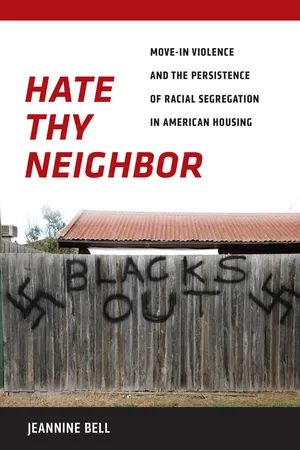
Despite increasing racial tolerance and national diversity, neighborhood segregation remains a very real problem in cities across America. Scholars, government officials, and the general public have long attempted to understand why segregation persists despite efforts to combat it, traditionally focusing on the issue of "white flight," or the idea that white residents will move to other areas if their neighborhood becomes integrated. In Hate Thy Neighbor, Jeannine Bell expands upon these understandings by investigating a little-examined but surprisingly prevalent problem of "move-in violence:" the anti-integration violence directed by white residents at minorities who move into their neighborhoods. Apprehensive about their new neighbors and worried about declining property values, these residents resort to extra-legal violence and intimidation tactics, often using vandalism and verbal harassment to combat what they view as a violation of their territory.
Hate Thy Neighbor is the first work to seriously examine the role violence plays in maintaining housing segregation, illustrating how intimidation and fear are employed to force minorities back into separate neighborhoods and prevent meaningful integration. Drawing on evidence that includes in-depth interviews with ordinary citizens and analysis of Fair Housing Act cases, Bell provides a moving examination of how neighborhood racial violence is enabled today and how it harms not only the victims, but entire communities.
By finally shedding light on this disturbing phenomenon, Hate Thy Neighbor not only enhances our understanding of how prevalent segregation and this type of hate-crime remain, but also offers insightful analysis of a complex mix of remedies that can work to address this difficult problem.
eBook - ePub
Hate Thy Neighbor
Move-In Violence and the Persistence of Racial Segregation in American Housing
- 256 pages
- English
- ePUB (mobile friendly)
- Available on iOS & Android
eBook - ePub
Hate Thy Neighbor
Move-In Violence and the Persistence of Racial Segregation in American Housing
About this book
Information
1
The Roots of Contemporary Move-In Violence
Though many Americans may imagine that racially segregated housing in the United States is a direct descendent of slavery, in actuality the history of the integration of housing by race is more complicated. Blacks and whites were much more likely to be housed in the same neighborhood in the nineteenth century than they are in the twenty-first century.
Starkly racially segregated neighborhoods are a relatively recent phenomenon. Until the twentieth century, the vast majority of blacks living in the North lived in close proximity to whites in “racially-mixed neighborhoods, usually on blocks with many white neighbors.”1 Prior to 1915, “Negro housing [in the North] did not differ from that of any other race.”2 This did not mean that primarily black areas did not exist; rather, blacks were not confined to black neighborhoods, and at that time many blacks lived in racially mixed neighborhoods. This chapter explores integrated living arrangements during the antebellum period and after the Civil War. It then analyzes the onset of violence associated with housing integration, which began to occur decades after whites and blacks began to live in the same neighborhoods.
Mixed-Race Neighborhoods before and after the Civil War
Though the living arrangements were significantly different in the antebellum North and South, for blacks and whites in both regions of the country there was a history of proximity in housing before the Civil War. In the pre–Civil War South, black slaves lived on plantations with whites. In southern cities, slaves lived in urban compounds in close proximity to their masters. In both the North and the South, it was convenient for black workers, whether slave or free, to live near the whites for whom they worked.3 House-by-house examination of neighborhoods in large cities in the antebellum period in the South shows mixed blocks of black and white residents.4 For instance, in Richmond, VA, communities of free blacks were interspersed among German and Irish immigrants.5
In the antebellum North, in cities like Cincinnati, free people of color often lived side by side with whites, rather than being confined to an exclusively black environment. In Cincinnati it was not just the case that a few blacks lived among whites; rather, “whites lived on every street where blacks resided and … usually outnumbered blacks on these streets.”6 Whites dominated the Cincinnati neighborhoods where the largest numbers of free blacks lived. In one of these areas, Buck-town, “black and white residences were intermixed along every street where blacks lived. It is of significant importance that despite prejudice and discrimination in virtually every other aspect of urban life, residential patterns were not a racial issue, and blacks and whites shared the urban living space.”7
After the Civil War, freed from the bonds of slavery, many southern blacks migrated from rural to urban areas. From 1865 until the 1890s, throughout the country blacks made their home in both all-black residential areas and much more racially mixed areas. In suburban Chicago’s North Shore, Philadelphia’s Main Line, and New York’s lower Westchester County, entirely black areas were populated by the cooks, mechanics, and gardeners who worked for the well-off.8 There were slums as well, but these were not necessarily exclusively black. Prior to the 1920s, the slums in which blacks lived contained what Ira Berlin described as “a mélange” of whites and blacks.9
These areas were not characterized by racial interaction, but the closeness of residence was still significant, given what followed: violence occurring when blacks tried to occupy the same neighborhood. Laws proscribing integrated blocks or integrated neighborhoods generally did not exist in either the North or the South in the late nineteenth and early twentieth centuries. At this time in the South, racially mixed neighborhoods may have been frowned upon but nevertheless were permitted. For instance, upper-middle-class blacks who could afford to do so were allowed to live in white neighborhoods even in the South.10 In the postbellum period, truly integrated neighborhoods frequently developed from necessity. Poorer whites such as widows or unskilled laborers lived among blacks because they could not afford to move out of the neighborhoods in which blacks lived.11
It was not just the South where blacks and whites lived in close quarters after the Civil War. In Detroit, on the Near East Side, blacks and whites lived side by side in the postbellum period. In some cases semiskilled or unskilled immigrants lived in houses next door to blacks and in other cases lived even closer, as boarding places on the Near East Side housed people of a variety of backgrounds. The 1880 US census of Detroit reveals that even in areas with the highest number of blacks, blacks and whites lived in adjoining dwellings.12 Similarly, in Cleveland, prior to the 1880s there was significant integration of blacks, with no section of the city being more than 5 percent black.13 Even though most of the blacks in the city lived in just three neighborhoods, they were nevertheless integrated throughout each of these neighborhoods.14
Expulsion, on the Road to Segregation
Racially integrated housing may have been an outgrowth of antiracist idealism after the Civil War. James Loewen, who has documented the expulsion of African Americans from white spaces after 1890, insists that for a time immediately after the Civil War, antiracism played a significant role in American political life. Loewen maintains that the period between 1865 and 1890 was somewhat of a “springtime of race relations,” during which many towns and counties throughout the northern United States demonstrated their antiracism by welcoming African Americans from the South.15 Freedom provided empowerment and the space to occupy a new place in society. Describing this era, Loewen reminds his readers that in the period between the end of the Civil War and 1890, African Americans had “voted, served in Congress, received some spoils from the Republican Party, worked as barbers, railroad firemen, midwives, mail carriers, and landowning farmers, and played other fully human roles in American society. Their new rights made African Americans optimistic, even buoyant.”16
Unfortunately, by the 1890s the springtime of race relations had begun to subside into a cold, harsh winter. In towns and cities across the northern and southern United States, once-blurry racial lines began to solidify. Loewen describes deepening racism sweeping the country after 1890. The first victims of this racism were Chinese Americans. Chinese Americans lived in virtually every town in the West until 1884, making their living mining gold and working as farmers, on the railroad, as domestic servants, and fishermen, among other things.17 Between 1885 and 1920, many cities and towns in the western United States forcibly expelled Chinese Americans. In Idaho, for instance, in 1870 Chinese were one-third of the population of the territory. In the 1880s, white Idahoans began to assault and murder Chinese residents. In 1886, an anti-Chinese convention helped galvanize support for expelling Chinese residents. Over the course of the 1890s, Chinese were expelled from several Idaho towns.18 Similar incidents occurred in cities and towns in California, Oregon, and Washington as Chinese residents were driven out and Chinatowns, where Chinese Americans had been living, were burned to the ground.
Following the Chinese exclusion, US census and historical records reveal a similar expulsion directed at African Americans beginning in 1890 and lasting until between 1930 and 1940. In 1890 just 119 counties—excluding the traditional South—had no African Americans. By 1930, this figure had nearly doubled, increasing to 235 counties, as towns around the country went “sundown”: African Americans were expelled and told not to let the sun set on them in a particular town. Frequently, the process of going sundown involved violence. For instance, in July 1899 in Carterville, Illinois, white miners killed five African American strikebreakers. The whites were all acquitted and the remaining African Americans were forced to leave Carterville.19 African Americans forced out of sundown towns went to a variety of places. For instance, some all-black towns like Mount Bayou, Mississippi, were voluntarily established during this period.
In large cities, the sharpening of racial lines, while not as stark as the blatant expulsion in sundown towns, occurred nevertheless. Analysis of census records reveals that even though blacks and whites lived in close proximity to one another in the postbellum period, in the early twentieth century this began to change as residential segregation between native whites and blacks sharply increased in cities around the country.20 The index of dissimilarity is a tool used by social scientists to calculate the extent to which groups are distributed throughout the population. Using a range from 0 to 100, the index of dissimilarity is used to assess the degree of segregation of two groups from each other in a particular location. Zero signifies complete integration, while 100 represents total segregation. In 1870 in Milwaukee, Wisconsin, data at the ward level showed a dissimilarity index between American-born whites and blacks of 56.9.21 This means that for blacks to be evenly distributed among the white group, 56.9 percent of blacks in the city would have to move to a white ward. In 1910, the index of black-white dissimilarity had risen to 66.7.22 Maps of distribution of blacks in the city of Chicago in 1900, 1910, and 1920 depict increasing concentration of the black population over time and consequently increasing segregation from whites as Chicago’s black population increased.23
Using the Law to Enforce Segregation: The Rise of Segregation Ordinances
The first racial zoning ordinances in the United States were used against Chinese residents of West Coast cities in the late nineteenth century.24 The western experience aside, it was not until the early twentieth century that such ordinances were created in other cities. More than two dozen cities around the South passed segregation zoning ordinances restricting blacks to particular neighborhoods, blocks, or streets.25 One of the first such ordinances aimed at blacks was created in 1910 in Baltimore, Maryland. The Baltimore law was ostensibly designed for “preserving peace, preventing conflict and ill feeling between white and colored races in Baltimore city, and promoting the general welfare of the city by providing, so far as practical, for the use of separate blocks by white and black people for residences, churches and schools.”26 The Baltimore ordinance did not apply to mixed blocks where both African Americans and whites lived. Rather, it was designed to prevent integration in the future by prohibiting residential integration by street blocks where all members of a single race, black or white, lived.
The ordinance had been created in response to African American moves into white neighborhoods, particularly of the sort made by George McMechen and his family. In the summer of 1910, McMechen purchased a house in the Eutaw Place neighborhood, an all-white area in Baltimore, just ten blocks west of his former home in the Negro district. McMechen was a law graduate and practicing attorney, and as was true of many other targets of anti-integrationist violence, his new home in one of the most fashionable areas of Baltimore was an attempt to capture some of the benefits of his wealth and status. In other words, he was attempting to move “up.” After the family moved in, the McMechens needed police protection from whites who were threatening violence. Concerned that other blacks intended to “plant themselves on Madison Street and Eutaw Place,” ten thousand citizens of Baltimore petitioned the mayor and city council, requesting that officials “take some measures to restrain the colored people from locating in a white community and to prescribe a limit beyond which it shall be unlawful for them to go.”27
Public officials responded, and Baltimore’s first racial segregation ordinance was signed into law in December 1910. After a constitutional challenge, this ordinance was followed in quick succession by a second and then a third ordinance, both of which were also challenged and subsequently struck down. Despite the legal troubles these ordinances encountered in Baltimore, in 1912 ordinances were promulgated in Mooresville and Winston-Salem in North Carolina. The following year similar ordinances mandating segregation were passed in Asheville, North Carolina; Richmond, Norfolk, and Roanoke, Virginia; Atlanta, Georgia; Madisonville, Kentucky; and Greenville, South Carolina. Within a few years, ordinances regulating interracial housing in other cities—Louisville, Kentucky, and Birmingham, Alabama—followed.28
The black community did not take the passage of these ordinances lying down. Wide-scale resistance, some of which involved lawsuits, was spearheaded by local and national branches of the National Association for the Advancement of Colored People (NAACP). The NAACP had been fighting to eradicate restrictions on housing for African Americans since the early 1900s. The New York office of the NAACP worked with local black and white members of the Louisville real estate exchange to create a case that would most effectively challenge segregation ordinances. Louisville’s ordinance prohibited “any colored person” from moving into and occupying a residence on any block where the greater numbers of residences are occupied by white persons. In the end, the legal strategists decided that the best challenge would involve having William Warley, president of the Louisville branch of the NAACP, enter into a contract to buy a lot on a white block from Charles Buchanan, a white real estate agent. Warley’s offer specified, among other things, that he did not have to accept a deed to the property or to pay for it “unless I have the right under the laws of the state of Kentucky and the city of Louisville to occupy said property as a residence.” Warley and Buchanan were colluding, so Buchanan sued to compel specific performance of the contract. The state court ruled that Louisville’s ordinance prevented Warley from performing.29
The Louisville case was appealed to the US Supreme Court. In making its decision, the Court evaluated a number of defenses, including the view that such ordinances promote public peace by preventing race conflicts, and that such ordinances protect property values. The Court said t...
Table of contents
- Cover Page
- Title Page
- Copyright Page
- Dedication
- Contents
- Acknowledgments
- Introduction: Violence and the Neighborhood Color Line
- 1. The Roots of Contemporary Move-In Violence
- 2. The Contemporary Dynamics of Move-In Violence
- 3. Anti-Integrationist Violence and the Tolerance-Violence Paradox
- 4. Racism or Power? Explaining Perpetrator Motivation in Interethnic Cases
- 5. When Class Trumps Race: Explaining Perpetrator Motivation in Interclass Cases
- 6. Responding to Neighborhood Hate Crimes
- Conclusion: The Reality of Anti-Integrationist Violence and Prospects for Integration
- Notes
- Index
- About the Author
Trusted by 375,005 students
Access to over 1.5 million titles for a fair monthly price.
Study more efficiently using our study tools.
Frequently asked questions
Yes, you can cancel anytime from the Subscription tab in your account settings on the Perlego website. Your subscription will stay active until the end of your current billing period. Learn how to cancel your subscription
No, books cannot be downloaded as external files, such as PDFs, for use outside of Perlego. However, you can download books within the Perlego app for offline reading on mobile or tablet. Learn how to download books offline
Perlego offers two plans: Essential and Complete
- Essential is ideal for learners and professionals who enjoy exploring a wide range of subjects. Access the Essential Library with 800,000+ trusted titles and best-sellers across business, personal growth, and the humanities. Includes unlimited reading time and Standard Read Aloud voice.
- Complete: Perfect for advanced learners and researchers needing full, unrestricted access. Unlock 1.5M+ books across hundreds of subjects, including academic and specialized titles. The Complete Plan also includes advanced features like Premium Read Aloud and Research Assistant.
We are an online textbook subscription service, where you can get access to an entire online library for less than the price of a single book per month. With over 1.5 million books across 990+ topics, we’ve got you covered! Learn about our mission
Look out for the read-aloud symbol on your next book to see if you can listen to it. The read-aloud tool reads text aloud for you, highlighting the text as it is being read. You can pause it, speed it up and slow it down. Learn more about Read Aloud
Yes! You can use the Perlego app on both iOS and Android devices to read anytime, anywhere — even offline. Perfect for commutes or when you’re on the go.
Please note we cannot support devices running on iOS 13 and Android 7 or earlier. Learn more about using the app
Please note we cannot support devices running on iOS 13 and Android 7 or earlier. Learn more about using the app
Yes, you can access Hate Thy Neighbor by Jeannine Bell in PDF and/or ePUB format, as well as other popular books in Law & Civil Rights in Law. We have over 1.5 million books available in our catalogue for you to explore.