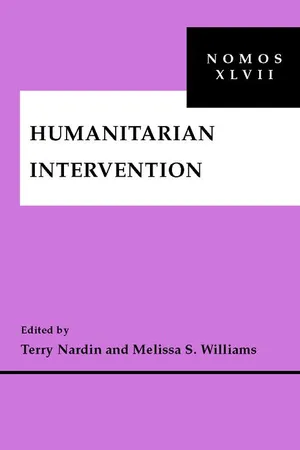
Somalia, Haiti, Bosnia, and Kosovo. All are examples where humanitarian intervention has been called into action. This timely and important new volume explores the legal and moral issues which emerge when a state uses military force in order to protect innocent people from violence perpetrated or permitted by the government of that state. Humanitarian intervention can be seen as a moral duty to protect but it is also subject to misuse as a front for imperialism without regard to international law.
In Humanitarian Intervention, the contributors explore the many questions surrounding the issue. Is humanitarian intervention permitted by international law? If not, is it nevertheless morally permissible or morally required? Realistically, might not the main consequence of the humanitarian intervention principle be that powerful states will coerce weak ones for purposes of their own? The current debate is updated by two innovations in particular, the first being the shift of emphasis from the permissibility of intervening to the responsibility to intervene, and the second an emerging conviction that the response to humanitarian crises needs to be collective, coordinated, and preemptive. The authors shed light on the timely debate of when and how to intervene and when, if ever, not to.
Contributors: Carla Bagnoli, Joseph Boyle, Anthony Coates, Thomas Franck, Brian D. Lepard, Catherine Lu, Pratap Bhanu Mehta, Terry Nardin, Thomas Pogge, Melissa S. Williams, and Kok-Chor Tan.
eBook - ePub
Humanitarian Intervention
NOMOS XLVII
- 320 pages
- English
- ePUB (mobile friendly)
- Available on iOS & Android
eBook - ePub
Humanitarian Intervention
NOMOS XLVII
About this book
Information
PART I
PRINCIPLES
1
TRADITIONAL JUST WAR THEORY AND HUMANITARIAN INTERVENTION
1. INTRODUCTION
By “traditional just war theory,” I mean the organized set of precepts and their rationale concerning the moral permissibility of engaging in warfare developed by medieval canonists and moral theologians chiefly from the work of St. Augustine. I do not call this medieval just war thinking because it has continued to develop in the modern period, not only in the work of sixteenthcentury scholastics such as Vitoria but also in continuing Roman Catholic teaching, and in the reflections of neoscholastic philosophers and theologians. I do not call this Catholic just war thinking because it is not narrowly religious or theological and remains of interest to many non-Catholics.
By “warfare,” I follow the older tradition in understanding it to be simply “contending with arms.” So a violent conflict need not be formally declared nor need it be conducted by established polities to be a war: one can go to war with brigands or terrorists, although such wars, like others, can be wrong to undertake or to execute in some ways.
An important component of the idea of war in this older just war tradition is that it is a collective action—something individuals cannot do acting alone but only in concert with others, and therefore with some coordination of individuals’ contributing actions by social authority. This further implies as a condition for a war’s permissibility that the authority coordinating the bellicose action be of the right kind.
The kind of war to be discussed is an intervention. I understand that interventions are not necessarily by force or its threat; it is only interventions that compel by force that I address, and they surely are morally a kind of warfare.1
Interventions are held to be to be similar to, if not instances of, the kind of aggressive war widely held to be impermissible, indeed criminal, insofar as it ordinarily involves border crossing and is not undertaken for the sake of legitimate self-defense. But an intervention can be understood to be distinct from aggression when this is defined as a crime, and to be possibly justifiable because its purposes do not include an ongoing occupation of the target’s territory, or the removal of whatever political independence that nation may have. Thus, to take two of the three kinds of intervention that Michael Walzer identifies—a state’s intervening to support the secession of a people from a larger polity or a state’s intervening in a civil war to balance the interference of other states—are not, or at least not obviously, cases of aggression.2
The sort of intervention I will discuss is humanitarian in a narrow sense: namely, intervention undertaken for the sake of protecting or securing noncitizens’ fundamental human rights when these rights either (1) are violated by their government’s own action or by its refusal to prevent other agents from doing so, or (2) are in jeopardy because of an anarchic situation in which no government exists capable of securing those rights, typically the condition of a failed state. This defines roughly the third species of intervention identified by Walzer. One of Howard Adelman’s definitions captures the idea nicely and is sufficient to specify the kind of human activity I will discuss: humanitarian intervention is “[t]he use of physical force within the sovereign territory of another state by other states or the United Nations for the purpose of either the protection of, or the provision of emergency aid to, the population within that territory.”3
It is perhaps worth noting that this definition is of a kind of social act—of warfare undertaken for a certain purpose. Thus, it is not intended to be a definition of an action already evaluated as morally good. According to this relatively descriptive account of humanitarian intervention, a use of force can be wrong even after it is agreed to be a humanitarian intervention.4
Relating traditional just war theory and the moral issues raised by humanitarian intervention has more than merely historical interest. Because its focus and vocabulary differ somewhat from those of modern international law and powerful current formulations of just war theory like Walzer’s, this theory offers a practically relevant alternative to those views.
The modern international law applicable to the legitimacy of going to war has initial and primary focus on the crime of aggression, on the presumptive impermissibility of border crossings, and on the fundamental importance of states’ mutual respect for one another’s sovereignty and political independence.5 This same focus is central in current just war theory. For example, the casuistic method that arrives at and applies rules for justified warfare begins with widely accepted ideas about the relationships between members of a society and develops analogies to the relationships between states. Developing the relevant analogies plainly requires careful attention to the ways in which states and individuals within a society are different, but states are presumptively free, much as individual members of a society ordinarily should be, to carry on their business unimpeded by other relevant actors. So, political sovereignty and territorial integrity function in international society much as individual rights do within a polity. Walzer has formulated the general results of this “domestic analogy” as what he calls “the legalist paradigm”: a set of norms and normatively interpreted facts that he plausibly holds to be the basis for the significant consensus underlying the legal status quo on the legitimacy of going to war.6
In contrast to the focus and vocabulary of international law and current just war theory, the older tradition focused on the common good of a polity, and therefore on the (conceptually consequential) question of the authority of those leading a state’s bellicose action, and on the justice of the cause for fighting. So, aggression will be wrong not simply because it is a border crossing or a violation of sovereignty but either because it is substantively unjust if a just cause is lacking, or because it is ultra vires for a state’s leaders to undertake, or because the bellicose actions are not strictly for the sake of the just cause and, more ultimately, for the sake of peace. This difference in focus and vocabulary suggests there may be important moral differences between older just war moralizing and the deliverances of current just war theory and practice. For two reasons I think the suggestion is correct.
First, traditional just war theory is an integral part of a larger view of moral and social life. Its casuistry is controlled by moral principle, and its reasoning and norms are integrated with other personal and social moral concerns. If modern just war conviction were equally imbedded in a rich moral framework, it could not have achieved the widespread positive establishment and the consensus surrounding its norms that it actually enjoys. So traditional just war theory has different and likely richer, if also more contentious, resources to bring to the questions raised about humanitarian intervention than do positive legal developments and such moral reasoning as is likely to be widely acceptable.
Posing the question about the permissibility of humanitarian intervention in terms of what is legally established or widely acceptable within what Walzer calls the common moral world seems unlikely to provide an unambiguous answer. Indeed, the accepted categories raise the question as especially problematic and exceptional. Similarly, seeking resources to answer this question from larger conceptions of international society, whether from those premised on the sovereign independence of states, or from those emphasizing their interdependence and mutual interests, moves one very quickly outside the areas in which there is normative consensus.
Second, the ideas that dominate traditional just war theorizing—notably the common good, political authority and its limits, and, to a real but lesser extent, justice—certainly appear to be both distinctive and theoretically important for reflection upon the responsibilities of various kinds of communities and of various persons within them. These ideas do not dominate modern discussions of justified war. And if ideas such as sovereignty and aggression now do the work these concepts once did, it is not clear that the results of reflection carried on in these different vocabularies will turn out to be identical. Even if the normative conclusions justified did turn out to be the same, the differences in the reasoning would likely remain significant.
2. THE TRADITIONAL CRITERIA FOR A MORALLY JUSTIFIED WAR
Thomas Aquinas gathered the teachings of Augustine on the morality of war, by his day widely interpreted and incorporated into canon law, and in a short, clear statement provided what is probably the classic statement of the traditional just war theory. This treatment appears in Aquinas’s best known and most mature work, the Summa Theologiae, in the second part of the second part, which deals with moral problems. The discussion falls within the sins against the virtue of charity because war is presumptively a sin against charity.7
Aquinas maintains that a war can be morally justified if and only if three conditions are met. Those conditions are proper authority, just cause, and right intent. His concern is plainly with conditions for what came to be called jus ad bellum, the moral permissibility of going to war. I believe that all the central norms usually associated with just war, although not their casuistic nuancing, are assumed by or implicit in what Aquinas says here. The jus in bello norms for the conduct of war that have been the center of just war concern about twentieth-century warfare were not explicit until Vitoria’s work, but the normative direction is surely here as well.
It is reasonable to think that Aquinas assumes in this discussion that the absolute prohibition against murder—intentionally or wantonly killing innocents—applies in warfare just as robustly as the prohibition against lying, which is explicitly held (in article 3) to remain in force. For, as he makes plain in the discussion of killing, no one can be authorized to intentionally kill innocents.8 But since the main issue at stake today is the moral permissibility of undertaking warfare to defend or secure human rights, Aquinas’s focus on the conditions for going to war is more useful than concerns about how war is executed.
Proper Authority
The first of Aquinas’s conditions is proper authority; that is, only the head of a polity (princeps, often translated as “sovereign”) can properly command the waging of war. Two reasons are given: first, private persons have no business waging war, and public officials lacking the sovereign authority can appeal to higher authority to settle disputes and to remedy injustices; second, only a sovereign, as head of the community, is authorized to bring together the members of that community to fight.
What grounds the sovereign’s authority, in both these relationships, is the fact that the care of the community is entrusted to the prince, who has the responsibility to look after its welfare. This responsibility includes authority to use force not only internally against domestic criminals but also against outsiders who harm the polity. It is perhaps relevant to our inquiry that one of the biblical proof texts Aquinas uses here is taken as addressing political leaders as follows: “Rescue the weak and the needy; save them from the clutches of the wicked.”
So, war waged without public authority is not permissible. And not any kind of public authority qualifies. Only the authority of one who has the final say for the welfare of a political community may rightly take it to war; by implicit definition, a public official has “final say” when there is no higher authority capable of and authorized to deal with the harm to the polity. The idea seems to be that the welfare of a political community requires care and protection and that sometimes this requires using armed force. Those who are in charge of the community’s welfare are the legitimate primary agents of this force. Those officials who can invoke higher authority within the community are not in this ultimate way in charge of its welfare.
Nothing in this analysis requires the sovereign to be a single individual; sovereign authority may be exercised by a constitutional group operating according to some fixed decision procedure, such as a parliament. Nor is there anything in it that prohibits the relevant official or body of officials from having worldwide jurisdiction.
Plainly, such worldwide authority as exists in the world today is not the authority of a great polity. Such worldwide authorities as exist, in the United Nations and in the wider U.N. system, do serve a genuine common good that has global reach, but that common good appears to be less than an all-encompassing common good that contains the proper goods of the states of the world as subordinate parts. Neither the treaties and customs that normatively bind peoples together nor the technology that allows their extensive interaction and cooperation have yet created the conditions for a superpolity that might allow worldwide officials to care for the welfare of each polity.
In other words, in terms neither of capacity nor of normative considerations are officials with some worldwide responsibility in charge of the common good of the whole world. In the older scholastic language: the community of states and any other communities that make up the world politically do not constitute a societas perfecta, capable of definitively settling all things pertaining to all human interactions and so capable of generating law and so being a general court of last resort.
My application of Thomistic categories to the normative sources of political authority in the world today cannot resolve the important questions raised by the fact that a state’s or an alliance’s unilateral intervention to protect human rights may be illegal by the terms of the U.N. Charter or by international law. The claim is only that in traditional just war theory the authority to undertake war lies in the sovereign, and that, in the world as it now is, a sovereign is the ruler of a sovereign state, and worldwide organizations are not sovereign states. This complex view is compatible with a very considerable limitation of a sovereign’s authority to undertake war, primarily by way of treaties of the kind that have shaped the modern international system. Such treaty-based limitations might also be extended and reinforced by the normative force of widely held custom. If it were sensible today to think of a renewed jus gentium, it would plausibly contain the expectation that sovereign authorities of a state will not undertake warfare without the consent of international authorities except in conditions in which the common good of the state is imminently and gravely threatened.9
The grounds for some such normative expectation would likely include the developing awareness of the need for impartiality in relations between states, especially when those relations are bellicose. The sovereign of a state cannot be impartial between his state’s interests and those of enemies. The sovereign’s responsibility for the common good of his or her own polity is precisely the ground of the authority to undertake warfare. Nevertheless, the sovereign is bound to act only for a just cause in the service of peace, and justification within the framework of the U.N., and international law surely contributes to meeting these conditions.10
Just Cause
Aquinas’s second necessary condition for the permissibility of a war is that there be a just cause. He gives little justification for what he rightly takes to be an obvious ethi...
Table of contents
- Cover Page
- Title Page
- Copyright Page
- Contents
- Preface
- Contributors
- Introduction
- Part I: Principles
- Part II: Institutions
- Index
Trusted by 375,005 students
Access to over 1.5 million titles for a fair monthly price.
Study more efficiently using our study tools.
Frequently asked questions
Yes, you can cancel anytime from the Subscription tab in your account settings on the Perlego website. Your subscription will stay active until the end of your current billing period. Learn how to cancel your subscription
No, books cannot be downloaded as external files, such as PDFs, for use outside of Perlego. However, you can download books within the Perlego app for offline reading on mobile or tablet. Learn how to download books offline
Perlego offers two plans: Essential and Complete
- Essential is ideal for learners and professionals who enjoy exploring a wide range of subjects. Access the Essential Library with 800,000+ trusted titles and best-sellers across business, personal growth, and the humanities. Includes unlimited reading time and Standard Read Aloud voice.
- Complete: Perfect for advanced learners and researchers needing full, unrestricted access. Unlock 1.5M+ books across hundreds of subjects, including academic and specialized titles. The Complete Plan also includes advanced features like Premium Read Aloud and Research Assistant.
We are an online textbook subscription service, where you can get access to an entire online library for less than the price of a single book per month. With over 1.5 million books across 990+ topics, we’ve got you covered! Learn about our mission
Look out for the read-aloud symbol on your next book to see if you can listen to it. The read-aloud tool reads text aloud for you, highlighting the text as it is being read. You can pause it, speed it up and slow it down. Learn more about Read Aloud
Yes! You can use the Perlego app on both iOS and Android devices to read anytime, anywhere — even offline. Perfect for commutes or when you’re on the go.
Please note we cannot support devices running on iOS 13 and Android 7 or earlier. Learn more about using the app
Please note we cannot support devices running on iOS 13 and Android 7 or earlier. Learn more about using the app
Yes, you can access Humanitarian Intervention by Terry Nardin,Melissa S. Williams, Terry Nardin, Melissa S. Williams in PDF and/or ePUB format, as well as other popular books in Politica e relazioni internazionali & Relazioni internazionali. We have over 1.5 million books available in our catalogue for you to explore.