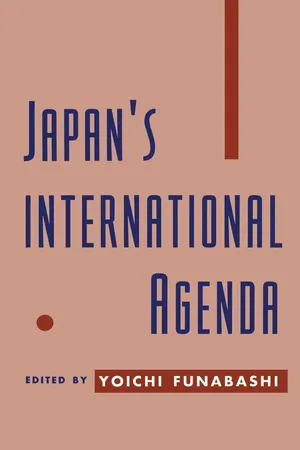
What is Japan's political role in the world? Over the past decade, Japan has been increasingly pressured to assume more financial and political burdens globally. Its foreign policy has thus evolved in a piecemeal manner, around the question of managing foreign pressures. To date, policy has been largely developed by bureaucrats, who are traditionally responsible for public policy in Japan. The lack of a clear set of foreign policy objectives, however, has made it impossible for the bureaucracy to play its previous role as the arbiter of public interests.
Today, there is increased recognition that in a more pluralistic society, nongovernmental public policy specialists are needed to provide a more integrated and longer-term vision of foreign policy goals. This book represents the first private and non- governmental indigenous effort to stimulate public debate of Japanese foreign policy.
Japan's International Agenda makes a distinctive contribution to the foreign policy debate. Its contributors are younger Japanese non-governmental foreign affairs specialists, each with considerable international experience and committed to the belief that significant policy reforms are essential. As a statement of Japan's ability to contribute substantially to international policy debates on such broad questions of security and trade and development, Japan's International Agenda will enable scholars and experts in North America, Europe, the Asia-Pacific region, and elsewhere to engage in substantive dialogue on critical public policy issues with their Japanese counterparts. This book represents the first private, indigenous effort to stimulate public debate of Japanese foreign policy. Its contributors are young Japanese foreign affairs specialists, each with considerable international experience and a commitment to the belief that significant policy reforms are essential.
- 216 pages
- English
- ePUB (mobile friendly)
- Available on iOS & Android
eBook - ePub
Japan's International Agenda
About this book
Trusted by 375,005 students
Access to over 1.5 million titles for a fair monthly price.
Study more efficiently using our study tools.
Information
1. Japan’s Security Policy in the 1990s
The end of the Cold War forces many nations to reformulate or at least rearticulate their respective security policies. Japan is no exception. Japan’s defense policy has long assumed that the main threat to its security comes from the North. But with the complete collapse of the Soviet Union, new defense planning in a narrow sense as well as redefinition of a more broad security policy are required for Japan. It is obvious that the end of the Cold War hardly means the beginning of a harmonious and peaceful world. New threats are emerging; Iraq’s invasion of Kuwait was the most vivid case in point. Even in East Asia, where on the surface there are no overt military conflicts, international politics is beginning to see some sources of instability: the nuclear threat of North Korea is not yet gone; possible reunification of the Korean Peninsula may entail military aspects; tensions over the Taiwan strait could be heightened; the South China Sea might become a stage of arms competition among the regional states; security implications of the current economic regionalization of China, especially in the post-Deng Xiaoping era, are not clear; and the future of the Russian Federation contains many elements of uncertainty. Japan, a geographical neighbor of Russia, a close ally of the United States, and an advanced industrialized democracy heavily dependent on free flows of international trade, has to reanalyze these current trends in this security environment and reconceptualize its security policy for the coming decades.
In an attempt at such reconceptualization, I will begin by summarizing the basic orientation of Japan’s security policy in the postwar period. Thereafter I will analyze the nature of international security in the post—Cold War period; present a new agenda for Japan’s security policy in the 1990s; and, finally, discuss some specific policy issues, their feasibility, and domestic constraints that may stand in the way of realizing such new policies.
Basics of Japan’s Postwar Security Policy
The basic framework of Japan’s security policy is largely determined by the Constitution of 1947 and the security treaty with the United States concluded in 1952 and extensively revised in 1960. One of the reasons why Japan’s security policy has sometimes appeared opaque and defense-related debates have often sounded theological is that the historical developments in the postwar period were not anticipated by the Constitution of 1947.
One of the clear characteristics of the Constitution of 1947, written under the strong influence of the U.S. Occupation Forces, was its idealistic and pacific nature. Article 9 stipulates,
Aspiring sincerely to an international peace based on justice and order, the Japanese people forever renounce war as a sovereign right of the nation and the threat or use of force as means of settling international disputes.
In order to accomplish the aim of the preceding paragraph, land, sea, and air forces, as well as other war potential, will never be maintained. The right of belligerence of the state will not be recognized.1
Under this constitution, Japan did not possess military forces during most of the occupation period. But with the beginning of the Cold War, the U.S. posture toward Japan’s armaments changed, and under Washington’s strong pressure, Japan began to equip itself with armed forces under various names: the Police Reserve Forces were created in August 1950 under the direction of General Headquarters (GHQ); the Maritime Security Forces were established in April 1952; the Police Reserve Forces and the Maritime Security Forces were reorganized under the heading of the Hoancho (Security Agency) in August 1952; and in 1954, these forces were further reorganized as the Self-Defense Forces (Jieitai).2
The Japanese Self-Defense Forces (SDF) are currently composed of the Ground Self-Defense Force, with 156,000 personnel; the Maritime Self-Defense Force, with fourteen submarines, fifty-five destroyers and frigates (goeikan), and seventy-nine reconnaissance airplanes (including fifty P-3Cs); and the Air Self-Defense Force, with nine squadrons of fighters (including 120 F-15J/DJs).3 In terms of expenditures, Japan’s SDF is one of the largest military forces in the world.4
Though some in Japan argue that the current Self-Defense Forces constitute “forces” the constitution bans and are therefore unconstitutional, the government of Japan has long maintained that the sovereign right of self-defense is not denied by the constitution and that Japan can maintain such forces as long as they are strictly for the purpose of self-defense. But because of the clear pacific intentions of the constitution, Japan’s SDF is restricted in its tasks, area of operation, and the weapons it is allowed to procure. In fact, according to the interpretation of the government of Japan, Japan could constitutionally use “minimally necessary forces” only against “urgent and unjust infringements” when no other means to remove them are available. These three phrases—“urgent and unjust infringement,” “no other means available,” and “minimally necessary forces”—are usually referred to as the three conditions of resorting to the right of individual self-defense. Beyond such individual self-defense, according to the government interpretation, the constitution does not allow Japan to exercise “collective self-defense.”
The tasks of the SDF, stipulated by the 1954 Self-Defense Forces Law, are primarily to defend Japan from direct and indirect aggression and secondarily to preserve public order in Japan, which includes disaster relief activities. The geographic area of operation of the SDF is not clearly specified by law, but the government of Japan declared on various occasions, including a number of Diet sessions, that the SDF’s area of operation is not necessarily restricted to Japan’s territory, territorial waters, or territorial space but that Japan could not send armed troops to other countries’ territory, territorial waters, and territorial space for military purposes because such dispatch goes beyond strict “self-defense” and hence constitutes the exercise of “collective self-defense.” On the high seas, there are no legal restrictions against the military operations of the SDF other than the “three conditions of resorting to the right of self-defense.” As for the dispatch of the SDF to foreign countries for noncombat purposes, such as in the case of U.N. peacekeeping operations, the government does not interpret such dispatch to be unconstitutional, but until the passage of the International Peace Cooperation Law in June 1992, since the 1954 SDF Law did not list such activity as the SDF’s task, it had been considered not within the mandate of the SDF.
The weapons that the SDF can procure are only those “minimally necessary” for self-defense, according to the official interpretation of the constitution. What constitutes “minimally necessary” in each specific circumstance depends on the international situation, the level of military technology, and other conditions, but, in the government’s interpretation, such weapons to be used exclusively for destruction of other countries (e.g., ICBMs, long-range bombers, etc.) are under no circumstances to be possessed by Japan. As for nuclear weapons, the government interpretation of the constitution says that the constitution does not prohibit nuclear weapons per se; if nuclear weapons are considered “minimally necessary” for self-defense, the constitution allows Japan to possess them, in the government’s interpretation. But the Basic Law of Atomic Energy does not allow Japan to conduct research, develop, or use atomic energy other than for peaceful purposes, and as a signatory of the Nuclear Nonproliferation Treaty, Japan is also prohibited from possessing nuclear weapons. Further, the government declared on various occasions that as a matter of national policy Japan maintains the three nonnuclear principles of not possessing nuclear weapons, not producing them, and not permitting their introduction into Japan.
In addition to the types of weapons, the amount of defense expenditure has also been restricted, though this quantitative restriction is not clearly anchored to any specific law. The most clear restriction was the 1976 cabinet decision to consider 1 percent of the GNP to be the ceiling of the annual defense budget. This 1 percent ceiling was abolished in 1986 and was replaced by a looser and more flexible scheme of deciding the annual budget “within the definite limit” of the Mid-Term Defense Program.
Another area of important self-restraint is that of military exports. In 1967, then Prime Minister Eisaku Sato declared the “Three Principles on Arms Export,” which disallowed exports to (1) Communist bloc countries, (2) countries subject to embargoes on arms export under the U.N. Security Council’s resolutions, and (3) countries engaged or likely to be engaged in an international conflict. In 1976, Prime Minister Takeo Miki further tightened the restrictions: (1) arms exports to areas specified in the Three Principles shall not be allowed; (2) arms exports to other areas shall be avoided; and (3) export of arms production—related equipment shall be dealt with in the same way as “arms” are.5
In addition to the constitution, the security treaty with the United States provides another important framework for Japan’s security policy. The 1960 treaty, formally known as the Treaty of Mutual Cooperation and Security between Japan and the United States of America, is often characterized as being asymmetrical; the United States is obligated by this treaty to defend Japan while Japan is not obligated to defend the United States; the United States is granted the right to maintain its bases in Japan for “the purpose of contributing to the security of Japan and the maintenance of international peace and stability in the Far East,” while Japan is not granted similar rights.6 The former asymmetry has clearly resulted from Japan’s constitutional limitations as described above; the Japanese government has maintained that the constitution does not allow Japan to exercise the right of collective self-defense.
Unlike the NATO alliance, the U.S.-Japan alliance, thus created by the security treaty, had not created substantive joint works to improve the effectiveness of the alliance until the mid-1970s. For one thing, quite a few Japanese were inclined against further military cooperation with the United States, especially during the Vietnam War, while many other Japanese took the American presence in the Asian-Pacific region for granted; for another, the Soviet Union had not acquired military capability in the Far East to pose direct threats to Japan until the late 1970s.
But with the Soviet Union military buildup in Asia in the late 1970s, several developments have been made to substantiate the alliance. In 1978, Guidelines for Japan-U.S. Defense Cooperation were agreed upon by the two countries, and on the basis of these guidelines various studies have been conducted; the studies that have been given priority include joint operations, defense of sea lanes of communications, and enhancement of interoperability. In 1981, Prime Minister Zenko Suzuki expressed Japan’s willingness to make efforts to protect sea lanes. Joint exercises between the SDF and U.S. forces have increased in number and in scope since the beginning of the 1980s (see table 1.1). As discussed above, exports of military weapons as well as military technology from Japan are strictly controlled. But in 1983, the Japanese government decided not to apply these rules to the United States. Another important development is the host-nation support for U.S. forces in Japan; the budget for the host-nation support increased from 163 billion yen in 1981 to 262.4 billion yen in 1989.7
Table 1.1 Japan-U.S. Joint Exercises

To integrate the frameworks created by the Constitution of 1947 and the security treaty with the United States, two guiding concepts were developed in the mid-1970s to early 1980s: the standard defense force (kibanteki boeiryoku) and comprehensive security (sogo anzenhosho). According to the National Defense Program Outline adopted on October 29, 1976, the document that embodies the concept of a standard defense force, Japan’s defense goal is “the maintenance of a full surveillance posture in peacetime and the ability to cope effectively with situations up to the point of limited and small-scale aggression,” and the defense capability of Japan should be “standardized so that, when serious changes in situations so demand, the defense structure can be smoothly adapted to meet such changes.” With this sort of defense capability, Japan is supposed to “repel limited and small-scale aggression, in principle, without external assistance. In cases where the unassisted repelling of aggression is not feasible, . . . Japan will continue an unyielding resistance by mobilizing all available forces until such time as cooperation from the United States is introduced, thus rebuffing such aggression.” What concretely has materialized under this concept in the 1980s includes the buildup of land defense capability in Hokkaido and of antisubmarine warfare capability around Japan and along the sea lanes one thousand miles south and southwest of Tokyo.
If the goal of the “standard defense force” is to deal with purely military threats by defensive and restrained defense capability with dependence on the United States, the goal of “comprehensive security,” developed in the late 1970s to early 1980s, is to define the concept of security more broadly by giving emphasis to nonmilitary aspects of security. The report of a blue-ribbon commission appointed by Prime Minister Masayoshi Ohira defined security in 1980 as “protecting the people’s life from various forms of threat” and argued that there should be three levels of efforts for security: “efforts to turn the overall international environment into a favorable one; self-reliant efforts to cope with threats; and as intermediary efforts, efforts to create a favorable international environment within a limited scope while protecting security in solidarity with countries sharing the same ideals and interests.”8
In retrospect, a number of new developments in Japan’s security policy in the 1980s may be interpreted in terms of these three levels as introduced by the report on comprehensive national security. Continuous annual increase in defense expenditures, procurement of highly sophisticated military equipment, and efforts to maintain petroleum reserves (as of 1990, 142 day reserves) are all efforts on the unilateral, self-reliant level. Increasing substantiation of the U.S.-Japan alliance through joint exercises and host-nation support is on the level of cooperation with a like-minded nation. Prime Minister Noboru Takeshita’s declaration at the United Nations in 1988 of the three pillars of international cooperation—cooperation for peace, increase of Official Development Assistance, and promotion of international cultural exchange—is a declaration of the intention to promote efforts on the level of preserving peace and stability in the international system.
Thus, by the end of the 1980s, Japan seemed to have reached a point where the Japanese were more or less comfortable with their country’s security framework as based on the constitution, the alliance with the United States, and the concepts of standard defense forces and of comprehensive national security. In 1989, 67 percent of the Japanese were in support of the current formula of security policy: a combination of the SDF and the U.S. alliance. Though many criticisms existed as to the organization of the SDF, lack of SDF sustainability, weakness of logistics, and lack of philosophy and coordination in Japan’s economic assistance policy, any suggestion of a radical departure from the current framework was not taken seriously. However, radical changes in East-West relations in 1989 and subsequent international events have demanded that the Japanese seriously reexamine their security policy.
Nature of International Security in the 1990s
The end of the Cold War has greatly decreased the probability of the worst possible catastrophe: an all-out nuclear war and a massive conventional attack by the Warsaw Pact army on Western Europe. It is sometimes pointed out that the Cold War has not quite ended in Asia. It is true that in Asia there remain a number of sources of international conflict that were more or less created under the influence of the Cold War. But to the extent that the Cold War means an ideological battle as well as the danger of a nuclear war between the United States and the Soviet Union, it is over even in Asia.
As Saddam Hussein’s invasion of Kuwait in August 1990 dramatically showed, however, the end of the Cold War does not entail the end of security issues. Even if it is unlikely that major powers, including the United States and Russia, will engage in large-scale military conflicts with each other, a host of dangers still exist: emergence of adventurer regimes in some countries; proliferation of sophisticated weapons; ethnic conflicts; destabilization of thus-far stable countries; transnational terrorism; supply shortage of critical resources; collapse of the world economy; global environmental destruction; and others. These dangers are related, and more can be added to this list. But many of them are threats not clearly defined and analyzed in traditional analysis of security policy; some of them are not even mentioned. Therefore, now that the time when almost all international conflicts have been interpreted in terms of the East-West confrontation is behind us, systematic efforts to analyze various types of threats are called for in order to place them in proper perspective. The following is an attempt to classify these and other possible threats into four broad groups according to the degree of specificity and identity of actors involved and the degree of the actors’ aggressive intentions (figure l.l).9
First, there are threats coming from specific and clearly identifiable actors with clear aggressive intentions. Adventurous regimes trying to invade or intimidate their neighbors are such threats. Saddam Hussein’s Iraq and North Korea, which planned and actually bombed a KAL airliner, are examples par excellence. Security policy in the traditional sense has mainly dealt with this type of threat. Defense planning is often made on the assumption ...
Table of contents
- Cover Page
- Title Page
- Copyright Page
- Contents
- Foreword
- Preface
- Introduction: Japan’s International Agenda for the 1990s
- 1. Japan’s Security Policy in the 1990s
- 2. Technology and the Setting for Japan’s Agenda
- 3. U.S.–Japan Macroeconomic Policy Coordination: Agenda for the 1990s and Beyond
- 4. Rule Maker of World Trade: Japan’s Trade Strategy and the World Trading System
- 5. Japan’s Role in Economic Cooperation and Direct Foreign Investment
- 6. Japan’s International Agenda: Structural Adjustments
- Contributors
- Index
Frequently asked questions
Yes, you can cancel anytime from the Subscription tab in your account settings on the Perlego website. Your subscription will stay active until the end of your current billing period. Learn how to cancel your subscription
No, books cannot be downloaded as external files, such as PDFs, for use outside of Perlego. However, you can download books within the Perlego app for offline reading on mobile or tablet. Learn how to download books offline
Perlego offers two plans: Essential and Complete
- Essential is ideal for learners and professionals who enjoy exploring a wide range of subjects. Access the Essential Library with 800,000+ trusted titles and best-sellers across business, personal growth, and the humanities. Includes unlimited reading time and Standard Read Aloud voice.
- Complete: Perfect for advanced learners and researchers needing full, unrestricted access. Unlock 1.5M+ books across hundreds of subjects, including academic and specialized titles. The Complete Plan also includes advanced features like Premium Read Aloud and Research Assistant.
We are an online textbook subscription service, where you can get access to an entire online library for less than the price of a single book per month. With over 1.5 million books across 990+ topics, we’ve got you covered! Learn about our mission
Look out for the read-aloud symbol on your next book to see if you can listen to it. The read-aloud tool reads text aloud for you, highlighting the text as it is being read. You can pause it, speed it up and slow it down. Learn more about Read Aloud
Yes! You can use the Perlego app on both iOS and Android devices to read anytime, anywhere — even offline. Perfect for commutes or when you’re on the go.
Please note we cannot support devices running on iOS 13 and Android 7 or earlier. Learn more about using the app
Please note we cannot support devices running on iOS 13 and Android 7 or earlier. Learn more about using the app
Yes, you can access Japan's International Agenda by Yoichi Funabashi in PDF and/or ePUB format, as well as other popular books in Politics & International Relations & International Relations. We have over 1.5 million books available in our catalogue for you to explore.