2007 Ruth Shonle Cavan Young Scholar Award presented by the American Society of Criminology
2007 American Society of Criminology Michael J. Hindelang Award for the Most Outstanding Contribution to Research in Criminology
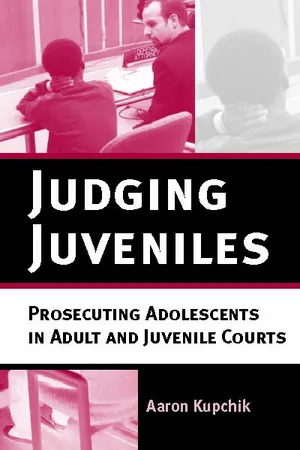
By comparing how adolescents are prosecuted and punished in juvenile and criminal (adult) courts, Aaron Kupchik finds that prosecuting adolescents in criminal court does not fit with our cultural understandings of youthfulness. As a result, adolescents who are transferred to criminal courts are still judged as juveniles. Ultimately, Kupchik makes a compelling argument for the suitability of juvenile courts in treating adolescents. Judging Juveniles suggests that justice would be better served if adolescents were handled by the system designed to address their special needs.
- 211 pages
- English
- ePUB (mobile friendly)
- Available on iOS & Android
eBook - ePub
About this book
1
Introduction
Growing Up Quickly
Just over a century ago, the juvenile court was created in Cook County, Illinois. Although scholars might disagree about the motives of the court’s founders, most would agree that the creation of a juvenile court was a natural result of shifting social consciousness about youth. Throughout the seventeenth, eighteenth, and nineteenth centuries, childhood developed as a social category,1 as the Enlightenment ushered in new ideas about children as incompetents in need of care. A new ideal of children as dependent, lacking the mental and physical capacities of adults, and in need of guidance arose and was universally accepted. This modern conception of youthfulness necessitated separate court systems for juveniles and adult offenders.
Over the past few decades, however, increasing numbers of adolescents have been denied the protections of the juvenile court in favor of prosecution and punishment in criminal, adult court. Since the mid-1970s, nearly every U.S. state has revised its laws to facilitate the transfer of adolescents from juvenile to criminal court (these laws are thus referred to as “transfer laws”).2 Some states have lowered the age at which an adolescent is eligible to be transferred by a judge to criminal court; some states have allowed prosecutors to directly file adolescents’ cases in criminal court, prior to any hearing in the juvenile court; and some states created laws that automatically exclude certain adolescents (based on their ages and charged offenses) from juvenile court. The specifics of states’ transfer laws vary considerably, but the end result is that more and more youth under age eighteen are now prosecuted in criminal court rather than juvenile court.
What happened to the idea that adolescents are less mature, and therefore less culpable, or blameworthy, for their offenses than adults? Slogans like “old enough to do the crime, old enough to do the time” offer a new logic to compete with the modern conception of reduced culpability for youths relative to adults by suggesting that youth who commit severe crimes should be treated as adults rather than as juveniles. Policy makers who create transfer laws and academics who study them focus on the worthiness and potential effects of transfer policies while accepting at face value the assumption that reduced culpability for youth ends at the transfer hearing. In contrast, this book argues that prosecuting adolescents in criminal court creates an awkward ambivalence for courtroom decision makers who must apply adult laws to adolescent defendants. This results in a hybrid form of justice in the criminal court, what I call a sequential model of justice, that borrows from both a criminal justice model and a juvenile justice model.
This finding, in conjunction with evidence from prior research showing that the transfer of large numbers of youth to criminal court is counterproductive and might actually increase crime, strongly suggests the need to limit the number of youth who are prosecuted as adults. By introducing “get tough on crime” measures that are popular with the general public, policy makers have instituted a set of practices that not only have the potential to put the public at greater danger, but are also “filtered” by court actors in ways that reintroduce the very elements of juvenile justice these policies are intended to avoid. Though this reintroduction of juvenile justice may be positive in that it adds some sensibility to a counterintuitive policy, it does not sufficiently mitigate the counterproductiveness of policies that result in large numbers of juveniles being transferred to criminal court.
The well-publicized recent case of Lionel Tate illustrates the ambivalence that arises when adolescents are prosecuted as if they were adults. On July 28, 1999, in Florida, twelve-year-old Lionel Tate was playing with six-year-old Tiffany, whom his mother was babysitting as a favor to the girl’s mother. Lionel assaulted Tiffany by repeatedly imitating professional wrestling moves, thereby killing her. Since Florida law allows prosecutors to bypass the juvenile court for children younger than fourteen and seek indictment by a grand jury, Lionel was prosecuted in criminal rather than juvenile court. He was indicted by a grand jury, convicted in criminal court, and, by the time he was fourteen years old, sentenced to life in prison for killing Tiffany. On March 3, 2000, he became the youngest American ever sentenced to life in prison.3 This sentence, however, was later voided; a Florida Appeals Court reversed Lionel’s conviction and granted him a new trial. Rather than holding a new trial, Lionel accepted a plea bargain in January 2004, the same bargain that he had refused during his initial trial: three years of incarceration, a year of house arrest, ten years of probation, and a thousand hours of community service. Having already served his three years in prison, Lionel was released (and subsequently re-incarcerated on a probation violation in 2006).
The apparent absence of age as a determining factor in Lionel’s trial illustrates my point. Lionel’s age did not alter the results of his trial; in the end, the evidence against him was the most important factor. According to the trial judge: “The evidence of Lionel Tate’s guilt is clear, obvious and indisputable.”4 The defense argued that Lionel was not mature enough to comprehend that professional wrestling is staged, and therefore that Tiffany’s death was accidental. However, rather than being swayed by this argument hinging on Lionel’s immaturity and lack of comprehension, jurors focused on the level of violence inflicted upon Tiffany. The jury agreed with prosecutors that the number and severity of Tiffany’s injuries indicated intentional cruelty rather than an immature mistake of a child who did not comprehend the consequences of his actions. Tiffany suffered as many as thirty-five injuries before her death, including a fractured skull, brain contusions, multiple bruises, a rib fracture, injuries to her kidneys and pancreas, and the detachment of part of her liver.5 According to a juror, “The injuries were so extensive we all felt that wasn’t an accident. We had to abide by the law and the law spelled it out. It wasn’t just wrestling.”6 Thus, the physical evidence against Lionel led to conviction; once convicted of first-degree homicide, Florida law left no option but life in prison without parole. Lionel’s age at the time of the offense—twelve—was neither a determining factor in the jury’s decision, nor a consideration during sentencing.
Yet upon further inspection, we see that age was a paramount factor in Lionel’s case. The prosecutor had offered Lionel a plea bargain (which was eventually accepted after the successful appeal) of three years in prison, due to his youthfulness. Lionel’s mother, a Florida highway patrol trooper, denied his guilt and told him to refuse the deal. She stated: “How do you accept a plea for second-degree murder when your child is playing? How do you send him to prison when you know that he was playing?”7 After the trial, the prosecutor criticized a life sentence as inappropriately harsh for Lionel, and stated his intention to appeal to Governor Jeb Bush for clemency for Lionel. For his part, the judge blamed the life sentence on the defense and prosecutor, and defended his inability to depart from the life sentence mandated by law.
More importantly, the success of Lionel’s appeal hinged on his immaturity. The Florida Appeals Court voided Lionel’s conviction because he was not given a competency evaluation during his trial. As a result, the court could not be sure that Lionel was competent to stand trial, and questioned if he had the ability to appreciate the charges against him, understand the potential penalties he could face, relate to his attorney and assist in his defense, challenge the testimony of witnesses for the prosecution, testify relevantly, and, most importantly, understand the plea bargain he was offered. This decision may have been surprising to some, since Lionel’s competency was discussed during his trial, even if it was not officially evaluated. The defense alleged that his I.Q. was ninety or ninety-one, and thus at the twenty-fifth percentile for his age—this gave him “an age equivalent of nine or ten years old,” according to a neuropsychologist testifying during the trial.8 Though Lionel was given a competency assessment by a state witness, the Appeals Court ruled that this assessment was insufficient and not court ordered. Thus Lionel received a new trial.
Multiple psychological professionals assessed Lionel, and his competency was discussed during his trial. His I.Q. was undisputed in court and by the Appeals Court. Lionel was diagnosed as immature and below average in intelligence, but not mentally unstable nor handicapped. He was nowhere near the seventy I.Q. level normally used by courts to indicate mental retardation.9 Yet the fact that he was so young persuaded the Appeals Court of the necessity for an official, thorough competency evaluation:
The question we resolve, here, is whether, due to his extremely young age and lack of previous exposure to the judicial system, a competency evaluation was constitutionally mandated to determine whether Tate had sufficient present ability to consult with his lawyer with a reasonable degree of rational understanding and whether he had a rational, as well as factual, understanding of the proceedings against him. We conclude that it was.
The inconsistency here between logics of the legislature and the Appeals Court embodies the difficulty of prosecuting adolescents as adults. The Florida legislature has created a system in which prosecutors can indict juveniles directly in criminal court, based only on their charged offenses. As the Appeals Court judges wrote:
The legislature, however, has supplanted the common law defense of ‘infancy’ with a statutory scheme, which includes section 985.225, specifying when a juvenile is capable of committing a crime under which he or she should be treated as an adult. See State v. D.H., 340 So. 2d 1163, 1165 (Fla. 1976) (holding that the common law presumption of incapacity of a minor between the ages of seven and fourteen years to commit a crime no longer applies).
The law referred to by the judges, Florida Statute §985.225, states that “a child of any age who is charged with violation of state law punishable by death or by life imprisonment” is subject to criminal rather than juvenile court if indicted, and “must be tried and handled in every respect as an adult.” In fact, this last phrase (about being handled “in every respect as an adult”) is repeated throughout the legislature’s wording of this statute. Thus, in Florida a child’s offense can be more important for judging culpability than age; in fact, by statute age is entirely irrelevant for youth who commit certain offenses.
The Appeals Court judges note in this passage that with this statute the legislature overrules a legal tradition of presuming incapacity among youth younger than fourteen. This doctrine holds that youth younger than seven are not to be held responsible for their crimes, since they do not have a sufficient understanding of right and wrong to make punishment efficacious; for youth between the ages of seven and fourteen, courts should assume that they are not mature enough to comprehend right from wrong, to understand court proceedings, or to help in their own defenses, but with an opportunity for the state to rebut this presumption. By requiring that offense-based criteria determine whether children from seven to fourteen can be held fully responsible for their offenses in criminal court as if they were adults, the Florida legislature rebuts this longstanding presumption. Yet the Appeals Court judges seem to disagree, as they reversed Lionel’s conviction based only on his age and lack of experience with the judicial system, not on any signs of mental deficiencies (other than the natural deficiency of immaturity).
I begin with a discussion of this case because it illustrates a central theme of this book: that the prosecution of adolescents in criminal court fails to resonate with culturally inscribed understandings of youthfulness. Prosecuting youth in criminal courts is a rejection of widely held principles about the immaturity of adolescents.10 It creates tension for courtroom decision makers and forces them to creatively filter court proceedings in a way that reintroduces the modern principles that gave rise to the juvenile court: that adolescents are less mature than adults, and therefore less culpable for crimes than adults. However, the reintroduction of juvenile justice principles is incomplete, as Lionel Tate’s initial sentence shows us; the current state of jurisdictional transfer laws results in harsh punishments for adolescents in criminal courts, often regardless of whether court decision makers recognize a reduced level of culpability for youth.
This ambivalence is not present only in cases with extremely young defendants like Lionel. The case of Lee Boyd Malvo, one of the snipers that terrorized the Washington, D.C., metropolitan area during the fall of 2002, illustrates an ambivalence between full and reduced culpability as well. By his own admission, the seventeen-year-old Lee was the trigger-man—working with a father figure and mentor, John Allen Muhammad—in many of the sniper shootings that killed ten and injured three others. He was a serial killer who struck seemingly random targets, and was less than a year from the bright line of eighteen that marks legal adulthood in most arenas. Because the sniper killings occurred throughout the D.C. area, the defendants were eligible for prosecution in counties in both Virginia and Maryland. U.S. Attorney General John Ashcroft had the case prosecuted in Virginia, since at the time, Virginia’s laws allowed for the execution of offenders who commit crimes before age eighteen.11
If only offense severity matters in determining punishment, then it is likely that both Lee and Muhammad would have received the death penalty, or perhaps only Lee (as the triggerman). Yet Muhammad was sentenced to death, while Lee was spared the death penalty and sentenced to life in prison. Most likely, Lee’s life was spared because of the defense’s strategy during the trial; the defense made a case for Lee’s reduced culpability due to his immaturity and childish attachment to Muhammad. Lee doted on Muhammad and called him his father. He absorbed Muhammad’s violent teachings and listened to Muhammad’s wishes to rebel against the government. At one point before the killing spree, Lee followed an extreme diet set by Muhammad consisting of crackers and water.12 The defense portrayed Lee as an immature and misled adolescent who followed his father-figure down the wrong path, and was thus less culpable for his serial murders than Muhammad.13 As a result, the likely triggerman received a lesser penalty than his mentor.
Of course, Lee did not receive a mild slap on the wrist, nor was he treated as if he lacked culpability. Rather, he was sentenced to life in prison. Yet when we consider the severity of his offenses—he is a serial
murderer at least partially responsible for ten deaths—and his age, his case is a far cry from that of a twelve-year-old who killed a playmate by mimicking professional wrestling moves. Nonetheless, his immaturity appeared to play a significant role in the jury’s decision making and helped to spare him from execution. Though less visible in this case than in Lionel Tate’s, we again see that the cultural belief in reduced culpability for juveniles has some role in their prosecution as adults. This seems to be true even in one of the most horrible cases imaginable for an adolescent, one who was very close in age to legal adulthood.
Of course, these two cases are unusually violent and sensational cases and do not represent the population of adolescent offenders. Yet they highlight the tensions involved in prosecuting youth in criminal courts, and the lessons learned from these cases apply to other less sensational cases as well. In this book I explain how and why adolescents are prosecuted as if they are adults, then are judged with their youthfulness in mind. To best understand what happens when adolescents are transferred from juvenile to criminal courts, I compare the criminal court prosecution of adolescents to its alternative: the prosecution of adolescents in juvenile courts.
Models of Justice
The reason why Lionel Tate, Lee Boyd Malvo, and other adolescents are prosecuted in criminal court is because policy makers assume that criminal courts act differently than juvenile courts. This assumption is based on the theoretical models of justice that best describe each court type. Traditionally, the juvenile court and the criminal court have relied on very different models of justice regarding case processing, evaluating offenders, and punishing them. The criminal court is often characterized by reference to a criminal justice model, and the juvenile court by reference to a juvenile justice model. Relative to a juvenile justice model, a criminal justice model suggests that case processing is formal, evaluation of offenders is centered on offense-relevant criteria rather than offender-relevant criteria, and the primary goals of sentencing are to punish and deter rather than to rehabilitate. Conversely, relative to a criminal justice model, a juvenile justice model suggests that case processing is informal, evaluation...
Table of contents
- Cover Page
- Title Page
- Copyright Page
- Dedication
- Contents
- Acknowledgments
- 1 Introduction: Growing Up Quickly
- 2 Law and Context
- 3 The Process of Prosecuting Adolescents: How Formal?
- 4 Judging Adolescents: What Matters?
- 5 Punishment for Adolescents: What Do They Get, and Why?
- 6 Children in an Adult World
- 7 Putting the Genie Back in the Bottle: Lessons for Policy
- Appendix: Research Methods
- Notes
- Index
- About the Author
Trusted by 375,005 students
Access to over 1.5 million titles for a fair monthly price.
Study more efficiently using our study tools.
Information
Publisher
NYU PressYear
2006Topic
Ciencias socialesPrint ISBN
9780814747742
Subtopic
CriminologíaeBook ISBN
9780814749418
Frequently asked questions
Yes, you can cancel anytime from the Subscription tab in your account settings on the Perlego website. Your subscription will stay active until the end of your current billing period. Learn how to cancel your subscription
No, books cannot be downloaded as external files, such as PDFs, for use outside of Perlego. However, you can download books within the Perlego app for offline reading on mobile or tablet. Learn how to download books offline
Perlego offers two plans: Essential and Complete
- Essential is ideal for learners and professionals who enjoy exploring a wide range of subjects. Access the Essential Library with 800,000+ trusted titles and best-sellers across business, personal growth, and the humanities. Includes unlimited reading time and Standard Read Aloud voice.
- Complete: Perfect for advanced learners and researchers needing full, unrestricted access. Unlock 1.5M+ books across hundreds of subjects, including academic and specialized titles. The Complete Plan also includes advanced features like Premium Read Aloud and Research Assistant.
We are an online textbook subscription service, where you can get access to an entire online library for less than the price of a single book per month. With over 1.5 million books across 990+ topics, we’ve got you covered! Learn about our mission
Look out for the read-aloud symbol on your next book to see if you can listen to it. The read-aloud tool reads text aloud for you, highlighting the text as it is being read. You can pause it, speed it up and slow it down. Learn more about Read Aloud
Yes! You can use the Perlego app on both iOS and Android devices to read anytime, anywhere — even offline. Perfect for commutes or when you’re on the go.
Please note we cannot support devices running on iOS 13 and Android 7 or earlier. Learn more about using the app
Please note we cannot support devices running on iOS 13 and Android 7 or earlier. Learn more about using the app
Yes, you can access Judging Juveniles by Aaron Kupchik in PDF and/or ePUB format, as well as other popular books in Ciencias sociales & Criminología. We have over 1.5 million books available in our catalogue for you to explore.