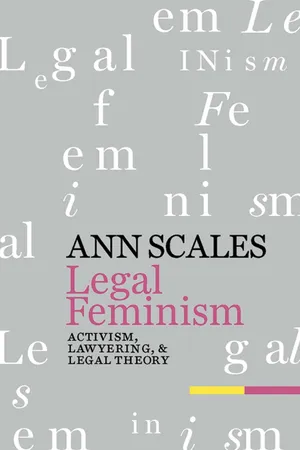
In the late 1970s, feminist scholars and activists joined together to build a movement aimed at bringing feminist theory and experiences to the practice and teaching of American law. Since then, the feminist jurisprudence movement has taken root, with courts and legislatures addressing matters of sex and gender inequality, and law schools employing feminist and post-feminist theory in the classroom. In this important book, Ann Scales, a founding contributor to the movement, reflects on the past, present, and future of feminist jurisprudence.
Legal Feminism situates the feminist jurisprudence movement within the larger context of Western law and philosophy, focusing first on common problem areas of legal theory and decision-making, and then explaining how feminist jurisprudence can analyze and address these issues in new ways. Throughout, Scales draws on legal disputes to show how feminist theory works in the courtroom and in other real-life arenas.
Part personal memoir, part primer, and part treatise, Legal Feminism is a de-jargonized, lively account of how feminist jurisprudence can solve traditional legal conflicts, and why it matters to anyone committed to building an equitable and progressive society.
- 217 pages
- English
- ePUB (mobile friendly)
- Available on iOS & Android
eBook - ePub
About this book
Information
Topic
DroitSubtopic
Le genre et la loiNotes
NOTES TO THE INTRODUCTION
1. See Ann Scales, “Towards a Feminist Jurisprudence,” 56 Indiana Law Journal 375 (1981); “The Emergence of Feminist Jurisprudence,” 95 Yale Law Journal 1373 (1986); “Militarism, Male Dominance, and the Law: Feminist Jurisprudence as Oxymoron?” 12 Harvard Women’s Law Journal 25 (1989). Some dislike the term “jurisprudence” because it sounds haughty or pseudoscientific. I, too, am critical of scientistic pretense in law (a position developed in chapter 3). I am fond of the term “jurisprudence,” however, for two reasons. First, in my mind, it refers to the legal theory generated by lawyers, as opposed to theories about law emerging from other disciplines. Second, the term makes it possible to refer to those engaged in the enterprise as “jurisprudes,” and that’s fun. In any case, I use the terms “feminist jurisprudence” and “feminist legal theory” interchangeably in this book.
2. See Black’s Law Dictionary (8th ed. 2004) (under category of “jurisprudence,” crediting me with first published use of the term “feminist jurisprudence”); Patricia A. Cain, “Feminist Jurisprudence: Grounding the Theories,” 4 Berkeley Women’s Law Journal 191, 193 (1989–90) (reporting that I coined the term as a student in 1977, while planning a panel for the celebration of the twenty-fifth class of women to graduate from Harvard Law School); Sheila James Kuehl, “For the Women’s Reach Should Exceed Their Grasp, or How’s a Law Journal to be Born?” 20 Harvard Women’s Law Journal 5, 7 (1997) (same).
3. Martha Chamallas, Introduction to Feminist Legal Theory (New York: Aspen Publishers, 2d ed., 2003).
4. I will refer in this book to most of these variations and achievements, and will offer definitions as needed, but I refer the reader to Professor Chamallas for the basic bibliography.
5. Matthew Brelis, “Law Professor’s Murder Still Unsolved a Year Later, Few Leads in ‘Classic Whodunit,’” Boston Globe, April 5, 1992, at 29; Matthew Brelis, “An Accomplished Life, A Brutal Death,” Boston Globe, April 14, 1991.
6. Mary Joe Frug, “A Postmodern Feminist Legal Manifesto (An Unfinished Draft),” 105 Harvard Law Review 1045 (1992); Fox Butterfield, “Parody Puts Harvard Law Faculty in Sexism Battle,” New York Times, April 27, 1992, at A10.
7. For an almost visceral experience of the disappearing of Mary Joe Frug, read Peter Collier, “Blood on the Charles,” Vanity Fair, October 1992, at 144. Professor Patricia Williams says that what she found remarkable about the parody incident was that discussion of it
on campus and in newspapers, swirled mostly around whether the editors (who went on to employment as clerks of Supreme Court Justices and associates in powerful rainmaking firms), had the legal right to say it. Indeed they did. That said, the curious culture of sadism that produced it was scarcely addressed.
Patricia J. Williams, “The Disquieted American,” Nation, May 26, 2003, at 9.
8. See Ann Scales, “Disappearing Medusa: The Fate of Feminist Legal Theory?” 20 Harvard Women’s Law Journal 34 (1997).
9. Professor Halley has published various articles making the argument. Best known is the one she published under the name Ian Halley, “Queer Theory by Men,” 11 Duke Journal of Gender, Law, and Policy 7 (2004).
10. My brief talk to the Tenth Circuit is reprinted as “Law and Feminism: Together in Struggle,” 51 University of Kansas Law Review 291 (2003).
11. Recurring in the debate are Harry T. Edwards, “The Growing Disjunction Between Legal Education and the Legal Profession,” 91 Michigan Law Review 34 (1992), and the other articles in that symposium issue of the Michigan Law Review. See also Alex Kozinski, “Who Gives a Hoot about Legal Scholarship?” 37 Houston Law Review 295 (2000); Sanford Levinson, “The Audience for Constitutional Meta-Theory (or, Why, and to Whom, Do I Write the Things I Do?),” 63 Colorado Law Review 389 (1992); David M. Ebel, “Why and to Whom Do Constitutional Meta-Theorists Write?—A Response to Professor Levinson,” 63 Colorado Law Review 409 (1992).
12. For an excellent overview of the sources, see William W. Fisher III, Morton J. Horwitz, and Thomas A. Reed, eds., American Legal Realism (New York: Oxford University Press, 1993).
13. “The statement has been made so frequently that it has become a truism to refer to it as a truism.” Lauren Kalman, Legal Realism at Yale, 1927–1960 (Chapel Hill: University of North Carolina Press, 1986), at 229.
14. David Luban, “What’s Pragmatic about Legal Pragmatism?” 18 Cardozo Law Review 43, 72 (1996).
15. Oliver Wendell Holmes, Jr., “The Path of the Law,” 10 Harvard Law Review 457, 477–78 (1897).
16. Richard A. Posner, “What Has Pragmatism to Offer Law?” in Michael Brint and William Weaver, eds., Pragmatism in Law and Society (Boulder: West-view Press, 1991), at 44.
17. Thomas C. Grey, “Freestanding Legal Pragmatism,” 18 Cardozo Law Review 21, 26 (1996).
18. Will Rogers, quoted in Joseph H. Carter, I Never Met a Man I Didn’t Like: The Life and Writings of Will Rogers (New York: Avon Books, 1991), at 186.
19. The jurisprudential views that include lenses of class, race, ethnicity and/or gender are the ones that are usually deemed illegitimate or unhelpful. For example, Judge Alex Kozinski of the United States Court of Appeals for the Ninth Circuit has acknowledged that at least two jurisprudential movements, Legal Realism and Law and Economics, have had profound influences on the administration of the law. He went on to predict, however, that “Critical legal studies and its offshoots—critical race theory, critical feminism, and the like” would not “be accepted.” Alex Kozinski, “Who Gives a Hoot about Legal Scholarship?” 37 Houston Law Review 295, 317 (2000). I share the perplexity expressed by Professor David Dow about how we go about measuring such acceptance. In any case, as Professor Dow reminds us, at least critical legal studies has had a profound impact in that it has “taught us something about law, and that is the measure of relevance.” David R. Dow, “The Relevance of Legal Scholarship: Reflections on Judge Kozinski’s Musings,” 37 Houston Law Review 329, 337 n. 35 (2000).
20. “Two intellectual movements—critical race theory and gay and lesbian legal studies—are currently so closely allied with post-essentialist feminist writings that it is difficult to tell whether all three will eventually merge into a more unified approach (such as anti-subordination theory) or will continue to develop among more distinctive lines.” Chamallas, note 3, at 135.
21. A number of papers and reports about gender mainstreaming are available at the Council of Europe Web site, http://www.coe.int.
22. Respectively, they are “The Emergence of Feminist Jurisprudence,” 95 Yale Law Journal 1373 (1986), and “Feminist Legal Method: Not So Scary,” 2 U.C.L.A. Women’s Law Journal 1 (1992).
23. Richard Rorty, “Pragmatism and Law: A Response to David Luban,” in Philosophy and Social Hope (New York: Penguin Books, 1999), at 112.
24. Claire L’Heureax-Dubé, “The Importance of Dialogue: Globalization and the International Impact of the Rehnquist Court,” 34 Tulsa Law Journal 15 (1998). At the time she published this piece, Madame L’Heureax-Dubé was a Justice of the Supreme Court of Canada. She is now retired.
NOTES TO CHAPTER 1
1. John Adams coined the phrase “a government of laws, and not of men.” John Adams, “Novanglus Papers, No. 7” (1774), in 4 Works of John Adams (Charles Francis Adams, ed. 1851), at 106. For a range of contemporary commentaries, see: George P. Fletcher, Basic Concepts of Legal Thought (1996), at 12 (“[W]e are never quite sure what we mean by ‘the rule of law.’”); Ian Shapiro, ed., The Rule of Law: Nomos XXXVI (1994); Allan C. Hutchinson and Patrick Monahan, eds., The Rule of Law: Ideal or Ideology (Toronto: Carswell, 1987); David Kairys, “Searching for the Rule of Law,” 36 Suffolk University Law Review 307 (2003); Michael Rosenfeld, “The Rule of Law and the Legitimacy of Constitutional Democracy,” 74 Southern California Law Review 1307 (2001); Jessie Allen, “Blind Faith and Reasonable Doubts: Investigating Belief in the Rule of Law,” 24 Seattle University Law Review 691 (2001); James W. Torke, “What Is This Thing Called the Rule of Law?” 34 Indiana Law Journal 1445 (2001); William C. Whitford, “The Rule of Law,” 2000 Wisconsin Law Review 723 (2000); Richard H. Fallon, Jr., “‘The Rule of Law’ as a Concept in Constitutional Discourse,” 97 Columbia Law Review 1 (1997); Francis J. Mootz, “Is the Rule of Law Possible in a Postmodern World?” 68 Washington Law Review 249 (1993); Robert S. Summers, “A Formal Theory of the Rule of Law,” 6 Ratio Juris 127 (1993); Margaret Jane Radin, “Reconsidering the Rule of Law,” 60 Boston University Law Review 781 (1989); Joseph Raz, “The Rule of Law and Its Virtue,” in The Authority of Law: Essays on Law and Morality (New York: Oxford University Press, 1979), at 210.
2. United States v. Nixon, 418 U.S. 683 (1974) (President must comply with subpoena issued in a criminal investigation) (Justice Rehnquist did not participate in the decision). The subpoena in question was for audiotapes that President Nixon made and maintained of conversations within the Oval Office. On August 9, 1974, four days after release of transcripts of the tapes and sixteen days after the decision of the Court, President Nixon resigned.
3. My research assistant queried the term “rule of law” in Westlaw as a self-contained phrase, excluding serendipitous conjunctions of the words, in the Clinton Impeachment Transcripts database. The term was counted when referenced in the verbatim transcripts of the House of Representatives Judiciary Committee Hearing, the House Floor Debate, and the Senate Impeachment Hearings, and not in any other materials. Clinton Impeachment Transcripts, www.westlaw.com.
4. U.S. Representative Henry Hyde (R-Illinois) Holds Hearings on Articles of Impeachment of President Clinton, Hearing Before the House Comm. On the Judiciary, 105th Cong. (1998) (opening statement of Stephen E. Buyer (R-Indiana)).
5. House Floor Debate on the Four Articles of Impeachment Against President Clinton, 105th Cong. (1998) (statement of Representative Henry Hyde (R-Illinois)); U.S. Senate Holds the Impeachment Trial of President Clinton, 105th Cong. (1999) (statement of Representative Henry Hyde (R-Illinois)).
6. U.S. Senate Impeachment Trial of President Clinton, 105th Cong. (1999) (statement of Gregory B. Craig, Office of the White House Counsel).
7. U.S. Senate Impeachment Trial of President Clinton, 105th Cong. (1999) (statement of Charles F. C. Ruff, Office of the White House Counsel); see also U.S. Senate Impeachment Trial of President Clinton, 105th Cong. (1999) (statement of David E. Kendall, Attorney for President Clinton): “The rule of law is more than rhetoric. It means that in proceedings like these, where important rights are being adjudicated, that evidence matters. Fairness matters. Rules of procedural regularity matter. The presumption of innocence matters. And proportionality matters.”
8. Thomas Carothers, “The Rule of Law Revival,” Foreign Affair...
Table of contents
- Cover Page
- Title Page
- Copyright Page
- Dedication
- Contents
- Acknowledgments
- Introduction
- I Places of Stuckness: Roles, Rules, Facts, and the Liberal View of Human Nature
- II Places beyond Stuckness: Feminist Notions, Controversies, and Promises
- Notes
- Index
- About the Author
Trusted by 375,005 students
Access to over 1.5 million titles for a fair monthly price.
Study more efficiently using our study tools.
Frequently asked questions
Yes, you can cancel anytime from the Subscription tab in your account settings on the Perlego website. Your subscription will stay active until the end of your current billing period. Learn how to cancel your subscription
No, books cannot be downloaded as external files, such as PDFs, for use outside of Perlego. However, you can download books within the Perlego app for offline reading on mobile or tablet. Learn how to download books offline
Perlego offers two plans: Essential and Complete
- Essential is ideal for learners and professionals who enjoy exploring a wide range of subjects. Access the Essential Library with 800,000+ trusted titles and best-sellers across business, personal growth, and the humanities. Includes unlimited reading time and Standard Read Aloud voice.
- Complete: Perfect for advanced learners and researchers needing full, unrestricted access. Unlock 1.5M+ books across hundreds of subjects, including academic and specialized titles. The Complete Plan also includes advanced features like Premium Read Aloud and Research Assistant.
We are an online textbook subscription service, where you can get access to an entire online library for less than the price of a single book per month. With over 1.5 million books across 990+ topics, we’ve got you covered! Learn about our mission
Look out for the read-aloud symbol on your next book to see if you can listen to it. The read-aloud tool reads text aloud for you, highlighting the text as it is being read. You can pause it, speed it up and slow it down. Learn more about Read Aloud
Yes! You can use the Perlego app on both iOS and Android devices to read anytime, anywhere — even offline. Perfect for commutes or when you’re on the go.
Please note we cannot support devices running on iOS 13 and Android 7 or earlier. Learn more about using the app
Please note we cannot support devices running on iOS 13 and Android 7 or earlier. Learn more about using the app
Yes, you can access Legal Feminism by Ann Scales in PDF and/or ePUB format, as well as other popular books in Droit & Le genre et la loi. We have over 1.5 million books available in our catalogue for you to explore.