Though American crime novels are often derided for containing misogynistic attitudes and limiting ideas of masculinity, Greg Forter maintains that they are instead psychologically complex and sophisticated works that demand closer attention. Eschewing the synthetic methodologies of earlier work on crime fiction, Murdering Masculinities argues that the crime novel does not provide a consolidated and stable notion of masculinity. Rather, it demands that male readers take responsibility for the desires they project on to these novels.
Forter examines the narrative strategies of five novels--Hammett's The Glass Key, Cain's Serenade, Faulkner's Sanctuary, Thompson's Pop. 1280, and Himes's Blind Man with a Pistol--in conjunction with their treatment of bodily metaphors of smell, vision, and voice. In the process, Forter unearths a "generic unconscious" that reveals things Freud both discovered and sought to repress.
eBook - ePub
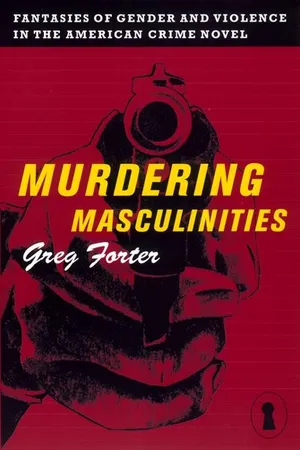
Murdering Masculinities
Fantasies of Gender and Violence in the American Crime Novel
- 278 pages
- English
- ePUB (mobile friendly)
- Available on iOS & Android
eBook - ePub
About this book
Information
1 Hardboiled Masochism
The Corpse in Dashiell Hammett’s The Glass Key
“I liked somebody being dead”
Let us begin with the hardboiled detective novel, as this—according to the critical history—is both the first American species of crime novel and the most resolutely masculinist.1 These two claims are not unrelated. The American character of the hardboiled form resides in part, as critics have noted, in its preoccupation with violence.2 And that violence typically includes a misogyny by which the male hero defines himself by vanquishing a feminine principle that threatens his “sense of discrete self.”3 The pleasure of hardboiled reading in this sense inheres in our identification with an invulnerable agent of male power and mastery. It results from our imaginative alignment with a man whose mastery includes a capacity to overcome a feminine “outside” that threatens to pierce and dissolve him, as well as a more conventional ability to reduce semantic plurality to a unity by solving the mystery’s crime.
Without denying this basic characterization, I want to begin by suggesting that there are pleasures to hardboiled reading that can’t be contained within these contours. Critics have often noted these pleasures, though without pursuing their full implication. They’ve stressed, for example, how hardboiled fiction lingers over linguistic textures and non-teleological narrative elements that are strictly absent from the analytical detective story, and that tend to downplay or even subvert the pleasures of solution.4 And they’ve emphasized how the hardboiled detective, far from demonstrating unending mastery, often becomes a manipulated object and even a victim of violence. Tzvetan Todorov thus speaks of hardboiled fiction as “the story of the vulnerable detective.” “Its chief feature,” he writes, “is that the detective loses his immunity, gets beaten up, badly hurt, constantly risks his life, in short, he is integrated into the universe of the other characters, instead of being an independent observer.”5 Marty Roth suggestively re-describes this danger in terms of a masochistic erotics within the hardboiled form. “Masochism,” he writes, “flourishes in hardboiled detective fiction,” as “[a]sking for pain is the point of the detective’s dares and challenges and his wisecracks.”6 The repeated danger that the dick encounters results in this light from his compulsively repetitive effort to put himself in harm’s way. And a final comment, by Gertrude Stein, links this effort more generally to the dilatory pleasures of hardboiled reading:
I never was interested in cross word puzzles or any kind of puzzles but I do like detective stories. I never try to guess who has done the crime and if I did I would be sure to guess wrong but I liked somebody being dead and how it moves along and Dashiell Hammett was all that and more.7
“How it moves along,” not “how it ends”: the penetration of the mystery is here inessential to the pleasure of hardboiled reading. “I liked somebody being dead,” Stein says. Such a preference may help refine our sense of the “other” hardboiled enjoyment. For to say “I like somebody being dead” is to say that the end-pleasure of narrative significance is subordinated to what we might call the fore-pleasure of a traumatic violation. It’s to offer the disturbing but provocative suggestion that the hardboiled corpse—the very thing that provides the mystery and seems therefore most intimately bound up with a temporality of semantic recuperation—is also that which erodes that temporality, dysfunctionalizes pleasure, fixates us on a brute physicality that resists hermeneutic or semantic redemption. To be sure, the detective conventionally manages to overcome that resistance. And, to be sure, he typically does so through gestures of mastery whose incipient misogyny often becomes explicitly violent and central to his success. But inasmuch as the hardboiled novel subordinates the sense of an ending, the scene of the crime might be said to become not just something to be reconstructed and mastered but a scene to whose trauma we’re invited to submit. It becomes not merely the impetus for a quest that dramatizes the detective’s prowess, but also an initiation into the limits of that prowess: an opportunity to let the mind play over death as one’s ownmost destiny.
In this sense the “somebody” one likes “being dead” is not, perhaps, someone else at all. The corpse elicits in us and the dick an identification, a desire to be dead. It asks the detective to embark on a journey in which he compulsively courts a violence that threatens his imminent death. And it encourages us to partake of that journey through acts of imaginative identification. To the extent that we enjoy ourselves through this identification, the hardboiled novel begins to subvert the conventionally masculine commitment to mastery, exposing it as a reflex of fear that masks a secret desire: a desire for the renunciation of power in the name of a compulsively repeated submission to the pleasures of masochistic pain.
In order to describe this desire more fully, I want to turn at this point to Freud’s late essay, Beyond the Pleasure Principle (1920), which offers a searching account of the relations between pleasure, mastery, and submission. A reading of this text can help us explore the masochistic dimension to pleasure in a way that connects it to the compulsively repetitive character of the detective’s pursuit of pain. We can do this, however, only by reading Freud in some ways against himself—by suggesting that the hardboiled novel makes visible things about the pleasures of repetition that Freud both sees and seeks to repress.
Beyond the Pleasure Principle attempts at first to theorize compulsive submission in terms of a basic drive toward mastery. “The child cannot possibly have felt his mother’s departure as something agreeable or even indifferent,” writes Freud in the famous fort/da section. “How then does his repetition of this distressing experience as a game fit in with the pleasure principle?”8 The answer he gives begins as follows:
[O]ne gets the impression that the child turned his experience [of his mother’s departure] into a game from another motive. At the outset he was in a passive situation— he was overpowered by the experience; but, by repeating it, unpleasurable though it was … he took on an active part. These efforts might be put down to an instinct for mastery that was acting independently of whether the memory was in itself pleasurable or not. (16)
Passivity stands to unpleasure as activity does to the (linguistic) binding of that unpleasure, and to a consequent pleasure-in-mastery. What Freud intuits yet represses in this series is the possibility of a pleasurable compulsion, since pleasure needs to reside with mastery if the term “perversion” is to retain its significance. A pleasurable compulsion would be a perverse pleasure in being unpleasurably “overpowered by [an] experience.” It would be a pleasure in masochistic submission to the influx of painful excitation, rather than the incipiently sadistic enjoyment to be had from subduing by binding that excitation. Since Freud sees pleasure as a state corresponding to “a diminution” of unbound energy in the mind (8), a repetition that declines to master such excitation—either by discharging it or by psychically binding it—can for him be only a kind of abnormality. The opposition between death drive and Eros will thus turn out to require and enforce the separation of compulsion from enjoyment itself.
For if—as Freud goes on to argue—the compulsion to repeat is the sign of the ego’s most radically deathward tendencies, it must be subordinated to this opposition if it is to become conceptually legible. If such repetition is the mark of the psyche’s deathly drive to unbind itself, then locating pleasure on the side of compulsion enables an erotics of increased psychic tension in which the ego takes pleasure in its own unpleasurable undoing. Compulsive enjoyment is exactly this enjoyment in the impulse to self-destruction. Neither the satisfaction attaching to masterful binding nor the biologized satiation of an ultimate or complete discharge, such enjoyment is the vexatious pleasure of a compulsively repeated embrace of psychic tension that tends ineluctably toward death. It’s the pleasure of a boy repeatedly submitting to the pain of his mother’s departure, for no reason more or less than the sheer unmitigated hell of it. It’s a pleasure that, far from being masterful, resides instead in the ego’s desire to repeat a remembered unpleasure in order self-explosively to submit to it. And it’s in this compulsively pleasurable submission that the stakes of Freud’s argument start to become clear. The death drive, after all, along with the compulsion to repeat that instantiates it, is meant to lie somewhere “beyond” the pleasure principle, not to inhere secretly within it. To the extent that his argument might therefore fail to separate enjoyment from compulsive repetition, it threatens to transform its intended message—“I seek (nonerotically) my own death”—into its more radically true one: “I like (take pleasure in) somebody (myself) being dead (ecstatically dying).”9
And there can be little doubt that the text fails to keep these terms apart. Freud’s recourse to “an instinct for mastery,” in a passage meant to explain a child’s compulsive submission to unpleasure, betokens his surrender to an oxymoronic logic that portends a complete theoretical collapse. For the concept of an “instinct” has meaning only if we take it seriously as something to which we must submit. Instincts master us, not we them. The most plausible reading, then, of an “instinct for mastery” is that I am compelled, driven, submitted to (my own) mastery, that in submitting I become master, and in mastering, I give myself up. The pleasure attendant on a will-to-mastery becomes indissociable from the conceptual incoherence of a (masochistically) pleasurable unpleasure.10 What we give up for the sake of such mastery is the prior and compulsively repetitive pleasure of masochistic surrender itself, and hence the peculiarly repetitive character of Freud’s second account of his grandson’s game:
These efforts might be put down to an instinct for mastery that was acting independently of whether the memory was in itself pleasurable or not. But still another interpretation may be attempted. Throwing away the object so that it was “gone” might satisfy an impulse of the child’s … to revenge himself on his mother for going away from him. In that case it would have a defiant meaning: “All right, then, go away! I don’t need you. I’m sending you away myself.” (16)
If, as Freud says, “another interpretation may be attempted,” we might well wonder why the content of that “other interpretation” resembles so closely that of the first. The movement from explanation one (“it’s not masochism, it’s a will-to-mastery”) to explanation two (“it’s still not masochism, it’s sadism”) is almost no movement at all. The second proposition merely extends and renders explicit the aggression implicit in the “instinct for mastery” of the first. Freud’s own compulsion to repeat, therefore, the excess of his explanatory ardor, allows us to read in that very repetition a negative affirmation of the assertion his explanations are designed to disallow. When a footnote describes the child staging his own disappearance in a mirror (15), we’re entitled to see in that action what Freud tries not to see, to prevent us from seeing: that this moment marks the disruptive restaging of an originary and involuntary self-abnegation that pre-dates the pretensions of sadistic mastery and well-bound egoic control. The entire project of searching for something “beyond” the pleasure principle now comes into focus as a defense against the recognition that there is, in truth, nothing beyond it, and that consequently, the compulsive submission to unpleasurable tension may be not just enjoyable, but sexual enjoyment itself.11
How to Be Dead in Style
Let us return, then, to the scene of crime, in order to reformulate our thesis. The pleasure I take in hardboiled reading is in part the pleasure that Freud would deny me: a pleasure in the unpleasure of increased psychic tension that might more properly be said to “take me,” in that it entails my compulsory luxuriance in being possessed, broken, and lost to myself. What does this mean? Or—more crucially—what does it look like?
In what follows I explore such questions particularly in the work of Dashiell Hammett, who’s both the acknowledged first master of the hardboiled form and a far more eccentric figure than critics have usually acknowledged. His eccentricity is nowhere more evident than in two key elements of his work. First, Hammett was unusually interested in third-person stylistic experiments. He wrote two of his five finished novels in the third person, and this places him in an idiosyncratic relation to a tradition dominated by the first-person voice of a cynical but sentimental detective.12 Second, only one of his five finished novels (The Maltese Falcon) relies for resolution on a full-blown, Blame-it-on-Mame femme fatale. Given the centrality of that figure within the hardboiled canon, this fact should seem stranger to readers than it apparently does. My claim is that it’s connected to the first eccentricity I’ve mentioned. For despite the fact that the novel that relies on a femme fatale is written in the third person, I will be suggesting that the third-person style provided Hammett with an idiom with which to subvert the masculinism that requires the production and ultimate destruction of that figure. He uses that style to shatter, in ways I shall describe in The Glass Key (1931), the fiction of a psychically invulnerable and impermeable masculinity. The style enables him to do so as part of a larger attempt to make men acknowledge that the violence they imagine as the external threat of a dangerous woman is, in fact, the disguised return of an inadmissible pleasure: a pleasure in psychic self-dissolution that I’ve begun to describe through Freud, and that’s deeply at odds with our culture’s commitment to masculine singularity and power. Hammett’s eccentricity in this sense results from the fact that the hardboiled tradition has sought to repress the dangerous pleasures he offers. Those pleasures nonetheless continue to reverberate within the texts of that tradition, and make it possible to think of Hammett’s work as giving us access to the unconscious truth of hardboiled pleasure itself.
Here is how The Glass Key opens:
Green dice rolled across the green table, struck the rim together, and bounced back. One stopped short holding six white spots in two equal rows uppermost. The other tumbled out to the center of the table and came to rest with a single spot on top.13
Language like this wreaks, to begin with, a kind of epistemological havoc, as it practically disappears in the gesture of its emergence and unsays as much as it says. We can stress as critics often have the “clipped,” “bare,” “sparse,” “lean,” “clean,” or “hard” stylistic indices. We can even note the observational and practically monosyllabic precision of this language, which seems to record with photographic accuracy the objects on which it focuses. But what’s crucial to my mind is the withholding character of a discourse that seems, at the same time, so generously attentive to the minutiae of detail that it’s almost forced to operate in slow-motion. (We could even read the numbers on the two dice—one giving in abundance, the other reluctant and refraining—as a kind of representational announcement of this parsimonious generosity.) The temporal distention of an event that lasts seconds mirrors in miniature the dilatory fixations of hardboiled narrative as a whole, while simultaneously masking, beneath the strained attitude of its concentration, the informational dearth of its content. Where are we? When? Who’s there? Who’s speaking? At the extreme, these epistemological uncertainties give way to a kind of ontological murder, which is figured already in the extirpation of human agency from this passage. The dice appear to roll themselves; they’re animated with a subjective agency that should not strictly belong to them, striking, stopping, tumbling, and holding in a way that invests them with a human dignity whose very condition, as we shall see, is the stylistic eradication of humanity itself.
But let us begin with the epistemological difficulties posed by this language. We can start by noting that at least some of the omissions of knowledge are made good in the subsequent narrative. In an almost cinematic manner, the novel could be said to relay us in relative coherence along its syntagmatic chain, displacing readerly desire from “cut” to “cut” and trans-forming each “shot” retrospectively into a signifier that makes good the lack of the previous. Thus, when the text moves in the second paragraph to “Ned Beaumont grunt[ing] softly,” it begins to fill in the gaps in knowledge broached by its opening passage. Part of the fictive world that the initial close-up omits is conjured into the field of vision by this second shot, in the person of Ned Beaumont. That shot, meanwhile, can’t but leave out something else, which it then requires a third shot to provide—and so on. In the very movement of narrational unfolding, epistemological lacks are made good in this way: through the gradual production of a knowable world that, thanks to the recognizable solidity of its contours, confers on the reader a sense of sufficiency, mastery, and knowledgeable control. The gambling room acquires fixed coordinates; the novel peoples it, locates it in larger temporal and spatial networks, embroils it in a plot that endows it with meaning and promises to infuse it with significance. The text’s capacity to render its world familiarly mappable in this way—as well as its ability to bind that world in a hermeneutically compliant plot that illuminates it—enables the reader progressively to become an imaginary master of the narrative kingdom. Epistemological desire is thus the desire both of and for realism: a desire for conventions of narrative and verisimilitude that the novel can hardly fail in certain basic respects to satisfy.
And yet the fictive world of The Glass Key retains an oddly emaciated look, an eerily evaporative proclivity. We’ve come a long way from the social density of even, say, a Henry James novel, in part because Hammett only incompletely fulfills the requirements of epistemological lucidity I’ve been describing. The location of the main action remains unspecified throughout, the historical mome...
Table of contents
- Cover Page
- Title Page
- Copyright page
- Dedication
- Contents
- Acknowledgments
- Introduction
- 1 Hardboiled Masochism: The Corpse in Dashiell Hammett’s The Glass Key
- 2 Deadly Is the Female Animal: Smell in James Cain’s Serenade
- 3 The Apocalypse of Male Vision: Vomit in William Faulkner’s Sanctuary
- 4 The Killer in Me Is the Killer in You: Violent Voice in Jim Thompson’s Pop. 1280
- 5 The Waste of White Masculinity: Excrement in Chester Himes’s Blind Man with a Pistol
- Afterword
- Notes
- Index
- About the Author
Trusted by 375,005 students
Access to over 1.5 million titles for a fair monthly price.
Study more efficiently using our study tools.
Frequently asked questions
Yes, you can cancel anytime from the Subscription tab in your account settings on the Perlego website. Your subscription will stay active until the end of your current billing period. Learn how to cancel your subscription
No, books cannot be downloaded as external files, such as PDFs, for use outside of Perlego. However, you can download books within the Perlego app for offline reading on mobile or tablet. Learn how to download books offline
Perlego offers two plans: Essential and Complete
- Essential is ideal for learners and professionals who enjoy exploring a wide range of subjects. Access the Essential Library with 800,000+ trusted titles and best-sellers across business, personal growth, and the humanities. Includes unlimited reading time and Standard Read Aloud voice.
- Complete: Perfect for advanced learners and researchers needing full, unrestricted access. Unlock 1.5M+ books across hundreds of subjects, including academic and specialized titles. The Complete Plan also includes advanced features like Premium Read Aloud and Research Assistant.
We are an online textbook subscription service, where you can get access to an entire online library for less than the price of a single book per month. With over 1.5 million books across 990+ topics, we’ve got you covered! Learn about our mission
Look out for the read-aloud symbol on your next book to see if you can listen to it. The read-aloud tool reads text aloud for you, highlighting the text as it is being read. You can pause it, speed it up and slow it down. Learn more about Read Aloud
Yes! You can use the Perlego app on both iOS and Android devices to read anytime, anywhere — even offline. Perfect for commutes or when you’re on the go.
Please note we cannot support devices running on iOS 13 and Android 7 or earlier. Learn more about using the app
Please note we cannot support devices running on iOS 13 and Android 7 or earlier. Learn more about using the app
Yes, you can access Murdering Masculinities by Gregory Forter in PDF and/or ePUB format, as well as other popular books in Social Sciences & Gender Studies. We have over 1.5 million books available in our catalogue for you to explore.