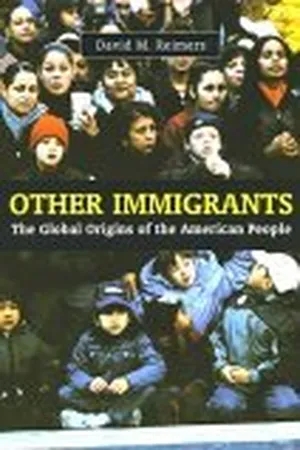
Blacks, Hispanics, and Asians represent three of every four immigrants who arrived in the United States after 1970. Yet despite their large numbers and long history of movement to America, non-Europeans are conspicuously absent from many books about immigration.
In Other Immigrants, David M. Reimers offers the first comprehensive account of non-European immigration, chronicling the compelling and diverse stories of frequently overlooked Americans. Reimers traces the early history of Black, Hispanic, and Asian immigrants from the fifteenth century through World War II, when racial hostility led to the virtual exclusion of Asians and aggression towards Blacks and Hispanics. He then tells the story of post-1945 immigration, when these groups dominated the immigration statistics and began to reshape American society.
The capstone to a lifetime of groundbreaking work on immigration, Reimers’s thoughtful history recognizes the ambiguity and subjectivity of race, noting that individuals often define themselves more complexly than census forms allow. However classified, record numbers of immigrants are streaming to the United States and creating the most diverse society in the world. Other Immigrants is a timely account of their arrival.
- 389 pages
- English
- ePUB (mobile friendly)
- Available on iOS & Android
eBook - ePub
About this book
Information
Topic
StoriaSubtopic
Storia nordamericanaPART I
From beyond Europe,
1492–1940
After 1492 the French, Spanish, and English were the major explorers of America, but the Dutch West India Company was also active. Once the colonies became established, Europeans, especially those from the British Isles, were most influential. Europeans had the greatest numbers, and they had the power to control the largest group of non-European peoples, black slaves from Africa, who made up 20 percent of the American population at the time of the Revolution.
The French influence was limited to Canada and New Orleans, whereas the Spanish presence was restricted to Florida and the Southwest, which did not become part of the United States until 1848. Amid the English colonies along the Atlantic Coast, small settlements of Swedes and Dutch were established, but they were quickly absorbed by the English.
During the eighteenth century, substantial numbers of Germans and Scots-Irish settled in the colonies. The Scots-Irish, Protestant settlers from the northern part of Ireland, were especially prominent in Pennsylvania and the backcountry of the southern colonies. Germans also scattered to the frontier, but they were most prominent in Pennsylvania. Smaller numbers of French Huguenots, Dutch, Catholic Irish, Scots, and Jews from Brazil and Amsterdam also arrived. A few immigrants settled in towns and cities, but most lived in agricultural areas. Pennsylvania and New York City, with their ethnically diverse populations, became models for the American future, a pluralist society.
In the 1790s Germans, Irish, and French came to America, but their numbers were not large, and immigration was disrupted during the Napoleonic Wars. The federal government took little interest in immigration and did not even begin to count the new arrivals until 1819. But then immigration picked up again. The Irish potato famines after 1840 sent hundreds of thousands of Irish to the United States. Germans were also forced by economic conditions to head for the United States, and Germans became the largest group of immigrants until they were surpassed in recent years by Mexicans. Five million immigrants arrived between 1840 and 1860, representing the first mass immigration to America. After the lull during the Civil War, immigration again increased from Ireland and Germany. In the late nineteenth century, large numbers of southern and eastern Europeans—Poles, Slovaks, Greeks, Italians, and Russian and Polish Jews—migrated to America. They were joined by Scandinavians: Norwegians, Swedes, and Danes. After 1900, Germans and Irish still came but in reduced numbers. During this period of mass immigration, French speakers from Canada also came to farm and work in New England mill towns. Overall, some 24 million immigrants settled in the United States from the 1880s to the 1920s. In 1910 the American foreign-born population, overwhelmingly European, accounted for 14.7 percent of the United States population, the highest proportion in American history.
The flow from Europe did not diminish until Congress put up barriers in the 1920s. The new system was strictly enforced during the Great Depression and World War II. Only 700,000 persons arrived from 1930 to 1945, a figure that was surpassed annually in the first decade of the twentieth century.
While Europeans dominated the immigration statistics before the 1940s, people of color—Asians, blacks, and Latinos—also joined the movement to the United States. Most black newcomers were slaves, but black West Indians came voluntarily, especially after 1900. In the nineteenth century Asians also decided on their own to make America their new home. When the numbers of Asians grew, the American government banned their entrance. Some Latinos settled in the United States in the second half of the nineteenth century, but more substantial numbers of Hispanics from Mexico entered from 1900 until the 1930s. The stories of these first people of color to settle in the United States before World War II are the subject of the first three chapters.
1
The Beginnings, 1550–1900
European men and women were not the only people exploring and settling in what is now the United States. Although Africans did not send ships to the Western Hemisphere, they worked on European vessels, sometimes in positions of authority; it was not unheard of for persons of one nationality or ethnicity to captain ships of another. Everyone knows that Christopher Columbus, an Italian, sailed under the flag of Spain when he made his famous voyage of 1492. But a black Portuguese also commanded a vessel, flying the flag of Spain, that entered New York City’s harbor in 1526. Two blacks accompanied Ponce de León during his “pacification” campaigns in the Caribbean.1 Among the first persons on European vessels to reach Texas was the Moor Estevanico, who was considered a black man. Estevanico, along with three whites, landed there in 1528 by chance when their vessel lost its way in a storm. In other cases ships’ crews were made up of a variety of ethnic groups.
How was it possible for blacks to work on ships sailing to the New World? North Africans had traded with Spain and had even settled there before the Spanish and the Portuguese explored the west coast of Africa. Among the exchanges from trading were west Africans; as a result, Africans, both slave and free, were found living along the Atlantic rim.2 By 1550, 10,000 people of African origin lived in Lisbon alone, and Seville claimed 6,000. One scholar has compared Seville to a “chessboard with equal numbers of black and white pieces.”3 Although blacks were found in other regions and nations, Spain and Portugal claimed the largest number, most of whom were slaves.4 Ira Berlin reports that some won their freedom and found niches in the Iberian Peninsula, as interpreters, peddlers, merchants, artisans, and sailors. Thus it was that black sailors accompanied European vessels to America, including the ships of Christopher Columbus. In other cases, after coming to America in chains, they were manumitted and went to sea as free men. Berlin notes that one Sebastian Cain from Massachusetts won his freedom, took to the sea, and settled in Virginia after visiting it several times.5 A number of these sailors decided to stay in the New World when their ships took them there, and by the end of the seventeenth century free blacks formed communities in the Western Hemisphere.6
Among these communities of Africans in the New World were free blacks in the Chesapeake region of Virginia and Maryland. Some historians believe that the first vessel of blacks to arrive in 1619 with “twenty Negars” was transporting black indentured servants to Jamestown. John Russell found evidence of black indentured servants who became free when their term was over.7 Slaves who had obtained their freedom, black indentured servants who had been freed after serving their term, and the small number of those who were free when they entered the country joined to form a free black community.8 Timothy Breen and Stephen Innes and others have traced free blacks in the Chesapeake region. The black settlers acquired property, married, used the courts, and raised tobacco.9
As slavery became more important to the economic development of the colonies, it became more difficult to purchase one’s freedom. Because of the tightening grip of slavery and because so few free blacks migrated to Virginia and Maryland, the free black population grew slowly until the American Revolution.
A small free black community also developed in South Carolina in the eighteenth century. As was the case in Virginia and Maryland, some of these blacks were indentured servants who obtained their freedom after a term of years; others were slaves who were manumitted; still others came in as free men and women. Marina Wikramanayke reports, “Free black immigration was also not uncommon, particularly in the coastal areas of Charleston, Beaufort and Georgetown.” She notes that James Mitchell, a prominent free black in antebellum South Carolina, was “a Portuguese mulatto seaman who, finding conditions in Charleston more congenial, forsook the sea and became a landowner.”10
The small number of free blacks in the southern colonies did not have the same rights as those of English or other immigrants. As white colonists increasingly turned to slavery to satisfy their labor needs, they feared that free blacks might become a troublesome presence. Planters and white farmers enacted a number of restrictions on free blacks, such as the right to vote or to serve in the militia, and free blacks had to pay special taxes.11 In contrast, the vast majority of European immigrants, including indentured servants whose terms were over, could become naturalized under the various acts passed by the English, the most important being the Naturalization Act of 1740. Naturalization carried certain rights and privileges, including equal access to the ballot. More than 10,000 European immigrants were naturalized in the eighteenth century, of whom about 94 percent were Germans. In the critical days at the beginning of the American Revolutionary era, 2,600 Pennsylvania Germans became English citizens, and they voted in the assembly elections.12
In New Amsterdam, while under Dutch rule, slaves were permitted to have “half freedom.” This status did not grant them equality with white immigrants; it was given mainly to elderly slaves, and even then they had to pay an annual tribute. Moreover, “half freedom,” which allowed individuals to be virtually free, left the legal status of their children in the hands of the parents’ former owners. Slaves and free blacks did have some rights in the judicial system, such as testifying in court, but not total equality.13
Free blacks, although not equal to whites, nonetheless were better off than those who entered as slaves and remained enslaved for life.14 Moreover, slaves from Africa and the West Indies were brought to America under horrendous conditions. The story of the slave trade is a familiar one. Once bought or captured in Africa, slaves were taken to the New World like cattle. In a classic study, authors wrote of the Middle Passage, “Along with human cargoes, crowded, filthy, undernourished, and terrified out of the wish to live, the ships also carried an invisible cargo of microbes, bacilli, spirochetes, viruses, and intestinal worms from one continent to another; the Middle Passage was a crossroads and marketplace of diseases.”15 Conditions were so bad that about 10 percent died en route, a figure twice that for whites crossing the Atlantic, and those who survived still suffered deprivation and illness on the journey. In America they were sold on ship or in slave markets. By the first third of the eighteenth century, the native-born slave population outnumbered those who came from Africa, but the slave trade was still an important source for labor. Those engaged in the Atlantic slave trade were only too eager to provide black slaves for ready purchasers.
Historians differ over how much control slaves had of their own lives and how much of their African culture they were able to maintain in colonial America, but there is little disagreement about the brutality of the American slave system for either imported slaves or those born in the colonies. In many cases, especially in the early days of the colonies, slaves sometimes worked side by side with their owners or with white indentured servants. As the plantations turned increasingly to slave labor after 1700, white indentured workers became less common. By the eighteenth century life for the majority of incoming slaves was located on the growing plantations of the American southern colonies, cultivating rice, indigo, and tobacco. Working and living conditions were especially harsh on rice plantations, where health conditions were deplorable.16 On the tobacco plantations Ira Berlin notes, “Confined to the plantation, African slaves faced a new harsh work regimen as planters escalated the demands they placed on laborers in the tobacco fields.”17
As the century wore on, slaves lost much of the independence that had permitted them to grow their food and maintain a family life. Because slaves were defined as property, they could be bought and sold, thus breaking up their families. As for working conditions, Berlin concludes, “As plantation production expanded and the planters’ domination grew, slaves in mainland North America faced higher levels of discipline, harsher working conditions, and greater exploitation than ever before. Without question, members of the plantation generations worked longer, harder, and with less control over their own lives than did the members of the mixed labor force of slaves, servants, and wage workers, who had preceded them.”18
Because white owners feared the growth of an independent free black class, they grew increasingly reluctant to manumit their slaves and enacted a growing number of restrictions on slaves. Thus legislatures declared that conversion to Christianity did not entitle one to freedom. In the case of children born of parents where one was free and the other enslaved, the law declared the child would follow the mother. Most unions of free persons and slaves involved white men and black women slaves; hence, these children were slaves.19
During the American Revolutionary era, several northern states took steps to end slavery. Religion and the revolutionary rhetoric about equal rights played roles in the antislavery movement. Quakers, for example, were among the leaders persuading their members to rid themselves of slavery. In Massachusetts the courts declared that the new state constitution of 1780 providing for equal rights of men meant that no one could be a slave in that state. But the fact that slavery was not especially important to the economies of the northern states certainly explains why they abolished slavery. Most laws provided for gradual manumission, and slavery was not totally eliminated from the North until well into the nineteenth century. In addition, once freed, former slaves were not granted equal rights. They lacked the ballot in many states, were segregated in schools as well as in some public accommodations and facilities, and faced growing hostility as the antislavery movement became more radical after 1830.20
Some blacks entered northern states as free persons. In 1850 16 percent of the blacks in Boston were foreign born. A few came from the West Indies, but about half of them migrated from Canada, and a few entered from Europe, South America, or Africa. One scholar suggests that those born in Africa were originally slaves who had obtained their freedom, but at least some blacks had probably entered as free immigrant...
Table of contents
- Cover Page
- Title Page
- Copyright Page
- Dedication
- Contents
- Preface
- Introduction
- Part I: From beyond Europe, 1492–1940
- Part II: The Emergence of a New Multicultural Society, 1940–Present
- Epilogue
- Notes
- Suggested Reading
- Index
- About the Author
Trusted by 375,005 students
Access to over 1.5 million titles for a fair monthly price.
Study more efficiently using our study tools.
Frequently asked questions
Yes, you can cancel anytime from the Subscription tab in your account settings on the Perlego website. Your subscription will stay active until the end of your current billing period. Learn how to cancel your subscription
No, books cannot be downloaded as external files, such as PDFs, for use outside of Perlego. However, you can download books within the Perlego app for offline reading on mobile or tablet. Learn how to download books offline
Perlego offers two plans: Essential and Complete
- Essential is ideal for learners and professionals who enjoy exploring a wide range of subjects. Access the Essential Library with 800,000+ trusted titles and best-sellers across business, personal growth, and the humanities. Includes unlimited reading time and Standard Read Aloud voice.
- Complete: Perfect for advanced learners and researchers needing full, unrestricted access. Unlock 1.5M+ books across hundreds of subjects, including academic and specialized titles. The Complete Plan also includes advanced features like Premium Read Aloud and Research Assistant.
We are an online textbook subscription service, where you can get access to an entire online library for less than the price of a single book per month. With over 1.5 million books across 990+ topics, we’ve got you covered! Learn about our mission
Look out for the read-aloud symbol on your next book to see if you can listen to it. The read-aloud tool reads text aloud for you, highlighting the text as it is being read. You can pause it, speed it up and slow it down. Learn more about Read Aloud
Yes! You can use the Perlego app on both iOS and Android devices to read anytime, anywhere — even offline. Perfect for commutes or when you’re on the go.
Please note we cannot support devices running on iOS 13 and Android 7 or earlier. Learn more about using the app
Please note we cannot support devices running on iOS 13 and Android 7 or earlier. Learn more about using the app
Yes, you can access Other Immigrants by David Reimers in PDF and/or ePUB format, as well as other popular books in Storia & Storia nordamericana. We have over 1.5 million books available in our catalogue for you to explore.