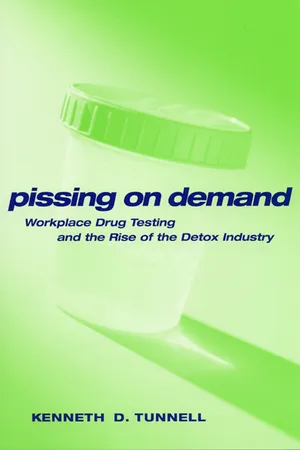
Drug testing has become the norm in many workplaces. In order to get a job, potential employees are required to provide their urine for testing. Pissing on Demand examines this phenomenon along with the resulting rise of the anti-drug testing movement, or the "detox industry," that works to beat these tests. Strategies include over-the-counter products like "body flushers" that sound innocent but are really designed to mask the presence of illegal drugs to kits advertised in pro-drug publications like High Times that make no bones about their real purpose. The first exposé of the detox industry in all its manifestations, this book is required reading for anyone concerned with social control, privacy, and workers' rights.
eBook - ePub
Pissing on Demand
Workplace Drug Testing and the Rise of the Detox Industry
- 179 pages
- English
- ePUB (mobile friendly)
- Available on iOS & Android
eBook - ePub
About this book
Information
1
The Emergence of Drug Testing
Prologue
After a successful career with the U.S. Air Force, David Lee applies for a pilot’s position with United Airlines. About the same time, his seventeen-year-old daughter, Hannah, applies for a part-time clerk’s job with her local Walmart. Although qualifications and interview processes are vastly different for these two applicants, each has to comply with one similar corporate policy. Each must, in the presence of a witness, urinate into a specimen cup. For United and Walmart, this final step in the application process yields unequivocal validation of David’s and Hannah’s abilities to perform their respective duties, regardless of other qualifications that they may possess. And despite David’s meritorious career as an air force pilot and Hannah’s straight A high school performance and the fact that she is applying for only a part-time clerk’s position, the urine sample has the ability to negate all other credentials. For if the sample test results are positive for drug use, each will be denied employment and perhaps forbidden from ever again applying to those corporations.
David’s and Hannah’s stories often are lost in the political maze of drug-testing policies and procedures. Yet, they are hardly unique, as millions of workers now face similar scrutiny. Pissing on demand is now a widely accepted requirement for employment. In the midst of these new invasive procedures for determining credentials, some job applicants and employees decide to quietly engage in subterfuge. This is their story.
During the past two decades, Americans have witnessed some frightening social and political changes governing drug use. The U.S. government initiated an international war on drugs; a national drug czar was appointed and a White House Office on Drug Abuse created; public expenditures for the war on drugs increased exponentially, from $1.5 billion in 1981 to $19.2 billion for 2003—a 1200 percent increase (“Drug free workplace” 2002), with most of the monies (viz., 67 percent) earmarked for activities other than drug rehabilitation; “Just Say No” and “DARE to Say No to Drugs” became public strategies for reducing drug use; zero tolerance became a stated goal and a popular-culture expression; asset forfeiture laws were passed whereby law enforcement could, with impunity, seize properties of those merely suspected of using them for, or acquiring them from, drug trafficking, thereby shifting the burden of proof to the accused; federal policies were created and upheld in a U.S. Supreme Court ruling in March 2002 whereby residents of public housing are evicted for possessing or using drugs on the premises; the issuance of “noknock” warrants, which allow authorities to simply run through suspects’ doors, became more commonplace; stop and frisk procedures, within the context of the further erosion of search and seizure laws, became an accepted component of order maintenance policing; the use of the military in international and domestic campaigns to contain drug use became commonplace; mandatory prison sentences increased (in some cases to life sentences) for drug possession and trafficking with the result that the number of individuals incarcerated for drug offenses increased from 431,291 in 1992 to 625,358 in 1999—a 45 percent increase (Economic Costs of Drug Abuse in the United States 2001); and the even newer war on terrorism (since September 11, 2001) has dovetailed with the war on drugs, with the newly created White House Office of Homeland Security and the White House drug czar (along with the Pentagon) coordinating efforts.
But, drug users and traffickers, or those typically regarded as criminal problem populations, are far from the only ones suspected of deviance and subjected to these forms of increasing surveillance. Policymakers eventually turned their attention to suspected drug users who, it was alleged, are harmful to business, the national economy, and a general quality of life. These other drug users who increasingly have come under suspicion and monitoring are otherwise law-abiding, working, and tax-paying men and women.
As containment efforts shifted to this new population of deviants, an abundance of news coverage and political rhetoric emerged about the many adverse consequences of drug use in the workplace. Claims have been made that workplace drug use adversely affects industry, public health, and the national economy in extraordinary ways. The Office of National Drug Control Policy (NDCP) tracks public costs of drug abuse in the categories of health care, productivity, and other miscellaneous areas. According to NDCP reports, during the 1990s, the overall cost of drug abuse increased 5.9 percent annually from $102.2 billion in 1992 to a total societal cost of $160.7 billion in 2000. Of the three categories, productivity losses comprise the bulk, at 69 percent of total losses. For example, in 1992, productivity losses were placed at $69.4 billion; in 2000 such losses reached the $110.5 billion mark. By comparison, healthcare costs were at $14.9 billion for 2000 (Economic Costs of Drug Abuse in the United States 2001).
Although such figures are broadly propagated, these and more recent numbers are widely disputed, partly because of the difficulty of measuring losses in productivity and profits that result from one single issue or problem (e.g., workplace drug or alcohol use). Teasing out such estimates is undoubtedly complex; results arguably are less than definitive and yearly estimates vary widely. Nonetheless, published research methodologies used for collecting these data are based on sound and widely accepted scientific procedures. In response to such overwhelming evidence of increased societal costs from drug abuse, the past two decades witnessed the meteoric rise of antidrug-use policies both general and workplace related. Such policies are manifest in a variety of activities, including the testing of job applicants and current employees for drug use. Measuring workplace drug use with data acquired from testing applicants and employees initially revealed fairly high levels of drug use. Over time, they have declined. But, as most critics of drug-testing policies and procedures continually remind us, testing, as currently performed, reveals previous rather than current use, which is the stated concern among drug-testing proponents.
Early in the public and private campaigns for corporate drug-testing programs, companies often were given the news that drug use costs business $33 billion each year in lost productivity. This figure originated from a 1984 Research Triangle study that actually never examined lost productivity resulting from drug use. Rather, the research simply compared wage differentials between marijuana-using households and nonusing ones. Increases in the original figure across the next few years were simply based on adjustments for inflation (Morgan 1988). A decade before the Research Triangle study, during a 1972 Firestone Corporation luncheon, a speaker encouraged the company, in order to reduce costs associated with alcohol abuse, to adopt an employee assistance program as a cost-effective policy. The focus was on “medical-behavioral problems,” specifically alcohol-related ones. The speaker and the source of the data remain publicly unidentified to this day although the report (minus the original data) was published a year later. Ten years afterwards, the information from the report was reproduced in the Drug Abuse and Alcoholism Newsletter. Data from the original source were defended as scientific and methodologically sound. Furthermore, they were misrepresented as reflecting illicit drug use and as representative of industry in general (Cohen 1983; cf. Gilliom 1994: 40). The misinformation was reproduced many times over in drug testing corporations’ promotional literature, in anti-drug-use advertising, by politicians, and in the mainstream press. The National Academy of Sciences’ commentary on the report and its use claims that “the data … do not provide clear evidence of the deleterious effects of drugs other than alcohol on safety and other job performance indicators” (Normand, Lempert, and O’Brien 1994a: 107). Nonetheless, the report, with its misinterpreted data, became reified as it took on a life of its own and evolved into another justification for companies’ efforts at implementing drug-testing programs (Drug Testing: A Bad Investment 1999). Given this report and the ongoing estimates of losses from employee drug use, it is hardly surprising that informed and scientifically grounded research was lost or buried in a race for a solution to a somewhat misinformed public and a socially constructed drug problem.
Employers implemented drug testing after having become convinced that testing programs would reduce costs resulting from employee absenteeism, accidents, and theft, each of which is assumed to result from employee drug use. Technological determinism also has been credited with the rise of drug testing. As the technology for testing large groups of workers became accessible, so too did the assumption that testing was necessary to stem the tide of workplace drug abuse (Gilliom 1994: 36). Companies implemented testing policies so quickly and at such a volume that one could surmise that they evidently defined drug testing as a panacea. Yet, during the late 1980s, when companies were adopting drug-testing programs wholesale, there was little scientific evidence available about the validity of the costs associated with employee drug use. Corporations were left to the information provided them by parties that oftentimes had vested interests in implementing drug-testing programs. Companies within the drug-testing industry itself glorified the benefits of testing employees. Drug testing was also promoted by the federal government as it persuaded employers to join the national war on drugs. Federal and state governments began offering corporations all sorts of financial and legal incentives for participating in this facet of the war on drugs (Zimmer and Jacobs 1992). Today, the drug-testing enterprise is a multi-billion-dollar industry.
Workplace anti-drug-use strategies also initially were fueled by disparate and (fortunately few) tragic workplace events in which workers were later determined to have been under the influence of one drug or another. For example, after an Amtrak train wreck, engineers were discovered to have been under the influence of marijuana; in another case a national bank’s computer system collapsed, allegedly because of programmers’ drug use. Although tragic and costly, these events offer little information about the pervasiveness of workplace drug use or its associated and real costs. In actuality, the “extent of drug use on the job, much less drug-related losses, is not known” and has never been known (Nock 1993: 100; cf. Shepard and Clifton 1998). Nonetheless, lost revenue and workplace safety are the most common reasons given by employers supporting drug testing.
Only in recent history has workplace drug use been defined as a social problem by social scientists, medical experts, and employers. The Shafer Commission of 1972 (a blue ribbon panel of presidential appointees), the Domestic Council on Drug Abuse Task Force of 1975 assembled by President Ford, and the Liaison Task Force Panel of 1978 appointed by President Carter each investigated and reported that drug use, and cocaine use in particular, was a rather insignificant social problem. Yet, just a few short years afterwards such interpretations of drug use seemingly were disregarded, although workplace drug use and abuse apparently had changed little. Indeed, drug use generally changed little, except for a decreasing trend. Data indicate that general drug use declined from 25 percent of young adults reporting current use (i.e., within the previous month) in 1985 to a low of 13 percent in 1992. Since then the trend shows a slight increase to 18 percent in 2000 (National Household Survey on Drug Abuse 2001). The percentage of persons reporting current drug use decreased consistently and across all age categories from the high point of 1979 to 1992 (National Household Survey on Drug Abuse 1997; Mieczkowski 1996). In other words, “there was no nationwide burst in drug use in the 1980s that can account for the eruption of attention and action in the circles of media, government, and public opinion” (Gilliom 1994: 22; Economic Costs of Alcohol and Drug Abuse in the United States 1992). Policies based on concerns about drug abuse, however, were not entirely misplaced or without justification. While reported drug use decreased markedly during the second half of the 1980s (the decade during which the bulk of drug-testing policies were enacted), use has increased since then. Current levels remain below those of the late 1970s and early 1980s. Data show, for example, in 1996 an estimated 13 million Americans (6.1 percent of the population over age twelve) were current users of illicit drugs. In 2000, an estimated 14 million Americans (6.3 percent of the population over age twelve) were current users of illicit drugs. Although drug use is higher among the unemployed, most drug users are employed. Indeed, of the 11.8 million adult drug users in 2000, 9.1 million, or 77 percent, were employed (National Household Survey on Drug Abuse 1997, 2001). Due in part to these data (and the social construction of a workplace drug-use problem), drug testing in the workplace became the normative method for screening applicants and routinely investigating employees.
Given the degree to which drug testing entered the workplace and preemployment application processes, the casual observer probably would assume that workplace drug use represents a critical social problem affecting economic growth, safety, employees’ loyalty and reliability, and costs to employers, consumers, and taxpayers. Evidence to date from employers themselves disputes assumptions that workplace drug use is a major social problem. For example, a survey conducted during the early 1990s found that 0.3 percent of employers defined drugs in the workplace as a major problem although an additional 8 percent considered it a moderate one (Zeese 1997: 1.1). Evidence indicates that the driving impetus for drug testing has not come from employers but rather from “public anxiety about drug use, aggressive marketing by drug testing companies, and government regulations and policies requiring testing” (Zeese 1997: 1.2). Today about 40 percent of Fortune 500 companies conduct drug screening but most report that they test employees because they are required to rather than because they believe drug use in the workplace is a significant problem. Acceptance of drug-testing policies and increased use of drug testing, by most accounts, probably is a response to government initiatives rather than to a worsening and empirically observable social problem.
Testing is not limited to Fortune 500 corporations. With the kickoff of the “Drugs Don’t Work” campaign of President George Bush Sr., the federal government turned its attention to small businesses with the intention of persuading them to test their employees. Although at that time 85 percent of small-business owners reported that drug use was not a significant problem, today businesses of every size in the industrial and service sectors have implemented applicant and employee drug-testing policies (Zeese 1997). This change resulted in part from the 15 percent of small-business owners reporting drug use as a significant problem. It also is attributed to the wider issues of shifting public opinion about drug use and government initiatives to business for implementing testing programs.
Drug-testing results confirm employers’ perceptions of the pervasiveness of drug use in the workplace. During the late 1980s, overall positive findings were 13.6 percent. Since 1988, positive results have steadily declined to 4.7 percent in 1999. Among safety-sensitive positions, positive findings were at 3.2 percent in 1999 (Drug Testing Index 1999). Between 1 and 3 percent of employees subjected to random testing have tested positive for drug use.1 Likewise, SmithKline Beecham Clinical Laboratories (a major player in the testing industry) reports that overall positive findings have decreased from 18 percent in 1987 to 6 percent in 1996. These data complement those of the semiannual Drug Testing Index, which shows that positive results decreased from a high of 13.6 percent in 1988 to a low of 4.7 percent for 1999 (“Drug abuse and workplace demographics” 2001). Although screening proponents claim that testing initiatives themselves have affected employee drug use, inferring a causal relationship at this point is premature. There may be other valid explanations for these declining positive results. For example, age-related decreases in drug use, the informal pressures to desist, the overall declining rates of drug use since the late 1970s, individuals’ discovery and use of detox products, and other methods of subverting testing procedures (detox and subversion are addressed later in this book) are equally credible explanations. Furthermore, the American Management Association claims that early workplace drug screening commonly focused on workers “suspected” of drug use. As the screening net widened to include workers who were not suspected of use, increasing numbers of nonusers were tested. This also probably has contributed to decreasing trends in positive results (“Supreme Court v. teens 2002”).
According to the most recent household survey of 2000, nearly 77 percent of adults who reported current illicit drug use (as measured by use within the previous thirty days) are employed either full or part time. This percentage translates into 9.1 million people or 6.4 percent of the nation’s adult work force (“Drug abuse and workplace demographics” 2001; National Household Survey on Drug Abuse 2001). Of those individuals testing positive for drug use, there is no evidence that they were under the influence while at work. (Indeed, only blood testing, which is rarely used, can detect impairment from alcohol and drugs, and only the Breathalyzer, which is not used by employers, can determine alcohol intoxication.) This is especially the case with marijuana, the drug found most often through testing (about 40 percent of positive results indicate marijuana use). Marijuana continues to be the illicit drug of choice among Americans. It reportedly is used by 77 percent of all illicit drug users, or about 10.1 million Americans (National Household Survey on Drug Abuse 1997), although new marijuana users declined from 2.6 million in 1996 to 2.0 million in 1999 (National Household Survey on Drug Abuse 2001). Marijuana metabolites, 2 unlike, say, cocaine, typically are detectable in chronic users’ urine sometimes weeks after their last use of the drug. As a result of tests’ inability to differentiate impairment from previous use, the American Medical Association has called for the development of more sophisticated technologies that are able to distinguish between the two. To date, there has been little political will for creating and implementing such discerning testing measures, which suggests that the actual purpose of workplace drug testing is to control drug use generally rather than workplace drug use in particular.
Accidents in the workplace are more likely to be related to fatigue, stress, and illness than to external factors (including drug use). Among those worst-case accidents involving a worker’s death, alcohol is the drug most commonly detected. Yet drug-testing programs rarely include screening for the presence of alcohol (other than in cases where testing is done “for cause” or in postaccident instances). Indeed, drug screening programs are more than twice as likely to test for illicit drugs as for alcohol although the latter is associated with far more on-site accidents, absenteeism, tardiness, and overall poor job performance. In American society, alcohol remains the drug of choice and abuse, whether on or off the job.
Proponents of drug-testing initiatives typically speak in terms of dollars and cents, that is, the amount of money drug use costs because of work-related accidents and lost productivity. The claim is made that testing programs have the ability to counter such public expense, a questionable conjecture since testing programs continue to screen for illicit drugs rather than the costliest drug of abuse—alcohol—or the other costly yet legal and highly addictive drug—tobacco. According to the National Household Survey on Drug Abuse, 2000 (2001), 46.6 percent, or 104 million Americans, currently drink alcohol. About 29.3 percent, or 65.5 million Americans, reportedly are current users of tobacco products. These figures obviously far surpass those on illicit drug use.
The National Institute on Drug Abuse has estimated an annual cost to industry from alcohol abuse in excess of $67 billion (Ackerman 1991: 19). These data, however, like costs attributed to drug use, are equally murky, especially when one compares them to other estimates of alcohol-related costs. For example, estimates from 1992 place total alcohol costs (including industrial, health, and social expenses) at $148 billion and estimates from 1998 place those costs at $184 billion (Harwood 2000; Harwood, Fountain, and Livermore 1998). Costs to industry alone are estimated at $134 billion for 1998 (Harwood 2000) or about 2.3 percent of the gross national p...
Table of contents
- Cover Page
- Title Page
- Copyright Page
- Contents
- Acknowledgments
- 1 The Emergence of Drug Testing
- 2 The Drug-Testing Industry
- 3 The Detox Industry
- 4 Drug Testing as Social Monitoring and Control
- 5 The Politics of Resistance
- Appendix
- Notes
- References
- Index
- About the Author
Trusted by 375,005 students
Access to over 1.5 million titles for a fair monthly price.
Study more efficiently using our study tools.
Frequently asked questions
Yes, you can cancel anytime from the Subscription tab in your account settings on the Perlego website. Your subscription will stay active until the end of your current billing period. Learn how to cancel your subscription
No, books cannot be downloaded as external files, such as PDFs, for use outside of Perlego. However, you can download books within the Perlego app for offline reading on mobile or tablet. Learn how to download books offline
Perlego offers two plans: Essential and Complete
- Essential is ideal for learners and professionals who enjoy exploring a wide range of subjects. Access the Essential Library with 800,000+ trusted titles and best-sellers across business, personal growth, and the humanities. Includes unlimited reading time and Standard Read Aloud voice.
- Complete: Perfect for advanced learners and researchers needing full, unrestricted access. Unlock 1.5M+ books across hundreds of subjects, including academic and specialized titles. The Complete Plan also includes advanced features like Premium Read Aloud and Research Assistant.
We are an online textbook subscription service, where you can get access to an entire online library for less than the price of a single book per month. With over 1.5 million books across 990+ topics, we’ve got you covered! Learn about our mission
Look out for the read-aloud symbol on your next book to see if you can listen to it. The read-aloud tool reads text aloud for you, highlighting the text as it is being read. You can pause it, speed it up and slow it down. Learn more about Read Aloud
Yes! You can use the Perlego app on both iOS and Android devices to read anytime, anywhere — even offline. Perfect for commutes or when you’re on the go.
Please note we cannot support devices running on iOS 13 and Android 7 or earlier. Learn more about using the app
Please note we cannot support devices running on iOS 13 and Android 7 or earlier. Learn more about using the app
Yes, you can access Pissing on Demand by Ken D. Tunnell in PDF and/or ePUB format, as well as other popular books in Social Sciences & Labour & Employment Law. We have over 1.5 million books available in our catalogue for you to explore.