Choice's Outstanding Academic Title list for 2013
A bold approach to re-envisioning the future of academic publishing
Academic institutions are facing a crisis in scholarly publishing at multiple levels: presses are stressed as never before, library budgets are squeezed, faculty are having difficulty publishing their work, and promotion and tenure committees are facing a range of new ways of working without a clear sense of how to understand and evaluate them.
Planned Obsolescence is both a provocation to think more broadly about the academy's future and an argument for re-conceiving that future in more communally-oriented ways. Facing these issues head-on, Kathleen Fitzpatrick focuses on the technological changes—especially greater utilization of internet publication technologies, including digital archives, social networking tools, and multimedia—necessary to allow academic publishing to thrive into the future. But she goes further, insisting that the key issues that must be addressed are social and institutional in origin.
Springing from original research as well as Fitzpatrick's own hands-on experiments in new modes of scholarly communication through MediaCommons, the digital scholarly network she co-founded, Planned Obsolescence explores these aspects of scholarly work, as well as issues surrounding the preservation of digital scholarship and the place of publishing within the structure of the contemporary university. Written in an approachable style designed to bring administrators and scholars into a conversation, Planned Obsolescence explores both symptom and cure to ensure that scholarly communication will remain relevant in the digital future.
Related Articles:
"Do 'the Risky Thing' in Digital Humanities"—Chronicle of Higher Education
"Academic Publishing and Zombies"—Inside Higher Ed
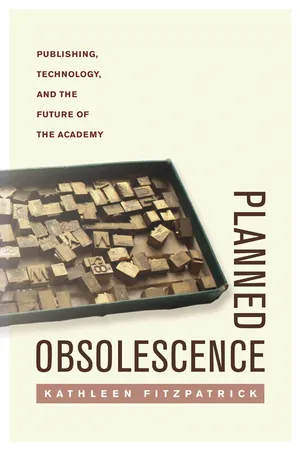
eBook - ePub
Planned Obsolescence
Publishing, Technology, and the Future of the Academy
- 256 pages
- English
- ePUB (mobile friendly)
- Available on iOS & Android
eBook - ePub
About this book
Information
Topic
Scienze socialiSubtopic
Antropologia culturale e sociale1
Peer Review
In a world where knowledge is being made available at a rate of millions of pages per day, it is comforting to know that some subset of that knowledge or science has been critically examined so that, were we to use it in our thinking for our work, we would be less likely to have wasted our time.
—Ray Spier, “The History of the Peer-Review Process”
[E]lectronic publishing distinguishes between the phase where documents are placed at the disposal of the public (publishing proper) and the phase where “distinctions” are being attributed. It used to be that being printed was “the” distinction; electronic publishing changes this and leads us to think of the distinction phase completely separately from the publishing phase.
However, doing so changes the means by which distinction is imparted, and imparting distinction is a sure sign of power. In other words, those who now hold that privilege are afraid of losing it (“gate keepers”) and they will [use] every possible argument to protect it without, if possible, ever mentioning it.
—Jean-Claude Guédon and Raymond Siemens,
“The Credibility of Electronic Publishing:
Peer Review and Imprint”
“The Credibility of Electronic Publishing:
Peer Review and Imprint”
We police ourselves into irrelevance and insignificance.
—Cathy Davidson, “‘Research’: How
Peer Review Counts and Doesn’t”
Peer Review Counts and Doesn’t”
For the past few years, I have worked with the Institute for the Future of the Book, my colleague Avi Santo, and a range of prominent scholars in media studies on MediaCommons, an all-electronic scholarly publishing network. During the planning phases of the project, we blogged, held meetings, and tested some small-scale implementations of the network’s technologies—and in all of the feedback that we received, in all of the conversations we had with scholars both senior and junior, one question repeatedly resurfaced: What are you going to do about peer review?
I’ve suggested elsewhere (Fitzpatrick 2007a) that peer review threatens to become the bottleneck in which the entire issue of electronic scholarly publishing gets wedged, preventing many innovative systems from becoming fully established. This is a flippant response, to be sure; such concerns are quite understandable, given that peer review is in some sense the sine qua non of the academy. We employ it in almost every aspect of the ways that we work, from hiring decisions through tenure and promotion reviews, in both internal and external grant and fellowship competitions, and, of course, in publishing. The work we do as scholars is repeatedly subjected to a series of vetting processes that enable us to indicate that the results of our work have been scrutinized by authorities in the field, and that those results are therefore themselves authoritative.
But as authors such as Michael Jensen (2007a, 2007b) of the National Academies Press have recently argued, the nature of authority is shifting dramatically in the era of the digital network. Scholars in media studies have explored such shifts as they affect media production, distribution, and consumption, focusing on the extent to which, for instance, bloggers are decentralizing and even displacing the authority structures surrounding traditional journalism, or the ways that a range of phenomena including mashups and fan vids are shifting the previously assumed hierarchies that existed between media producers and consumers, or the growing tensions in the relationship between consumers, industries, and industry regulators highlighted by file-sharing services and battles with the Recording Industry Association of America. These changes are at the heart of much of the most exciting and influential work in media studies today, including publications such as Siva Vaidhyanathan’s The Anarchist in the Library (2004), Henry Jenkins’s Convergence Culture (2006), and Yochai Benkler’s The Wealth of Networks (2006), projects that have grown out of an interest in the extent to which the means of media production and distribution are undergoing a process of radical democratization in the age of blogs, Wikipedia, and YouTube, and a desire to test the limits of that democratization.
To a surprising extent, however, scholars have resisted exploring a similar sense in which intellectual authority might likewise be shifting in the contemporary world.1 Such a resistance is manifested in the often unthinking and over-blown academic response to Wikipedia—for instance, the Middlebury College history department’s ban on the use of the online encyclopedia as a research source and the debate that ensued—which seems to indicate a serious misunderstanding about the value of the project.2 Treating Wikipedia like any other encyclopedia by consulting only the entries runs the risk of missing the point entirely; as Bob Stein (2006) has suggested, a user has to learn to read Wikipedia differently, given that the real intellectual heart of the project lies on the history and discussion pages, where the controversies inherent in the production of any encyclopedia entry are enacted in public, rather than smoothed over into an untroubled conventional wisdom (see Visel 2006; Stein 2006). More centralized projects, such as Citizendium, that seek to add traditional, hierarchical modes of review to a project like Wikipedia overlook the facts that the wiki is in its very architecture a mode of ongoing peer review, and that not only the results of that review but the records of its process are available for critical scrutiny.3 Failing to engage fully with the intellectual merits of a project like Wikipedia, or with the ways in which Wikipedia represents one facet of a far-reaching change in contemporary epistemologies, is a mistake that we academics make at our own peril. As one librarian frames the issue, “Banning a source like Wikipedia (rather than teaching how to use it wisely) simply tells students that the academic world is divorced from real-world practices” (Bill Badke, quoted in Regalado 2007). The production of knowledge is the academy’s very reason for being, and if we cling to an outdated system for establishing and measuring authority while the nature of authority is shifting around us, we run the risk of becoming increasingly irrelevant to contemporary culture’s dominant ways of knowing. We too often keep our work as scholars hidden away from the cultural mainstream, pointing toward a pervasive anti-intellectualism that disqualifies the public from engaging with our ideas. Today’s funding climate for higher education requires, however, that we look more deeply within for the sources of our resistance to public engagement and the ways that resistance hinders rather than supports us as professionals. As Janice Radway (2004, 217) has argued, the rise of professionalization in the academy “had everything to do with specialization, with the growing emphasis on laboratory research, and with the creation of a communications infrastructure that enabled the publication, circulation, and discussion of research results not only among peers but within a larger society called upon to finance such research, to support it with students, and to understand its value,” thus reminding scholars that our very professional existences (and the support that we need in order to maintain them) may depend on communicating, not just among ourselves, but with a broader public, so that they understand the value of academic ways of knowing. We must open ourselves up in order to be part of rather than apart from contemporary culture, and in order to do so, we need to expand and rethink the very idea of who our peers are today.
For this reason, what I am absolutely not arguing in what follows is that we need to ensure that peer-reviewed journals online are of equivalent value to peer-reviewed journals in print; in fact, I believe that such an equation is part of the problem I’m addressing. Imposing traditional methods of peer review on digital publishing might help a transition to such publishing in the short term, enabling more traditionally minded scholars to see electronic and print scholarship as equivalent in value, but it will hobble us in the long term, as we employ outdated methods in a public space that operates under radically different systems of authorization. Instead, we must find ways to work with, improve, and adapt those new systems for scholarly use—but we must also find ways to convince ourselves, our colleagues, our colleges and universities, our disciplinary organizations, and the academy at large of the value that is produced by the use of such systems.
Traditional Peer Review and Its Defenses
David Shatz notes in the introduction to his 2004 volume on peer review that his text is not only “the first book-length study of peer review that utilizes methods and resources of contemporary philosophy,” but also “the first wide-ranging treatment of the subject by a scholar in the humanities,” a fact that becomes all the more surprising when he points out that
[b]esides its ethical aspect, the topic also has dimensions of epistemological significance, since it implicates such concepts as truth, bias, relativism, conservatism, consensus, and standards of good argument. Philosophers and other humanities scholars have produced a voluminous literature on these subjects. Yet they have not applied their approaches to these topics to peer review itself, that is, to the very procedures and practices that produced much of the voluminous literature in ethics, epistemology, and so many other fields. (Shatz 2004, 4)
Shatz indicates a number of reasons why this may be so, including that the more nebulous (or, rather, problematized) understanding of “truth” in the humanities precludes such scholars from being able to “show that a peer review was wrong” (p. 6), and that a critical study of peer review might require empirical work of a sort for which humanists are neither trained nor rewarded. Beyond these factors, however, I’d argue that a critical study of the epistemological practices of peer review requires a form of self-analysis that, as Donald Hall has argued in The Academic Self (2002), many of us resist. Such resistance might suggest an underlying anxiety about the outcome of the analysis, a concern that the time-honored procedures and standards of the humanities might be shown to be flawed—and thus that the work that has developed through those procedures and according to those standards might be even further marginalized within the academy’s mission of knowledge-production. However, as Hall argues, genuinely “owning” our careers and the ways in which we conduct them requires taking the risk of applying our critical skills to an examination of “the textuality of our own profession, its scripts, values, biases, and behavioral norms” (Hall 2002, xiv). Too often, such examinations and proposals for change are met with stern reminders that We Have Never Done It That Way Before. The apparently intractable nature of the way things have always been done is precisely the kind of signal that, in other institutions, impels scholars to critical analysis; a resistance to turning the same critical eye on our own seemingly naturalized assumptions may create (or deepen) an atmosphere of intellectual oppression and stultification, as we allow systems in which we do not genuinely have faith to dictate our engagements with the world and with one another. Opening up the basis of those engagements through a thorough reconsideration of peer review may be precisely what we need in order to allow our work to help shape ways of knowing in the contemporary world.
Resistance to considering the merits of a more open mode of publishing often runs something like that expressed—in, I assume, an intentionally hyperbolic fashion—by Shatz:
It is hard to say who would have the biggest nightmare were open review implemented: readers who have to trek through enormous amounts of junk before finding articles they find rewarding; serious scholars who have to live with the depressing knowledge that flat earth theories now can be said to enjoy “scholarly support”; or a public that finds the medical literature flooded with voodoo and quackery. Let us not forget, either, that editors and sponsoring universities would lose power and prestige even while their workload as judges would be eliminated. (2004, 16)
The vehemence of such resistance often reveals something about the nervousness of those who express it, and, as in much psychotherapeutic discourse, only after some initial projection and displacement does the real source of that anxiety come out: the loss of “power and prestige.”4 However, in responding to those earlier displacements of anxiety, one can provide certain kinds of reassurance. The computer technologies that make open review possible also make possible the implementation of analytical tools that can help filter “rewarding” articles from any “junk” in which they may be mired, whether those tools employ the results of the open review system themselves or use other modes of sophisticated textual analysis and recommendation. Further, serious scholars depressed by the apparent anything-goes nature of open publishing can see to it, by participating in the review system, that “flat earth” theories obtain the reception that they deserve. In fact, the public is already flooded with voodoo and quackery, as revealed by even the most cursory look at the relationship between the pharmaceutical industry and the bulk of publicly available medical information; post-publication review might actually help readers know how to interpret the material that’s out there.5 But finally, if the loss of power and prestige is our primary concerns in clinging to closed review, we would be best served by admitting this to ourselves up front. If we enjoy the privileges that obtain from upholding a closed system of discourse sufficiently that we’re unwilling to subject it to critical scrutiny, we may also need to accept the fact that the mainstream of public intellectual life will continue, in the main, to ignore our work. Public funds will, in that case, be put to uses that seem more immediately pressing than our support. This can no doubt be rationalized as the inevitable, unenviable fate of genius in a world of mediocrity.
The History of Peer Review
It would be worthwhile, however, to explore several of the assumptions we make about the benefits of peer review in order to avoid clinging to our present ways of working out of the mistaken sense that as they have ever been thus, so they should remain. In fact, peer review as we currently know it has a different history than we might assume. Very little investigation of the historical development of peer review has been done, and the few explorations that do attempt to present some sense of the system’s history largely cite the same handful of brief texts.6 Moreover, nearly all of the texts exploring the history of peer review focus on the natural and social sciences, and almost none mention peer review in scholarly book publishing.7 Although it is beyond the scope of this chapter to fill in all of those gaps, it is worth noting a few wrinkles in the history of peer review as it is conventionally understood. Most often, authors date the advent of what we now refer to as editorial peer review—the assessment of manuscripts by more than one qualified reader, usually not including the editor of a journal or press—to the Royal Society of London’s 1752 creation of a “Committee on Papers” to oversee the review and selection of texts for publication in its nearly century-old journal, Philosophical Transactions.8 A number of authors complicate this history by pointing to the existence of at least one earlier instance of formalized peer review in a scientific journal: the Royal Society of Edinburgh seems to have had such a system in place as early as 1731 (Kronick 1990).9
However, Mario Biagioli (2002) argues that a deeper excavation of the genealogy of peer review suggests that its origins may lie in seventeenth-century book publishing, and that peer review of journal articles formed a significantly later stage in the process’s development. Biagioli ties the establishment of editorial peer review to the royal license that was required for the legal sale of printed texts; this mode of state censorship, employed to prevent sedition or heresy, was delegated to the royal academies through the imprimatur granted them at the time of their founding. The Royal Society of London, for instance, took on that imprimatur by passing a resolution in December 1663, one year after its founding, which stated, “No book be printed by order of the council, which hath not been perused and considered by two of the council, who shall report, that such book contains nothing but what is suitable to the design and work of the society” (quoted in Biagioli 2002, 21). The purpose of such review, as Biagioli (2002, 23) emphasizes, remained more related to censorship than to quality control: “As in traditional book licensing, the review was about making sure that a text did not make unacceptable claims rather than to certify that it made good claims.” Because the members of the royal academies were, if not literally part of the government, certainly dependent upon the state for their livelihoods, the concept of “peer review” in this instance indicates an early ambiguity between review by one’s peers and review by a peer of the realm; as Biagioli suggests, “[B]ecause of the ‘pre-disciplining’ of academicians, the simple requirement that manuscripts had to be reviewed by the whole academy or by a committee made it almost impossible that anything controversial would go to press” (p. 15). Gradually, however, scholarly societies facilitated a transition in scientific peer review from state censorship to self-policing, allowing them a degree of autonomy but simultaneously creating, in the Foucauldian sense, a disciplinary technology, one that produces the conditions of possibility for the academic disciplines that it authorizes.
Biagioli’s argument leads us to understand peer review not simply as a system that produces disciplinarity in an intellectual sense, but as a mode of disciplining knowledge itself, a mode that is “simultaneously repressive, productive, and constitutive” of academic ways of knowing (2002, 11). He pertinently distinguishes Michel Foucault’s disciplinary reference points in medicine and the prison from the discipline of peer review, however, as only in the academy do we find “that the roles of the disciplined and the discipliner are often reversed during one’s career” (p. 12), indicating the ways that peer review functions as a self-perpetuating disciplinary system, inculcating the objects of discipline into becoming its subjects. Though peer review may have shed “its negative symbolic connections to early modern absolutism,” as Biagioli concludes, and instead become “the new symbol of the relationship between science and liberal societies,” and though its work today “is now about technical accuracy...
Table of contents
- Cover Page
- Title Page
- Copyright Page
- Contents
- Acknowledgments
- Introduction: Obsolescence
- 1 Peer Review
- 2 Authorship
- 3 Texts
- 4 Preservation
- 5 The University
- Conclusion
- Notes
- Bibliography
- Index
- About the Author
Trusted by 375,005 students
Access to over 1.5 million titles for a fair monthly price.
Study more efficiently using our study tools.
Frequently asked questions
Yes, you can cancel anytime from the Subscription tab in your account settings on the Perlego website. Your subscription will stay active until the end of your current billing period. Learn how to cancel your subscription
No, books cannot be downloaded as external files, such as PDFs, for use outside of Perlego. However, you can download books within the Perlego app for offline reading on mobile or tablet. Learn how to download books offline
Perlego offers two plans: Essential and Complete
- Essential is ideal for learners and professionals who enjoy exploring a wide range of subjects. Access the Essential Library with 800,000+ trusted titles and best-sellers across business, personal growth, and the humanities. Includes unlimited reading time and Standard Read Aloud voice.
- Complete: Perfect for advanced learners and researchers needing full, unrestricted access. Unlock 1.5M+ books across hundreds of subjects, including academic and specialized titles. The Complete Plan also includes advanced features like Premium Read Aloud and Research Assistant.
We are an online textbook subscription service, where you can get access to an entire online library for less than the price of a single book per month. With over 1.5 million books across 990+ topics, we’ve got you covered! Learn about our mission
Look out for the read-aloud symbol on your next book to see if you can listen to it. The read-aloud tool reads text aloud for you, highlighting the text as it is being read. You can pause it, speed it up and slow it down. Learn more about Read Aloud
Yes! You can use the Perlego app on both iOS and Android devices to read anytime, anywhere — even offline. Perfect for commutes or when you’re on the go.
Please note we cannot support devices running on iOS 13 and Android 7 or earlier. Learn more about using the app
Please note we cannot support devices running on iOS 13 and Android 7 or earlier. Learn more about using the app
Yes, you can access Planned Obsolescence by Kathleen Fitzpatrick in PDF and/or ePUB format, as well as other popular books in Scienze sociali & Antropologia culturale e sociale. We have over 1.5 million books available in our catalogue for you to explore.