Whether in the form of Christmas trees in town squares or prayer in school, fierce disputes over the separation of church and state have long bedeviled this country. Both decried and celebrated, this principle is considered by many, for right or wrong, a defining aspect of American national identity.
Nearly all discussions regarding the role of religion in American life build on two dominant assumptions: first, the separation of church and state is a constitutional principle that promotes democracy and equally protects the religious freedom of all Americans, especially religious outgroups; and second, this principle emerges as a uniquely American contribution to political theory.
In Please Don't Wish Me a Merry Christmas, Stephen M. Feldman challenges both these assumptions. He argues that the separation of church and state primarily manifests and reinforces Christian domination in American society. Furthermore, Feldman reveals that the separation of church and state did not first arise in the United States. Rather, it has slowly evolved as a political and religious development through western history, beginning with the initial appearance of Christianity as it contentiously separated from Judaism.In tracing the historical roots of the separation of church and state within the Western world, Feldman begins with the Roman Empire and names Augustine as the first political theorist to suggest the idea. Feldman next examines how the roles of church and state variously merged and divided throughout history, during the Crusades, the Italian Renaissance, the Protestant Reformation, the British Civil War and Restoration, the early North American colonies, nineteenth-century America, and up to the present day. In challenging the dominant story of the separation of church and state, Feldman interprets the development of Christian social power vis--vis the state and religious minorities, particularly the prototypical religious outgroup, Jews.
eBook - ePub
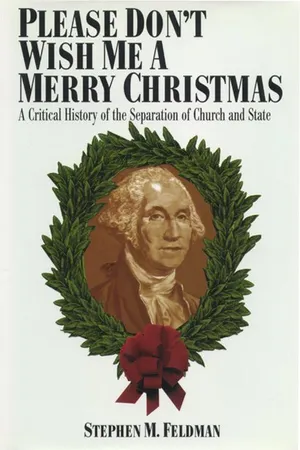
Please Don't Wish Me a Merry Christmas
A Critical History of the Separation of Church and State
- 395 pages
- English
- ePUB (mobile friendly)
- Available on iOS & Android
eBook - ePub
Please Don't Wish Me a Merry Christmas
A Critical History of the Separation of Church and State
About this book
Information
Table of contents
- Cover
- Title Page
- Copyright
- Dedication
- Contents
- Preface
- 1. Introduction: Different Stories
- 2. Origins of Power: The Emergence of Christianity and Antisemitism
- 3. The Christian Middle Ages
- 4. The Christian Renaissance and Reformation in Continental Europe
- 5. The English Reformation, Civil War, and Revolution
- 6. The North American Colonies
- 7. The American Revolution and Constitution
- 8. The Fruits of the Framing: Church and State in Nineteenth-and Early-Twentieth-Century America
- 9. The Fruits of the Framing: Church and State in Late-Twentieth-Century America
- 10. A Synchronic Analysis of the Separation of Church and State in the Late Twentieth Century: Concluding Remarks
- Notes
- Selected Bibliography
- Index
Trusted by 375,005 students
Access to over 1.5 million titles for a fair monthly price.
Study more efficiently using our study tools.
Frequently asked questions
Yes, you can cancel anytime from the Subscription tab in your account settings on the Perlego website. Your subscription will stay active until the end of your current billing period. Learn how to cancel your subscription
No, books cannot be downloaded as external files, such as PDFs, for use outside of Perlego. However, you can download books within the Perlego app for offline reading on mobile or tablet. Learn how to download books offline
Perlego offers two plans: Essential and Complete
- Essential is ideal for learners and professionals who enjoy exploring a wide range of subjects. Access the Essential Library with 800,000+ trusted titles and best-sellers across business, personal growth, and the humanities. Includes unlimited reading time and Standard Read Aloud voice.
- Complete: Perfect for advanced learners and researchers needing full, unrestricted access. Unlock 1.5M+ books across hundreds of subjects, including academic and specialized titles. The Complete Plan also includes advanced features like Premium Read Aloud and Research Assistant.
We are an online textbook subscription service, where you can get access to an entire online library for less than the price of a single book per month. With over 1.5 million books across 990+ topics, we’ve got you covered! Learn about our mission
Look out for the read-aloud symbol on your next book to see if you can listen to it. The read-aloud tool reads text aloud for you, highlighting the text as it is being read. You can pause it, speed it up and slow it down. Learn more about Read Aloud
Yes! You can use the Perlego app on both iOS and Android devices to read anytime, anywhere — even offline. Perfect for commutes or when you’re on the go.
Please note we cannot support devices running on iOS 13 and Android 7 or earlier. Learn more about using the app
Please note we cannot support devices running on iOS 13 and Android 7 or earlier. Learn more about using the app
Yes, you can access Please Don't Wish Me a Merry Christmas by Stephen M Feldman, Stephen M. Feldman in PDF and/or ePUB format, as well as other popular books in Law & Legal History. We have over 1.5 million books available in our catalogue for you to explore.