Mónica waits in the Anti-Venereal Medical Service of the Zona Galactica, the legal, state-run brothel where she works in Tuxtla Gutiérrez, Mexico. Surrounded by other sex workers, she clutches the Sanitary Control Cards that deem her registered with the city, disease-free, and able to work. On the other side of the world, Min stands singing karaoke with one of her regular clients, warily eyeing the door lest a raid by the anti-trafficking Public Security Bureau disrupt their evening by placing one or both of them in jail.
Whether in Mexico or China, sex work-related public policy varies considerably from one community to the next. A range of policies dictate what is permissible, many of them intending to keep sex workers themselves healthy and free from harm. Yet often, policies with particular goals end up having completely different consequences.
Policing Pleasure examines cross-cultural public policies related to sex work, bringing together ethnographic studies from around the world—from South Africa to India—to offer a nuanced critique of national and municipal approaches to regulating sex work. Contributors offer new theoretical and methodological perspectives that move beyond already well-established debates between “abolitionists” and “sex workers’ rights advocates” to document both the intention of public policies on sex work and their actual impact upon those who sell sex, those who buy sex, and public health more generally.
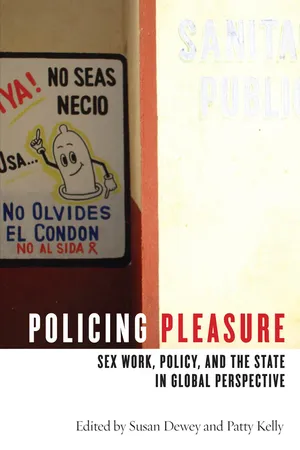
eBook - ePub
Policing Pleasure
Sex Work, Policy, and the State in Global Perspective
- 240 pages
- English
- ePUB (mobile friendly)
- Available on iOS & Android
eBook - ePub
Policing Pleasure
Sex Work, Policy, and the State in Global Perspective
About this book
Information
Topic
Scienze socialiSubtopic
Antropologia1
Introduction
Sex Work and the Politics of Public Policy
When a woman is arrested for selling sex on the streets of Nairobi, the very first thing she does is pick up her mobile phone. She dials a number from a list of her colleagues, who will do what they can to earn sufficient bribe money to secure her release. As Chimaraoke Izugbara observes in this volume, participation in such information networks is critical to sex workers’ survival in Nairobi. Sex workers, taxi drivers, and even night watchmen communicate via cell phone to help women navigate the dangerous streets of urban Kenya, securing clients while avoiding police harassment, arrest, and even worse fates. According to Kenyan sex worker Irene, “We have to watch out and act like sisters to each other. The one you help today will help you tomorrow.” Once in custody, as twenty-five-year-old Melissa confirms, “you can’t tell what they will do to you once the police have you with them.” The list of indignities that sex workers suffer at the hands of law enforcement is long, and includes rape, physical and verbal abuse, illegal detention, and extortion. Such crimes against sex workers are perpetrated not only by police but also by clients who view them as easy prey. As twenty-three-year-old Comfort says, “People know they can get away with anything they do to you because they know you can’t even go to the police.”
Mónica sits waiting in the Anti-Venereal Medical Service of the legal, state-run brothel where she works in the southern Mexican city of Tuxtla Gutiérrez. She is surrounded by other women who also wait, clutching the Sanitary Control Cards that deem them registered with the city, disease-free, and able to work. When her turn comes, Mónica will receive a basic gynecological exam and any number of tests for illnesses ranging from simple bacterial vaginosis to HIV. Workers who test positive for any communicable infection are legally forbidden from exchanging sex for money until they are cured. Built in 1991, the Galactic Zone, as this particular brothel is called, is considered by municipal authorities a showplace for the successes of neoliberal1 social policy in general and state-regulated prostitution in particular. The countless numbers of men and women who sell sex illegally in Tuxtla’s streets and bars, driven to do so, in part, by the neoliberal economic policies that have resulted in ever increasing rural to urban migration and immiseration due to the widespread failure of subsistence farming, are viewed by city officials as sources of disease and chaos.
In contrast, the highly regulated workers of the Galactic Zone are, to many, symbols of modern progress. For many workers themselves, the testing and regulation they experience is both socially and personally beneficial; as Lorena puts it, “It’s like a secretary with her typewriter. I’ve got to keep my machine clean.” Yet political agendas, economic interests, and gender discrimination sometimes combine to create a dangerous situation in the brothel. In one particularly sobering example, four women immediately tested positive for HIV upon switching medical laboratories, thus casting doubts upon the efficacy of the state’s claims to have improved public health via increased regulation.
In the Thai village that anthropologist Heather Montgomery calls Baan Nua, slightly more than half the boys and girls between the ages of six and fourteen work in prostitution. Unlike common media depictions of Thai child prostitutes as poor girls deceived into leaving their rural homes or sold by their struggling parents to brothels where they will be forced to have sex with countless foreign men, the young prostitutes of this coastal village on the edge of a larger tourist town live with their parents, who know what they do, and see themselves not as victims or even as prostitutes but as sons and daughters fulfilling obligations to their families. As one twelve year old who sells sex to foreign clients put it, “[That’s] only my body, but this is my family.” In addition, it is their engagement in occasional commercial sex that, ironically, allows these children some of the pleasures of childhood that would otherwise be unavailable to them, such as trips to arcades and theme parks.
As Montgomery argues in this volume, extradition laws passed in tourist-sending countries that help prosecute foreign men who purchase sex from children abroad were meaningless for the young sex workers of Baan Nua, as “neither the children nor their families [have] any interest in seeing their clients prosecuted.… In the absence of any social support or any form of welfare, these men [are] the only form of income and protection they [have], no matter how damaging that might seem to outsiders.” Montgomery further argues that Thai legislation focusing on commercial sex with foreigners is a simplification that ignores the countless local residents who purchase sex from children, corrupt law enforcement, and the Thai government’s informal promotion of sex tourism, or what the children of Baan Nua call “going out for fun with foreigners.”
Vignettes drawn from the women of Nairobi’s streets, the workers of the Galactic Zone, and the children of Baan Nua reveal the highly complex nature of commercial sexualities and the limits of policies and protections both local and global. The women, men, and children presented in the following pages are not simply criminals, victims, or even liberated individuals who shirk social norms, as some scholars, feminists, and activists might portray them. Indeed, recent ethnographic work2 on commercial sexualities demonstrates the diverse and multidimensional nature of sex work, moving well beyond previous binary debates about structure versus agency and exploitation versus liberation.3 The chapters in this volume provide ample evidence of the deficiencies inherent in subscribing to such polarized perspectives, which de-historicize, de-contextualize, and homogenize sex work, limiting our understanding of sexual labor and those who engage in it.
The ethnographic nature of the portraits in this volume richly illustrates the myriad ways in which discriminatory and counterproductive policies ranging from criminalization to forced medical testing to flawed legal protections coexist with discourses of agency presented by the workers themselves. As cultural anthropologists, we view the nuanced qualitative data collected through long-term fieldwork as essential to understanding commercial sexualities and forming effective policies to address them. Ethnography, the linchpin of anthropological research, gives readers the sense of “being there” (Bradburd 1998) by capturing the diversity of sex workers’ experiences as well as the larger patterns of stigmatization, discrimination, and persecution that they face from Bahia, Brazil, to Dalian, China. The findings presented here make a strong case for using ethnographic work to inform more realistic and beneficial public policies.
The chapters in this volume also vividly illustrate how the pervasive global reach of neoliberal ideologies and practices permeates both public policy and the worldview of sex workers themselves, many of whom see sex work as part of their individual self-improvement strategies. In recent decades the implementation of neoliberal economic policies in many nations has resulted in a marked decline in subsistence agriculture, widening gaps between the rich and poor, increased economic migration, and the explosive growth of a highly gendered service sector. Many scholars have argued that the present phase of late capitalism results in the commodification of all things, especially domestic and other forms of service work (Basi 2009; Bernstein 2007a; Freeman 2000; Parreñas 2001; Spar 2006).
These factors combine to make sex work, whether organized or de facto, full-time or informal, an increasingly common way to survive in an unstable economy. Service-sector employment, including sex work, is one of the few available options many underprivileged individuals have to generate income. Work in the service sector often requires strict management of emotions and great discipline, and workers who perform it may consequently suffer self-estrangement and problems of identity (Hochschild 1983). This estrangement is equally evident in the fragmentation of community bonds as families struggle to survive at a time when neoliberal economic policies dramatically reduce social services and other state benefits. Such atomization is equally evident in the words and actions of individuals who, through sex work, view themselves as independent entrepreneurs rather than organized laborers.4
Despite these commonalities, this volume is not intended to recommend a universal policy on sex work. Indeed, as anthropologists, we stress the importance of cultural context and the continuing relevance of the local, even in an era of globalization. In heeding the call for sex work policy that is evidence-based rather than informed by cultural, moral, and other ideological values, as presented in chapter 2 by Michael Goodyear and Ronald Weitzer, this book provides concrete recommendations for improving policy across municipal, state, and national lines. In uniting these chapters, all based upon diverse geographical and cultural regions, we strive to answer two interrelated questions: What accounts for the striking parallels and patterns at work in the lives of individual sex workers in such a variety of divergent cultural contexts? And how, in turn, might ethnographies of the sexual labor of women, children, and men offer unique recommendations for improved public policy on sex work?
Public Policy Debates on Sex Work
In the interests of a holistic approach to the topic, the chapters in this volume define sex work as a continuum of behaviors involving the commodification of intimacy. The vast majority of studies presented here document the lives of marginalized individuals who engage in such behaviors as part of their strategies for survival or social mobility.5 Their strategies generally involve the strategic use of sex or sexualized attention in exchange for money or something of value, and the highly nuanced and individual nature of these situations do not always lend themselves easily to clear-cut generalizations about sex work. Nonetheless, the ethnographic accounts presented here very effectively document an often sharp disconnect between policy and its practice.
It is certainly not our intention to portray the women, men, and children in this volume as unwitting sex workers whose poverty or innocence gives them a greater moral ground upon which to stand (as neither we nor our contributors believe that sex work is moral or immoral in and of itself). That the workers we write about are marginalized and that this arouses (intended or not) the sympathy of many readers and policy makers reflects many of the debates in the ensuing chapters on trafficking versus migration, morality, and beliefs about victimization that often inform faulty policy. Indeed, almost all the chapters demonstrate the nuanced ways in which prostitution policy impacts individuals differently based on class, race, ethnicity, citizenship, gender, and age.
From the legal brothels of the Netherlands to the illegal but very visible red light districts of urban India, public policy approaches to sex work are informed by shifting political climates and public perceptions of gender, health, and labor. Although these approaches vary cross-culturally, three broad categories emerge: legalization, criminalization, and decriminalization. This volume presents examples of the impact of legalized sex work in the Netherlands and in a state-run brothel in Mexico and discusses the consequences of criminalization in China, India, the United States, and South Africa, as well as the specific case of criminalization via municipal by-laws in Nairobi, Kenya. The impact of decriminalization is addressed in the context of New Zealand and in three very different Brazilian sites. Two chapters additionally address the problematic issue of age and the ability to consent in Thailand and South Africa, and another chapter raises unsettling questions about the rather unclear divisions between serial monogamy and sex work.
Where legal, sex work is often highly regulated by local or state authorities and generally requires that sex workers register with state authorities and have mandatory health screenings for HIV and other sexually transmitted illnesses. Women working in the legal brothels of rural Nevada are tested for gonorrhea, chlamydia, syphilis, and HIV before beginning work and then subsequently throughout their careers (Brents, Jackson, and Hausbeck 2009), whereas in urban Tijuana, Mexico, legal sex workers are given blood tests for some illnesses whereas other illnesses, such as syphilis, are screened for only visually (Katsulis 2008:99). In addition to medical management and bureaucratic oversight, legal sex work is often spatially regulated, as many countries confine legal sex work to bars, brothels, or particular districts with police oversight. Such areas are often far from private homes, businesses, and schools, and are characterized by the police and the public as places that tolerate sex work and other forms of “vice.” Tellingly, such areas are called zonas de tolerancia (tolerance zones) throughout Spanish-speaking Latin America, and workers selling sex outside the boundaries of such zones, such as in a bar or on the street, may be subject to police harassment and arrest.
Though laws and policies surrounding sex work are generally shaped by those in positions of privilege, in certain nations, such as Brazil, sex workers themselves participate in designing national health-care policy (particularly with regard to HIV/AIDS) and social-service provisions. Proponents of legalized sex work believe that this approach protects the health and safety of sex workers and society while also providing valuable tax revenue for local and national governments. Approaches to criminalization vary from the threat of stoning in Iran (Tait and Hoseiny 2008: 17) to police tolerating its concentration in peripheral and low-income areas where residents, whether engaged in sex work or not, experience marginalization and economic distress. Decriminalization also varies in the degree of permissiveness and enforcement, varying from a low priority accorded to sex work-related offenses to its legal definition as work, with sex workers accorded the same rights, responsibilities, and protections as other workers.
Debates surrounding sex work can be said to suffer a particular sort of ailment involving “too much heat, not enough light” (Valverde 1987). The bitter polemics that have divided scholars, writers, journalists, sex workers, and activists have done little to improve public policy on sex work. As such, this volume hopes to dispel myth and moralizing by shining a bright light on a subject that is often, both figuratively and literally, confined to the darkest recesses. Debates around sex work can be divided into two primary camps: those who oppose all forms of sexual commerce because they view it as a threat to public health and morality as well as a form of violence against women6 and those who recognize prostitution as an enduring reality. The latter group often takes either the position that state regulation minimizes the risks and dangers incurred by sex work or that participants in such activities should be free from government control, which they view as intrusive and even harmful.
Governments, organizations, and individuals that support anti-sex work legislation often contend that sex work is damaging to society at large and to women in particular. Those who take this position argue that sex work can never be considered legitimate employment, because it is always degrading, never freely chosen, and is characterized by extreme levels of exploitation. For those who believe that sexual labor is essentially a sexist and violent act, legalization represents governmental complicity and endorsement of gendered violence. States that illegalize certain or all aspects of sex work conceptualize sex work similarly, and Goodyear and Weitzer illustrate the impact of this policy in Sweden in chapter 2.
Institutions and individuals that recognize sex work as a pervasive and enduring (albeit problematic) institution maintain that criminalization does not effectively end sex work in its many forms but only removes it from public view, making it more dangerous for sex workers and society by raising the risk of violence, abuse, disease, and involvement by criminal elements. Feminist activists and organizations that support legalization or decriminalization insist that criminalizing sex work criminalizes sex workers, making them more vulnerable to social stigmatization, abuse, rape, and even murder. One of the central arguments for legalizing all forms of sex work is that, through government oversight, health risks for sex workers, clients, and society at large are reduced. Many institutions and individuals concerned with public health believe that medical testing, safe sex education, and condom distribution are effective means of preventing the transmission of sexually transmitted infections (STIs). As the ethnographic examples presented throughout this book clearly demonstrate, however, there is often a great difference between such discourse at the state level and its everyday practice by individuals.
Synopsis of Key Themes
The chapters that follow consistently reveal that sex work is itself inseparable from state actions and, indeed, is sometimes engendered by them. Much of the research presented in this volume offers strong evidence of how this intimate relationship between sex work and the state exists in all countries, albeit in divergent forms that alternately reject, accept, or tolerate the existence of sex work. Although state interest in regulating sex work is often couched in the rhetoric of public health, morality, or safety, the research presented here indicates that the relationship is in fact often much more complex for a variety of nuanced reasons. Chimaraoke Izugbara, for example, argues that sex work in Nairobi is inseparable from the postcolonial politics of Kenyan life, wherein economic difficulties and crises in neighboring African nations, pervasive rural-urban migration resulting in the growth of informal housing settlements, and crop failures have all contributed to greater numbers of women and men engaging in sex work. At the same time, however, the police actively benefit from this illegal activity in their capacity as state agents through the elaborate (and illicit) exchanges of bribes, women, and gifts between sex workers and police officers.
Even more troubling is that such a situation is hardly unique to Kenya, as Tiantian Zheng also notes this collusion between Chinese police and other state authorities with local officials and brothel managers. In such an uncertain atmosphere, where violence and extortion are the norm, sex workers are forced into a state of constant vigilance. This is particularly significant given that most of the sex workers Zheng describes are rural migrants who have come to the northeastern port city of Dalian in search of increased economic opportunities that will allow them to send remittances to their home villages. Notably, Zheng observes, such women report that the conditions of sex work compare quite favorably to sweatshop or low-wage service work, the only jobs available to them as low-status rural migrants in urban China’s burgeoning economy. They often note that sex work gives them a hope for urban social mobility that would otherwise be impossible.
Like Izugbara and Zheng, Treena Orchard also analyzes the disconnects between public policy and everyday practice in her chapter on devadasis, women who practice sex work as part of an ancient Hindu practice that has come under increasing scorn by the contemporary Indian state. She describes the similarities between colonial and post-independence efforts to “reform” such women as deeply embedded in moral-medical discourses of hygiene that, in turn, deeply contradict devadasis’ understanding of their work as religiously motivated. This repositioning of sex work as a social problem in India, in turn, mirrors broader global debates regarding its appropriate role in neoliberal economic systems. Patty Kelly, for instance, documents the establishment of a government-owned brothel in the troubled Mexican state of Chiapas as part of broader efforts to modernize the region by extending state control, particularly via the implementation of agribusiness and other initiatives that generate revenue for elites through the privatization of large-scale agribusiness, while disenfranchising the poor.
Dawn Pankonien and Susan Dewey also draw an explicit connection between state economic policy and sex work, as both note the elaborate intersections between neoliberal reforms and poor people’s increased need to devise creative strategies for survival. Pankonien describes the dramatic growth in the number of women who describe themselves as “single mothers” in Huatulco, a federally developed tourist region on Mexico’s southern Pacific coast. Like the women ...
Table of contents
- Cover Page
- Title Page
- Copyright Page
- Dedication
- Contents
- Acknowledgments
- 1 Introduction: Sex Work and the Politics of Public Policy
- 2 International Trends in the Control of Sexual Services
- 3 Into the Galactic Zone: Managing Sexuality in Neoliberal Mexico
- 4 Sex Work and the State in Contemporary China
- 5 Smart Sex in the Neoliberal Present: Rethinking Single Parenthood in a Mexican Tourist Destination
- 6 On the Boundaries of the Global Margins: Violence, Labor, and Surveillance in a Rust Belt Topless Bar
- 7 The Virtues of Dockside Dalliance: Why Maritime Sugar Girls Are Safer Than Urban Streetwalkers in South Africa’s Prostitution Industry
- 8 “Their own way of having power”: Female Adolescent Prostitutes’ Strategies of Resistance in Cape Town, South Africa
- 9 “Hata watufanyeje, kazi itaendelea”: Everyday Negotiations of State Regulation among Female Sex Workers in Nairobi, Kenya
- 10 Prostitution in Contemporary Rio de Janeiro
- 11 Prevailing Voices in Debates over Child Prostitution
- 12 Organizational Challenges Facing Male Sex Workers in Brazil’s Tourist Zones
- 13 “What is the use of getting a cow if you can’t make any money from it?”: The Reproduction of Inequality within Contemporary Social Reform of Devadasis
- 14 Moral Panic: Sex Tourism, Trafficking, and the Limits of Transnational Mobility in Bahia
- References
- About the Contributors
- Index
Trusted by 375,005 students
Access to over 1.5 million titles for a fair monthly price.
Study more efficiently using our study tools.
Frequently asked questions
Yes, you can cancel anytime from the Subscription tab in your account settings on the Perlego website. Your subscription will stay active until the end of your current billing period. Learn how to cancel your subscription
No, books cannot be downloaded as external files, such as PDFs, for use outside of Perlego. However, you can download books within the Perlego app for offline reading on mobile or tablet. Learn how to download books offline
Perlego offers two plans: Essential and Complete
- Essential is ideal for learners and professionals who enjoy exploring a wide range of subjects. Access the Essential Library with 800,000+ trusted titles and best-sellers across business, personal growth, and the humanities. Includes unlimited reading time and Standard Read Aloud voice.
- Complete: Perfect for advanced learners and researchers needing full, unrestricted access. Unlock 1.5M+ books across hundreds of subjects, including academic and specialized titles. The Complete Plan also includes advanced features like Premium Read Aloud and Research Assistant.
We are an online textbook subscription service, where you can get access to an entire online library for less than the price of a single book per month. With over 1.5 million books across 990+ topics, we’ve got you covered! Learn about our mission
Look out for the read-aloud symbol on your next book to see if you can listen to it. The read-aloud tool reads text aloud for you, highlighting the text as it is being read. You can pause it, speed it up and slow it down. Learn more about Read Aloud
Yes! You can use the Perlego app on both iOS and Android devices to read anytime, anywhere — even offline. Perfect for commutes or when you’re on the go.
Please note we cannot support devices running on iOS 13 and Android 7 or earlier. Learn more about using the app
Please note we cannot support devices running on iOS 13 and Android 7 or earlier. Learn more about using the app
Yes, you can access Policing Pleasure by Susan Dewey,Patty Kelly, Susan Dewey, Patty Kelly in PDF and/or ePUB format, as well as other popular books in Scienze sociali & Antropologia. We have over 1.5 million books available in our catalogue for you to explore.