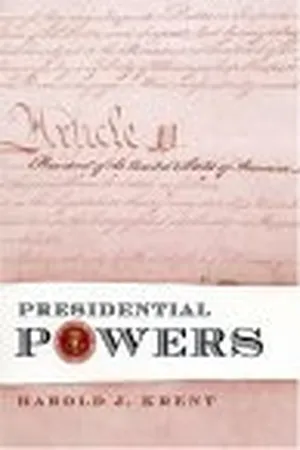
Framed in Article II of the Constitution, presidential powers are dictated today by judicial as well as historical precedent. To understand the ways the president wields power as well as how this power is kept in check by other branches of government, Harold J. Krent presents three overlapping determinants of the president's role under the Constitution-the need for presidential initiative in administering the law and providing foreign policy leadership, the importance of maintaining congressional control over policymaking, and the imperative to ensure that the president be accountable to the public.
Krent’s examination is sweeping, ranging from the president's ability to appoint and remove executive branch officials, to the president's role in proposing and implementing treaties and the power to conduct war, to the extent the president can refuse to turn over information in response to congressional and judicial requests. Finally, Krent addresses the history and purposes of presidential pardons.
By drawing on historic and contemporary presidential actions to illustrate his points, Krent reminds us that the president is both an exalted leader with the regalia of power and an American who is and should be accountable to fellow citizens-important considerations as we elect and assess our presidents.
- 279 pages
- English
- ePUB (mobile friendly)
- Available on iOS & Android
eBook - ePub
Presidential Powers
About this book
Information
Topic
DirittoSubtopic
Diritto amministrativo1
The President’s Power to Execute the Laws Passed by Congress
A. Presidential Participation in the Legislative Process—The Veto Power
Before addressing the president’s powers to enforce the law, a short detour is necessary. The president plays a fundamental role not only in administering the law but also in helping Congress decide what needs to be administered. When civics courses teach that Congress makes law, the president enforces the law, and judges interpret law, they miss the critical function that the Constitution assigns to the president in the lawmaking process: Congress must present all bills to the president for his approval before the bills can become law. The Constitution provides that “[e]very Bill which shall have passed the House of Representatives and the Senate, shall, before it become a Law, be presented to the President of the United States; If he approve he shall sign it, but if not he shall return it, with his Objections to that House in which it shall have originated. . . .”1 Congress can override a president’s veto only by vote of two-thirds of each house.
The veto power affords the president a potent weapon to influence legislation. As Madison commented, the veto power permits the president “to restrain the Legislature from encroaching on the other coordinate departments, or on the rights of the people at large, or from passing laws unwise in their principle, or incorrect in their form.”2 The power to block legislation also permits presidents to shape, if not control, the legislative agenda. The threatened use of a veto itself can cause Congress to revise or abandon planned legislation. Moreover, the Constitution provides that the president can “recommend to [Congress’s] Consideration such Measures as he shall judge necessary and expedient.”3 Indeed, presidents customarily propose a substantial portion of the policies that ultimately become legislation. Presidents and their subordinates identify needs and find legislative sponsors to champion the proposals. The Constitution clearly contemplates, therefore, that the president is to take part in the legislative process.
Early presidents, however, exercised the veto sparingly. Vetoes were to be deployed only in the rare case in which Congress passed a law that the chief executive thought unconstitutional or outrageous for some other reason. Washington, for instance, vetoed only two bills (the first attempted to apportion representatives), and neither Adams used the veto at all. Zachary Taylor articulated the cautious view of many early presidents when he said that the personal opinion of the president “ought not to control the action of Congress upon questions of Domestic policy.”4 Even President Warren Harding almost a century later pledged during the election of 1920 not to be a leader in legislation.5
President Andrew Jackson, however, recognized the veto’s promise in setting national policy. He issued twelve vetoes, none of which was overridden by a fractured Congress. Most notably, he vetoed a bill rechartering the Bank of the United States. President John Tyler vetoed a subsequent effort to recharter the bank twice, sparking a wave of protests, including death threats. His subsequent veto of a tariff measure prompted Representative John Minor Botts to introduce an impeachment resolution charging the president “with the high crime and misdemeanor of withholding his assent to laws indispensable to the just operation of the government.”6 Tyler’s successors became less hesitant in using the veto, whether to block legislation concerning economic policy, rights of private citizens, or Reconstruction after the Civil War.7 By the end of the nineteenth century, President Cleveland had exercised the veto almost six hundred times. FDR issued more vetoes than any other twentieth-century president.
In stressing the importance of the president’s veto power, the Supreme Court commented in INS v. Chadha: “The President’s role in the lawmaking process also reflects the Framers’ careful efforts to check whatever propensity a particular Congress might have to enact oppressive, improvident, or ill-considered measures.”8 And, the exercise of a veto tells only part of the story, for the threatened exercise of a veto molds legislation in far more contexts.9
The incidence of vetoes depends on not only a president’s willingness to take political heat but also his relationship to Congress as a whole. In the context of a divided government, the exercise of vetoes becomes far more important politically. Truman, Eisenhower, and Reagan, for instance, vetoed major economic and labor legislation passed by hostile majorities in Congress. On some occasions, use of a veto may reflect a presidential failure to achieve goals through persuasion and politicking.
Congress, of course, can take a number of actions to counter the president’s veto power. Principally, it can group so many items together in one package, called an omnibus bill, that the president may hesitate to veto the bill for fear of throwing the baby out with the bathwater. Much legislation currently runs hundreds of pages, so the risk—from a president’s perspective—of vetoing one offending paragraph is that hundreds of pages of beneficial legislation may never be enacted. The problem is particularly acute with appropriations bills. If Congress ties policy to appropriations, then the government may shut down if the president wishes to veto the unrelated legislative policy initiative.
Presidents have long advocated a line item veto to counteract the power of omnibus bills, as exists in many states. In that way, presidents can pick and choose which congressional provisions to approve. They can disapprove of so-termed pork and yet retain socially beneficial legislation. Presidents such as Buchanan and Grant refused to fund all of the projects specified in omnibus appropriations bills, and FDR, Truman, Eisenhower, LBJ, and Nixon in the twentieth century followed suit.10 In a bipartisan effort, Congress in 1996 passed the Line Item Veto Act to accord the president the power to cancel legislative items that he believed were wasteful.11 The Supreme Court, however, ultimately struck down the act.12 It explained that no constitutional provision authorized such veto power, and that such executive power would in effect afford presidents the power to rewrite legislation by selecting which provisions to enforce.
Overall, despite the practice of omnibus bills, vesting the veto power in the president provides the executive with a lever to pry concessions and help influence the shape of legislation.13 As Judge McGowan remarked, “A presidential veto can moderate legislation for the national good or skew legislation toward the President’s personal agenda. Each of these results is desirable. Since the veto clearly contemplates presidential participation in the difficult task of legislating, there is no good reason why the President should don blinders and ignore the full range of his policy, and even political, interests.”14 Thus, although we understandably speak as if Congress were solely responsible for legislation, the president plays a subsidiary role, shaping the laws that he subsequently must enforce and administer.
B. Degree of Centralized Control over Law Enforcement
Article II vests the president with the power to enforce and administer the laws enacted by Congress. Although the precise scope of the authority is not delineated, the language of Article II seemingly embraces some form of unitary executive by vesting “the executive Power”15 in a president; assigning the president the responsibility to “take Care that the Laws be faithfully executed;”16 and directing the president to appoint all principal officers of the United States.17 The text suggests that the president must exercise at least some hierarchical control: how else can he “take care that the laws be faithfully executed”? The “take care” clause presupposes some ability to ensure that laws are enforced: as the Supreme Court has stated, “The Constitution does not leave to speculation who is to administer the laws enacted by Congress; the President, it says, ‘shall take Care that the Laws be faithfully executed,’ personally and through officers whom he appoints.”18 When Congress delegates authority directly to the president, therefore, Article II requires the president to execute those responsibilities faithfully, whether in the civil or criminal law context.
Indeed, the first Congress provided for military pensions “under such regulations as the President of the United States may direct,”19 and it authorized executive officers to license “any proper person” to engage in trade with Indian tribes under “such rules and regulations as the president shall prescribe.”20 The first Congress evidently found that it could function more effectively through delegation of tasks to the president himself. Subsequent Congresses have delegated an array of additional responsibilities, including the power to impose and lift tariffs, impound funds in limited contexts, investigate crimes, and declare national emergencies. The president in those situations must be able to discharge the responsibilities delegated by Congress.
In the vast majority of contexts, however, Congress assigns duties not to the president directly but to other officials within the executive branch. Congress, particularly in the twentieth century, created a huge bureaucratic structure and lodged the responsibility in executive branch officials to administer a welter of regulatory requirements as well as to enforce crimes. Congress has created hundreds of administrative agencies, vested them with enormous and complicated authority, and staffed them with hundreds of thousands of employees. Congress has left agency heads with vast discretion. For instance, Congress has delegated the open-ended authority to set “fair and equitable” prices to agencies during wartime,21 and to the Federal Communications Commission the power to award broadcast licenses according to “the public interest.”22 Moreover, Congress has directed officials within the executive branch to protect the public, whether from a terrorist threat abroad or from a narcotics threat within.
Congress under Article I enjoys the authority to determine the identity of the delegate who is to discharge administrative and law enforcement authority. Does Article II, whether by vesting “executive” power in the president or by requiring the president to “take Care that the Laws be faithfully executed” mandate presidential control over administrative or law enforcement authority delegated to officials other than the president? Would that presidential control help the public trace executive branch actions more directly to the president, enhancing presidential accountability?
Much of the contemporary debate over the scope of presidential control over administrative and enforcement authority turns on the advisability of a centralized or unitary executive. Many fear the dangers from too strong of an executive, but others are more concerned that a fragmented executive might become too weak to assert the nation’s interests forcefully and effectively. Considerations of constitutional text, history, and judicial doctrine fail to depict a clear picture of presidential power over authority delegated by Congress to the executive branch.
The idea of a unitary executive is neither new nor radical. The Framers rejected several proposals to split the executive,23 prompting opponents to assert that a unitary executive was a “feotus of monarchy.”24 There have been adherents of a strong centralized executive ever since, from George Washington to Theodore Roosevelt to Ronald Reagan. Arguments today for greater centralized control based on the unitary executive ideal coalesce around two virtues: accountability to the public, and the requisite initiative to exert effective leadership in administering the federal government.
According to proponents of a strong executive, the constitutional structure stresses accountability to the public in order to secure individual liberty. In this context, accountability suggests that individuals and firms should be able to trace particular governmental actions to governmental officials who are responsible in some way to the electorate, whether through direct election or other means of voicing voter disapproval. From this vantage point, Articles I, II, and III delineate powers that the branches are to exercise so as to clarify the lines of constitutional authority. The president stands responsible for all discharge of criminal and civil law enforcement, and is judged by his or her performance on election day. To be sure, voters cannot always call the president to account for one particular issue, given that they vote for a candidate based upon that candidate’s entire record. And, the president may not stand for reelection. Nonetheless, the political process remains open to air misgivings about presidential leadership, and as those concerns mount in importance, they may become determinative at election time. At a minimum, even if a president does not face political repercussions, his party may.
This is not to suggest that the president must personally craft all foreign and domestic policy initiatives. Congress can create new offices pursuant to the Necessary and Proper Clause and delegate responsibility to particular government officials.25 But, from the perspective of those advocating a unitary executive, the president must be able to superintend that policy in order not to fragment and dissipate accountability. As Alexander Hamilton noted in the Federalist Papers (No. 70),
It often becomes impossible, amidst mutual accusations, to determine on whom the blame or the punishment of a pernicious measure . . . ought really to fall. . . . The circumstances which may have led to any national miscarriage or misfortune are sometimes so complicated that where there are a number of actors who may have had different degrees and kinds of agency . . . it may be impracticable to pronounce to whose account the evil which may have been incurred is truly chargeable.26
Liberty is gained to the extent that one electorally accountable official stands responsible for law implementation efforts. With a plural executive, responsibility may be shrouded, and the costs of determining who is responsible for what increase.
On the other hand, the desire for a strong unitary executive may be more an invention of twentieth-century thinkers than of the constitutional plan. Congress has a legitimate interest in determining how delegated authority should best be exercised, and that interest arguably includes the identity and independence of the officer selected to wield that power. Congress over the past two ...
Table of contents
- Cover Page
- Title Page
- Copyright Page
- Contents
- Acronyms and Abbreviations
- Introduction
- 1 The President’s Power to Execute the Laws Passed by Congress
- 2 The Executive’s Power over Foreign Affairs
- 3 The Protective Power of the President
- 4 Presidential Immunities and Privileges
- 5 The Pardon Power
- Conclusion
- Notes
- Bibliography
- Index
- About the Author and Acknowledgments
Trusted by 375,005 students
Access to over 1.5 million titles for a fair monthly price.
Study more efficiently using our study tools.
Frequently asked questions
Yes, you can cancel anytime from the Subscription tab in your account settings on the Perlego website. Your subscription will stay active until the end of your current billing period. Learn how to cancel your subscription
No, books cannot be downloaded as external files, such as PDFs, for use outside of Perlego. However, you can download books within the Perlego app for offline reading on mobile or tablet. Learn how to download books offline
Perlego offers two plans: Essential and Complete
- Essential is ideal for learners and professionals who enjoy exploring a wide range of subjects. Access the Essential Library with 800,000+ trusted titles and best-sellers across business, personal growth, and the humanities. Includes unlimited reading time and Standard Read Aloud voice.
- Complete: Perfect for advanced learners and researchers needing full, unrestricted access. Unlock 1.5M+ books across hundreds of subjects, including academic and specialized titles. The Complete Plan also includes advanced features like Premium Read Aloud and Research Assistant.
We are an online textbook subscription service, where you can get access to an entire online library for less than the price of a single book per month. With over 1.5 million books across 990+ topics, we’ve got you covered! Learn about our mission
Look out for the read-aloud symbol on your next book to see if you can listen to it. The read-aloud tool reads text aloud for you, highlighting the text as it is being read. You can pause it, speed it up and slow it down. Learn more about Read Aloud
Yes! You can use the Perlego app on both iOS and Android devices to read anytime, anywhere — even offline. Perfect for commutes or when you’re on the go.
Please note we cannot support devices running on iOS 13 and Android 7 or earlier. Learn more about using the app
Please note we cannot support devices running on iOS 13 and Android 7 or earlier. Learn more about using the app
Yes, you can access Presidential Powers by Harold J Krent in PDF and/or ePUB format, as well as other popular books in Diritto & Diritto amministrativo. We have over 1.5 million books available in our catalogue for you to explore.