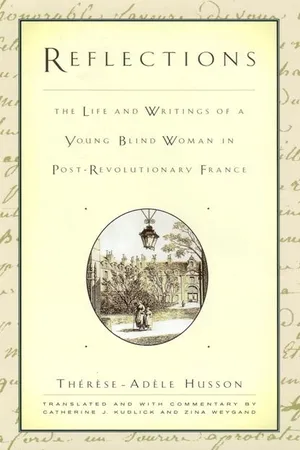
In the 1820s, several years before Braille was invented, Therese-Adele Husson, a young blind woman from provincial France, wrote an audacious manifesto about her life, French society, and her hopes for the future. Through extensive research and scholarly detective work, authors Catherine Kudlick and Zina Weygand have rescued this intriguing woman and the remarkable story of her life and tragic death from obscurity, giving readers a rare look into a world recorded by an unlikely historical figure. Reflections is one of the earliest recorded manifestations of group solidarity among people with the same disability, advocating self-sufficiency and independence on the part of blind people, encouraging education for all blind children, and exploring gender roles for both men and women. Resolutely defying the sense of "otherness" which pervades discourse about the disabled, Husson instead convinces us that that blindness offers a fresh and important perspective on both history and ourselves.
In rescuing this important historical account and recreating the life of an obscure but potent figure, Weygand and Kudlick have awakened a perspective that transcends time and which, ultimately, remaps our inherent ideas of physical sensibility.
eBook - ePub
Reflections
The Life and Writings of a Young Blind Woman in Post-Revolutionary France
- 144 pages
- English
- ePUB (mobile friendly)
- Available on iOS & Android
eBook - ePub
Reflections
The Life and Writings of a Young Blind Woman in Post-Revolutionary France
About this book
Information
IV.
REFLECTIONS ON A MANUSCRIPT, A LIFE, AND A WORLD
What are we to make of such a woman, who at once thwarted and embodied the prevailing social values of her day? Drawing on archival sources as well as secondary scholarship in history and literature, the remainder of this book offers a context for gaining a deeper understanding of Thérèse-Adèle Husson’s life and work.1 Not only do we hope to fill in some of the details of her mysterious and perplexing life, but we also want to raise larger questions about how she might fit into discussions about the role of women, religion, disability, and notions of the self in the early nineteenth century.
One of the first questions that comes to mind, especially after reading the “Reflections,” is to what extent Thérèse-Adèle Husson’s observations and ideas were original. To be sure, the manuscript housed at the Parisian hospital of the Quinze-Vingts is the first text written by a blind woman about blind people and blindness in daily life, at least as far as we know. Prior to Husson’s time, most works about blindness had been written by sighted people, particularly with the growing interest in the senses expressed by the Enlightenment philosophes. In 1749, for example, Diderot published his Letter on the Blind for the Benefit of Those Who See, a philosophical exploration of blindness largely based on his encounter with the Blind Man of Puiseaux, a reclusive, highly intelligent man who offered insights into perception.2 Though Diderot’s work generated much discussion and controversy while whetting the educated public’s curiosity about blindness, it really wasn’t about blind people as human beings; rather, it used the experiences of a blind man as a form of investigative data to launch a series of larger philosophical speculations about the role of touch and hearing in the accumulation of human knowledge.3
The nineteenth century brought changes in attitudes toward self-expression, writing, publishing, and reading that would help make it possible for someone like Thérèse-Adèle Husson even to conceive of writing her “Reflections.” Together, the French Revolution, which highlighted the political rights of the people, and Romanticism, with its artistic celebrations of the simple life of the common person, opened up a new space in which writers from all walks of life could be heard. For example, the proliferation of workers’ autobiographies in France and elsewhere during the early years of the new century demonstrated that people who had previously been ignored now aspired to tell their stories, and many even enjoyed modest successes with publishers.4 In such a climate, and coming on the heels of the excitement generated by Diderot’s writing, it’s not surprising that a number of blind men—and eventually a blind woman outside mainstream Parisian culture—began to dream that a broader public might be interested in reading about blindness from the perspective of a blind person rather than a sighted one.
Accordingly, in 1828 Alexandre Rodenbach published the first French work to be written by a blind person about blindness, Letter on the Blind Following That of Diderot.5 The title page mentioned his blindness to give his observations credibility because of his personal experience. Born in 1786 and raised in a family of Flemish notables, he attended a private school run by the great French educator of the blind, Valentin Haüy, in Paris. Two years after publishing his response to Diderot, Rodenbach ran for a seat in the newly formed Belgian legislature, where he would serve over the next several decades. Despite its author’s more elevated class status, Rodenbach’s work shared many features with Husson’s “Reflections,” including discussions of colors and the external environment, the education of the blind, and even thoughts about deaf people. Probably both Rodenbach and Husson had been influenced by many of the same forces, and had the young provincial woman been differently connected, perhaps the “Reflections,” which she had written a few years before Rodenbach’s Letter, might have appeared first. Published or not, Thérèse-Adèle Husson’s manuscript differed from Rodenbach’s by openly addressing questions related to womanhood.
Even as it broke new ground in providing a firsthand account from a blind woman’s perspective for the benefit of other blind women, the “Reflections” followed certain literary conventions of the day. In particular, the manuscript drew upon a growing genre of books and pamphlets that outlined how girls should be educated. From someone such as Napoleon, who believed that “the weaker sex” must be schooled merely to raise sons worthy of the Empire, to Madame Campan and Madame de Rémusat, who argued that women should have knowledge in order to become better companions to men, discussion flourished regarding why and how girls of all social classes should be taught. Moreover, Husson wrote at a time when a growing turf war between convents and private secular boarding schools provoked numerous writers to explore the best ways that girls might receive a religious education in the decades before the state intervened. Coming in the aftermath of the Revolution, such discussions raised important issues with respect to religion and France’s efforts to re-Christianize. They also forced men and women alike to think about what roles wives and mothers should play in creating a stable nation after some revolutionaries’ aborted attempts to give women equal rights.6 While Husson didn’t overtly participate in these debates, the second half of her “Reflections” was probably inspired by the discussion; certainly her idealized, righteous blind girls helped maintain the status quo.
But how would Thérèse-Adèle Husson have gained access to such ideas? In the introduction we mentioned that the “Reflections,” produced before the refinement and diffusion of Braille for tactile reading, had been written by scribes under the author’s dictation. Several factors relating to both the form and content of the document suggest that the role of the individuals who helped Husson was not simply limited to transcription. For one thing, the style often resembles spoken language, implying that it may have originated from numerous discussions. It’s possible that even if these individuals didn’t critique her work, they at least read it to her many times, and that this, along with other works they also read to her, may have influenced her thoughts. Most important, we imagine that these individuals engaged in a dialogue with her, and as a consequence, forced her to formulate responses to certain questions that otherwise might not have been posed. These conversations could have acted to replace what she herself lacked in experience, especially in the domain of education. We wonder, for example, who could have whispered in her ear the pompous title for her manuscript, whose references to a widely disseminated philanthropic literature addressing the underprivileged classes—the poor, workers, prostitutes, prisoners, deaf-mutes, blind people—are so familiar to anyone who studies French society in the first half of the nineteenth century.
In any case, outside her own experience of blindness, we must ask what inner or outer authority compelled and enabled Thérèse-Adèle Husson to offer her own learned counsel to young blind women and their families. Had someone read her a number of works addressing these questions, such as those concerned with girls’ education, or did she rely on people in her circle for this information? Can we imagine that she had actually read the works she warned her young friends to avoid, or did she merely limit herself to parroting what the “good sisters” and the devout nobles who had taken care of her education had told her?
To take a specific example, it’s highly likely that someone read to her or commented on the Essay on the Instruction of the Blind by Dr. Sébastien Guillié, director of the Royal Institution for Blind Youth in Paris from 1815 to 1821.7 This work, which had three editions between 1817 and 1820, was actually sold in Thérèse-Adèle Husson’s hometown of Nancy. It must have been known to those interested in her education and who provided her with ongoing support in her projects. Without a doubt, the words of her “Reflections” evoke the first part of Guillié’s work, “General Considerations on the Mind and Character of the Blind.”8 And while the second part of Guillié’s Essay addresses the “instruction of the blind” as it was carried out in the first Paris school, Husson makes her own proposal for an “educational plan” to young blind girls and their parents in the second part of her book. At the time, the terms education and instruction were not used interchangeably. “Instruction” encompassed a much larger intellectual scope that included knowledge of specific subjects such as history, geography, literature, philosophy, and the sciences. “Education,” meanwhile, should also shape the mind but with the aim of improving morals through character building in order to prepare children for adulthood.9 As a general rule, “education” mattered far more for girls than did “instruction.” Since Thérèse-Adèle Husson was more interested in the fate of blind girls, it’s not surprising that, unlike Dr. Guillié, she made a point of proposing an educational plan rather than a program for instruction. At the same time, however, she appeared to follow his blueprint for discussing these matters, a possible clue that she knew his work.
But even if the “Reflections” and some of Husson’s subsequent observations seemed to conform to existing ideas in matters such as education, she definitely displayed a genuine streak of independence. That her own life contradicted much of what she wrote in her “Reflections,” for example, gives cause for thought while suggesting that perhaps the young provincial was in fact quite savvy. Consider her advice to young blind girls never to marry. What should we make of her baldly stated views at a time when marriage was so important to a woman’s identity that the “old maid” was considered “an anomaly; […] a fallen existence: […] a destiny without a goal”?10 The average French girl began getting this message at an early age and from virtually every direction. Relatives, neighbors, local events such as dances or fairs, characters in children’s stories, religious sermons, all reinforced the ideals of marriage and bearing children. In fact, many of the girls’ schools set up in the early nineteenth century had this as their expressly stated goal. The message was so ubiquitous that it almost became second nature to equate womanhood itself with married life. Even though women authors writing on female education incited mothers to warn their young people against “the false freedoms of marriage,” and even though they sometimes urged young women to marry only men whom they had “long examined and scrutinized from all possible angles with the calmness of reason,” they still agreed in a general way that “solitude, which is not good for the man, would be lethal for the woman.”11
A less prevalent but not insignificant narrative carried these ideas several steps further, ultimately celebrating the woman who either by religious avocation or some other moral reason chose not to cast her lot with a man. A certain Madame Mongellaz, whose work was published in 1828 and analyzed at length in a wide variety of newspapers, from the Catholic La Quotidienne to the women’s paper the Journal des Dames et des Modes, defended the single woman in a manner not unlike the one chosen by Thérèse-Adèle Husson in her “Reflections.”12 “Let us believe that the woman who does not marry has more delicacy, more sensitivity perhaps, and more spiritual refinement than others,” Mongellaz explained,
not having found the man whose heart was made for hers, not having found principles solid enough to guarantee her happiness, she preferred isolation from a society not worthy of her. Or, faithful to the love that the bonds of marriage were to consecrate and whose ties death had broken, she had wanted neither love, nor marriage in her life any longer. Another, who was disgraced by nature and sought only for her fortune, had enough wisdom to evade Cupid’s offers.13
Moreover, a Catholic country like France (particularly as it underwent a fervent religious revival with the restoration of the Bourbons to the throne) had long found places for single women in convents and religious orders. As nuns or lay sisters, they performed acceptable social roles outside the family, living a monastic ideal that celebrated virginity and the virtues of celibacy devoted to the service of others. Most likely Husson wrote her “Reflections” with such women in mind, not to mention with their aid and guidance. Perhaps she had learned the value of being single from observing the nuns who had been so kind to her, and perhaps she hoped to impress them by showing how well she had learned their lessons. Put bluntly, women devoted to the ideals of a single life made the “Reflections” possible both practically and intellectually.
But something deeper surely must have motivated what was clearly the most passionate part of Husson’s manuscript: perhaps she had internalized a powerful set of social taboos against disabled women creating families of their own. Perhaps her own doubts and self-hatred caused her to categorize herself among the unmarriageable women whom Madame Mongellaz described as “those disgraced by nature.” Even in the generations before Western science and medicine would help legitimize eugenics as a form of purifying the human race of imperfections, custom dictated that women with disabilities should not marry. Not only might such women seem unattractive or unappealing, but, as prevailing views held, they ran the risk of being unable to perform the basic tasks of wife and mother. As the nineteenth century wore on, a lively discourse among everyone from medical doctors to blind activists themselves corroborated these views, sometimes embellishing them with seemingly legitimate “data.”14 A blind couple posed an even greater danger, as noted in the strict rules forbidding marriage among the blind residents of the Quinze-Vingts enclave in Paris. The regulations of the Royal Institution for Blind Youth and Guillié’s writings stressed the need for maintaining strict separation between the sexes to guarantee an appropriate moral and disciplinary climate that some believed had been challenged by revolutionary excesses. (His predecessor and founder of the Royal Institution, Valentin Haüy, had always encouraged marriage among blind people.) But like Husson, the administrators had little problem with a blind man who desired to take in a sighted woman as his protector or a blind woman who married a sighted man. Somehow, however, it seemed more likely that a blind man would have a sighted protector than a blind woman would, perhaps because priority was given to men who couldn’t earn a living. Moreover, more places existed for blind men in the institution to begin with.
Despite such taboos, we know from both the preface to her Story of a Pious Heiress and from corroborating archival sources that Thérèse-Adèle married the generous blind musician Pierre-François-Victor Foucault in 1826. Why in the face of all these social pressures did she ultimately go against not only her own advice but also that of the influential pious people who protected her? Perhaps she had never allowed herself to dream of marriage as a young handicapped girl, and hence had written the “Reflections” in a fit of moral resignation. Perhaps she had intended to marry all along, and simply repeated what she thought people wanted to hear. Or perhaps the young provincial who had spoken from her heart out of religious conviction stunned even herself when she found her urban loneliness soothed by a man who welcomed her to share his small resources and life. As we shall see, her choice to marry would be viewed by many as a betrayal, and it would have serious consequences for her life.
•
A variety of sources in Nancy and Paris allowed us to piece together much of Thérèse-Adèle Husson’s “true” story. To put it in context and perhaps even to find traces of her life that she chose not to discuss, we needed to understand something about the lives of other blind people living at the time. At first, this seemed an impossible task because, as with women, peasants, the poor, or anyone else with little power or influence, few blind people from any class left personal traces of their existence. Largely illiterate and overwhelmed by the demands of survival, those on the margins seldom enjoyed the luxury of recording their hopes and fears, joys or sorrows. Even among the better off, not everyone had the skills or the desire, let alone the means, to make their voices heard. Few, for example, could afford the services of a scribe or reader. Fortunately, many left indirect testimonials in the form of pleas for admission to an institution or by capturing the imagination of someone such as a priest, a benefactor from the nobility, or a city official who recorded their impressions.
Though Thérèse-Adèle Husson left an astonishing amount of information compared wi...
Table of contents
- Cover Page
- Title Page
- Copyright Page
- Dedication
- Contents
- Foreword
- I. Introduction
- II. Reflections on the Physical and Moral Condition of the Blind
- III. Note on the Author’s Youth
- IV. Reflections on a Manuscript, a Life, and a World
- Notes
- About the Authors
Trusted by 375,005 students
Access to over 1.5 million titles for a fair monthly price.
Study more efficiently using our study tools.
Frequently asked questions
Yes, you can cancel anytime from the Subscription tab in your account settings on the Perlego website. Your subscription will stay active until the end of your current billing period. Learn how to cancel your subscription
No, books cannot be downloaded as external files, such as PDFs, for use outside of Perlego. However, you can download books within the Perlego app for offline reading on mobile or tablet. Learn how to download books offline
Perlego offers two plans: Essential and Complete
- Essential is ideal for learners and professionals who enjoy exploring a wide range of subjects. Access the Essential Library with 800,000+ trusted titles and best-sellers across business, personal growth, and the humanities. Includes unlimited reading time and Standard Read Aloud voice.
- Complete: Perfect for advanced learners and researchers needing full, unrestricted access. Unlock 1.5M+ books across hundreds of subjects, including academic and specialized titles. The Complete Plan also includes advanced features like Premium Read Aloud and Research Assistant.
We are an online textbook subscription service, where you can get access to an entire online library for less than the price of a single book per month. With over 1.5 million books across 990+ topics, we’ve got you covered! Learn about our mission
Look out for the read-aloud symbol on your next book to see if you can listen to it. The read-aloud tool reads text aloud for you, highlighting the text as it is being read. You can pause it, speed it up and slow it down. Learn more about Read Aloud
Yes! You can use the Perlego app on both iOS and Android devices to read anytime, anywhere — even offline. Perfect for commutes or when you’re on the go.
Please note we cannot support devices running on iOS 13 and Android 7 or earlier. Learn more about using the app
Please note we cannot support devices running on iOS 13 and Android 7 or earlier. Learn more about using the app
Yes, you can access Reflections by Therese-Adèle Husson, Catherine Kudlick, Zina Weygand, Catherine Kudlick,Zina Weygand in PDF and/or ePUB format, as well as other popular books in Social Sciences & Disabilities in Sociology. We have over 1.5 million books available in our catalogue for you to explore.