The first collection to distinguish religion's role in the creation of race and ethnic categories
Religion and the Creation of Race and Ethnicity is the first collection devoted to demonstrating the role that religion and myth have played in the creation of the categories of "race" and "ethnicity."
When scholars approach religion and race, they tend to focus on such issues as how African Americans have expressed Christianity, or how Japanese or Mexicans have lived "religiously." This volume, meant specifically for those new to the field, brings together an ensemble of prominent scholars and illuminates instead the role religious myths have played in shaping those very social boundaries that we call "races" and "ethnicities." It asks, what part did Christianity play in creating "Blackness"? To what extent was Japanese or Mexican identity itself the product of religious life?
The text, comprised of all original material, introduces readers to the social construction of race and ethnicity and the ways in which these concepts are shaped by religious narratives. It offers examples from both the U.S. and around the world, exploring these themes in the context of places as diverse as Bosnia, India, Japan, Mexico, Zimbabwe, and the Middle East. The volume helps make the case that any account of the social construction of race and ethnicity will be incomplete if it fails to consider the influence of religious traditions and myths.
Contributors include: Eddie S. Glaude, Jr., Joel Martin, Jacob Neusner, Roberto S. Goizueta, Laurie Patton, and Michael A. Sells.
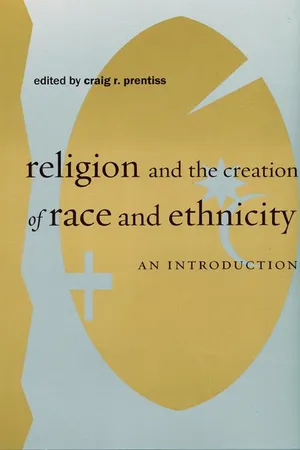
eBook - ePub
Religion and the Creation of Race and Ethnicity
An Introduction
- 243 pages
- English
- ePUB (mobile friendly)
- Available on iOS & Android
eBook - ePub
About this book
Information
Topic
Theology & ReligionSubtopic
ReligionChapter 1
“A Servant of Servants Shall He Be”
The Construction of Race in American Religious Mythologies
Genesis 9:18–27: 18 And the sons of Noah, that went forth of the ark, were Shem, and Ham, and Japheth; and Ham is the father of Canaan. 19 These are the three sons of Noah: and of them was the whole earth overspread. 20 And Noah began to be a husbandman, and he planted a vineyard. 21 And he drank of the wine, and was drunken; and he was uncovered within his tent. 22 And Ham, the father of Canaan, saw the nakedness of his father, and told his two brethren without. 23 And Shem and Japheth took a garment, and laid it upon both their shoulders, and went backward, and covered the nakedness of their father; and their faces were backward, and they saw not their father’s nakedness. 24 And Noah awoke from his wine, and knew what his younger son had done unto him. 25 And he said, “Cursed be Canaan; a servant of servants shall he be unto his brethren.” 26 And he said, Blessed be the Lord God of Shem; and Canaan shall be his servant. 27 God shall enlarge Japheth, and he shall dwell in the tents of Shem; and Canaan shall be his servant.
There are no white or black people as such. The specific ways in which we understand the terms “white people” and “black people” have some roots in antiquity but, as full–blown categories, they are relatively recent inventions. Once the categories of whiteness and blackness emerged in the modern world, however, they took on lives of their own, so much so that “race” became deeply inscribed in Western thought, permeating its religious beliefs, fables, and mythologies. This chapter grapples with the complicated question of how Christianity in America has mythically grounded (and frequently regrounded and revised) modern notions of race.
A complex of historical factors (such as the gigantic global enterprise of the African slave trade) and mythic groundings (such as stories from the Old Testament) influenced the construction of modern racial categories. Christianity was hardly the sole or even primary force in this process. Yet religious myth, originating from interpretations of biblical stories as well as speculations about God’s Providence, played an important role in the formation, revision, and reconstruction of racial categories in the modern world. Christianity necessarily was central to the process of racializing peoples—to imposing categories of racial hierarchies upon groups of humanity or other societies. But as we shall see, biblical passages were powerful but ambiguous, and arguments about God’s Providence in the slave trade and slavery were contentious.
The slave trade was essential to the creation of the modern international capitalist system. Products grown through slave labor—especially sugar, tobacco, and (much later) cotton—enriched the Europeans who colonized the New World, adding to the demand for more settlements, more produce, more laborers, and more profits. African slave labor provided the final and indispensable component needed for the building of the Americas. Slavery was a common feature of human societies since ancient times, one used widely for everything from establishing status ranking to forcing others to perform undesirable labor. Colonists in the Americas hungered for laborers, and slavery was well adapted to meet that need.
But the slave trade also took off during a great age of religious ferment and expansion following the Protestant reformation (and Catholic coun-terreformation). Thus, while the trade was fundamentally economic, the European participants sought some religious sanction for what was obviously a coercive and brutal activity.
Judeo-Christian stories were not necessarily, immediately, or inherently amenable to providing a religious basis for modern racial slavery. The Bible was silent, for example, on the specific meaning of white Europeans forcibly transporting black Africans to colonies for the purpose of ceaseless labor for European gain. The very modernity of such a mind–boggling international enterprise—with its capitalist support team of a ship–building industry, insurance against the ravages of the sea and slave revolts, venture capitalists to raise the massive funds needed for the voyages, staple crops like sugar and tobacco so in demand in Europe that they could be profitably traded for manufactured goods and luxuries—clearly extended far beyond the tightly circumscribed biblical world. Biblical characters lived in an ancient Semitic, Mediterranean, and North African world, one in which modern understandings of “white” and “black” people would have been meaningless.
Once slavery took root in the Americas, it was easy enough for religious authorities simply to decree that if slavery existed, God must have a reason for it—and that reason must be in the Bible. But because slavery in the Americas was specifically a racial form of bondage (in contrast to traditional forms of slavery found throughout the world, which were not “racial” in the modern sense, although they were sometimes “ethnic”), the religious justification of slavery would have to clarify God’s providence particularly in having one race of people enslave another. In this way, Euro-Americans worked out some of the meanings of “race” itself in the modern sense. They began to define what constituted “whiteness” and “blackness,” categories that would long outlive slavery itself.
Colonial and Early National Era (1600–1800):
The “Heathenism” Debate
Early colonizers in the Americas faced first the question of whether Christianity would apply to black slaves at all. The answer required, in part, deciding on whether Africans and African Americans were fully human—a debate that raged for several centuries, and indeed continued on into the post–Civil War era of scientific racism. If only Christians were truly human—and Christians were white—then where did that leave Negroes? English and Anglo–American theologians grappled with the problem. Was there a separate category, apart from “man,” into which blackness could be fit? As one early commentator put it, Negroes were “a people of beastly living, without a God, lawe, religion, or commonwealth.”1Heathenism thus was inextricable from barbarism and blackness, from being a non-Christian. The Virginia House of Burgesses, in 1699, noted that “the negroes born in this country are generally baptized and brought up in the Christian religion; but for negroes imported hither, the gross bestiality and rudeness of their manners, the variety and strangeness of their languages, and the weakness and shallowness of their minds, render it in a manner impossible to make any progress in their conversion.” The English Christians in particular, it seemed, were relatively indifferent to Christian duty: “Most men are well satisfied without the least thoughts of using their authority and endeavors to promote the good of the souls of those poor wretches,” one critic exclaimed.2
But at least in part, this indifference might have come about because so many white settlers remained unconvinced about whether blackness ultimately was compatible with the state of being Christian. For many, blackness conjured images of savagery even in the practice of religion itself. The Reverend Morgan Goodwin, who ministered in seventeenth-century Virginia, charged that “nothing is more barbarous and contrary to Christianity, than their ... Idolatrous Dances, and Revels.”3 Other early-day Anglo–American commentators on blackness simply threw up their hands at the inadequacy of explanations for black skin color, for which they could find no clear biblical explanation but which they nevertheless assumed must signify inferiority. “We must wholly refer it to God’s peculiar will and ordinance,” wrote one Englishmen, invoking exactly the same evasion generally employed to “explain” why a good God allowed evil and unjustified suffering.4
As some slaves converted to Christianity, however, reality once again confuted ideology and theology. Anglo–Americans faced this question: Would baptism require freedom? That is, did baptism into the Christian religion make people white? The early advocates of slave Christianization, accordingly, had to dissociate Christianity from whiteness—from free-dom—precisely for the purpose of defining “blackness” as a state of perpetual servitude continuing beyond one’s potential baptism into the Christian faith, and indeed beyond one’s own life into the lives of one’s children, grandchildren, to perpetuity. In 1664, the Maryland legislature worked out a law “obliging negroes to serve durante vita [for the duration of a lifetime] ... for the prevencion of the damage Masters of such Slaves must susteyne by such Slaves pretending to be Christ[e]ned.” Virginia’s statute held out the hope “that diverse masters, freed from this doubt, may more carefully endeavor the propagation of Christianity” among slaves, but this was a stretch, given the relative indifference of many planters to Christianity.5
In the northern colonies, Cotton Mather, the great and prolifically published Puritan minister of the late seventeenth and early eighteenth centuries, argued for the humanity of the slave and the Negro in intensively biblical tracts such as The Negro Christianized. Christian slaves, he said, would know “that it is GOD who has caused them to be Servants, and that they serve JESUS CHRIST, while they are at work for their Masters.” “Show yourselves Men,” Mather wrote, “and let Rational Arguments have their Force upon you, to make you treat, not as Bruits, but as Men, those Rational Creatures whom God has made your Servants.”6
Mather’s exhortations, part of a familiar litany of arguments in favor of Christianizing the slaves, met vigorous refutation among a number of northern ministerial writings in the eighteenth century. John Saffin, a Massachusetts jurist in the early eighteenth century and a slaveholder, enunciated an argument soon to be familiar in pro-slavery circles. The Bible sanctioned slavery, he insisted. The great patriarch Abraham owned slaves, so “our Imitation of him in this his Moral Action” was warranted, for “any lawful Captives of Other Heathen Nations may be made Bond men,” even if Christians could not buy and sell one another. Beyond that, God had “set different Orders and Degrees of Men in the World,” including some the Divine had made “to be born Slaves, and so to remain during their lives.” At the same time, and somewhat contradictorily, Saffin also articulated another point dear to the heart of pro-slavery theorists: that “it is no Evil thing to bring them [Africans] out of their own Heathenish Country, [to] where they may have the knowledge of the One True God, be Converted and Eternally saved.” Saffin even composed his own piece of wretched doggerel on “the Negroes Character”:
Cowardly and Cruel are those Blacks Innate,
Prone to Revenge, Imp of inveterate hate.
He that exasperates them, soon espies
Mischief and Murder in their very eyes.
Libidinous, Deceitful, False and Rude,
The Spume Issue of Ingratitude.7
Prone to Revenge, Imp of inveterate hate.
He that exasperates them, soon espies
Mischief and Murder in their very eyes.
Libidinous, Deceitful, False and Rude,
The Spume Issue of Ingratitude.7
Well before the full rise of pro-slavery thought in the mid-nineteenth-century South, then, pro-slavery ideologues in the North fleshed out many of the themes that would define the American defense of slavery and solidify the category of blackness. One popular argument was that people were indeed created by God to stay in varying degrees of freedom or subjection, and that for some to enjoy full liberty, others would have to be servants; this best served the happiness of the whole. This traditional conservative stance was a defense of social hierarchy, not especially related to racial considerations. But most expositions of this sort followed up with a defense of racial bondage in particular, explications of why the enslavement of black people contributed to God’s plan for the Americas. The African slave, wrote one Massachusetts conservative, was already enslaved to “the tyrannizing power of lust and passion” (the image of overpowering sexuality already being a standard image associated with blackness), and thus “his removal to America is to be esteemed a favor,” for it brought Africans “from the state of brutality, wretchedness, and misery ... to this land of light, humanity, and Christian knowledge.”8
Still, the ambiguity of slave Christianization remained troubling. For, if it was in the nature of the “black” to be subject to such “tyrannizing power,” then how could it be safe for domesticated and pure white Christians to subject themselves to such a menace? And if the black was born with that nature, was he human? If blackness was (by definition) unfree-dom, and Christianity was (by natural law) freedom, then how could the two be commingled? Christianity and whiteness were both states of freedom, making it easy for many to essentially equate the two: white = free and Christian; black/Indian/other = unfree and un-Christian. Would not the ultimate freedom promised by Christianity infect the minds of the not-free, such that they would begin to question their status, or to doubt the validity of Christianity?
A Swedish traveler in the North American colonies noted how masters feared that Christianity would incite feelings of freedom and equality among slaves:
There are even some, who would be very ill pleased at, and would by all means hinder their negroes from being instructed in the doctrines of Christianity; to this they are partly led by the conceit of its being shameful, to have a spiritual brother or sister among so despicable a people; partly by thinking that they should not be able to keep their negroes so meanly afterwards; and partly through fear of the negroes growing too proud, on seeing themselves upon a level with their masters in religious matters.9
For many Christians, whiteness simply became woven into the very fabric of Christianity itself.
Yet the inescapable fact remained that white Christians somehow had to fit black people into God’s Providence. Passages from the Old Testament, especially Genesis 9:18–27 (which outlined the curse on Canaan, son of Ham, who had originally espied Noah’s naked drunkenness)—once exegeted “properly”—provided at least a start at a religiomythical grounding for modern racial meanings, and a long-lived one. The passage was still cited in segregationist literature of the 1950s, and even today remains a hot topic of discussion on Internet sites with amateur biblical interpret...
Table of contents
- Cover Page
- Title Page
- Copyright Page
- Dedication
- Contents
- Acknowledgments
- Introduction
- 1 “A Servant of Servants Shall He Be”: The Construction of Race in American Religious Mythologies
- 2 Myth and African American Self-Identity
- 3 Almost White: The Ambivalent Promise of Christian Missions among the Cherokees
- 4 Indigenous Identity and Story: The Telling of Our Part in the Sacred Homeland
- 5 Jew and Judaist, Ethnic and Religious: How They Mix in America
- 6 Blackness in the Nation of Islam
- 7 Theologizing Race: The Construction of “Christian Identity”
- 8 “Loathsome unto Thy People”: The Latter-day Saints and Racial Categorization
- 9 Our Lady of Guadalupe: The Heart of Mexican Identity
- 10 Myths, Shinto, and Matsuri in the Shaping of Japanese Cultural Identity
- 11 Islam, Arabs, and Ethnicity
- 12 Cosmic Men and Fluid Exchanges: Myths of Arya, Varna, and Jāti in the Hindu Tradition
- 13 Religious Myth and the Construction of Shona Identity 197
- 14 Sacral Ruins in Bosnia-Herzegovina: Mapping Ethnoreligious Nationalism
- About the Contributors
- Index
- Footnotes
Trusted by 375,005 students
Access to over 1.5 million titles for a fair monthly price.
Study more efficiently using our study tools.
Frequently asked questions
Yes, you can cancel anytime from the Subscription tab in your account settings on the Perlego website. Your subscription will stay active until the end of your current billing period. Learn how to cancel your subscription
No, books cannot be downloaded as external files, such as PDFs, for use outside of Perlego. However, you can download books within the Perlego app for offline reading on mobile or tablet. Learn how to download books offline
Perlego offers two plans: Essential and Complete
- Essential is ideal for learners and professionals who enjoy exploring a wide range of subjects. Access the Essential Library with 800,000+ trusted titles and best-sellers across business, personal growth, and the humanities. Includes unlimited reading time and Standard Read Aloud voice.
- Complete: Perfect for advanced learners and researchers needing full, unrestricted access. Unlock 1.5M+ books across hundreds of subjects, including academic and specialized titles. The Complete Plan also includes advanced features like Premium Read Aloud and Research Assistant.
We are an online textbook subscription service, where you can get access to an entire online library for less than the price of a single book per month. With over 1.5 million books across 990+ topics, we’ve got you covered! Learn about our mission
Look out for the read-aloud symbol on your next book to see if you can listen to it. The read-aloud tool reads text aloud for you, highlighting the text as it is being read. You can pause it, speed it up and slow it down. Learn more about Read Aloud
Yes! You can use the Perlego app on both iOS and Android devices to read anytime, anywhere — even offline. Perfect for commutes or when you’re on the go.
Please note we cannot support devices running on iOS 13 and Android 7 or earlier. Learn more about using the app
Please note we cannot support devices running on iOS 13 and Android 7 or earlier. Learn more about using the app
Yes, you can access Religion and the Creation of Race and Ethnicity by Craig R Prentiss, Craig R. Prentiss in PDF and/or ePUB format, as well as other popular books in Theology & Religion & Religion. We have over 1.5 million books available in our catalogue for you to explore.