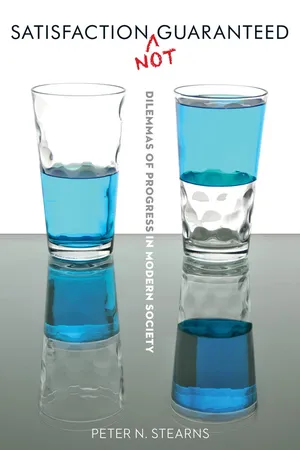
In the twentieth and twenty-first centuries, modern urban, industrial, affluent societies have made great strides towards fixing some of the problems that plagued other societies for centuries: food shortages are nearly eliminated, infant and maternal mortality has fallen dramatically, birth control is both readily available and effective, education levels are higher, and internal violence is significantly reduced. Modernity’s blessings are many and bountiful—but has modernity really made us happy?
Satisfaction Not Guaranteed is a book about the modern condition, and why the gains of living in modern urban, industrial, affluent societies have not proved more satisfying than they have. It examines why real results that paralleled earlier anticipations of progress have not generated the ease and contentment that the same forecasters assumed would apply to modern life. Employing his trademark inquiry of emotions in American history, Peter N. Stearns asks why, if modern life has been generally characterized by measurable themes of progress, abundance, and improvement, are people not happier or more content with their lot in life? Why is there an increased incidence of psychological depression, anxiety, and the sense that no one has ever reached a pinnacle of happiness or contentment? It’s not so much that modernity went wrong, but rather that it has not gone as swimmingly as was anticipated. Satisfaction Not Guaranteed uses concrete examples from both history and the present, such as happiness surveys, to discuss how as a society we might better juggle the demands of modern life with the pursuit of happiness.
The vision of what modern society might be emerged more than two centuries ago, as a product of a transformation in Western philosophy and a new belief in the way material progress and human improvability might combine. It was in the 1790s that the French philosopher Nicolas de Condorcet wrote that he had “no doubt as to the certainty of the future improvements we can expect…. Everything tells us that we are bordering the period of one of the greatest revolutions of the human race. The present state of enlightenment guarantees that it will be happy.”1
Students of intellectual history might quickly add, at this point, that Condorcet was unusual in his optimism. They might cynically note that the fact that he could write his Outlines of an Historical View of the Progress of the Human Mind while in hiding from French revolutionary radicals who sought to jail him (he later was arrested and committed suicide) suggests a clear problem in facing reality, and they might then turn to more complex Enlightenment theorists or to the surge of greater philosophical pessimism that would arise in later decades.
But the fact is that much of what Condorcet anticipated has actually happened. Agriculture has become vastly more productive, supporting larger populations. Machines have reduced physical labor. Education has spread. More parents are explicitly concerned about making their children happy. Diseases have receded in modern societies, greatly expanding life spans. And it’s fair to note that while Condorcet was unusual, he was not alone. In 1788 Benjamin Franklin himself wrote of the “growing Felicity of Mankind” resulting from improvements in technology, science, and medicine, and wished he could have been born two or three centuries later to see how all this progress would turn out.
Again, the vision was surprisingly accurate—save for two points. It did not cover the entire future of modern society, and it anticipated far more satisfaction from the gains that would occur than has turned out to be the case. This book, focusing on the second point, deals with the surprising double-sidedness of modern achievements. It explores the gulf between measurable advances and perceived happiness, and it probes the struggles people still face with many arguably beneficial results of modernity. Of course we’ll touch on the obvious misfires of modernity as well—for example, the increasing horror of modern warfare—but the main target is the satisfaction shortfall.
The basic point is straightforward, though underexplored to date. Even the gains modernity generated brought problems in their wake. Gains also prompted a rapid escalation of expectations that masked progress and brought their own dissatisfaction. And the whole process was complicated by modern claims about the new accessibility of happiness itself. The work of adjustment to modernity continues—we’re not that far from a number of basic transformations—and the opportunity for more successful adaptations continues as well. Exploring the gaps between hopes and gains, interesting in itself, assumes even greater importance when it can inform a reevaluation process.
Sweeping optimism about modernity’s potential has not entirely vanished. American politicians recurrently if vaguely invoke it—“yes we can”—and society at large sometimes manifests startling hopes about what more technology or more medicine might do in the future. And we’ll see in a moment how Enlightenment optimism surfaces almost perversely in the modern need to seem cheerful. But even as we continue to enjoy some of modernity’s obvious advantages, we fall short of the kind of happiness the visionaries had predicted. (It’s worth noting that the other great optimistic vision of modernity, Marxism, has also run aground.) Indeed, we’re as likely to project satisfaction backward in time as to ponder how far we have come. Thus the Good Old Days magazine, without making a systematic claim about current conditions, offers its readers “warm thoughts of the happy days gone by,” looking variously to the late 19th century, the 1920s, or the 1950s. Similarly, the popular slogan “back in the day,” though offering various meanings, connotes a simpler life in the past (sometimes in one’s own life span, sometimes more historically), despite constituting an incomplete thought with no clear meaning at all.
Often, the whole idea of a cozier past is just a matter of passing rhetoric, or a brief longing for (highly selective) memories of one’s own childhood. But nostalgia can pack more serious meaning as well. The current American penchant for big, traditionally designed houses or Martha Stewart “country chic” ware suggests a desire to surround oneself with an aura of the past—often on the part of people who are in fact working too hard to spend much time at home sinking back into their reminiscent trappings. French bookstores note a surge of interest in glamorized accounts of peasant life on the part of resolutely urban Parisians. And for many years, in France, the United States, and elsewhere, the purpose of many a vacation has been to get back (conveniently briefly) to soaking in the countryside or camping in nature, often on the assumption that some respite from modern conditions is periodically essential.
Modernity, in other words, proves double-edged, even as most of us have come to depend on its key achievements. Modern societies dramatically push back rates of mortality in children—allowing most families, for the first time in human history, to avoid the experience of a child’s death. Yet instead of enjoying the gain, modern parents often frantically track their children’s health and (particularly in the United States) surround them with annoying safety devices, making parenthood more complicated in the process. There are some good reasons for the concern—premodern societies did not have automobiles—but the lack of perspective is noteworthy as well. Indeed, anxieties around children seem to have surged since the 1980s, with growing fears about letting even older children out of sight. And childhood is just one instance of many where objective changes and widespread perceptions do not match. We can learn more about ourselves by exploring why modern advances have not produced a greater sense of ease.
This is a book about the modern condition and about why the gains of living in modern, urban, industrial, affluent societies have not proved more satisfying than they have. We won’t belabor the “good old days” theme. But we will examine why real results that parallel earlier anticipations of progress have not generated the ease and contentment that the forecasters assumed. The book explores a rupture between substantial improvements for a majority in modern societies, and the kinds of reactions they evince—a rupture that affects not only our understanding of recent history but also many aspects of the quality of daily life. It’s not so much that modernity went wrong—with a couple of obvious and substantial exceptions, there’s no reason to bash the trajectory—as that it has not gone as right as might reasonably be expected from the historical record.
I have been studying some of the changes that go into shaping the modern condition for my entire career as a historian. I was initially fascinated by the impact of the industrial revolution and the question of how people going from rural life or urban crafts into factories managed to survive their experience. The subject is still compelling, even when one recognizes that early factories were not nearly as large or mechanically overwhelming as their contemporary counterparts (they were, however, both noisier and less safe). In subsequent years I’ve tried to deal with some of the less direct results of modern change, in family life or body types or emotions. In all the work, the unifying themes have been how substantial modern change has been, from its 18th-century origins to the present, and how important it is to figure out how people have navigated it—and still navigate it. Happily, beyond my own endeavors, there has been a huge expansion in the range of historical research, which allows analysis of change and resistance in many aspects of the modern human experience.
In many ways, as I have long argued, people have managed to adjust to rapid, extensive modern change supremely well. There were shocks, and some individual collapses. And at points there was fierce protest. In general, however, most recent research, even on immigrants or the industrial working class, has tended to emphasize adaptation and accommodation, with extreme commitments to protest or disorientation being fairly unusual and episodic. While key passages in modernity have roused passionate opposition, the more characteristic patterns involve more complex reactions and more diffuse targets.
Yet I have also been impressed, probably increasingly over time, with some of the less overt costs involved in trying to deal with the advent and maturation of modernity, even among groups less beleaguered than early factory workers. Living in a modern framework is not easy, and even in societies like our own that have been dealing with the process for several generations, there are still areas where definitive standards have yet to be agreed upon. Assessing how some key problems and tensions have emerged, even amid considerable adaptation, contributes to personal understanding and helps free up space to discuss other options.
This book is a commentary on the emergence and evolution of the modern condition. Over two centuries ago a number of societies, initially in the West, began to forge the urban, industrial apparatus that, gradually but inexorably, came to replace the largely rural and agricultural framework that had shaped the human experience for several millennia. The apparatus foregrounded factories and power-driven technology, but it also recast family life, work, leisure, even sexuality—indeed much of the content of daily activity and personal meaning. Modernity would entail huge changes in government policy, the role of science, the nature of war—a variety of macro developments. But this inquiry deals more with the daily, even ordinary aspects of modernity, often on the more private side of life, which is where many of the nagging issues and conundrums nest. Even here, there’s no intention to explore all the details or phases of the establishment of modern life, but rather to focus on key directions and the ways in which contemporary challenges flow from the broad process of modern social change.
Modern developments introduced some unanticipated new problems that emerged on the heels of the resolution or partial resolution of older issues. They also provoked some responses that have turned out to be inadequate and open to review. Both the problem generation and the false starts warrant exploration, for they all contribute to the sense of potential unfulfilled.
Another vantage point is crucial here: the effective recency of the whole current of change that so vividly connects contemporary trends—like the latest iterations of discussions over what constitutes a successful modern childhood—to the first signs of disruption to agricultural patterns over two hundred years before. Though a two-century-plus span is a long time, when considered in terms of the magnitude of the changes involved as well as the deep roots of prior agricultural patterns, it’s barely the blink of an eye. We’re all still adjusting to basic shifts such as the separation between work and family or the decline in the omnipresence of death or the growing dependence on commercial purveyors of leisure for so much of what we see as the fun of life. We’re still trying to figure out how to deal with novel problems modernity generates, such as the unprecedented challenge of obesity, or with first responses to modernity (like retirement as the solution to the issues of modern old age) that probably need a second look. We hear a lot about the “post-modern” or postindustrial, and of course new directions arise within a modern framework. But the fact is that we’re still in the early stages of a more fundamental social order—the modern—that may (if past precedents are any model) last for many centuries. This is why most of the adjustments in ordinary daily life remain a bit tentative. This is why it is not at all too late to take hold of the reins of modernity, using the analysis of recent history as a partial guide, and shape it in ways that might work better for us than present patterns do.
A final complication demands attention as well, though more in the West, and particularly the United States, than in modern societies generally. While the dominant process of contemporary history centers on the construction of modern social institutions and experiences, a second process, a bit less familiar, highlights a mounting pressure to seem (and, if possible, to actually be) cheerful and happy. This process also began to take shape in the 18th century, and this meant that many of the really difficult adjustments to the modernization of social and personal life were surrounded by an unprecedented tide of secular optimism from a number of persuasive sources. Here, too, clear connections link contemporary patterns with the earlier directions of change, creating an ongoing relationship between the happiness imperative and the outcomes of modern, industrial transformation. Indeed, the cost of measuring up to intensifying demands for cheer, even while dealing with the inherent complexities involved in constructing modern childhoods or death rituals, has almost certainly gone up in recent decades. Here, too, is a revealing history to be explored not for its own sake but for what it shows about the sources and shadows of the present. The burdens of modernity are compounded by the need to keep smiling.
Combining new requirements for cheerful ebullience with the creation of modern social experiences has not always been inherently contradictory, which is why, at various points, the most starry-eyed optimists have been able to skirt the problem altogether. Elements of a progressive vision have not only come true but have indeed, as pundits predicted, removed or reduced age-old burdens in life in ways that can make it easier to be happy. There is far less untimely death to mourn, to take a leading example, than once was the case. But fulfilling happiness demands could itself be a strain, as several insightful scholars have pointed out, and the context encouraged the development of new expectations rather than the enjoyment of older problems resolved. Here is a set of relationships that has not been fully explored and yet is central to the satisfaction gap that so obviously defines key aspects of modern life.
Any prospectus that tosses around the word “modernity” as often as I already have must offer a few other explanations. “Modern” and “modernization” are terms that have been frequently misused, and much criticized. There’s no reason, in my judgment, to back off from the proposition that a cluster of changes has occurred—around new technologies, the rise of urban centers, and the relative decline of agriculture and agricultural forms—that can be accurately and efficiently summed up as modern, but there’s also no question that some further, if brief, definition is essential.
First: where, geographically, will this book focus? “Modern” is an encompassing term, and the roster of societies moving into the modern orbit is expanding rather rapidly. Many societies now are modern, in terms of basic urban and industrial structures, with life expectancies and educational levels to match. But modern frameworks, though important, can be variously implemented. In this study, the focus is on the United States, but to carry the analysis through properly some comparisons are essential. Figuring out what has been distinctive about American encounters with, for example, a rapidly falling death rate or the regularization of food supply, and what has been a standard part of the process whether in the United States or Japan, sheds light both on the global present and on the national particulars. The unusually heavy demands of American cheerfulness, which foreign observers noted already by the early 19th century and which have multiplied in recent decades, also transpose a widespread modern dilemma onto a distinctive national canvas. There are a few cases, as well, in which experiences elsewhere in handling modernity seem clearly superior to homegrown models, which is where comparison is practically as well as analytically essential despite a considerable national reluctance to admit any need to learn from abroad.
Issues of evaluation loom at least as large as geography in invoking modernity. Too often, in some social science literature, “modern” has been equated with good or desirable; but since much of the purpose of this study involves assessing the quality of the modern, we can surely hope to avoid this trap. It’s precisely because traditional arrangements often worked so well in many respects that the modern becomes more problematic than is often realized; and the fact that several modern societies emphasize happiness in new ways must not lead us to assume that premodern people were actually less happy. Indeed, to anticipate, it’s virtually certain that for some people less insistence on happiness would permit greater actual happiness. So the problem, modern=better, can be addressed without too much anticipatory agony.
Overgeneralization within a modern society is another challenge. It is vital to acknowledge a welter of diverse situations and responses. At various key points, and to an extent still today, the two genders have experienced aspects of emerging modernity differently, and the same applies to social class and other common dividers, including extent of religiosity. American responses to modern childhoods, for example, have been hugely contingent on whether traditional ideas about original sin were cast aside or re-embraced. On the class side of things, it has been easier but also more imperative for middle-class folks to try to measure up to happiness demands than for workers or farmers to do so, though by the later 20th century the huge expansion of the self-professed American middle class qualifies this point at least nationally. While on the whole the happiness push has tended to make expressions of outrage or anger more difficult—which was one of the reasons the whole theme gained so much manipulative attention—this doesn’t mean that everyone clusters around a ubiquitous smiley face, even in the United States. The complexities of the modern experience amid overt pressures for happiness demand assessment, but accompanied by recognition of varied subgroups and personality styles. Many people make a good thing out of modernity through some commonsense personal adjustments in expectations; many people are angry or resentful about modern standards and pressures; many fare adequately but amid more anxieties than they think they should have to face. The mixture challenges any glib generalizations about modernity.
This book is not intended as an attack on the modern condition—another evaluative posture that would not be helpful. Modern change has brought all sorts of benefits, and where down sides have emerged, they may yet be more successfully addressed.
It is clear as well, even as we turn to the unexpected constraints on modern happiness, that few people would willingly choose to return to a premodern framework. From the early 19th century onward, periodic experiments offered people the chance to go back to a somewhat idealized past, through bucolic, craft-centered communities. The outlet was important to a few individuals, and it did shed light on the pressures of modern change, but the communities always foundered and never posed a serious alternative to modern, industrial reality. The same judgment applies to the commune movement of the 1960s, briefly hailed as a wave of the future. A few small ventures survived, a few people stayed rural and anticonsumerist, but for almost everyone else modernity quickly resumed its forward march, incorporating a few countercultural trinkets ...
Table of contents
Cover page
Title Page
Copyright page
Dedication
Contents
Acknowledgments
1 Introduction: Being Cheerful and Modern
Part I. The Modern and the Happy: A Tenuous Embrace
Part II. Maladjustments in Modernity
Part III. Great Expectations
Conclusion: Shaping Modernity
Notes
Index
About the Author
Footnote
Trusted by 375,005 students
Access to over 1.5 million titles for a fair monthly price.
Study more efficiently using our study tools.
Frequently asked questions
Yes, you can cancel anytime from the Subscription tab in your account settings on the Perlego website. Your subscription will stay active until the end of your current billing period. Learn how to cancel your subscription
No, books cannot be downloaded as external files, such as PDFs, for use outside of Perlego. However, you can download books within the Perlego app for offline reading on mobile or tablet. Learn how to download books offline
Perlego offers two plans: Essential and Complete
Essential is ideal for learners and professionals who enjoy exploring a wide range of subjects. Access the Essential Library with 800,000+ trusted titles and best-sellers across business, personal growth, and the humanities. Includes unlimited reading time and Standard Read Aloud voice.
Complete: Perfect for advanced learners and researchers needing full, unrestricted access. Unlock 1.5M+ books across hundreds of subjects, including academic and specialized titles. The Complete Plan also includes advanced features like Premium Read Aloud and Research Assistant.
Both plans are available with monthly, semester, or annual billing cycles.
We are an online textbook subscription service, where you can get access to an entire online library for less than the price of a single book per month. With over 1.5 million books across 990+ topics, we’ve got you covered! Learn about our mission
Look out for the read-aloud symbol on your next book to see if you can listen to it. The read-aloud tool reads text aloud for you, highlighting the text as it is being read. You can pause it, speed it up and slow it down. Learn more about Read Aloud
Yes! You can use the Perlego app on both iOS and Android devices to read anytime, anywhere — even offline. Perfect for commutes or when you’re on the go. Please note we cannot support devices running on iOS 13 and Android 7 or earlier. Learn more about using the app
Yes, you can access Satisfaction Not Guaranteed by Peter N. Stearns in PDF and/or ePUB format, as well as other popular books in Historia & Historia moderna. We have over 1.5 million books available in our catalogue for you to explore.