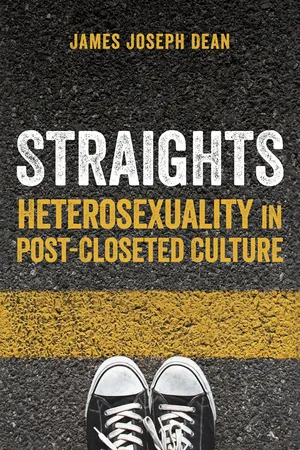
Explores how straight Americans make sense of their sexual and gendered selves
Since the Stonewall Riots in 1969, the politics of sexual identity in America have drastically transformed. It's almost old news that recent generations of Americans have grown up in a culture more accepting of out lesbians and gay men, seen the proliferation of LGBTQ media representation, and witnessed the attainment of a range of legal rights for same-sex couples. But the changes wrought by a so-called "post-closeted culture" have not just affected the queer community—heterosexuals are also in the midst of a sea change in how their sexuality plays out in everyday life. In Straights, James Joseph Dean argues that heterosexuals can neither assume the invisibility of gays and lesbians, nor count on the assumption that their own
heterosexuality will go unchallenged. The presumption that we are all heterosexual, or that there is such a thing as 'compulsory heterosexuality,' he claims, has vanished.
Based on 60 in-depth interviews with a diverse group of straight men and women, Straights explores how straight Americans make sense of their sexual and gendered selves in this new landscape, particularly with an understanding of how race
does and does not play a role in these conceptions. Dean provides a historical understanding of heterosexuality and how it was first established, then moves on to examine the changing nature of masculinity and femininity and, most importantly, the emergence of a new kind of heterosexuality—notably, for men, the metrosexual, and for women, the emergence of a more fluid sexuality. The book also documents the way heterosexuals interact and form relationships with their LGBTQ family members, friends, acquaintances, and coworkers. Although homophobia persists among straight individuals, Dean shows that being gay-friendly or against homophobic expressions is also increasingly common among straight Americans. A fascinating study, Straights provides an in-depth look at the changing nature of sexual expression in America.
- 320 pages
- English
- ePUB (mobile friendly)
- Available on iOS & Android
eBook - ePub
About this book
Information
1
Thinking Straight
When I started graduate school in 1997, I moved from Southern California to upstate New York. In order to keep up with current events, I subscribed to the New York Times. That same year, I started to follow the Times’s coverage of a court case in Vermont, where three same-sex couples filed lawsuits arguing that the state discriminated against them by not offering them the same rights as heterosexual married couples. The case proved disappointing. In 1999, the Vermont State Supreme Court ruled that it was unconstitutional to deny the same benefits of marriage to lesbian and gay couples, but the state’s legislature had accorded gay couples these benefits through “civil unions.” The second-class status of “civil unions” asserted a clear heteronormative message: same-sex relationships are inferior and unequal to straight relationships.
Between news reports of Vermont’s decision in 1999 and the Massachusetts Supreme Court’s decision in 2003, which made Massachusetts the first state to grant lesbian and gay couples the right to marry, I noticed that in September 2002 the New York Times started to include celebrations of same-sex couples’ commitment ceremonies in its Sunday Styles section. As a result of the inclusion of lesbian and gay couples, the heading in the Sunday Styles section changed from “Weddings” to “Weddings/Celebrations.” In this small but significant inclusionary change by this prestigious newspaper, regarded as the national keeper of the public record, I witnessed a newfound respect for lesbian and gay life and our relationships as deserving of the same recognition as straight couples’ marriages. Although the New York Times’s inclusion did not translate in a direct way into same-sex couples’ right to marry, it contributed to the trend of a post-closeted culture of open lesbian and gay couples as well as the social integration and cultural normalization of gay couples as equal to their straight counterparts.1
I start with these stories to call attention to the unique focus of this study. Reversing the focus on how lesbian women’s and gay men’s coming-out stories affect and change straight men and women and the larger American society, I ask, instead, how straight men’s and women’s attitudes and actions accommodate, resist, or paradoxically support gay equality yet remain homophobic in post-closeted contexts. How do straight men and women construct, maintain, and alter their identity practices due to the cultural presence of out lesbian women and gay men? American society today is experiencing an unprecedented proliferation of lesbian and gay representations in the mass media and popular culture. These remarkable changes in the cultural sphere are a product of the significant political victories of LGBTQ movements for a range of rights, policy inclusions, and recognitions over the last four decades. With this context in mind, I analyze how a post-closeted cultural dynamic shapes the meanings of heterosexuality, affects the performances of straight identity, and conditions the development of softer forms of homophobia, along with consciously pro-queer alliances on the part of straight men and women.
Further, this book analyzes the way gender (masculinities and femininities) and race (blackness and whiteness) shape and change the meaning of straight identities. Through in-depth interviews with a diverse range of straight individuals, I illustrate that there are a dizzying array of patterns of straight sexual identities in American society today. To understand the diversity of these constructions of racial straight masculinities and femininities, this book draws on research in sexualities studies, gender studies, and race studies to empirically explore the multiple patterns and dynamics of straight identity performances.
In this chapter I discuss the current research on heterosexualities by first defining the concept of heterosexual identities and situating my study within a Foucauldian and Butlerian theoretical framework. I then make the case for the rise of a post-closeted culture as a pattern in American society by examining some of the sociological literature on the status of gay and lesbian life. Keeping in mind the insight that heterosexualities are multiple, I problematize gender studies for conflating straight masculinity with homophobic practices and chart a multiplicity of straight femininities, from emphasized femininity to female masculinity. I argue for the need to understand how whiteness and sexual normativity are coupled in relation to blackness and hypersexuality in constructions of straight sexualities.
Defining Heterosexualities, Normalizing Power, and Performative Identities
Heterosexual identities need to be situated within the context of the rise of an out and visible lesbian, gay, and queer culture. The concept of a heterosexual identity aims to capture both one’s sense of self and the group that one identifies with on its basis. In its simplest form, a heterosexual identity is constructed by individuals taking on the attribution heterosexual or straight themselves.
More broadly, heterosexualities are configurations of practice and discourse that refer to the identity category heterosexuals and generally, but not necessarily, align with sexual behaviors and desires orientated to the other—as opposed to the same—gender. That is, an individual may claim a heterosexual identity but engage in same-sex behaviors and experience same-sex desires at various points in his or her lifetime. The fluidity and situational character of sexualities mean that individual factors (e.g., a person-based definition of sexual desire), social contexts (e.g., college life, a prison term, employment in the porn industry), and historical events (e.g., second-wave feminism) shape and are shaped by heterosexualities in particular and sexualities in general.
My study of heterosexualities, though, is less about sexual behaviors and desires and more about the identity practices or the words and deeds that straights use in social interactions and situations to project themselves as straight. For example, the traditional practice of wearing a wedding band, claiming a marital status as a husband or wife, and simply expressing sexual or romantic interest in the other gender are acts meant to indicate a straight status.
Significantly, straight identities are established through social norms that make up our society’s social structures and organizations, such as government bureaucracies, economic systems, and legal orders. These social structures, along with our social institutions, such as marriage, the family, schools and colleges, corporations, political parties, and the armed forces, create both individual and institutional privileges (unearned advantages, resources, and rights given without any effort on an individual’s part) that favor straight persons, relations, marriages, and families over nonstraight ones. This creates what is referred to as heteronormativity (the privileging of heterosexuality as normal, natural, and right over homosexuality) in daily life and social institutional settings.
Living in a heteronormative society, heterosexual individuals are accorded heterosexual privilege. This privilege is often invisible. It is enacted by the view that heterosexuality is “normal,” social-psychologically healthy, and complex, as well as through entitlements to “first-class” citizenship. The institutional legitimation of heterosexual identities is the linchpin of its hierarchical dominance over homosexualities. For example, heterosexual families are automatically viewed as better, healthier, and more “normal” than lesbian and gay families. Children are also thought to be best parented by a heterosexual mother and father (see, however, Stacey and Biblarz 2001; and Biblarz and Stacey 2010, who refute these notions).
Heterosexual identity, though, varies in strength for individuals: some individuals realize that heterosexual is merely an ascriptive category that one falls into, while others have a strong investment in the identity in their daily interactions. Paradoxically, individuals with normative identities (e.g., heterosexuals, whites, men) often experience the sense that they lack an identity since they serve as the standard by which others (e.g., nonheterosexuals, nonwhites, women) are measured and marked by their difference (Connell 1995; Perry 2002; Richardson 1996).
The invisible and compulsory nature of straight identities is not just due to their assumed normal or “majority” status. Straight identities, like sexual identities in general, are always and already constructed in part through gender norms and identities. This is because gender is a routine, methodical, and recurring accomplishment of daily life, and it is central to being viewed as an intelligible human being (West and Zimmerman 1987; Glick and Fiske 1999). Thus, gender norms and conventional displays construct and reinforce straight identity statuses, and heteronormativity affirms sex and gender binary conceptions of male/female, masculine/feminine, and man/woman as opposite but complementary pairings, although lesbians and gay men are increasingly embodying traditional gender norms and presentations while straights are taking on nontraditional gender conventions, complicating the use of gender displays as clear indicators of sexual identities. While a gendered social order enforces the construction of men’s and women’s gender identities as binary and supposedly “natural,” complementary opposites, heteronormativity establishes, sustains, and bolsters a gender order where men and women are meant only for each other. This ideological construction naturalizes straight sexual relations, reproduction, and identities as outside social norms and historical time.
In postmodern societies, however, power is neither simply group-based (e.g., heterosexuals over homosexuals) nor only the effect of macro-social structures (e.g., economics or the state) on a population. Although this form of juridical power, defined by the sociologist Max Weber as “the chance of a man or of a number of men to realize their own will in a communal action, even against the resistance of others who are participating in the action” (1946, 180), still operates in societies today, it fails to conceptualize the more refined, slippery, and invisible techniques through which power circulates as part of the micro-processes of identity formations.
Following the French social theorist Michel Foucault (1978), I understand the micro–power politics of social identities as constructed through norms, practices, discourses, and institutions that escape the machinations of any one group of people. Micro–power processes are normalizing and coextensive with social identity formation. Historicizing Foucault, though, is important, as the macro form of juridical power that structured the existence of homosexual lives in a top-down way was predominant from the 1930s to the 1960s (see chapter 2 for the historiographical research and my argument on the rise and fall of the closet). This top-down or macro conception of power is historicized by the concept of the closet. The closet was a macro-power formation based in state practices of prejudice and discrimination that oppressed homosexual people and life. Through its administrate and legal powers, public policies, and police force, the closet as a state formation imposed a double life on homosexual persons. For lesbians and gay men, the closet meant a double life: confining one’s homosexual self-presentation to a private sphere of homosexual friends and intimates while simultaneously passing as heterosexual in public in order to live a socioeco-nomically viable existence.
The effect of the repressive closet was not to eliminate homosexuals but to contain, circumscribe, and overwhelmingly stigmatize their existence. It formed a homosexual self based on anxieties of exposure, shame, and self-loathing. Ironically, this repressive power of containment and stigmatization led to the development of gay social worlds that would grow into powerful social movements that “reversed” the discourse of their stigmatization into a politics and discourse of rights, recognition, and visibility, aiming to rectify the wrongful prejudice, discrimination, and legal disenfranchisement they experienced. Symbolically, the Stonewall riots of 1969 signal the historical triumph of homosexuals as they reversed the discourse of stigma, pathology, and oppression used to repress them and turned it back on heterosexual society and its state-sanctioned institutions of control. As Foucault expressed it in an often-quoted passage,
There is no question that the appearance in nineteenth-century psychiatry, jurisprudence, and literature of a whole series of discourses on the species and subspecies of homosexuality, inversion, pederasty, and “psychic hermaphrodism” made possible a strong advance of social controls into this area of “perversity”; but it also made possible the formation of a “reverse” discourse: homosexuality began to speak in its own behalf, to demand that its legitimacy or “naturality” be acknowledged, often in the same vocabulary, using the same categories by which it was medically disqualified. (1978, 101)
For Foucault, however, this reverse discourse that explains the normalization of homosexuality does not mean unregulated freedom, total liberation, or the disappearance of social forces that shape, circumscribe, and control sexuality. Rather, as repressive juridical power recedes, normalizing forces adjust, shift, and expand. Normalizing power builds on the sociohistorical conditions it inherits. In a post-Stonewall context, this means the further entrenchment of the view that sexuality is an essential, core part of one’s self-identity. Sexual desire and identity are consolidated into the master categories of a binary divide: homosexuality and heterosexuality. Sexual desire is now seen as organizing not only one’s choice of a partner but a wide range of aspects unrelated to sexual desire, ranging from one’s personality and taste in cultural products like clothing styles and grooming habits to leisure activities and occupational pursuits. This logic of sexual desire and identity views homosexuality and heterosexuality as mutually exclusive and internally coherent categories. As a result, other axes of social difference and identity, such as race, class, gender, age, nationality, and immigration status are at times sidelined and minimized when the shared experience of being homosexual or heterosexual is emphasized.
Following Foucault, the philosopher Judith Butler (1990, 1992, 2004) argues that the notion of identity as the container of liberation is a ruse of normalizing power. She argues that power is coextensive with an individual’s subjectivity and identity formation. In her cautious theory of performative identities, Butler argues that identity performances are recurring and accomplished processes of daily life but are also deeply constructed by the effects of male domination and heteronormativity. In Gender Trouble: Feminism and the Subversion of Identity, Butler (1990) contends that
[t]he repetition of heterosexual constructs within sexual cultures both gay and straight may well be the inevitable site of the denaturalization and mobilization of gender categories. The replication of heterosexual constructs in non-heterosexual frames brings into relief the utterly constructed status of the so-called heterosexual original. Thus, gay is to straight not as copy is to original, but, rather, as copy is to copy. The parodic repetition of “the original” … reveals the original to be nothing other than a parody of the idea of the natural and the original. (31; italics in original)
In other words, straight identities are not the basis of gay identities or related to gay identities as an original is to a copy. Rather, as all identities are parodic performances, all identities are copies of copies. The parodic repetitious nature of straight identities (and this applies to identities more broadly) reveals them to be compulsory performances of norms (or copies of norms) that are enacted on bodies, bodies that are interpreted for sexuality, gender, and sex from a heteronormative principle of social organization.
In sum, Butler’s performative theory argues for seeing identities as the “stylized repetition of acts … [that constitute] sustained social performances” and that come into being through the very acts of the performance (1990, 140–41). Recent criticisms of Butler, however, contend that her performative theory underemphasizes the contextual and relational dimensions of identity performances. In her book Illicit Flirtations: Labor, Migration, and Sex Trafficking in Tokyo, Rhacel Parreñas (2011) analyzes the gender performances of Filipina transgender women hostesses to show that their performances as women require recognition by their Japanese male customers or other transgender men.
For transgender hostesses … the performance of gender, in this case of femininity, in itself does not constitute their identity of being “like women.” Instead, it is the acknowledgement of these performances, their recognition, and validation with masculine gestures that would constitute their feminine identity. My insistence on situating gender in a social context forces us to expand Judith Butler’s assertion that gender’s performance and reiteration of such a performance would on their own constitute the notion of a stable gender identity. (208)
Similarly, the sociologist Jane Ward (2010), examining the gender labor of queer femmes in recognizing, validating, and thus helping to enact the masculine performances of their romantic female-to-male (FtM) transmale partners, emphasizes how queer femmes do the labor of being “the girl” in the relationship. A queer femme ends up engaging in conscious acts of “forgetting” the transmale partner’s girlhood past in order to establish his masculine performance as legible, authentic, and real.
Parreñas and Ward, then, allow us to reexamine straight men’s identity performances as based on their relational recognition by straight (or lesbian) women’s feminine gestures or the feminine gestures of transwomen and feminine gay and straight men, along with the shared recognition and validation of their straight masculinity performances they receive from other masculine men (or women), straight or gay. Similarly, straight women’s performances of straight femininity are corroborated and confirmed through the masculine gestures of men, straight and gay, as well as the mutually approving feminine gestures of straight and lesbian women, on one hand, or the masculine enactments of butch lesbians and transmen, on the other.
In this book, I examine how straight men and women talk about acts of gender and sexuality to establish their own identity performances as well as those of lesbians and gay men. One way straight individuals reinforce their sexual-gender privilege is to view lesbians and gay men as failed women and men, whereas, in contrast, antihomophobic straight individuals often refuse to use traditional gender acts as signs of heterosexuality, viewing gays and lesbians as diverse in their embodiment of both normative and nonnormative gender performances. These straight men and women validate a wider range of gender expressions as masculine and feminine in their efforts to be gay-friendly and pro-queer.
The Implications of Queer Theory and the New Sociology of Heterosexualities
In thinking about the social construction of straight identities, Foucault, Butler, and other queer theorists (Fuss 1991; Sedgwick 1990; Seidman 1997; Somerville 2000; Warner 1993, 1999) have brought into analytical view the importance of shifting the study of sexuality “from explaining the modern homosexual to questions of the operation of the hetero/homosexual binary, from an exclusive preoccupation with homosexuality to a focus on heterosexuality as a social and political organizing principle, and from a politics of minority interest to a politics of knowledge and difference” (Seidman 1996, 9). Queer theory, then, makes clear the importance of focusing on the social construction of heterosexualities as not simply behaviors but as a set of identity practices in relation to nonheterosexualities. It is important to understand heterosexual identities as not only multiple and variable, but also irreducible to the social system that enforces the norm of heterosexuality across society (Corber and Valocchi 2003; Martin 2009). In other words, heterosexual identities should not be conflated with a singular, unitary set of identity practices, nor should they be viewed as automatically constitutive of normative heterosexuality’s institutional dominance. Rather, through solidarity and alliance with LGBTQ persons and issues, heterosexuals can challenge homophobia, refuse heterosexual privilege, and promote respect, recognition, and rights for LGBTQ identities and lives.
Sociological analysis of heterosexuality is a recent development. Thinking of heterosexualities as hegemonic, current scholarship shows how sexuality shapes the identities of straight individuals to be normative, neutral, and taken-for-granted practices in everyday life and institutional settings. These studies examine how straights fashion boundaries between heterosexuality and homosexuality in order to create and secure a privileged straight identity. Heterosexual identities are in positions of privilege and structural advantage. One main way privilege works is for heterosexuals to view their identities as neither identities nor forms of privilege. Since heterosexuals are able to take for granted their unacknowledged privilege, heterosexual rituals, social norms, and other behaviors go unseen as mechanisms through which heterosexual identity is made dominant in daily and institutional life. Straight identity practices are sociologically significant to the extent that core parts of an individual’s social life—work, family, and friendships—are organized by this id...
Table of contents
- Cover Page
- Title Page
- Copyright Page
- Dedication
- Contents
- Acknowledgments
- Introduction
- 1. Thinking Straight: Gender, Race, and (Anti)homophobias
- 2. From “Normal” to Heterosexual: The Historical Making of Heterosexualities
- 3. Straight Men: Renegotiating Hegemonic Masculinity and Its Homophobic Bargain
- 4. Straight Women: Doing and Undoing Compulsory Heterosexuality
- 5. Queering Heterosexualities? Metrosexuals and Sexually Fluid Straight Women
- 6. Conclusion: Straights, Post-Closeted Culture, and the Continuum of Identity Practices
- Appendix
- Notes
- Bibliography
- Index
- About the Author
Trusted by 375,005 students
Access to over 1.5 million titles for a fair monthly price.
Study more efficiently using our study tools.
Frequently asked questions
Yes, you can cancel anytime from the Subscription tab in your account settings on the Perlego website. Your subscription will stay active until the end of your current billing period. Learn how to cancel your subscription
No, books cannot be downloaded as external files, such as PDFs, for use outside of Perlego. However, you can download books within the Perlego app for offline reading on mobile or tablet. Learn how to download books offline
We are an online textbook subscription service, where you can get access to an entire online library for less than the price of a single book per month. With over 1.5 million books across 990+ topics, we’ve got you covered! Learn about our mission
Look out for the read-aloud symbol on your next book to see if you can listen to it. The read-aloud tool reads text aloud for you, highlighting the text as it is being read. You can pause it, speed it up and slow it down. Learn more about Read Aloud
Yes! You can use the Perlego app on both iOS and Android devices to read anytime, anywhere — even offline. Perfect for commutes or when you’re on the go.
Please note we cannot support devices running on iOS 13 and Android 7 or earlier. Learn more about using the app
Please note we cannot support devices running on iOS 13 and Android 7 or earlier. Learn more about using the app
Yes, you can access Straights by James Joseph Dean in PDF and/or ePUB format, as well as other popular books in Social Sciences & Gender Studies. We have over 1.5 million books available in our catalogue for you to explore.