Web Site
The interested reader is urged to contact the author and join a Pragmatic Psychology Dialogue Group at the following web site: http://www.rci.rutgers.edu/~dfishman/
"At long last, a tightly reasoned, thoroughly grounded treatise showing that complex social programs can be understood far more profoundly and usefully than past mindsets have allowed."
--Lisbeth B. Schorr, author of Common Purpose: Strengthening Families and Neighborhoods to Rebuild America
"Fishman creates a new paradigm for advancing clinical science. Every mental health professional aspiring to be accountable and a scientist practitioner in their work should be aware of the ideas in this readable and entertaining book."
--David H. Barlow, editor of Clinical Handbook of Psychological Disorders
"Daniel Fishman cuts through rhetoric with clear writing and a razor-sharp wit. The chapter on education is like the welcome beam of a lighthouse in a fog."
--Maurice J. Elias, coauthor of Social Problem Solving: Interventions in the Schools
"Fishman makes the case for a pragmatic psychology in unusually lucid and forceful prose. This book should be read not only by professional psychologists but by anyone interested in the future of mind-related science."
--John Horgan, author of The End of Science: Facing the Limits of Knowledge in the Twilight of the Scientific Age
"Fishman's liberating insights will free his readers to set aside the intellectual quandaries that plague philosophers and psychologists at the end of the 20th century, and turn back with confidence to the practice of their work."
--Stephen Toulmin, author of Cosmopolis: The Hidden Agenda of Modernity
"As we try to steer a course through the public policy debates of the 21st century, Fishman's pragmatic psychology for enhancing human services provides a far-reaching new resource for meeting this challenge."
--Pat Schroeder, President and CEO, Association of American Publishers. Former Congresswoman from Colorado.
About the Book
A cursory survey of the field of psychology reveals raging debate among psychologists about the methods, goals, and significance of the discipline, psychology's own version of the science wars. The turn-of-the-century unification of the discipline has given way to a proliferation of competing approaches, a postmodern carnival of theories and methods that calls into question the positivist psychological tradition.
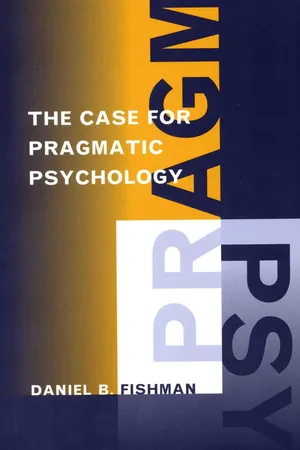
Bridging the gap between the traditional and the novel, Daniel B. Fishman proposes an invigorated, hybrid model for the practice of psychology–a radical, pragmatic reinvention of psychology based on databases of rigorous, solution-focused case studies. In The Case for Pragmatic Psychology, Fishman demonstrates how pragmatism returns psychology to a focus on contextualized knowledge about particular individuals, groups, organizations, and communities in specific situations, sensitive to the complexities and ambiguities of the real world. Fishman fleshes out his theory by applying pragmatic psychology to two contemporary psychosocial dilemmas —the controversies surrounding the "psychotherapy crisis" generated by the growth of managed care, and the heated culture wars over educational reform.
Moving with ease from the theoretical to the nuts and bolts of actual psychological intervention programs, Fishman proffers a strong argument for a new kind of psychology with far-reaching implications for enhancing human services and restructuring public policy.
- 387 pages
- English
- ePUB (mobile friendly)
- Available on iOS & Android
eBook - ePub
The Case for Pragmatic Psychology
About this book
Information
Topic
PsicologíaSubtopic
Movimientos en psicologíaIndex
The references to the figures are rendered in italics.
accountability: managed care exerting pressure for, 220;
performance accountability, 174;
in pragmatic psychology, 291–92
accountability model of evaluation, 144, 145, 321n.35
accuracy standards, 190
action: culture in rational agency, 22;
practical action, 113–15, 131;
relativism and moral responsibility for, 112. See also human behavior
action component in disciplined-inquiry model: in “Cindy” PTSD case, 240–42;
in disciplined-inquiry model, 11, 12;
in educational reform, 275;
in pragmatic and disciplined-inquiry models compared, 189, 189;
in pragmatic psychology, 136–37
action research, 27–28, 148, 321n.33
adoption of innovation, 181
advocacy model of evaluation, 144, 145
advocacy research, 147–48
affective learning, 250
alien abduction, 205;
and licensing and accreditation, 205–6
alternative schools: in New York City, 258–59, 270;
for school choice, 277
Altman, Irwin: on pendulum swings in history, 29, 36–37;
on psychology before 1879, 38;
on psychology from 1879 to 1960, 39, 42;
Toulmin compared with, 121;
on unifying trends since 1960, 306n.1;
on worldviews in psychology, 55
“Ambiguity Is of the Essence” (Sass), 298n.30
amelioration model of evaluation, 144, 145, 321n.35
America 2000, 277
American Education, A National Failure? (Rickover), 245
American Evasion of Philosophy, The: A Genealogy of Pragmatism (West), 107
American Psychiatric Association, 227
American Psychological Association (APA): APS splits from, 202, 298n.26, 306n.35;
centenary of Wundt’s laboratory celebrated by, 35;
clinical psychology’s growth in, 326n.15;
encouragement of diversity required of, 284;
formation of, 38;
growth since 1960s, 46;
a pragmatist division for, 286;
PsyclNFO database, 19;
for publishing and sponsoring pragmatic case studies, 288;
scholar-practitioners allied with, 203;
scientist-practitioners in, 327n.30;
splits in, 41;
Task Force on Promotion and Dissemination of Psychological Procedures, 211–12, 214, 329n.84
American Psychological Society (APS), 202, 203, 298n.26, 306n.35
American Psychologist (journal), 62, 330n.98
“American Psychology in the 1980s: Who Will Buy?” (Fishman and Neigher), xxii
amorality, as modernist value, 69
analytic/synthetic distinction, 80–81
...Table of contents
- Cover page
- Title page
- Copyright Page
- Dedication
- Preface
- Contents
- Figures and Tables
- Forward
- Preface1
- Acknowledgments
- Introduction
- I History
- II Philosophy
- III Method
- IV Application
- V Implications
- Notes
- References
- Index
- About the Author
Trusted by 375,005 students
Access to over 1.5 million titles for a fair monthly price.
Study more efficiently using our study tools.
Frequently asked questions
Yes, you can cancel anytime from the Subscription tab in your account settings on the Perlego website. Your subscription will stay active until the end of your current billing period. Learn how to cancel your subscription
No, books cannot be downloaded as external files, such as PDFs, for use outside of Perlego. However, you can download books within the Perlego app for offline reading on mobile or tablet. Learn how to download books offline
Perlego offers two plans: Essential and Complete
- Essential is ideal for learners and professionals who enjoy exploring a wide range of subjects. Access the Essential Library with 800,000+ trusted titles and best-sellers across business, personal growth, and the humanities. Includes unlimited reading time and Standard Read Aloud voice.
- Complete: Perfect for advanced learners and researchers needing full, unrestricted access. Unlock 1.5M+ books across hundreds of subjects, including academic and specialized titles. The Complete Plan also includes advanced features like Premium Read Aloud and Research Assistant.
We are an online textbook subscription service, where you can get access to an entire online library for less than the price of a single book per month. With over 1.5 million books across 990+ topics, we’ve got you covered! Learn about our mission
Look out for the read-aloud symbol on your next book to see if you can listen to it. The read-aloud tool reads text aloud for you, highlighting the text as it is being read. You can pause it, speed it up and slow it down. Learn more about Read Aloud
Yes! You can use the Perlego app on both iOS and Android devices to read anytime, anywhere — even offline. Perfect for commutes or when you’re on the go.
Please note we cannot support devices running on iOS 13 and Android 7 or earlier. Learn more about using the app
Please note we cannot support devices running on iOS 13 and Android 7 or earlier. Learn more about using the app
Yes, you can access The Case for Pragmatic Psychology by Daniel Fishman in PDF and/or ePUB format, as well as other popular books in Psicología & Movimientos en psicología. We have over 1.5 million books available in our catalogue for you to explore.