“The Contrast“, which premiered at New York City's John Street Theater in 1787, was the first American play performed in public by a professional theater company. The play, written by New England-born, Harvard-educated, Royall Tyler was timely, funny, and extremely popular. When the play appeared in print in 1790, George Washington himself appeared at the head of its list of hundreds of subscribers.
Reprinted here with annotated footnotes by historian Cynthia A. Kierner, Tyler’s play explores the debate over manners, morals, and cultural authority in the decades following American Revolution. Did the American colonists' rejection of monarchy in 1776 mean they should abolish all European social traditions and hierarchies? What sorts of etiquette, amusements, and fashions were appropriate and beneficial? Most important, to be a nation, did Americans need to distinguish themselves from Europeans—and, if so, how?
Tyler was not the only American pondering these questions, and Kierner situates the play in its broader historical and cultural contexts. An extensive introduction provides readers with a background on life and politics in the United States in 1787, when Americans were in the midst of nation-building. The book also features a section with selections from contemporary letters, essays, novels, conduct books, and public documents, which debate issues of the era.
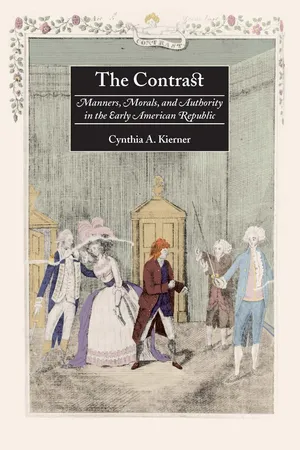
eBook - ePub
The Contrast
Manners, Morals, and Authority in the Early American Republic
- 180 pages
- English
- ePUB (mobile friendly)
- Available on iOS & Android
eBook - ePub
About this book
Information
1
Introduction
In 1786, five years after his stunning victory at Yorktown, George Washington feared for the survival of the American republic. He worried that its people behaved badly, that selfishness jeopardized the achievements of the Revolution, and that the government established under the Articles of Confederation lacked the power to maintain order. For Washington, Shays’s Rebellion in western Massachusetts was the most compelling evidence of the “anarchy and confusion” of the postwar years. The hero of the Revolution warned that lawlessness could lead to the reinstatement of monarchy or perhaps even to the loss of independence. “Without some alteration in our political creed,” he predicted, “the superstructure we have been seven years raising at the expence of so much blood and treasure, must fall.”1
Farmers in western Massachusetts who rebelled against their state government that August saw things differently. Captain Daniel Shays and many of his fellow insurgents had fought the British to secure their rights and liberties during the Revolution. Shays himself was a distinguished war veteran. In 1780, however, a new state constitution consolidated political power in the hands of the eastern mercantile elite, whose interests dictated economic policy in Massachusetts during the postwar era. Western farmers revolted because, from their perspective, the state’s enforcement of speedy payment of taxes and debts in hard money unfairly benefited selfish speculators and creditors, who profited at the expense of patriotic citizens. Government efforts to enrich the few at the expense of the many, they maintained, unjustly penalized western farmers, some of whom languished in debtors’ prison, where, according to one Shaysite declaration, they were “rendered incapable of being serviceable either to themselves or the community.”2
The profound disagreement between Washington and Shays, both staunch patriots and avowed republicans, was emblematic of a more general debate on the nature of American politics and society in the 1780s. One aspect of that debate, which focused on the powers of government and its authority in relation to citizens, culminated in the writing and ratification of the U.S. Constitution. Another contemporary debate, however, considered more generally the transformative effects of revolutionary republicanism.
If, as most believed, the survival of republics depended on the virtue and public spirit of their citizens, how should Americans manifest and promote virtue in their families and in society? What was the basis of political and cultural authority in a republican polity? Did the American colonists’ ultimate rejection of monarchy in 1776 necessitate the subsequent eradication of all European social forms and customs? Should republican families be more egalitarian than their counterparts under monarchical regimes? Should social distinctions be muted? What sorts of manners, amusements, and education were appropriate and beneficial in this post-revolutionary world? In sum, to be a nation, must Americans have a unique identity and culture? Specifically, must they distinguish themselves from Europeans—and, if so, how? These timely questions were at the heart of Royall Tyler’s play, The Contrast, which opened at the John Street Theatre in New York in April 1787.
In 1787, the United States was at a crossroads, both culturally and politically. On the one hand, 1787 was a banner year for America’s cultural nationalists. Poet Joel Barlow published his epic poem, The Vision of Columbus, which celebrated George Washington as an American hero and praised the promise and achievements of American writers and artists. Two new magazines, the American Museum and the American Magazine, commenced publication, and The Contrast, by Royall Tyler, became the first American play performed in public by a professional theater company. On the other hand, by 1787, many Americans worried that their existing political institutions were incapable of resolving the problems of the postwar era, though they disagreed about how serious those problems were and how much change they warranted. In May 1787, advocates for sweeping change scored a signal victory when delegates from every state convened in Philadelphia and drafted a controversial constitution to supplant the Articles of Confederation with a much stronger national government.
From their great triumph at Yorktown in 1781 through the ratification of the U.S. Constitution in 1788, Americans experienced political uncertainty, economic dislocation, and social conflict. At the national level, the Confederation government lacked the power both to tax and to enforce laws—both of which remained the exclusive domains of the sovereign states—and consequently was unable to repay debts, negotiate credibly with foreign nations, or protect and promote American trade and commerce. By 1787, some Americans supported the creation of a more powerful central government as the best means of addressing these problems. Meanwhile, at the state level, politics grew increasingly contentious, as members of a once dominant gentry elite now shared power with political newcomers of middling social origins. While many Americans applauded the revolutionary achievement of popular government, gentlemen like George Washington resented what they deemed an excess of democracy and disorder in the states. By 1787, such men wanted a stronger national government insulated from direct popular influence to impose order, which they believed essential to the preservation of the republic.

Advertisement for The Contrast, 1787. This brief notice first appeared in New York’s Daily Advertiser on 14 April 1787. Identifying the author simply as “a CITIZEN of the United States” signaled the play’s potential appeal to nationalists who championed American arts and literature in the post-revolutionary era.
Americans united in their commitment to a republic governed by the people’s representatives, but they disagreed profoundly on the issue of how democratic (and how egalitarian) their republic ought to be. Two key issues were at the heart of this debate. First, who were “the people” and how much power should they wield? Second, what sorts of political institutions and cultural forms were best suited to the preservation of a republican political order? In the process of addressing these issues, Americans considered the utility of education, literature, and manners in their society. They also reassessed the meaning of gender, race, and social rank, debating the proper roles of women, African Americans, and non-elite white men in their post-revolutionary world.
Before the Revolution, American society was rigidly and unapologetically hierarchical. Property qualifications kept many men from voting and in many colonies representatives from a few leading families held most political offices. Social mobility, though more common than in Europe, was not typical. Generally, sons of laborers expected to become laboring men themselves; sons of gentlemen expected to inherit their fathers’ wealth, connections, and political power, and they usually did.
The rhetoric and reality of the Revolution was deeply unsettling to this hierarchical social order. Involvement in pre-revolutionary protests and committees and in the war itself politicized many non-elite men who sought, and received, a share of political power. During the Revolution, most states decreased property qualifications for both voting and office-holding. In addition, voters increasingly held elected officials accountable for their actions, refusing to re-elect those who ignored their concerns and interests and often choosing middling men who shared their interests to represent them politically. While most Americans agreed that a European-style hereditary aristocracy had no place in the United States, some feared the consequences of popular rule, contending that a “natural aristocracy” of educated, experienced, and enlightened men would be the republic’s ideal governors.
But social identities were unusually fluid in revolutionary America. People of all social ranks aspired to upward mobility, and the libertarian ideals of the Revolution led many to believe that such mobility was possible. After the war, many Americans moved to the cities or to the northern, western, or southern frontiers to start new lives. Others looked to education as a means to get ahead. In this unstable social environment, even servants saw themselves less as a permanent laboring class than as temporary hired “help.”
The revolutionaries’ declaration that “all men are created equal” also led African Americans, supported by some sympathetic whites, to press revolutionary leaders to extend the “inalienable” rights of liberty and equality to slaves and free blacks. They made significant, if limited, gains in several states. In 1777, Vermont claimed independence from New York and adopted a constitution that explicitly banned slavery. In 1783, Massachusetts courts declared slavery unconstitutional, effectively abolishing it in that state. Three years earlier, Pennsylvania had passed a law that provided for the gradual emancipation of slaves, and this statute became a model for the other states. New Yorkers nearly enacted a similar law in the 1785–86 legislative session; they eventually did so in 1799. Further south, the challenge to slavery was less successful, though in 1782 a Virginia law empowered individual slaveowners to manumit their bondpeople. Meanwhile, African Americans attempted to forge new identities as free people, though most whites assumed that even free blacks would be relegated to menial occupations and remain their social inferiors.
The revolutionary era also witnessed unprecedented debate on gender issues, though that conversation focused primarily on the roles and status of elite and middling women. For instance, some educated and articulate women, many of whom had participated in the revolutionary movement, expressed their desire for a degree of political inclusion or empowerment after the war was over. Others unsuccessfully challenged the common law doctrine of coverture, under which a wife’s rights to own and control property were vested completely in her husband. Efforts to promote improvements in women’s education were more productive in part because many Americans increasingly believed that, as one contemporary essayist put it, “Cultivation of the female mind is of great importance, not with respect to private happiness only, but with respect to society at large.”3
Reassessing the status of American women was part of a larger transatlantic discourse that unfolded over the course of the eighteenth century as enlightened people embraced a culture of feeling or “sensibility.” Stimulating the sentiments or emotions of individuals, many increasingly held, inspired them to act in ways that promoted the virtue and happiness of others. Moralists and social critics, who lauded sensibility in men, nonetheless characterized it as a particularly feminine attribute. The notion of women’s special propensity for sensibility, in turn, led many to accept and even to champion feminine influence, both at home and in society.
These new sentimental feminine ideals, which had some influence among the colonists, became more salient after the Revolution, as Americans wrestled with the problem of how best to promote virtue among the citizens of their fledgling republic. Convinced that the survival of the republic depended on the virtue of its citizens, some Americans came to appreciate the potential utility of women’s education. Educated women, they suggested, could wield gentle, but beneficial, influence over the values, manners, and morals of their husbands and children. This new idealized republican woman was an American variation on the more general contemporary theme of sentimentalized womanhood. Its proponents infused women’s customary roles as wives and mothers with new political or public significance, even as they sought to circumscribe women’s influence and activities within their households.
Reappraisals of women’s abilities and status were part of a more general rethinking of marriage ideals that had begun earlier in the century as part of the emergence of the culture of sensibility. In Europe and in Europe’s American colonies, marriages and families were traditionally patriarchal. Authority, not affection, was the customary basis of family relationships, and both law and custom sanctioned the near-absolute authority of men in their households. Presupposing that women were weak, frivolous, and irrational, this patriarchal ideal accordingly mandated that wives be subservient to their husbands. By the eighteenth century, however, many commentators, who now valued women for their supposedly superior sensibility and virtue, rejected this view in favor of one that emphasized a more affectionate and companionate relationship between spouses. One consequence of this change was a decline in parental control over children’s marriage choices, as young people sought matches based on affection which would bring them lasting happiness. Though financial considerations remained important, especially for propertied families, purely mercenary matches became increasingly disreputable.
The rise of companionate marriage, in turn, resulted in the emergence and gradual popularization of new gender ideals for both women and men. In a companionate marriage, the ideal wife would be virtuous, modest, affectionate, and loyal. Her main role was to provide wholesome companionship and support for her husband. The ideal husband would be industrious and independent, able to fulfill his responsibilities both to his family and to the wider community. Strong but not tyrannical, this new companionate husband respected his wife and was unashamedly susceptible to the influence of virtuous women.
Post-revolutionary Americans engaged in a lively debate over the reciprocal duties of spouses. Although some continued to defend the traditional patriarchal marriage ideal, the revolutionary experience seems to have accelerated public acceptance of the newer, more affectionate, and more egalitarian husband-wife relationship. American women, many of whom participated in the Revolution and persevered during the long years of war, demonstrated that they were neither weak nor irrational, thereby proving their suitability as companions and partners. Companionate marriage did not eradicate patriarchy, but it nonetheless elevated the status of women. Proponents of companionate marriage saw husbands and wives as partners in the marital enterprise, though in America, as in Europe, few explicitly endorsed the notion that marriage should be a partnership of equals.
Marriage and family life, in general, were compelling topics for Americans, who looked to the domestic sphere to foster virtue and order in their post-revolutionary world. American revolutionaries had challenged traditional authorities that constituted the underpinnings of the colonial social order. They toppled the monarchy and dismantled religious establishments. The departure of the Tories or loyalists—those Americans who remained loyal to King George III after 1776—and widespread migration within the United States during and after the war led to the break-up of many families and communities. Family, community, and church authorities traditionally had monitored the behavior of individuals, imposing significant penalties on those who violated social norms. With the weakening or dissolution of these customary constraints, many Americans looked to affective family bonds to constrain vice and instill virtue in the younger generation.
In the decades before 1776, a combination of cultural and economic factors contributed to a decline in parental authority in colonial America. On the one hand, the same cultural currents that eroded the traditional patriarch’s authority over his wife and sentimentalized relations between spouses had a similar effect on relations between parents and children. On the other hand, population growth resulted in land scarcities in some areas, leaving fathers less financially able to provide for their adult children, especially their sons. Young men who found their fathers unable to supply them with the property they needed to get started in life left home, seeking opportunity elsewhere. The decline of fathers’ economic power, in turn, diminished their ability to control their children’s behavior and lessened parental influence over the marriage choices of both daughters and sons.
The Revolution compounded these economic and cultural trends. Given the contemporary imagery of kings as father figures, the colonists’ overthrow of George III represented a dramatic assertion of anti-patriarchal rights. Indeed, some historians see the colonists’ war for independence as the culmination of a larger “American revolution against patriarchal authority” in both politics and family life.4 At the same time, the war and its aftermath presented youngsters with economic challenges and opportunities that often put them beyond the reach of parental control, both physically and psychologically. Young men, many of whom left home for the first time as revolutionary soldiers, settled elsewhere after the war was over.
Americans reassessed relationships between parents and children, as they did those between spouses, in the post-revolutionary era. What were the obligations, they asked, of children toward their parents? Did the duties of sons differ from those of daughters? Although Americans agreed that children should respect and obey their parents, they debated the limits of parental authority and overwhelmingly gave less freedom to daughters than to sons. Most parents hoped that all of their offspring would marry; chastity before marriage was obligatory for women, though not for men. This sexual double standard, which few questioned, led parents to curtail their daughters’ freedom and independence to ensure their sexual purity and thereby advance their marital prospects.
While many Americans considered family life essential to the promotion of popular virtue, others looked beyond the family and championed education, in part as an antidote to declining parental authority. Educational reformers, who assumed that a republican polity required an informed citizenry, agreed that basic literacy skills were essential for post-revolutionary Americans. Many also argued that American citizens, who...
Table of contents
- Cover Page
- Title Page
- Copyright Page
- Contents
- List of Illustrations
- Preface
- 1 Introduction
- 2 The Contrast by Royall Tyler
- 3 Primary Documents
- Suggested Reading
- Index
- About the Author
Trusted by 375,005 students
Access to over 1.5 million titles for a fair monthly price.
Study more efficiently using our study tools.
Frequently asked questions
Yes, you can cancel anytime from the Subscription tab in your account settings on the Perlego website. Your subscription will stay active until the end of your current billing period. Learn how to cancel your subscription
No, books cannot be downloaded as external files, such as PDFs, for use outside of Perlego. However, you can download books within the Perlego app for offline reading on mobile or tablet. Learn how to download books offline
Perlego offers two plans: Essential and Complete
- Essential is ideal for learners and professionals who enjoy exploring a wide range of subjects. Access the Essential Library with 800,000+ trusted titles and best-sellers across business, personal growth, and the humanities. Includes unlimited reading time and Standard Read Aloud voice.
- Complete: Perfect for advanced learners and researchers needing full, unrestricted access. Unlock 1.5M+ books across hundreds of subjects, including academic and specialized titles. The Complete Plan also includes advanced features like Premium Read Aloud and Research Assistant.
We are an online textbook subscription service, where you can get access to an entire online library for less than the price of a single book per month. With over 1.5 million books across 990+ topics, we’ve got you covered! Learn about our mission
Look out for the read-aloud symbol on your next book to see if you can listen to it. The read-aloud tool reads text aloud for you, highlighting the text as it is being read. You can pause it, speed it up and slow it down. Learn more about Read Aloud
Yes! You can use the Perlego app on both iOS and Android devices to read anytime, anywhere — even offline. Perfect for commutes or when you’re on the go.
Please note we cannot support devices running on iOS 13 and Android 7 or earlier. Learn more about using the app
Please note we cannot support devices running on iOS 13 and Android 7 or earlier. Learn more about using the app
Yes, you can access The Contrast by Cynthia A. Kierner in PDF and/or ePUB format, as well as other popular books in History & Early American History. We have over 1.5 million books available in our catalogue for you to explore.