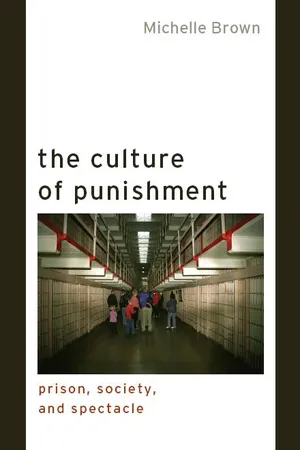
America is the most punitive nation in the world, incarcerating more than 2.3 million people—or one in 136 of its residents. Against the backdrop of this unprecedented mass imprisonment, punishment permeates everyday life, carrying with it complex cultural meanings. In The Culture of Punishment, Michelle Brown goes beyond prison gates and into the routine and popular engagements of everyday life, showing that those of us most distanced from the practice of punishment tend to be particularly harsh in our judgments.
The Culture of Punishment takes readers on a tour of the sites where culture and punishment meet—television shows, movies, prison tourism, and post 9/11 new war prisons—demonstrating that because incarceration affects people along distinct race and class lines, it is only a privileged group of citizens who are removed from the experience of incarceration. These penal spectators, who often sanction the infliction of pain from a distance, risk overlooking the reasons for democratic oversight of the project of punishment and, more broadly, justifications for the prohibition of pain.
- 260 pages
- English
- ePUB (mobile friendly)
- Available on iOS & Android
eBook - ePub
About this book
Information
Topic
SozialwissenschaftenSubtopic
Kriminologie1
Introduction: Notes on Becoming a Penal Spectator
Tipping Points
When I began graduate school, the first course I took was a proseminar on the administration of justice. The curriculum was an unprecedented experience and challenge for me, a former humanities student, in its deep survey of organizational theory through the central institutions of the criminal justice system. The last few weeks of the course were spent on classic and contemporary works in correctional research—leading me to work by pioneers in the sociology of imprisonment. I studied the first wave of social scientists who entered prisons and observed their daily life, including the work of sociologists Donald Clemmer, Gresham Sykes, and Erving Goffman.1 Encounters with historical documents such as The President’s Commission on Law Enforcement and the Administration of Justice, the American Friends Service Committee’s Struggle for Justice, as well as revisionist social control histories authored by David Rothman and Nicole Rafter, led me to reconsider the entire purpose of punishment and how visions of social control have such unforeseeable consequences and often go so badly awry.2 Contemporary work of the period, ranging from John DiIulio’s high-profile prediction of a wave of youthful super-predators, Norval Morris and Michael Tonry’s argument for the necessity of an interchangeability of punishment, to Nils Christie’s indictment of crime control gulags, opened up issues with little resolution against the backdrop of a deepening sense of futility.3 My final project in the proseminar examined a key debate about the role of rehabilitation in U.S. punishment, relying heavily upon the controversial work of Robert Martinson, widely recognized as having come to the infamous conclusion that “nothing works” in the field of corrections. During that time, Marc Mauer’s groundbreaking Sentencing Project report was issued, which found that one out of three black men between the ages of 20 and 29 were in prison, jail, or on probation or parole.4
I left the course and my first semester of graduate school feeling as if these researchers were discordant voices in a strange wilderness as the United States continued to build the most massive penal system on the planet. All of this culminated in a deepening commitment to the study of punishment. It seemed clear that the U.S. penal system remained the most invisible and overlooked of justice institutions and that the reasons for this strange inattention were remarkably thin and undertheorized. It also seemed clear that a generation of criminologists and sociologists were taking on a deep sense of urgency in mapping these penal transformations and arguing their meanings. I remember thinking that, as a citizen and potential criminologist, I bore some responsibility and accountability in this new understanding, as it was developing against the relatively quiet backdrop of unprecedented prison expansion and mass, racialized incarceration in the United States.
I launched energetically into the project of visiting prisons at every security level and across the United States as part of my plan to study them. I eventually obtained a teaching position at the largest women’s correctional facility in my home state of Indiana, all in order to lay the groundwork for gaining access and conducting doctoral research in the statewide correctional system. In these pursuits, I found myself immersed for the first time in the physical world I proposed to study and hoped to change. It was a claustrophobic space whose structural tensions, ironies, inertia, and contradictions were immediately apparent. All of my visions of reform and transformation quickly dissipated into a chronic kind of worry and exhaustion, alongside of an overwhelming sense of being up against something impossible to transform. The anxious awareness of the impossibility of change, after all, is in many ways the story of the prison and reform—and certainly marks its history and its sociology. The physical world of incarceration was also, in a mundane, horrific way, a space, in the late 1990s, overflowing with people—prisoners, correctional officers, case workers, mental health staff, attorneys, administrators, and brief but routine appearances by families and community members. During those long drives home from class and facility tours, through beautiful, desolate rural counties, where the roads were largely empty and the economy long gone, I continuously pondered what it meant to be a prison culture—a society committed to the construction of prisons and the warehousing of mass numbers of people with little regard for the complexities of their lives, the lives of those hired to confine them, and the communities that surrounded them. I returned home to conversations with friends, family, colleagues, and students that seemed deeply disconnected from these stark environments and their consideration, with debates and dialogues developing in which authority could be tried on freely and assertively, where declarations about punishment and the appropriateness of pain were playfully tossed about. Those same playful discourses became apparent in the programs I watched on television, the films that I screened, the video games that I played, and the commentary that pervaded the news. Everywhere I looked, the architecture and vocabulary of punishment suddenly appeared.
In the days since, I have conducted multiple research and teaching projects in prisons with the people who work and live there. Many have been gracious enough to lead me through these complex worlds. Former prisoners have permitted me to follow them through reentry, back to cities, into their homes and the lives of their parents, children, brothers and sisters, partners, employers, and spiritual communities. Others remain in the same halls, cells, and dormitories where I met them ten years ago, fighting against the effects of prolonged institutionalization and worrying about the day they have to enter a world now virtually unrecognizable, with few resources and family to support them. Some will never leave. Some have died. In that process, I have witnessed the devastating, fruitless impact of stigma, isolation, and confinement—of dead time and holding patterns that are chronically dysfunctional for people who will one day return to society, to us—the long-standing and most basic findings of prison sociology. Along the way, people who spend their lives working in this environment have discussed the stress they encounter in performing the work of incarceration on the job and off. They have spoken candidly and passionately about how they and those around them change in doing a work whose positive effects are hard to find, on how they withdraw into communities of workers who understand the day-to-day life of prisons … because broader society does not.5 It is out of this experience that I decided to write this book.
Historically, prisoners and prison workers are necessarily divided by power and by function. The prison then epitomizes what it is to position people in fundamentally unequal structures. However, what prisoners, prison workers, and those who care about them share is an extreme sense of difference and isolation from society—a sense that they are ultimately disposable and most socially valuable when invisibly fulfilling the warehousing mandate of a society that has come to view incapacitation as the first and most logical political and social choice in dealing with a vast array of issues, some crime-related and many not. They are aware of broader societal attitudes, assumptions, and understandings of punishment and have, with all of us, experienced the rise of a popular punitiveness over the last four decades. Sometimes they support and internalize this turn. But even in that context, they know the work that they do and the experience of being in prison are social realities that few outside of their worlds care or wish to know about—except in connection with a certain voyeuristic sensationalism.
In this book, I argue that many American citizens access punishment through cultural practices removed from formal institutions like prisons in a manner which, although largely unacknowledged, massively extends throughout our social foundations. Across families, communities, schools, religion, the military, politics, the economy, and beyond, punishment is practiced and played with in daily life. In part, this manner of cultural engagement perhaps occurs because it is simply easier, convenient, and more accessible, but it also marks a choice. Americans choose when and under what conditions they would prefer to see prisons and, in the particularity of that engagement, invoke and reproduce specific kinds of logics and explanatory frameworks. I look to the places where this engagement is occurring, places that lie outside of the prison-industrial complex, where punishment arises popularly and culturally. Like a detective, I glimpse a lead—a film about prison that attracts a cult following or a hit television show that playfully engages penal judgment; an advertisement for a prison ghost hunt whose popularity is growing locally, regionally, and nationally; a news story whose penal images are so graphic and so immediately global as to defy previous representations of prisons, evoking international outrage; and finally, a popularized scientific publication on rehabilitation that maintains its hold across time in textbooks, popular discourse, and the common history of a discipline—and I follow it where it goes. Why? Because other people are doing this also, citizens with—and, more significantly, without—direct connections to prisons. In all of these cases, cultural fragments emerge whose hold on people is deeply bound up with the nature of their connections to punishment—but from a distance.
It is in these spaces that much of the popular knowledge about punishment is constructed—in spaces far from the social realities and the social facts that define mass incarceration. Consequently, the turn away from imprisonment, if and when it occurs, will only be meaningful if we know something beyond the political, economic, and structural forces which led to its downfall. We will need to know something about the ways in which people who are removed from punishment imagine it— and why certain kinds of political rhetorics and cultural meanings are given so much privilege. We will need to know how ordinary citizens use imprisonment, what they find fascinating about it, why it emerges at key moments in particular kinds of representational frameworks and public discourse, and finally, and perhaps most significant, what kinds of penal subjectivities develop out of these interactions. By penal subjectivity, I mean that these performances of punishment, when distant from actual punishment, nonetheless provide frameworks for ordinary citizens to step into or out of self-conscious modes of awareness as moral spectators and deliberative citizens. In those positions, Americans make decisions about the proper place and meanings of punishment and the role of pain and exclusion in society. Such a framework insists that there are specific conditions in which Americans engage the complex work of punishment. When do they recognize and act upon their own complicity in the practice of punishment? Of equal importance, when do they fail to recognize this role—or intentionally evade it—and under what conditions? In contexts where individuals only know incarceration at a distance, the dynamics of penal participation are slippery and can quickly devolve into complex, often voyeuristic frameworks which privilege various kinds of punitive, individualistic judgment. Citizens may participate vicariously in mediated worlds where pain is inflicted across television, films, recreation, and news. They may be disturbed by these images. They may find such engagement titillating. In any case, they are enthralled in a manner that is not easily conducive to analysis or self-reflection. Thus, a shadow world of moral judgment and penal logics exists beyond prison walls as a constant and perpetually growing cultural resource for people to make sense of punishment. Few other institutions encounter such a radical and momentous divide between their physical realities and cultural imagining. And without some awareness of how this separation occurs, we not only risk reproducing the worst aspects of penal history, but developing new and more awful trajectories as well.
Of course, it is also true that the scale of incarceration in the United States has brought unprecedented numbers of people into the penal system and created social networks of incarceration that exceed any in previous history. The world leader in incarceration, the United States now imprisons just under two and a quarter million people, with over 7 million under some form of criminal justice supervision. Ninety-five percent or more of those incarcerated will be released from prison at some point in the future. The nature of this pattern of imprisonment occurs in a manner fueled by the war on drugs and the disproportionate imprisonment of African American men, who are seven times as likely to be incarcerated as white men. Beyond the bare demographics of the U.S. penal system are the extensive, largely hidden collateral consequences of mass incarceration. Although these costs vary across jurisdictions and states, they include lifetime bans for those with felonies of the receipt of welfare and food stamp benefits, restricted rights to housing and higher education, limits in emergency public aid and social service access, occupational licensure restrictions, and voter disenfranchisement, all of which can add up to insurmountable barriers for individuals returning to poor, working-class communities. The costs of incarceration extend far beyond the individuals who are housed in the U.S. penal system. The future for the estimated 2 million children who have a parent in prison is stark. Among the most vulnerable of demographic groups, these children are more likely to grow up in poverty and encounter the criminal justice system far earlier and more consistently than their middle-class peers. Families of prisoners, consequently, are informed by a unique set of economic, social, emotional, and existential stressors. As well, the people and corporations who serve as the rising labor force for the prison-industrial complex point to new ways in which American towns and cities can be organized around the project of punishment with no economic motive or social investment plan beyond mass incarceration. These kinds of cumulative effects add up to structural shifts for entire communities and ultimately all of American society, exacerbating fundamental race, class, and gender divisions and inequalities and providing scarce resources or impetus to think through alternative approaches to crime and its contingent social problems. Significantly, these discussions are largely absent from political discourse. Senator James Webb, who coordinated hearings on mass incarceration in 2007, addressed this omission, arguing that “the United States has embarked on one of the largest public policy experiments in our history, yet this experiment remains shockingly absent from public debate.”6 Although mass imprisonment figures largely as the country’s most critical civil rights concern, not one recent presidential candidate has identified it as a key issue.
Such developments frustrate the project of democracy in a number of ways. Social dynamics and interrelations in penal contexts are built fundamentally upon exclusionary practices and ideas of difference which divide rather than unite, turning citizens against citizens. Contemporary federal, state, and local initiatives build up last-resort institutions like prisons in a manner that renders communities economically and politically dependent upon them, while pulling resources from education, health care, the economy, and other social institutions and services. Communities then take as their most basic good a potentially limitless drive toward an impossible sense of security, founded upon governance through crime and fear. Such contexts are most disturbing in their normalization of crime and punishment, where both risk becoming pretexts or simply accepted, well-intentioned ways of accomplishing other kinds of social and political goals. How we think about privacy, personal responsibility, and the needs of others, deserving or not, may be radically reshaped. This book takes seriously the possibility of a convergence of concerns like these in a manner that changes who we are as individuals and a society. Thinking about punishment as something beyond sheer normalcy or the safety of the self-evident is a necessity given the institution’s uniqueness, a social practice that has been theorized since the birth of democracy as a force to be carefully deliberated upon and limited in its application in any society that values freedom, equality, and self-governance.
We “mass” imprison in this country in a manner that is defined by sheer scale (massive, incomparable numbers of bodies and beings) and by a concentration of the social effects of incarceration upon particular groups. Because the axis of incarceration extends along distinct race and class lines, it is only a privileged group of citizens who do not know this experience. As a result, the U.S. penal system is defined specifically by a classed, racialized minority presence from which white middle-class citizens are comfortably distanced—distanced enough to support and sustain the largest punitive political turn in U.S. history, a phenomenon that most prisoners and prison workers do not view as beneficial to larger society or the operations of prisons. Although public works, prisons are not frequented like libraries, highways, memorials, parks, or state houses. Their access is carefully regulated, and consequently many citizens never encounter the overpowering tangibility of imprisonment. Ironically, perhaps, these are the very individuals who are politically positioned to facilitate the existing system through democratic processes that result in policies which exacerbate social divisions and inequalities.
This volume then is predicated upon the fact that we must examine the ways in which those who have no need to address the problem of punishment develop cultural meanings about it if we are to understand— and change—the penal route we have taken. Even those who directly experience incarceration and its impacts—prisoners, prison workers, and their families and communities—do not do so in a social vacuum without being shaped by culture more broadly. Consequently, the material reality of incarceration requires careful examination. It is, however, also an argument of this volume that culture is shaped by punishment in ways that we are only beginning to map. Performances, engagements, and representations of punishment proliferate and diversify daily, accumulating into complex logics and mentalities that will be very difficult to leave behind—as difficult as it will be to move beyond prison walls. And these logics already extend well beyond our borders. In late modernity, as citizens across the planet struggle through the contradictions of globalization and deeply riven economic and social inequalities, decisions are being made about how to deal with the potential threat of mass, unending violence and insecurity, of how and whether to engage in processes of democratization, of how to govern ourselves and others. These decisions are informed directly by imprisonment and the technologies and strategies that the United States, as both a global security force and a prison culture, has invoked and propagated. U.S. military prisons can be found the world over, with a detention facility located at nearly a thousand military bases— and this does not include secret prisons and black sites. These prisons rely heavily upon U.S. civilian prisons in design, staffing, and implementation. Moreover, they are advertised as “state of the art” facilities, planned and publicized as models for the rest of the world. These emergent ways of being risk an unprecedented diversification, extension, and permanence of penal systems across social life, in ways entirely capable of reshaping what it means to live meaningfully and to count as a social and political subject, not just at home but abroad. In the era of mass incarceration, this global subject is increasingly defined in penal terms—refugees, detainees, deportees, enemy combatants, persons under custody, illegal aliens—whose status depends upon values and frameworks for judgment which tend toward exclusion over inclusion and isolation over social commitment. This penal subject, of course, runs up against another—the distanced citizen, a penal spectator, secure in his or her place within sovereignty and the opportunity to exercise exclusionary judgment from afar.
Penal Spectatorship and the Cultural Work of Punishment
To conceive of ourselves as penal spectators asks us to consider a different set of aspects about the practice of punishment. First, it foregrounds the fact that for those of us without direct connections to formal institutions of punishment, a kind of experiential distance defines our relationship to its practice. Such distance shields us first from the most fundamental feature of punishment—its infliction of pain. This is a strangely difficult concept. Because punishment is assumed to follow a crime, an act of violence or harm against another, the infliction of pain is perceived as deserved or necessary. Consequently, the question of pain’s authority and its effects rarely materializes and instead these are seen as natural and indisputable consequences of individual actions. To understand the spectacle upon which punishment depends, we must temporarily consider the act of punishment alone. Legal theorist Robert Cover famously explores why it is that any man walks into prison of his own volition.7 How is it that thousands, now millions, of people in the United States are funneled uniformly, bureaucratically, into institutions designed to deprive them of liberty, autonomy, material possessions, family, friends, sex, and security? The answer of course is found in the sheer force and potential violence of the state, embodied in law, the kind of power that can carry the individual to the prison cell, the interrogation room, and the execution chamber. The legitimacy of this claim depends upon the idea of punishment as the only just and effective way to organize human accountability. And yet, to someone with no knowledge of such claims and justifications, punishment would always appear as violence coordinated by one human or group upon another. To talk of pain inflicted in such a context is seen as denying a preexisting pain—the pain of victims and past criminal acts. However, punishment is always a narrative about a chain of pain, one whose origin is not easily traced. The fact that contemporary imprisonment occurs against the backdrop of structural conditions of poverty and ...
Table of contents
- Cover Page
- Title Page
- Copyright Page
- Contents
- Acknowledgments
- 1 Introduction: Notes on Becoming a Penal Spectator
- 2 Prison Theory: Engaging the Work of Punishment
- 3 Prison Iconography: Regarding the Pain of Others
- 4 Prison Tourism: The Cultural Work and Play of Punishment
- 5 Prison Portents: Guantánamo, Abu Ghraib, and the War on Terror
- 6 Prison Science: Of Faith and Futility
- 7 Prison Otherwise: Cultural Meanings beyond Punishment
- Notes
- References
- Index
- About the Author
Trusted by 375,005 students
Access to over 1.5 million titles for a fair monthly price.
Study more efficiently using our study tools.
Frequently asked questions
Yes, you can cancel anytime from the Subscription tab in your account settings on the Perlego website. Your subscription will stay active until the end of your current billing period. Learn how to cancel your subscription
No, books cannot be downloaded as external files, such as PDFs, for use outside of Perlego. However, you can download books within the Perlego app for offline reading on mobile or tablet. Learn how to download books offline
Perlego offers two plans: Essential and Complete
- Essential is ideal for learners and professionals who enjoy exploring a wide range of subjects. Access the Essential Library with 800,000+ trusted titles and best-sellers across business, personal growth, and the humanities. Includes unlimited reading time and Standard Read Aloud voice.
- Complete: Perfect for advanced learners and researchers needing full, unrestricted access. Unlock 1.5M+ books across hundreds of subjects, including academic and specialized titles. The Complete Plan also includes advanced features like Premium Read Aloud and Research Assistant.
We are an online textbook subscription service, where you can get access to an entire online library for less than the price of a single book per month. With over 1.5 million books across 990+ topics, we’ve got you covered! Learn about our mission
Look out for the read-aloud symbol on your next book to see if you can listen to it. The read-aloud tool reads text aloud for you, highlighting the text as it is being read. You can pause it, speed it up and slow it down. Learn more about Read Aloud
Yes! You can use the Perlego app on both iOS and Android devices to read anytime, anywhere — even offline. Perfect for commutes or when you’re on the go.
Please note we cannot support devices running on iOS 13 and Android 7 or earlier. Learn more about using the app
Please note we cannot support devices running on iOS 13 and Android 7 or earlier. Learn more about using the app
Yes, you can access The Culture of Punishment by Michelle Brown in PDF and/or ePUB format, as well as other popular books in Sozialwissenschaften & Kriminologie. We have over 1.5 million books available in our catalogue for you to explore.