"An indispensable and provocative guide through the thicket of today's most challenging constitutional controversies by some of the most eminent judges of their time. It offers an invaluable peek behind the curtain of judicial decision making."
—David Cole, Professor of Law, Georgetown University
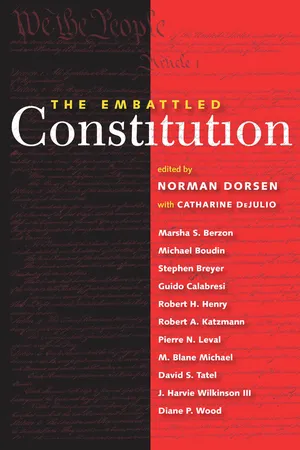
The Embattled
Constitution presents the
fourth collection of the James Madison lectures delivered at the NYU School of
Law, offering thoughtful examinations of an array of topics on civil liberties
by a distinguished group of federal judges, including Justice Stephen Breyer of
the U.S. Supreme Court. The result is a fascinating look into the minds of the
judges who interpret, apply, and give meaning to our “embattled Constitution.”
In these insightful
and incisive essays, the authors bring to bear decades of experience to explore
wide-ranging issues. Are today’s public schools racially segregated? To what
extent can the federal courts apply the Bill of Rights without legislative
guidance? And what are the criteria for the highest standards of judging and constitutional
interpretation? The authors also discuss how and why the Constitution came to
be embattled, shining a spotlight on the current polarization in both the
Supreme Court and the American body politic and offering careful and informed
analysis of how to bridge these divides.
Contributors include
Marsha S. Berzon, Michael Boudin, Stephen Breyer, Guido Calabresi, Robert H.
Henry, Robert Katzmann, Pierre N. Leval, M. Blane Michael, Davis S. Tatel, J.
Harvie Wilkinson, III, and Diane P. Wood.
- 400 pages
- English
- ePUB (mobile friendly)
- Available on iOS & Android
eBook - ePub
The Embattled Constitution
About this book
Information
Topic
DerechoSubtopic
Teoría y práctica del derecho1
Our Democratic Constitution
The United States is a nation built on principles of human liberty—a liberty that embraces concepts of democracy. The French political philosopher Benjamin Constant understood the connection. He distinguished between liberty as practiced by the ancient Greeks and Romans and the “liberty” of the eighteenth- and nineteenth-century “moderns.”1 Writing thirty years after the French Revolution and not long after the adoption of our American Constitution, Constant said that the “liberty of the ancients” consisted of an “active and constant participation in collective power.”2 The ancient world, he added, believed that liberty consisted of “submitting to all the citizens, without exception, the care and assessment of their most sacred interests.”3 Liberty thereby “ennobles their thoughts, and establishes among them a kind of intellectual equality which forms the glory and power of a people.”4
Constant distinguished that “liberty of the ancients” from the more “modern liberty” consisting of “individual independence” from governmental restriction.5 Having seen the Terror, he argued that this “liberty of the moderns” was necessary to protect the individual from the excesses of democratic majorities and those acting in their name. But, he said, we must not renounce “either of the two sorts of freedom[;] … it is necessary … to learn to combine the two together.”6
The ideas that underlie these concepts, including the importance of citizen participation in government, were in the minds of those who helped to create America’s government. Jefferson, for example, spoke directly of the rights of the citizen as “a participator in the government of affairs,”7 and Adams referred to the importance of ensuring that all citizens have a “positive Passion for the public good.”8 My discussion concerns the role that this more “ancient,” participatory, active liberty might play when courts interpret the Constitution, including its more “modern” individual liberty-protecting provisions.9
I shall focus upon several contemporary problems that call for governmental action and potential judicial reaction. In each instance I shall argue that, when judges interpret the Constitution, they should place greater emphasis upon the “ancient liberty,” i.e., the people’s right to “an active and constant participation in collective power.”10 I believe that increased emphasis upon this active liberty will lead to better constitutional law—law that will promote governmental solutions consistent with individual dignity and community need.
At the same time, my discussion will illustrate an approach to constitutional interpretation that places considerable weight upon consequences—consequences valued by basic constitutional purposes. It disavows a contrary constitutional approach, a more “legalistic” approach that places too much weight upon language, history, tradition, and precedent alone while understating the importance of consequences. If the discussion helps to convince you that the more “consequential” approach has virtue, so much the better.
I.
A.
Three important views underlie my discussion. First, the Constitution, considered as a whole, creates a framework for a certain kind of government. Its general objectives can be described abstractly as including: (1) democratic self-government; (2) dispersion of power (avoiding concentration of too much power in too few hands); (3) individual dignity (through protection of individual liberties); (4) equality before the law (through equal protection of the law); and (5) the rule of law itself.11
The Constitution embodies these general objectives in particular provisions. In respect to self-government, for example, Article IV guarantees a “Republican Form of Government”;12 Article I insists that Congress meet at least once a year,13 that elections take place every two14 (or six)15 years, and that a census take place every decade;16 the Fifteenth,17 Nineteenth,18 Twenty-fourth,19 and Twenty-sixth20 Amendments secure virtually universal adult suffrage. But a general constitutional objective such as self-government plays a constitutional role beyond the interpretation of an individual provision that refers to it directly. That is because constitutional courts must consider the relation of one provision to another. They must consider the document as a whole.21 And consequently, the document’s handful of general purposes will inform judicial interpretation of many clauses that do not refer directly to the general objective in question. My examples seek to show how that is so. And, as I have said, they will suggest a need for judges to pay greater attention to one of those general objectives, namely participatory democratic self-government.
Second, the Court, while always respecting language, tradition, and precedent, nonetheless has emphasized different constitutional objectives at different periods in its history. Thus, one can characterize the early nineteenth century as a period during which the Court helped to establish the authority of the federal government, including the federal judiciary.22 During the late nineteenth and early twentieth centuries, the Court underemphasized the Constitution’s efforts to secure participation by African American citizens in representative government—efforts related to the participatory “active liberty” of the ancients.23 At the same time, it overemphasized protection of property rights, such as an individual’s freedom to contract without government interference,24 to the point where President Franklin Roosevelt commented that the Court’s Lochner-era decisions had created a legal “no-man’s land” that neither state nor federal regulatory authority had the power to enter.25
The New Deal Court and the Warren Court emphasized “active liberty.” The former did so by dismantling various Lochner-era distinctions, thereby expanding the scope of democratic self-government.26 The latter did so by interpreting the Civil War Amendments in light of their purposes to mean what they say, thereby helping African Americans become members of the nation’s community of self-governing citizens—a community that the Court expanded further in its “one person, one vote” decisions.27
More recently, in my view, the Court has again underemphasized the importance of the citizen’s active liberty. I will argue for a contemporary emphasis that better combines “the liberty of the ancients” with that “freedom of governmental restraint” that Constant called “modern.”
Third, the real-world consequences of a particular interpretive decision, valued in terms of basic constitutional purposes, play an important role in constitutional decision making. To that extent, my approach differs from that of judges who would place nearly exclusive interpretive weight upon language, history, tradition, and precedent. In truth, the difference is one of degree. Virtually all judges, when interpreting a constitution or a statute, refer at one time or another to language, to history, to tradition, to precedent, to purpose, and to consequences. Even those who take a more literal approach to constitutional interpretation sometimes find consequences and general purposes relevant. But the more “literalist” judge tends to ask those who cannot find an interpretive answer in language, history, tradition, and precedent alone to rethink the problem several times before making consequences determinative. The more literal judges may hope to find, in language, history, tradition, and precedent objective interpretive standards; they may seek to avoid an interpretive subjectivity that could confuse a judge’s personal idea of what is good for that which the Constitution demands; and they may believe that these “original” sources more readily will yield rules that can guide other institutions, including lower courts. These objectives are desirable, but I do not think the literal approach will achieve them, and, in any event, the constitutional price is too high. I hope that my examples will help to show why that is so, as well as to persuade you that it is important to place greater weight upon constitutionally valued consequences, my consequential focus in this lecture being the effect of a court’s decisions upon active liberty.
B.
To recall the fate of Socrates is to understand that the “liberty of the ancients” is not a sufficient condition for human liberty. Nor can we replicate today the ideal represented by the Athenian agora or the New England town meeting. Nonetheless, today’s citizen does participate in democratic self-governing processes. And the “active liberty” to which I refer consists of the Constitution’s efforts to secure the citizen’s right to do so.
To focus upon that active liberty, to understand it as one of the Constitution’s handful of general objectives, will lead judges to consider the constitutionality of statutes with a certain modesty. That modesty embodies an understanding of the judges’ own expertise compared, for example, with that of a legislature. It reflects the concern that a judiciary too ready to “correct” legislative error may deprive “the people” of “the political experience, and the moral education and stimulus that come from … correcting their own errors.”28 It encompasses that doubt, caution, prudence, and concern—that state of not being “too sure” of oneself—that Learned Hand described as the “spirit of liberty.”29 In a word, it argues for traditional “judicial restraint.”
But active liberty argues for more than that. I shall suggest that increased recognition of the Constitution’s general democratic participatory objectives can help courts deal more effectively with a range of specific constitutional issues. I shall use examples drawn from the areas of free speech, federalism, privacy, equal protection, and statutory interpretation. In each instance, I shall refer to an important modern problem of government that calls for a democratic response. I shall then describe related constitutional implications. I want to draw a picture of some of the different ways that increased judicial focus upon the Constitution’s participatory objectives can have a positive effect.
In emphasizing active liberty, I do not intend to understate the great importance of securing other basic constitutional objectives, such as personal liberty—what Constant called “modern liberty”—and equal protection. Obviously courts must offer protection against governmental infringement of those rights, including infringement by democratic majorities. What could be more important? Yet modern (or “negative”) liberty is not the primary subject of this lecture.
II.
A.
I begin with free speech and campaign finance reform. The campaign finance problem arises out of the recent explosion in campaign costs along with a vast disparity among potential givers. A typical contested House seat in the 2000 election, for example, led to campaign expenditures of $308,000 per candidate (an open contested seat averaged about $522,000 per candidate); a typical contested Senate seat led to expenditures of $2.7 million per candidate (an open seat averaged about $6.1 million per candidate); and the two major-party presidential candidates spent approximately $306 million.30 In 1999, congressional candidates together spent over $1 billion.31 Only nine years earlier, the comparable costs were about a third of that—$340 million.32 Comparable figures from abroad show far lower expenditures, with a British or Canadian Parliamentary candidature leading to direct campaign expenditure of about $13,000 and $43,000, respectively.33 A major cause of the difference seems to be the cost of...
Table of contents
- Cover Page
- Title Page
- Copyright Page
- Dedication
- Contents
- Acknowledgments
- Introduction
- 1 Our Democratic Constitution
- 2 Federal and State Courts: Restoring a Workable Balance
- 3 Judicial Methodology, Southern School Desegregation, and the Rule of Law
- 4 Our Eighteenth-Century Constitution in the Twenty-First-Century World
- 5 Judging under the Constitution: Dicta about Dictum
- 6 Judge Henry Friendly and the Mirror of Constitutional Law
- 7 Toward One America: A Vision in Law
- 8 Securing Fragile Foundations: Affirmative Constitutional Adjudication in Federal Courts
- 9 Reading the Fourth Amendment: Guidance from the Mischief That Gave It Birth
- 10 Living Our Traditions
- 11 Statutes
- About the Contributors
- About the Editors
- Index
Trusted by 375,005 students
Access to over 1.5 million titles for a fair monthly price.
Study more efficiently using our study tools.
Frequently asked questions
Yes, you can cancel anytime from the Subscription tab in your account settings on the Perlego website. Your subscription will stay active until the end of your current billing period. Learn how to cancel your subscription
No, books cannot be downloaded as external files, such as PDFs, for use outside of Perlego. However, you can download books within the Perlego app for offline reading on mobile or tablet. Learn how to download books offline
We are an online textbook subscription service, where you can get access to an entire online library for less than the price of a single book per month. With over 1.5 million books across 990+ topics, we’ve got you covered! Learn about our mission
Look out for the read-aloud symbol on your next book to see if you can listen to it. The read-aloud tool reads text aloud for you, highlighting the text as it is being read. You can pause it, speed it up and slow it down. Learn more about Read Aloud
Yes! You can use the Perlego app on both iOS and Android devices to read anytime, anywhere — even offline. Perfect for commutes or when you’re on the go.
Please note we cannot support devices running on iOS 13 and Android 7 or earlier. Learn more about using the app
Please note we cannot support devices running on iOS 13 and Android 7 or earlier. Learn more about using the app
Yes, you can access The Embattled Constitution by Norman Dorsen,Catharine DeJulio in PDF and/or ePUB format, as well as other popular books in Derecho & Teoría y práctica del derecho. We have over 1.5 million books available in our catalogue for you to explore.