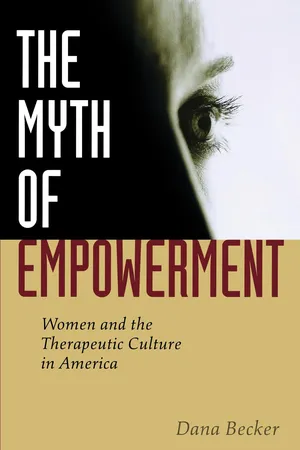
The Myth of Empowerment surveys the ways in which women have been represented and influenced by the rapidly growing therapeutic culture—both popular and professional—from the mid-nineteenth century to the present. The middle-class woman concerned about her health and her ability to care for others in an uncertain world is not as different from her late nineteenth-century white middle-class predecessors as we might imagine. In the nineteenth century she was told that her moral virtue was her power; today, her power is said to reside in her ability to “relate” to others or to take better care of herself so that she can take care of others. Dana Becker argues that ideas like empowerment perpetuate the myth that many of the problems women have are medical rather than societal; personal rather than political.
From mesmerism to psychotherapy to the Oprah Winfrey Show, women have gleaned ideas about who they are as psychological beings. Becker questions what women have had to gain from these ideas as she recounts the story of where they have been led and where the therapeutic culture is taking them.
- 272 pages
- English
- ePUB (mobile friendly)
- Available on iOS & Android
eBook - ePub
About this book
Information
Topic
Psychologie1
Introduction
As the old adage goes, “knowledge is power.” And, in our culture, self-knowledge—psychological knowledge—is often thought of as power, particularly for women. The term “empowerment” is now used to describe what women are supposed to gain from a variety of very personal activities, from exercise to psychotherapy. What empowerment promises women is control over their lives; however, when applied specifically to women, it is rarely a term that connotes more than self-knowledge or self-improvement. Power is not personal fulfillment, self-esteem, relational skill, or an improved ability to cope with or adapt to familial, social, or societal expectations, although these, singly or in combination, may be some of the spoken or unspoken aims of the therapeutic culture. Psychotherapy, as a product of an American individualist heritage that emphasizes personal change in the service of achieving personal goals, cannot furnish women, either collectively or individually, with power. In light of the promises of psychotherapy over the past three decades or more, this might sound like an unfair indictment, particularly to those women who have found therapy to be “empowering.” Yet, the repackaging of the psychological as power reproduces what has long been the cultural norm for women: the colonization of both the interior world of the psyche and the small world of intimate relationships. There was a time when psychotherapy was primarily considered necessary for those whose behavior was considered abnormal. But now that the idea of psychotherapy for the “normal” has been institutionalized for more than fifty years,1 now that women have been exposed to many decades-worth of psychologizing, it is time to question more closely how the therapeutic culture has served “normal” women with respect to the broader social and political problems they face.
Those of us who theorize about and practice psychotherapy rarely acknowledge the effects upon women of our society’s individualistic understanding of humans and their problems as psychotherapy clients, as consumers of a vast self-help literature, and as frequent targets of media preoccupation with psychological matters. As I shall argue, the sense of women’s strengths as primarily relational, their needs as primarily personal, and their expected roles in society as primarily unchangeable is the effect of our historical reliance on individualism. Decades ago, Philip Rieff argued that, within the culture of the therapeutic, socialization could be achieved without the symbolism of social goals.2 What he meant by this was that Americans could reach adulthood without a sense of communal purpose enlarged much beyond the self and its pleasures. I argue that today, within the therapeutic culture, women are exposed to social goals only as symbols. The toothless notion of women’s psychological “empowerment” constitutes one such symbol.
“Psychological woman”3 is by and large not an activist, nor is her therapist—nor are the media experts that counsel her about how to handle relationships, how best to juggle work life and parenting responsibilities, and how to take care of herself as she tries to manage all of these. Even feminist therapists cannot assume that they are helping achieve the aims of social change in psychotherapy4 when the cultural milieu makes upon therapists and clients alike the individualistic claims that have marked us as a nation. Of course, social activism is not the only means of producing social change. The therapeutic culture could help to create a different awareness of ourselves and the world, an awareness that, in theory, might promote social change. However, although the therapeutic culture does create its subjects, it is not generally creating subjects who are directed toward changing the status quo.
Mine is by no means the first discussion of psychotherapy as an individualistic enterprise; indeed, these discussions have become legion. But I am asking these questions: What kind of woman is the therapeutic culture as a whole producing? What sort of representation of women emerges from the understanding of self and the world that the therapeutic culture provides? The middle-class woman who is concerned about her health and her ability to care for others in an uncertain world is not as different from her late-nineteenth-century white middle-class predecessors as we might imagine. In the nineteenth century she was told that her moral virtue was her power; today her power is said to exist in her ability to relate to others or to take better care of herself and others. For tools she is expected to use primarily her inner resources.
It is as true now as it was in 1979, when Richard Cloward and Frances Fox Piven made the assertion, that “more and more women are being led to think of the tensions they experience as rooted in their health or mental health.”5 The “women’s sphere” of the nineteenth century has been reborn in the therapeutic, emerging from the tradition of sentimental power that women have been expected to wield within families and in society at large. What the therapeutic culture offers women (particularly middle-class women, but, increasingly, women from all socioeconomic strata) is merely a type of compensatory power6 that supports and reproduces the existing societal power/gender arrangements by obviating the need for social action to alter them, as women continue to perform the “emotion work”7 of society, both domestically and professionally.
Power relations are implicit in the story of the professionalization of American “mind cure,” and today’s medical-therapeutic discourse represents women to themselves in a way that has significant social ramifications. If one’s sense of oneself is influenced by what one takes in from the larger society—if, as Foucault believed, subjectivity and subjection are doubles—then the “truth” of women’s experience of themselves in the therapeutic world is shaped by relations of power.
Individualism
In order to comprehend how a therapeutic culture geared in large part toward the perceived needs and the presumed identities of women has influenced and continues to influence women’s understanding of themselves, I believe we must take into account the contexts both of feminism and therapy. Feminism is, indeed, the “daughter of individualism.” Its language and goals are shaped within the historical and political context of its time, its “conditions, … limits, and … forms” established by society.8 Although at times in our history women have engaged in communal efforts for the purpose of challenging societal traditions and structures, generally they have been responding to the tantalizing promise of individualism: the expansion of women’s opportunities and individual rights.9 It was, after all, through the consideration of individual rights that the powerful prerogatives many American women now take for granted—the right to own property, the right to vote—were gained.
One of the particularly American forms of individualism that has shaped feminism incorporates male discourses about the self, identity, autonomy, and agency that have long influenced our hypotheses and our conclusions about the origins of human problems as well as their “cures.” As a result, the history of women alone cannot illuminate the association between individualism and power that has influenced women’s relationship to the therapeutic. The reviled yet cosseted “hysteric”; the corseted, virtuous housewife; the mental healer; the suffragist; the feminist therapist—all occupy a central place in the story of psychological woman, but so do the mesmerist, the man of science, the general medical practitioner, the neurologist, and the psychiatrist. In the nineteenth century, it was men of science who formulated the “Woman Question”—the question of women’s place in the modern world—hoping to answer it in a way that would allay their own anxieties. Today, science continues to pose—and to try to answer—many questions that speak both directly and indirectly to women’s place. One such “answer,” born of the unholy union of the medical and the psychological, can be found in our current preoccupation with stress. The discourse of stress attempts to address the question of women’s place by locating her problems within a medical and psychological context rather than in the sociopolitical domain.
In this book, in order to demonstrate how psychological woman has been shaped by the discourses of individualism and of science, I turn to specific historical narratives, particularly to discussions of American “scientism,” the place of men’s interests in woman’s sphere, and the origins and professionalization of psychotherapy in America. Men have pride of place in these stories; however, more recently, the feminization of psychotherapy has put women squarely at the center of their own psychological universe. Although some subjects addressed in this book will be well known to feminists and others interested in women’s studies (e.g., “women’s sphere”; the debates over equality versus difference; the artifact of hysteria as women’s disease in the nineteenth century), in the chapters that follow these are frequently paired with subjects perhaps less familiar (e.g., the notion of “domestic individualism”; the professionalization of psychotherapy). The interplay of the themes I have outlined—science, subjectivity, and power—dictates the form of my discussion. My choice has been to illustrate specific social and therapeutic developments and practices in the nineteenth century in order to illuminate their relationship to the therapeutic context in which contemporary psychological woman finds herself.
Women and Psychotherapy
In the nineteenth century, when the practice of mental therapeutics began, there were many more men than women engaged in helping women to manage their emotions and their lives—clergymen, mesmerists, gynecologists, neurologists, psychologists—lecturing them about what was wrong with them and why, and offering treatment for what ailed them. As that century progressed, medical men emerged from the broad field of practitioners to become the dominant guardians of women’s mental health, and women offered these new specialists a steady clientele and a good income.
Although middle- and upper-class white women have traditionally constituted the group most fluent in the vernacular of the therapeutic culture, in our time all women are increasingly exposed on a daily basis to the incessant psychologizing of a culture to which this psychologizing is mother’s milk. And, indeed, psychologizing is almost literally mother’s milk, for even though women have always been the primary consumers of psychotherapy and popular advice about ways to think and feel, now the practice of psychotherapy has been feminized, as women have become psychotherapy’s chief professional purveyors. This development represents a new phenomenon in American life. The societal expectation that women will take up the work of the psyche and of fostering emotionally “healthy” relationships and that they will teach others, especially men, how to do this is not new; women have done society’s emotion work for centuries. What is new is the sheer pervasiveness of therapeutic rhetoric in contemporary American society and the fact that more and more women are becoming professional psychotherapists. Women are now doing formally what they have always done informally, and men have taken and will continue to take comfort in women’s psychological ministrations. History tells us that women’s interiority and their claim to moral and emotional influence, their “domestic individualism,” have always been championed by men, and for good reason.10 If we continue fervently to privilege the inner world we will be less likely to foment trouble outside it.
The Culture and Discourse of the Therapeutic
In this book’s title I refer to a “therapeutic culture” that I believe encompasses the professional or “expert” world of those who work in the psychological professions (e.g., psychologists, social workers, and psychiatrists); popular self-help books and self-help groups; media representations of the psychological; and the ideas that emanate from both the popular and the professional cultures, ideas that are often combined, transformed, recycled, and used for purposes other than the therapeutic (e.g., advertising, politics). Not only are all these domains—expertise, self-help, popular ideas—in continual and reciprocal interplay, but each in its own way owes its existence to one or both of two historical traditions. The first is that of American individualism (in one or another of its manifestations); the second, a belief in the application of scientific ideas to human problems.
Some therapeutic ideas have a short shelf life in our culture, whereas others become part of a more lasting discourse. Throughout this book, my use of the term discourse relates to the idea that when individuals inhabit the same culture, their discussions and their descriptions of what they see and experience are generated by the issues that worry them. Some of these discussions and their descriptions—discourses—become widely disseminated and broadly understood, both as embodiments and as reflections of a particular culture. In America, discourses on the nature of the self and its destiny have been ubiquitous. And, naturally, when the subject of the self arises, the subject of individualism is close at hand.11
Psychological woman is what society in general and the therapeutic culture in particular have made of her—her roles, her “place,” her troubles, and her options for confronting them. And since the nineteenth century, individualistic psychological and medical discourses have been the vehicles through which she has been defined. These discourses, as I have previously suggested, have masked the need for structural changes—social, political, economic—in the gendered arrangements that have dictated women’s roles and responsibilities with respect to domestic and emotional labor and have, in many cases, reduced women’s struggles to purely personal problems.
In the nineteenth century, “hysteria” was the term given to the illness thought to result in the extreme changes in mood, excessive emotionality, nervousness, depression, sexual difficulties, and other symptoms that incapacitated some women. The medicalized “hysterical woman” discourse stood in contrast to the discourse of “true womanhood” that celebrated women’s allegedly innate psychological characteristics of moral purity, patience, and tenderness. In my view, the contemporary replacements for the “hysterical woman” and “true womanhood” discourses are the “stress” discourse and the “relational woman” discourse. “Stress” is now blamed for women’s shortness of temper, lack of sexual desire, sense of being overwhelmed, and, at times, their situational depression and anxiety. The relational discourse, in contrast, represents women as naturally affiliative beings and emotionally available, nurturing caretakers.12
A modern addition to these discourses has been the “empowerment” discourse. An emphasis on the ability of a person to experience a type of personal power through a sense of self-confidence or self-esteem, although not applicable to nineteenth-century women, nonetheless has its American roots in New Thought and other nineteenth-century mind cure movements. Currently, the empowerment and relational discourses are intertwined; psychological woman expects herself to “be her own person” as well as to be emotionally available to those she loves.
The medical and psychological discourses stand in reciprocal relation to each other. If the “stressed-out” woman cures herself or is cured of her symptoms, she can return to her position as the family’s emotional center and to performing, in most cases, the lion’s share of the household labor (and, today, she can also return to work);13 if she has difficulty managing or balancing her myriad roles and duties, a primary social option is that of stress-related illness, a “curable” condition. To overcome her “disease,” the nineteenth-century woman could try to “buck herself up” or call upon a male physician for help; in the twenty-first century, psychological woman can see a therapist, read a self-help book, or take the oft-recommended soak in a hot tub surrounded by scented candles.
If the “stressed-out” woman is a poor single mother who lives with her children in a dangerous neighborhood with bad schools (and this mother will more often be described as “overwhelmed” than “stressed”), her options will be different: she can look to similarly overwhelmed social service systems and/or to frequently over-stressed family members for support; look to the church for moral guidance and/or material assistance; and/or receive mandated therapeutic “help” if her children are not faring well. If the woman is childless and/or not heterosexual, she should not, according to contemporary judgments, be “stressed” in the first place.
It is probably clear by now that psychological woman is typically white, heterosexual, and middle class. She is, nonetheless, the “type” against which other normative evaluations and identifications will be made. And more and more women are taking after her, either looking to or being told to look to the therapeutic culture not only for answers to their problems, but for guidance on how to be.
Professionalization vs. Popularization
Although the feminization of psychotherapy may have begun in the aftermath of feminist consciousness-raising in the “second wave” of 1960s and 1970s feminism, the feminization of the psychological dates back to the popular culture of the nineteenth century, during which period journalists, women authors of sentimental novels, and advertising men made use of moral and psychological persuasion to influence middle-class women.14 Since that time, the broad dissemination of many psychological ideas has helped create increasing numbers of psych...
Table of contents
- Cover Page
- Title Page
- Copyright Page
- Dedication
- Contents
- Acknowledgments
- Prologue
- 1 Introduction
- 2 In the Self’s Country: Individualism in America
- 3 Romancing the Self: From Mind Cure to Psychotherapy
- 4 American Nervousness and the Social Uses of Science
- 5 Long Day’s Journey: From Sentimental Power to Professional Expertise
- Interlude: Feminism and Ongoing Dialectic of Equality versus Difference
- 6 Psychological Woman and Paradox of Relational Individualism
- 7 The Myth of Empowerment
- 8 American Nervousness Redux: Women and the Discourse of Stress
- Afterword
- Notes
- Index
- About the Author
Trusted by 375,005 students
Access to over 1.5 million titles for a fair monthly price.
Study more efficiently using our study tools.
Frequently asked questions
Yes, you can cancel anytime from the Subscription tab in your account settings on the Perlego website. Your subscription will stay active until the end of your current billing period. Learn how to cancel your subscription
No, books cannot be downloaded as external files, such as PDFs, for use outside of Perlego. However, you can download books within the Perlego app for offline reading on mobile or tablet. Learn how to download books offline
Perlego offers two plans: Essential and Complete
- Essential is ideal for learners and professionals who enjoy exploring a wide range of subjects. Access the Essential Library with 800,000+ trusted titles and best-sellers across business, personal growth, and the humanities. Includes unlimited reading time and Standard Read Aloud voice.
- Complete: Perfect for advanced learners and researchers needing full, unrestricted access. Unlock 1.5M+ books across hundreds of subjects, including academic and specialized titles. The Complete Plan also includes advanced features like Premium Read Aloud and Research Assistant.
We are an online textbook subscription service, where you can get access to an entire online library for less than the price of a single book per month. With over 1.5 million books across 990+ topics, we’ve got you covered! Learn about our mission
Look out for the read-aloud symbol on your next book to see if you can listen to it. The read-aloud tool reads text aloud for you, highlighting the text as it is being read. You can pause it, speed it up and slow it down. Learn more about Read Aloud
Yes! You can use the Perlego app on both iOS and Android devices to read anytime, anywhere — even offline. Perfect for commutes or when you’re on the go.
Please note we cannot support devices running on iOS 13 and Android 7 or earlier. Learn more about using the app
Please note we cannot support devices running on iOS 13 and Android 7 or earlier. Learn more about using the app
Yes, you can access The Myth of Empowerment by Dana Becker in PDF and/or ePUB format, as well as other popular books in Psychologie & Histoire et théorie en psychologie. We have over 1.5 million books available in our catalogue for you to explore.