One fifth of the population of the United States belongs to the immigrant or second generations. While the US is generally thought of as the immigrant society par excellence, it now has a number of rivals in Europe. The Next Generation brings together studies from top immigration scholars to explore how the integration of immigrants affects the generations that come after. The original essays explore the early beginnings of the second generation in the United States and Western Europe, exploring the overall patterns of success of the second generation.
While there are many striking similarities in the situations of the children of labor immigrants coming from outside the highly developed worlds of Europe and North America, wherever one looks, subtle features of national and local contexts interact with characteristics of the immigrant groups themselves to create variations in second-generation trajectories. The contributors show that these issues are of the utmost importance for the future, for they will determine the degree to which contemporary immigration will produce either durable ethno-racial cleavages or mainstream integration.
Contributors: Dalia Abdel-Hady, Frank D. Bean, Susan K. Brown, Maurice Crul, Nancy A. Denton, Rosita Fibbi, Nancy Foner, Anthony F. Heath, Donald J. Hernandez, Tariqul Islam, Frank Kalter, Philip Kasinitz, Mark A. Leach, Mathias Lerch, Suzanne E. Macartney, Karen G Marotz, Noriko Matsumoto, Tariq Modood, Joel Perlmann, Karen Phalet, Jeffrey G. Reitz, Rubén G. Rumbaut, Roxanne Silberman, Philippe Wanner, Aviva Zeltzer-Zubida, andYe Zhang.
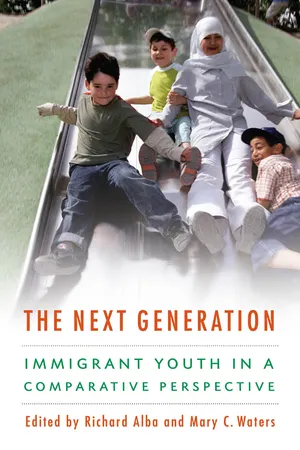
eBook - ePub
The Next Generation
Immigrant Youth in a Comparative Perspective
- 382 pages
- English
- ePUB (mobile friendly)
- Available on iOS & Android
eBook - ePub
The Next Generation
Immigrant Youth in a Comparative Perspective
About this book
Information
1
Dimensions of Second-Generation Incorporation
AN INTRODUCTION TO THE BOOK
Richard Alba and Mary C. Waters
Immigration is transforming the societies of North America and western Europe in ways that could not have been predicted a few decades ago. The roots of this population movement extend back to the middle of the twentieth century—a period of world war and recovery from wartime destruction—and they have been nourished subsequently by decolonization, economic development, and political instability in the Third World, along with the steadily shrinking significance of distance in human affairs, a development often referred to by the term globalization.
One consequence of these population movements has been the rise of ethnic, religious, and racial diversity in societies that previously thought of themselves as homogeneous, along with its permanent expansion in societies where immigration was already part of the national story. There is some degree of historical role reversal in this development, as countries such as Germany and Italy that previously were the source of many Immigrants going elsewhere have become places where Immigrants now settle in large numbers.
The second generation occupies a key position with respect to the future of the new groups and the societies where they reside, for this generation, born and/or raised in the host society, has a far greater capacity for integration than does the Immigrant one. The term second generation is often taken in a broad sense to encompass the children who grow up in Immigrant homes, whether they are born in the receiving society or enter it at a young age. In the more precise language of social-science research, the term second generation is usually reserved for those children of Immigrants who are born in the host society, while the children who arrive at a young age and thus receive part or all of their schooling in the new society are called the 1.5 generation, a term invented by the sociologist Rubén Rumbaut. In this introduction, however, we use second generation in the broader sense.
Because of differences in national systems of statistical accounting for Immigrants and the second generation, it is impossible to give commensurate figures for all the societies involved, but a few illustrative ones suggest the magnitude of the developments. In the United States, a common estimate (as of 2006) is that more than a fifth of the population belongs to the Immigrant or second generations, with the two very roughly of the same order of size; a similar fraction of school-age children lives in Immigrant households (Hernandez, Denton, and Macartney, chap. 3 in this volume). The United States is generally thought of as the immigration society par excellence, but numerically at least, it now has a number of rivals in Europe. In Switzerland, for instance, nearly a quarter of the population is foreign-born; and the children of the Immigrants account for almost 40 percent of the overall child population (Innocenti Research Centre 2009). In Germany, where according to the scrupulous accounting of Rainer Münz and Ralf Ulrich (2003) about one-sixth of the German population as of the late 1990s was born outside the boundaries of present-day Germany, the 1.5 and second generations now amount to 26 percent of all children. Even in Italy, which has not appeared to be central to the immigration flows transforming western Europe until very recently, the children of Immigrants are already a tenth of all children (Innocenti Research Centre 2009).
The comparative study of the second generation is in its infancy, despite the critical importance of clarifying the uncertainties that surround the trajectories of the children of Immigrants in contemporary immigration societies. At one vertex of a triangle of possibilities lies assimilation, associated with gradual cultural, social, and socioeconomic integration into the mainstream society. Although assimilation is prevalent among the descendants of past Immigrants (Alba and Nee 2003; Noiriel 1988), its applicability to contemporary immigrations has been called into question. At another vertex is the possibility, increasingly raised, that the value of ethnic social and cultural capital, combined with transnational connections on a scale never before seen in human history, will sustain ethnic pluralism to a new extent (Glick Schiller, Basch, and Blanc-Szanton 1995; Levitt 2001; Portes and Zhou 1993). The final vertex is occupied by a special form of assimilation, associated with the theory of “segmented” assimilation: assimilation into a racial or ethnic minority status that entails systematic disadvantage vis-à-vis members of the societal mainstream (Portes and Rumbaut 2001)
Because segmented-assimilation theory explicitly addresses these three modes of incorporation, it is an important reference point for any comparative examination of the second generation. This theory, formulated in the U.S. context, poses starkly different possible outcomes for the second generation: upward assimilation, downward assimilation, and a combination of upward mobility with persistent biculturalism. These paths correspond to three processes that summarize the relations between Immigrant children, their parents, and the wider ethnic community: consonant, dissonant, and selective acculturation. Consonant acculturation occurs when the children and the parents learn American culture and gradually abandon their home language and “old country” ways at about the same pace. Thus, as children enter the American mainstream, they achieve upward mobility with the support of their parents. Dissonant acculturation occurs when children’s learning of the English language and American ways outstrips that of their Immigrant parents. Portes and Rumbaut (2001) argue that this process can lead to downward assimilation, as young people confront racial discrimination, bifurcated labor markets, and an often nihilistic inner-city youth subculture on their own, without strong parental authority and resources and with few community supports. The third process, selective acculturation, is the one that leads to upward assimilation and biculturalism. Selective acculturation occurs when parents and children both learn American ways gradually while remaining embedded, at least in part, in the ethnic community. Portes and Rumbaut (2001, 54) argue that selective acculturation is especially important for those groups who are subject to discrimination.
Segmented assimilation also takes into account background factors such as parental human capital (including parents’ education and income), modes of incorporation (state definitions of Immigrant groups, eligibility for welfare, degree of discrimination and antipathy toward Immigrant groups), and family structure (single-parent versus married-couple families as well as multigenerational versus nuclear-family living arrangements). Although less explicitly stated, the model also points to the varying degrees of transnational connection among Immigrant groups as an important element of the context of reception. This theory has helped to organize and systematize a large volume of work on Immigrant incorporation. The concept of modes of incorporation, for instance, has been extremely useful in systematizing the relationship between varying political and cultural reactions to Immigrant groups and the experiences of acceptance or resistance of individual Immigrants themselves. In the United States there is close to universal agreement that American society and the American economy do not make up an undifferentiated whole—and in that sense the experience of assimilation is clearly segmented. Virtually all studies show that the children of Immigrants do not follow a single trajectory and that second-generation outcomes are highly contingent on the segment of American society into which they are being incorporated (Greenman and Xie 2008).
Other authors have argued that they do not find evidence of segmented assimilation because they generally do not find second-generation decline or downward assimilation. Farley and Alba (2002), Hirschman (2001), Smith (2003), Waldinger and Feliciano (2004), and Kasinitz et al. (2008) all find evidence of progress for the second generation vis-à-vis the first generation, and this evidence is sometimes interpreted as disputing segmented assimilation. For instance, Boyd (2002,1037) finds no support for segmented assimilation in Canada and concludes that “contrary to the second generation decline or the segmented underclass assimilation model found in the United States, adult Immigrant offspring in Canada who are people of color (visible minorities) exceed the educational attainments of other non-visible minority groups.” This pattern of second-generation advantage, in particular in educational attainment, is a key theme in Tariq Modood’s chapter on Britain in this volume (chap. 9).
Segmented assimilation was raised first in the U.S. context as a prospect for groups that face especially high barriers to their entry into the mainstream, as appears to be true for groups deemed phenotypically black by North American standards (Portes and Zhou 1993; Waters 1999a), and its relevance for other national contexts has been widely discussed since then. The question of how relevant segmented assimilation is for the European context is explicitly raised in several of chapters in this volume, most notably Roxane Silberman’s chapter on France (chap. 14), Fibbi, Lerch, and Wanner’s chapter on Switzerland (chap. 6), and Phalet and Heath’s chapter on Belgium (chap. 7).
But the question about the trajectories of incorporation of Immigrant groups in contemporary societies hovers over all the essays in this volume. It is most usefully addressed within a comparative frame because of the strong likelihood that features of the receiving society interact with characteristics of the Immigrant group to determine the latter’s trajectory. In the remainder of this introductory essay, we sketch some of the major axes of difference among immigrations and among the societies of North America and western Europe that are widely thought to bear on processes of incorporation and hence on the life chances of the second generation. We view four in particular as primary: the character of the immigration; the citizenship regime, whose scope extends, according to the famous formulation of T. H. Marshall (1964), from the basic political rights understood as part of citizenship narrowly construed to the socioeconomic rights embedded in social-welfare systems; the institutions of the host society that the children of Immigrants must pass through; and the local contexts within the receiving society where the children of Immigrants grow up and whose features impact on their opportunities. We consider also how the essays in this volume contribute empirically to our knowledge about the role of these dimensions.
Types of Immigration
All immigrations are not the same when it comes to their impact on societal diversity, for some are easily absorbed into the societal mainstream because of ethnic proximity to natives, whereas others can lead to longstanding, if not permanent, majority-minority divisions. In the United States, western European and Canadian Immigrants, though making up a small fraction of the whole, are rather invisible in ethnic terms and generally blend easily into the white-dominated mainstream. The same cannot be said for the more massive immigrations from Asia, Latin America, and the Caribbean. In most of western Europe, the intra-European immigrations made possible by the European Union, though not invisible, nevertheless do not stand out as problematic in their incorporation, whereas most of the non-European groups do. In France, for instance, Portuguese Immigrants and their children are viewed as immigration successes, while the North Africans, sub-Saharan Africans, and Turks are not (see Silberman, chap. 14 in this volume). The implications of the immigration mix for societal diversity are hardly limited to racial visibility, as Tariq Modood describes for Great Britain in chapter 9 in this volume.
Though we do not discuss in depth the role of state policy and law in shaping the volume and mix of immigration streams flowing into a society, it is obviously consequential and thus to some extent agenda setting for second-generation integration. To be sure, the impact of states is never as absolute as they would like—prospective Immigrants, usually in collaboration with their already settled relatives and contacts, can often use immigration law and policy in ways unforeseen by policymakers to gain entry. Yet the differences between the immigration streams into receiving societies seem, at least in some cases, undeniably related to state policies. Canada and the United States offer an informative comparison, for despite their geographic proximity, Canada takes in relatively little of the low-wage immigration, especially from Latin America, that looms large in the United States; plausibly, this difference is related to the occupational selectivity entailed in the Canadian point system as compared to the predominance of family relationships in the U.S. immigration system (Boyd and Vickers 2009; Reitz 1998), although the long land border between the United States and Mexico also plays an important role.
Of the major types of immigration, labor migrations hold a fundamental importance for the ethnic and racial divisions that have emerged in North America and western Europe; and most of the essays in this volume focus largely or exclusively on the second generations from these migrations, typified by the Turks of Europe and the Mexicans of the United States. Generally large in size and usually coming from Third World countries whose citizens are perceived as culturally different from the mainstream of the countries of reception and frequently as racially different too, the labor migrations of the post-World War II era have created new minorities in many countries or expanded old ones. Though often conceived as temporary by the governments that promote them, labor migrations generally lead to permanent settlement by some portion of the Immigrant group, which finds the opportunities in the new society, however humble, preferable to those it would face upon return. Most of the groups whose second generations face incorporation difficulties have arisen from this form of immigration.
Though labor immigrations have been promoted by profound economic and political changes in both source and receiving countries, they typically require legal and policy steps in both countries in order to take place (Sassen 1988; Massey et al. 1993). For this reason, they often develop in fits and starts, synchronized with political decision-making. In the United States, the beginnings of the contemporary labor immigration can be spotted in the “bracero” program, which was initiated during World War II to fill the need for labor at a time when many American men were in uniform. The bracero program, which gave several million Mexican workers their first taste of life in “El Norte,” led to a rise in immigration from Mexico that predates 1965, the date of changes in immigration law that are often cited as the moment of birth of contemporary immigration to the United States.
In Europe, too, the labor needs that gave rise to large-scale labor migrations came after the war, when additional labor was needed to reconstruct damaged infrastructures and economies, especially given the massive losses of manpower due to the war itself. France, for instance, established its office of immigration (ONI) in 1945. Germany had perhaps the exemplary program during the postwar period, recruiting so-called guest workers, who were expected to come without their families and to work for predetermined periods and then return home (Bade 1994). Initially, many were housed in barracks by the companies they worked for and took jobs at the bottom rungs of the labor market.
Often what started as a temporary immigration initiated by the state turned into permanent settlement. Family reunification has been the key policy provision that has catalyzed this process and allowed labor immigration to continue to grow in many countries. In the United States, a series of critical laws established family reunification as the primary principle that would govern legal admission: it was a centerpiece in the watershed 1965 act, which has shaped the landscape of immigration ever since its passage. In Europe, active recruitment of low-wage Immigrants came to an end in most countries in the early 1970s when their economies were rattled by the shock of oil-price rises. However, labor-Immigrant populations have continued to grow as a result of the family-reunification parts of immigration law, which are found in all countries (although there have been some recent efforts to narrow them). Indeed, the end of active recruitment precipitated a process of settlement for many Immigrant groups. The Turks in Germany are a case in point: Many of the guest workers did not return home but found ways to stay and to bring their families. Family reunification accelerated with the official halt to guest-worker recruitment in 1973, when the Immigrants realized that entry into western Europe would become more difficult. The Turkish population continues to grow through family-reunification immigration, which now often occurs in the form of marriages between second-generation Turks in Germany and partners from the home regions of their parents (Kelek 2005). Maurice Crul’s chapter in this volume (chap. 13) discusses the immigration dynamics of the Turks in Germany and in three other west European countries.
In both the United States and Europe, labor immigration also persists in unauthorized ways, with undocumented Immigrants after a period of residence and work often receiving legal sanction through amnesties and regularizations, which have occurred in the United States and in several western European countries. In the United States, studies have shown that undocumented immigration occurs both as a result of clandestine border crossing, especially at the Rio Grande, and visa overstaying. As of 2008, the total number of the unauthorized was estimated at twelve million, truly an astonishing figure in a nation with a population of about three hundred million—according to this accounting, one of every twenty-five to thirty residents lacks the legal right to live and work in the United States (Passel and Cohn 2008). The United States has had one previous amnesty, which was legislated in the 1986 Immigration Reform and Control Act (IRCA) and which resulted in about three million grants of permanent residence to previously undocumented residents. Whether and under what conditions currently undocumented residents can gain legal status is the subject of current debate in the U.S. Congress and in the media. Chapter 2 in this volume, by Susan Brown, Frank Bean, Mark Leach, and Rubén Rumbaut, addresses the impact of Immigrant legal status on the socioeconomic position of the second generation.
The unauthorized population is almost certainly not as large in western Europe as it is in the United States, in part because a number of major European countries have much tighter internal controls—for example, requiring the regular presentation of identity documents—than the United States does. Nevertheless, there is a significant unauthorized population in western Europe also, albeit one that is less settled than that in the United States. Much of this population comes from the Mediterranean region or from sub-Saharan Africa. It is thought to be particularly large in the countries of southern Europe, Greece, Italy, and Spain. Several of the European countries with sizable undocumented populations have had fairly frequent regularizations—this is true of Spain, for instance, which in 2005 decreed a large-scale regularization that gave legal status to some seven to eight hundred thousand Immigrants, including some from Latin America.
The groups that have originated from low-wage labor migrations are the ones that stand out whenever immigration is discussed in North America and western Europe—especially Mexicans and Central Americans in the United States and Turks and North Africans in western Europe. Yet not all migrations are of humble workers with limited educations seeking jobs that natives are reluctant to take. Many states are currently seeking to expand their intake of Immigrants with high educational diplomas, professional qualifications, or unusual skills. The presence of a highly skilled stratum in the immigration stream gives the Immigrant populations in many countries a bimodal appearance: along with the low-skilled workers who fill jobs at the bottom are high-skilled ones who take well-paid jobs and live in middle-class, if not wealthy, neighborhoods (Portes and Rumbaut 2006). This bimodal division in skills and wages is accentuated by ethnic difference. Generally speaking, the low-skilled Immigrants and the highly educated ones do not come from the same countries, creating an ethnic division of considerable consequence within the foreign-born and then the second-generation population. In the United States, for instance, Indians are concentrated in the ranks of engineers, physicians, and other highly trained Immigrants.
States also seek out entrepreneurs, although many small-business owners enter receiving countries initially as labor or professional Immigrants. The United States, for example, has a provision to admit “investors” who bring significant financial capital and intend to funnel it into businesses that will provide employment. However, many Immigrant entrepreneurs arise from the ranks of labor Immigrants, and in fact the larger the Immigrant group, the greater the chance for enterprising individuals to establish businesses that initially depend on servicing the needs of coethnics. In Germany, for example, the Turks are well known for the many businesses they have established, often in ethnic neighborhoods. The Mexicans in the United States, who have a very low rate of self-employment, demonstrate that not every labor immigration gives rise to a sizable entrepreneurial stratum.
The position of the second generation of professional and entrepreneurial migrations is very different...
Table of contents
- Cover Page
- Title Page
- Copyright Page
- Contents
- Acknowledgments
- 1 Dimensions of Second-Generation Incorporation: An Introduction to the Book
- Part I: Starting Points
- Part II: Major Case Studies
- Part III: The Role of Local Context
- Part IV: In Closing: Comparative Studies
- References
- About the Contributors
- Index
Trusted by 375,005 students
Access to over 1.5 million titles for a fair monthly price.
Study more efficiently using our study tools.
Frequently asked questions
Yes, you can cancel anytime from the Subscription tab in your account settings on the Perlego website. Your subscription will stay active until the end of your current billing period. Learn how to cancel your subscription
No, books cannot be downloaded as external files, such as PDFs, for use outside of Perlego. However, you can download books within the Perlego app for offline reading on mobile or tablet. Learn how to download books offline
Perlego offers two plans: Essential and Complete
- Essential is ideal for learners and professionals who enjoy exploring a wide range of subjects. Access the Essential Library with 800,000+ trusted titles and best-sellers across business, personal growth, and the humanities. Includes unlimited reading time and Standard Read Aloud voice.
- Complete: Perfect for advanced learners and researchers needing full, unrestricted access. Unlock 1.5M+ books across hundreds of subjects, including academic and specialized titles. The Complete Plan also includes advanced features like Premium Read Aloud and Research Assistant.
We are an online textbook subscription service, where you can get access to an entire online library for less than the price of a single book per month. With over 1.5 million books across 990+ topics, we’ve got you covered! Learn about our mission
Look out for the read-aloud symbol on your next book to see if you can listen to it. The read-aloud tool reads text aloud for you, highlighting the text as it is being read. You can pause it, speed it up and slow it down. Learn more about Read Aloud
Yes! You can use the Perlego app on both iOS and Android devices to read anytime, anywhere — even offline. Perfect for commutes or when you’re on the go.
Please note we cannot support devices running on iOS 13 and Android 7 or earlier. Learn more about using the app
Please note we cannot support devices running on iOS 13 and Android 7 or earlier. Learn more about using the app
Yes, you can access The Next Generation by Richard Alba,Mary C. Waters, Richard Alba, Mary C. Waters in PDF and/or ePUB format, as well as other popular books in Social Sciences & Ethnic Studies. We have over 1.5 million books available in our catalogue for you to explore.