The State of Play presents an essential first step in understanding how new digital worlds will change the future of our universe. Millions of people around the world inhabit virtual words: multiplayer online games where characters live, love, buy, trade, cheat, steal, and have every possible kind of adventure. Far more complicated and sophisticated than early video games, people now spend countless hours in virtual universes like Second Life and Star Wars Galaxies not to shoot space invaders but to create new identities, fall in love, build cities, make rules, and break them.
As digital worlds become increasingly powerful and lifelike, people will employ them for countless real-world purposes, including commerce, education, medicine, law enforcement, and military training. Inevitably, real-world law will regulate them. But should virtual worlds be fully integrated into our real-world legal system or should they be treated as separate jurisdictions with their own forms of dispute resolution? What rules should govern virtual communities? Should the law step in to protect property rights when virtual items are destroyed or stolen?
These questions, and many more, are considered in The State of Play, where legal experts, game designers, and policymakers explore the boundaries of free speech, intellectual property, and creativity in virtual worlds. The essays explore both the emergence of law in multiplayer online games and how we can use virtual worlds to study real-world social interactions and test real-world laws.
Contributors include: Jack M. Balkin, Richard A. Bartle, Yochai Benkler, Caroline Bradley, Edward Castronova, Susan P. Crawford, Julian Dibbell, A. Michael Froomkin, James Grimmelmann, David R. Johnson, Dan Hunter, Raph Koster, F. Gregory Lastowka, Beth Simone Noveck, Cory Ondrejka, Tracy Spaight, and Tal Zarsky.
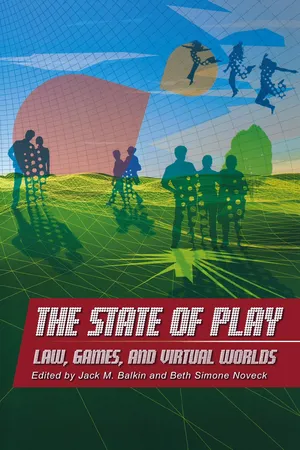
eBook - ePub
The State of Play
Law, Games, and Virtual Worlds
- 304 pages
- English
- ePUB (mobile friendly)
- Available on iOS & Android
eBook - ePub
The State of Play
Law, Games, and Virtual Worlds
About this book
Information
Introduction
1
Introduction
In his 1992 novel Snow Crash, science fiction writer Neal Stephenson imagined the Metaverse. The Metaverse was a virtual world—a three-dimensional simulation of reality in cyberspace—where people lived, worked, and socialized. Since then programmers have used increasingly sophisticated graphical interfaces to create their own versions of the Metaverse. Although the development of these virtual worlds has been driven by the game industry, by now these worlds are used for far more than play, and soon they will be widely adopted as spaces for research, education, politics, and work. In the years to come our gateway to the Internet will probably look more like a video game and less like a book. Thus anyone who wants to understand the future of the Internet needs to understand virtual worlds.
Millions of people around the globe now play in these virtual or synthetic worlds. In fact, many of the 20 to 30 million regular participants now spend more time in virtual environments than they do at their real-world jobs or engaged with their real-world communities; according to one recent estimate, the average number of hours played is almost twenty-two per week. People who do not vote or engage in politics in real space eagerly do so in virtual spaces, drawn by the promise of new adventures, new identities, and the possibility of building new social universes.
People go to virtual spaces like Britannia or Norrath or Second Life to create characters, swap stories, build things, solve problems, pay taxes, enact rules, and break them. Some play in military virtual worlds like America’s Army; in fact, the U.S. military now uses virtual worlds to simulate military situations and train and recruit real soldiers for battle. Virtual worlds have become active sites for commerce, where players trade in virtual goods and services. On any given day between ten and twenty thousand virtual-world items are for sale on eBay. Participants go to virtual churches, join virtual societies, and engage in social activism and political protest.
The rich, persistent, interactive and graphical interfaces of virtual worlds stimulate social experimentation and encourage people to create new lives and to build vibrant economies and cultures. Virtual worlds are full of social cooperation and social conflict; they present all the problems of social order we find in real space and some that we do not. No wonder, then, that legal scholars have increasingly been drawn to study these worlds, both for the legal problems arising within them and for what these worlds might tell us about law and social order in real space.
This book brings together essays by some of the most important thinkers on law and virtual worlds. It grows out of the first annual State of Play Conference, held at New York Law School from November 13 to 15, 2003. The State of Play was organized by the Institute for Information Law and Policy at New York Law School and the Information Society Project at Yale Law School; it brought together leading legal scholars, game designers, and software industry professionals, as well as cognitive psychologists, communications experts, computer scientists, visual artists, and game players to explore the next frontier of cyberspace: the virtual world.
Greg Lastowka and Dan Hunter’s introductory essay explains the basic terminology of virtual worlds and gives a brief history. They trace the origins of today’s virtual worlds from the early text-based adventure games called MUDs (standing for either “multiuser dungeon” or “multiuser dimension”) and MOOs (“MUD object oriented”—a reference to the style of programming used) to much larger and more interactive games with elaborate graphical interfaces. These games are sometimes called MORPGs (multiplayer online role-playing games) or MMORPGs (massively multiplayer online role-playing games).
The second section of the book, “Game Gods and Game Players,” describes the basic conflicts that arise in virtual worlds between the players, the game owners, and the state. Private companies build and control virtual worlds for the entertainment of their subscribers. Players sign end-user license agreements (EULAs) that give them the right to play in the space in return for agreeing to the game owner’s terms. As these games evolve into online societies, the question naturally arises whether and when real-world law should step in to protect the players from arbitrary decisions by the “game gods” and from allegedly unfair features of EULAs. Should the law leave the regulation of virtual worlds largely to the market and to the artistic decisions and programming expertise of game owners or should legislatures and courts create new legal rules to constrain game owners?
The authors in this section take contrasting positions about the appropriate balance of rights between the players, game owners, and the state. Richard Bartle, one of the earliest virtual-world designers and cocreator of the first MUD, argues strongly for the rights of game designers in the virtual world. Playing a game means agreeing to abide by the rules the game designers set down. Designers, Bartle points out, have natural incentives to create worlds that people will want to play in, and so they should be given wide discretion in the way they organize a virtual world. Designers crucially maintain order in the game world, disciplining and even expelling players who make the game worse for everyone. Without the ability to recode the rules as the game designer chooses, a virtual world is “greatly diminished if not mortally wounded,” and the game designer’s incentives to design are skewed. Adminstrators of virtual worlds (often called “admins”) can and sometimes do willingly surrender their powers over the game to the players, Bartle explains, but “I am not happy for them to be taken away through ignorance by external forces.”
An opposing view comes from Raph Koster, creative director of Sony On-Line Entertainment, and the designer of Star Wars Galaxies and many other of the most popular massively multiplayer games. Koster argues that players deserve respect from the game designers and administrators as well as basic regulatory protections. Koster’s contribution to this volume is an expanded version of his famous essay “A Declaration of the Rights of Avatars,” a manifesto for the age of virtual worlds loosely based on the 1789 Declaration of the Rights of Man. Game administrators, Koster argues, should bind themselves to basic standards of decency and conduct, not only because it makes good business sense but because avatars are not merely fictional characters, but represent real people and their identities. “Some day,” Koster predicts, “there won’t be any [game] admin[istrator]s. Some day it’s gonna be your bank records and your grocery list and your credit report…. Some day it’s gonna be Snow Crash and Neuromancer and Otherland all wrapped up into one, and it may be a little harder to write to Customer Service.” “On the day that happens, I bet we’ll all wish we had a few more rights in the face of a very large, distributed server, anarchic, virtual world where it might be very hard to move to a different service provider.”
Ted Castronova is one of the first social scientists to have taken virtual-worlds seriously; he pioneered the study of virtual world economies, demonstrating that the GDP of Norrath, part of the virtual world EverQuest, was larger than that of several developing countries. Although Castronova gained fame by studying how players made real-world money from virtual economies, he argues that game spaces should be reserved for play and not for commodification. The point of virtual worlds, Castronova argues, is to allow the players to engage in fantasy. The law should safeguard the “Magic Circle” that allows them to do this. Castronova worries that the buying and selling of virtual goods using real-world money has turned virtual worlds into real-world economic zones, destroying the distinction between the play space and ordinary life. To prevent this, Castronova proposes the idea of “interration.” Just as the law has statutes of incorporation that allow for the creation of corporations—fictional legal persons with certain rights and obligations—the law should have special legal charters that he calls “statutes of interration.” These would recognize game spaces as fictional worlds with their own independent powers of regulation. Interrated worlds would be “closed” worlds. Goods and services may not be traded for real-world currency in these closed worlds and players who attempt to do so can be excluded from the game. In addition, closed worlds would be separate jurisdictions with rules of their own, into which real-world law would not enter: “Once a world is interrated under th[e] law whatever rights or obligations its internal government decrees (again, assuming they do not violate the terms of the charter itself) are sacrosanct there, and no user has a right to redress under any outside authority.”
By contrast, Jack Balkin argues that the law cannot be kept out of virtual worlds. As more and more people spend increasing amounts of time and energy there, they will inevitably call upon the state to protect their interests, and legislatures, administrative agencies, and courts will inevitably respond. Balkin believes that commercialization and commodification are the root causes of this trend. Because both game owners and players seek property protection for goods created in virtual worlds, they are effectively inviting the law in.
Balkin argues that the players’ freedom to play and the designers’ freedom to design are related to but not identical with the First Amendment rights of freedom of speech and association. He emphasizes the importance of protecting the free speech rights of both players and game designers from the state and balancing the free speech interests of players and designers. Building on Castronova’s notion of interration, he argues that interration statutes should allow game designers to choose among different kinds of regulatory schemes for virtual worlds, some which protect property rights and some which do not, some which secure public spaces for unfettered dissent and protest, and some which protect the free association rights of game designers. Whereas Castronova suggests that statutes of interration should be used to keep the real law out, Balkin believes that the real point of statutes of interration is to bring law in to protect free speech property and privacy rights.
Property rights are one of the most hotly debated topics about virtual worlds. Many view property as essential to the existence not only of virtual worlds, but of society more generally. The next section of essays, entitled “Property and Creativity in Virtual Worlds,” asks about the proper role of real-world law in regulating property in virtual worlds. The very idea of property in virtual worlds raises a host of questions: Can there be crime or theft of property? What kind of governance of property should apply in virtual worlds? How should property protections be reshaped to serve the larger purposes of promoting social interaction and creativity in different kinds of virtual worlds? Although nominally about property, the essays in this section reflect a broader philosophical debate about the role of the law in producing social order and shaping social life.
Greg Lastowka and Dan Hunter’s essay “Virtual Crime” considers whether the law should penalize the theft of virtual property that people invest time and energy in creating. What complicates the issue is that crime sometimes takes place in the context of the game, and may or may not be part of the game. Thus, Lastowka and Hunter worry that courts and legislatures will misunderstand the setting in which disputes about theft of virtual goods arise. They argue that the issue of virtual crime should be resolved by the EULA. “By concentrating the legal control of and rules regarding virtual property in their own hands, game owners and designers may essentially disarm many of the difficult legal issues stemming from inter-avatar property crime.” “Some degree of confusion and category mistake would almost inevitably result from judicial attempts to interpret traditional criminal laws in order to police player behaviors in virtual worlds. Ironically, if we wish to preserve the benefits of virtual worlds as free and independent social experiments, it may be best if we keep the criminal law at a safe distance.”
Julian Dibbell is a journalist of cyberspace, and the author of a famous Village Voice article, “A Rape in Cyberspace,” that described a rape in a virtual world and introduced many people to the special characteristics of these worlds. In his essay, “Owned!” Dibbell tells the story of Black Snow Interactive, a fly-by-night organization which hired Mexican nationals in Tijuana to play Mythic Entertainment’s Dark Age of Camelot around the clock to produce game currency that could be exchanged for dollars.
The best way to deal with property rights in virtual worlds, Dibbell argues, is to allow the game designer to control the rules of play and the existence or nonexistence of real-world property. When faced with exploits like Black Snow’s, Dibbell contends, “the end-user license agreement—that egregious tool of corporate tyranny over the defenseless, voiceless customer (or so I had painted it)—starts to look more like the place where a complicated give and take between designers and players is finally ratified, transformed from a murky power struggle into the legally binding rules of the game. The EULA starts to look less like a contract of adhesion, in other words, than like a social contract.” Indeed, Dibbell argues, “the feedback loop” between game players and game designers “is at best a crude approximation of democratic government—and for the sake of whatever fun inheres in these games is probably better left that way.”
While Dibbell hopes that the EULA might serve as an imperfect social contract that guarantees some decree of democratic accountability between players and game gods, James Grimmelmann views this social contract in far more Hobbesian terms. Grimmelmann sees disputes in virtual worlds as the rough and tumble of politics. “Every debate over the rules and every change to the software is political,” he explains. “When players talk about the rules, they are practicing politics.” Grimmelmann argues that there is no logical distinction between what he calls an “exploit,” taking advantage of a loophole in the game’s coding to contravene the spirit, if not the rules of the game, and a “feature” of the game that players discover and use to make the game more fun and to secure a competitive advantage. Grimmelmann believes the distinction between exploits and features will be decided, if at all, through the political negotiation between the various players and the game gods. Hence, Grimmel-mann concludes that virtual worlds present many of the same problems that we see in real-world politics, including international politics. “Any difference [between real and virtual worlds] is illusory; these worlds may be virtual, but their politics are wholly real.”
Cory Ondrejka is one of the designers of Second Life, a popular virtual world that encourages its inhabitants to build...
Table of contents
- Cover Page
- Title Page
- Copyright Page
- Dedication
- Contents
- PART I: Introduction
- PART II: Game Gods and Game Players
- PART III: Property and Creativity in Virtual Worlds
- PART IV: Privacy and Identity in Virtual Worlds
- PART V: Virtual Worlds and Real-World Power
- About the Contributors
- Acknowledgments
- Case List
- Index
Trusted by 375,005 students
Access to over 1.5 million titles for a fair monthly price.
Study more efficiently using our study tools.
Frequently asked questions
Yes, you can cancel anytime from the Subscription tab in your account settings on the Perlego website. Your subscription will stay active until the end of your current billing period. Learn how to cancel your subscription
No, books cannot be downloaded as external files, such as PDFs, for use outside of Perlego. However, you can download books within the Perlego app for offline reading on mobile or tablet. Learn how to download books offline
Perlego offers two plans: Essential and Complete
- Essential is ideal for learners and professionals who enjoy exploring a wide range of subjects. Access the Essential Library with 800,000+ trusted titles and best-sellers across business, personal growth, and the humanities. Includes unlimited reading time and Standard Read Aloud voice.
- Complete: Perfect for advanced learners and researchers needing full, unrestricted access. Unlock 1.5M+ books across hundreds of subjects, including academic and specialized titles. The Complete Plan also includes advanced features like Premium Read Aloud and Research Assistant.
We are an online textbook subscription service, where you can get access to an entire online library for less than the price of a single book per month. With over 1.5 million books across 990+ topics, we’ve got you covered! Learn about our mission
Look out for the read-aloud symbol on your next book to see if you can listen to it. The read-aloud tool reads text aloud for you, highlighting the text as it is being read. You can pause it, speed it up and slow it down. Learn more about Read Aloud
Yes! You can use the Perlego app on both iOS and Android devices to read anytime, anywhere — even offline. Perfect for commutes or when you’re on the go.
Please note we cannot support devices running on iOS 13 and Android 7 or earlier. Learn more about using the app
Please note we cannot support devices running on iOS 13 and Android 7 or earlier. Learn more about using the app
Yes, you can access The State of Play by Jack M. Balkin,Beth Simone Noveck, Jack Balkin, Beth Simone Noveck in PDF and/or ePUB format, as well as other popular books in Law & Intellectual Property Law. We have over 1.5 million books available in our catalogue for you to explore.