Rarely in American history has a political figure been so pilloried and despised as Thomas Hutchinson, Governor of Massachusetts and an ardent loyalist of the Crown in the days leading up to the American revolution.
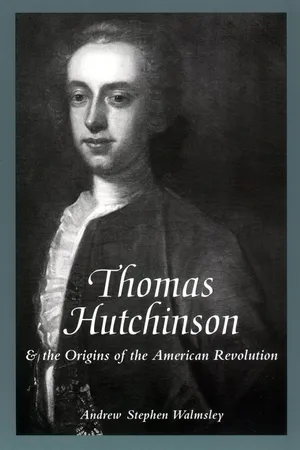
In this narrative and analytic life of Hutchinson, the first since Bernard Bailyn's Pulitzer-Prize-winning biography a quarter century ago, Andrew Stephen Walmsley traces Hutchinson's decline from well- respected member of Boston's governing class to America's leading object of revolutionary animus. Walmsley argues that Hutchinson, rather than simply a victim of his inability to understand the passions associated with a revolutionary movement, was in fact defeated in a classic political and personal struggle for power. No mere sycophant for the British, Hutchinson was keenly aware of how much he had to lose if revolutionary forces prevailed, which partially explains his evolution from near- Whig to intransigent loyalist. His consequent vilification became a vehicle through which the growing patriot movement sought to achieve legitimacy.
An entertaining and thought-provoking view of revolutionary events from the perspective of the losing side, Thomas Hutchinson and the Origins of the American Revolution tells the story of the American Revolution through the prism of one of its most famous detractors.
- 288 pages
- English
- ePUB (mobile friendly)
- Available on iOS & Android
eBook - ePub
Thomas Hutchinson and the Origins of the American Revolution
About this book
Information
Notes
NOTES TO THE PREFACE AND ACKNOWLEDGMENTS
1. Bernard Bailyn, The Ordeal of Thomas Hutchinson (Cambridge: Belknap Press, 1974). Other major treatments of Hutchinson are: James K. Hosmer, The Life of Thomas Hutchinson (Cambridge: Riverside Press, 1896); James H. Stark, The Loyalists of Massachusetts and the Other Side of the American Revolution (Boston: James H. Stark, 1907); Malcolm Freiberg, Prelude to Purgatory: Thomas Hutchinson in Provincial Massachusetts Politics, 1760 to 1770 (New York: Garland, 1990); Clifford K. Shipton, ed., Sibley’s Harvard Graduates, vol. 8 (Boston: Massachusetts Historical Society, 1951); William Pencak, America’s Burke: The Mind of Thomas Hutchinson (Washington, D.C.: UP of America, 1982).
2. Peter Shaw, American Patriots and the Rituals of Revolution (Cambridge: Harvard UP, 1981).
3. Theodore Draper, A Struggle for Power: The American Revolution (New York: Random House, 1996).
NOTES TO THE PROLOGUE
1. Mercy Warren to Sally Sever, December 1781, Mercy Otis Warren Letterbooks, Massachusetts Historical Society.
2. John C. Miller, Samuel Adams: Pioneer in Propaganda (Stanford: Stanford UP, 1936).
NOTES TO CHAPTER ONE
1. Emery Battis, Saints and Sectaries: Anne Hutchinson and the Antinomian Controversy in the Massachusetts Bay Colony (Chapel Hill: U of North Carolina P, 1962), 248; David D. Hall, ed., The Antinomian Controversy, 1636–1638: A Documentary History (Middletown: U of Connecticut P, 1968); Lyle Koehler, “The Case of the American Jezebels: Anne Hutchinson and Female Agitation during the Years of Antinomian Turmoil,” William and Mary Quarterly 31 (January 1974): 55–78.
2. Thomas Hutchinson, “Hutchinson in America,” Hutchinson Papers, Massachusetts Historical Society. Thomas Hutchinson wrote this document in England between 1777 and 1778. He never intended this essay for publication and it is the only detailed primary source available concerning Hutchinson’s lineage and early family life.
3. Ibid., 27–28; Peter O. Hutchinson, ed., The Diary and Letters of His Excellency Thomas Hutchinson 2 vols. (Boston: Houghton, Mifflin, 1884–86), 2, 466–67.
4. Hutchinson, “Hutchinson in America,” 39.
5. Ibid., 41.
6. Ibid., 39 and 43.
7. Frank J. Sulloway, Born to Rebel: Birth Order, Family Dynamics, and Creative Lives (New York: Pantheon, 1996).
8. Hutchinson, “Hutchinson in America,” 43–46; Peter O. Hutchinson, Diary and Letters, 1, 47.
9. “Hutchinson in America,” 44; Diary and Letters, 1, 46.
10. “Hutchinson in America,” 49; Diary and Letters, 1, 48.
11. “Hutchinson in America,” 46.
12. Peter O. Hutchinson, Diary and Letters, 1, 33–46.
13. Charles Francis Adams, ed., The Works of John Adams, Second President of the United States: With a Life of the Author, Notes and Illustrations, 10 vols. (Boston: Little, Brown, 1856), 10: 231; Lawrence Shaw Mayo, “Governor Hutchinson’s Own Copies of His History of Massachusetts,” Colonial Society of Massachusetts, Publications, 28 (Boston, 1935): 438–446; Lawrence Shaw Mayo, “Thomas Hutchinson and His History of Massachusetts-Bay,” American Antiquarian Society Proceedings, 41 (Worcester, 1932), 321–339.
14. William Pencak, America’s Burke: The Mind of Thomas Hutchinson (Washington, D.C.: UP of America, 1982).
15. William Palfrey to John Wilkes, October 30, 1770; John Gorham Palfrey, “Life of William Palfrey,” in Jared Sparks, ed., The Library of American Biography, 25 vols. (New York: Harper, 1848–64), 17, 368–369.
16. John W. Raimo, Biographical Dictionary of American Colonial and Revolutionary Governors, 1607–1789 (Westport: Meckler Books, 1980); Michael Clement Batinski, “Jonathan Belcher of Massachusetts, 1682 to 1741” (unpublished Ph.D. dissertation, Northwestern University, 1970).
17. “Hutchinson in America,” 50.
18. Bailyn, Ordeal, 30–32.
19. “Hutchinson in America,” 50.
20. Ibid., 51.
21. The Hutchinson children were: Thomas, Jr., b. 1740 d. 1811 (m. Sarah Oliver); Elisha, b. 1743 d. 1824 (m. Mary Watson); Sarah, b. 1744 d. 1780 (m. Peter Oliver); William (Billy), b. 1752 d. 1780 (unmarried); Margaret (Peggy), b. 1754 d. 1777 (unmarried).
22. “Hutchinson in America,” 76.
23. Ibid., 76.
24. Ibid., 51.
25. Jonathan Belcher to Francis Harrison, June 27, 1734, Belcher Papers, Massachusetts Historical Society, Collections, 2 vols. (Boston, 1893), 2, 77.
26. The Massachusetts legislature was referred to collectively as the General Court. This body comprised two houses. The lower house was referred to as the House of Representatives. The upper house was referred to as the Council. The Council was elected by the House of Representatives and then subjected to the governor for approval or rejection. Boston was governed by the Town Meeting. This body elected selectmen to conduct town business as well as representatives to the General Court.
27. A Report of the Records Commissioners of the City of Boston Containing the Boston Records from 1729 to 1742 (Boston: Rockwell and Churchill, 1885), 197–201.
28. Malcolm Freiberg, “Thomas Hutchinson and the Province Currency,” New England Quarterly 30 (June 1957): 190–208; Gary Nash, The Urban Crucible: Social Change, Political Consciousness, and the Origins of the American Revolution (Cambridge: Harvard UP, 1979), 112–118; William Douglass, A Discourse Concerning the Currencies of the British Plantations in America (Boston: Kneeland and Green, 1740); Theodore Thayer, “The Land Bank System in the American Colonies,” Journal of Economic History 13 (June 1953): 145–159.
29. Boston Town Records, 1729–1741, 197.
30. Peter O. Hutchinson, Diary and Letters, 1, 50.
31. Lawrence Shaw Mayo, ed., Thomas Hutchinson’s History of the Province of Massachusetts Bay, 3 vols. (Cambridge: Harvard UP, 1936), 2, 297.
32. Peter O. Hutchin...
Table of contents
- Cover Page
- Title Page
- Copyright Page
- Dedication
- Contents
- Preface and Acknowledgments
- Prologue: Departure
- ONE Boston's Fortunate Son
- TWO “The Butt of a Faction”
- THREE Enter the Crowd
- FOUR “An Ill Temper and a Factious Spirit”
- FIVE John Mein and Christopher Sneider: Two Martyrs
- SIX The Deepening Crisis
- SEVEN Hutchinson's Final Humiliation
- EIGHT Exile
- Notes
- Selected Bibliography
- Index
- About the Author
Trusted by 375,005 students
Access to over 1.5 million titles for a fair monthly price.
Study more efficiently using our study tools.
Frequently asked questions
Yes, you can cancel anytime from the Subscription tab in your account settings on the Perlego website. Your subscription will stay active until the end of your current billing period. Learn how to cancel your subscription
No, books cannot be downloaded as external files, such as PDFs, for use outside of Perlego. However, you can download books within the Perlego app for offline reading on mobile or tablet. Learn how to download books offline
Perlego offers two plans: Essential and Complete
- Essential is ideal for learners and professionals who enjoy exploring a wide range of subjects. Access the Essential Library with 800,000+ trusted titles and best-sellers across business, personal growth, and the humanities. Includes unlimited reading time and Standard Read Aloud voice.
- Complete: Perfect for advanced learners and researchers needing full, unrestricted access. Unlock 1.5M+ books across hundreds of subjects, including academic and specialized titles. The Complete Plan also includes advanced features like Premium Read Aloud and Research Assistant.
We are an online textbook subscription service, where you can get access to an entire online library for less than the price of a single book per month. With over 1.5 million books across 990+ topics, we’ve got you covered! Learn about our mission
Look out for the read-aloud symbol on your next book to see if you can listen to it. The read-aloud tool reads text aloud for you, highlighting the text as it is being read. You can pause it, speed it up and slow it down. Learn more about Read Aloud
Yes! You can use the Perlego app on both iOS and Android devices to read anytime, anywhere — even offline. Perfect for commutes or when you’re on the go.
Please note we cannot support devices running on iOS 13 and Android 7 or earlier. Learn more about using the app
Please note we cannot support devices running on iOS 13 and Android 7 or earlier. Learn more about using the app
Yes, you can access Thomas Hutchinson and the Origins of the American Revolution by Andrew Stephen Walmsley in PDF and/or ePUB format, as well as other popular books in History & Early American History. We have over 1.5 million books available in our catalogue for you to explore.