2014 Runner-Up, MLA Prize in United States Latina and Latino and Chicana and Chicano Literary and Cultural Studies
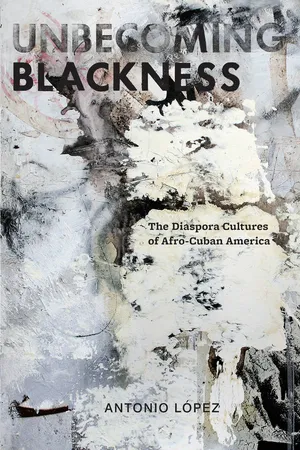
In Unbecoming Blackness, Antonio López uncovers an important, otherwise unrecognized century-long archive of literature and performance that reveals Cuban America as a space of overlapping Cuban and African diasporic experiences.
López shows how Afro-Cuban writers and performers in the U.S. align Cuban black and mulatto identities, often subsumed in the mixed-race and postracial Cuban national imaginaries, with the material and symbolic blackness of African Americans and other Afro-Latinas/os. In the works of Alberto O'Farrill, Eusebia Cosme, Rómulo Lachatañeré, and others, Afro-Cubanness articulates the African diasporic experience in ways that deprive negro and mulatto configurations of an exclusive link with Cuban nationalism. Instead, what is invoked is an "unbecoming" relationship between Afro-Cubans in the U.S and their domestic black counterparts. The transformations in Cuban racial identity across the hemisphere, represented powerfully in the literary and performance cultures of Afro-Cubans in the U.S., provide the fullest account of a transnational Cuba, one in which the Cuban American emerges as Afro-Cuban-American, and the Latino as Afro-Latino.
- 282 pages
- English
- ePUB (mobile friendly)
- Available on iOS & Android
eBook - ePub
About this book
Information
Topic
Ciencias socialesSubtopic
Alfabetización1 / Alberto O’Farrill: A Negrito in Harlem
In an April 1929 edition of the Diario de la Marina, two essays appeared side by side in “Ideales de una Raza”: “El teatro cubano” (Cuban Theater), published by Gustavo Urrutia in “Armonías,” and “El camino de Harlem” (The Road to Harlem) by Nicolás Guillén. In “Teatro,” Urrutia calls for a “modern Cuban theater” in which actors and actresses of “our race” (nuestra raza) would appear in roles as “cultured and patriotic blacks [negros cultos y patriotas], full of dignity.” Urrutia hopes such a theater would challenge not only the contemporary Cuban blackface stage but also the influence of other dramatic works whose settings “in slavery” seem particularly “belated” (tardía) and possibly even “harmful to the harmony of the two Cuban races [las dos razas cubanas].” Advocating on behalf of “Cuba’s colored race” (la raza de color en Cuba) is also the idea behind Guillén’s “Camino.” Guillén cites incidents across the island in which “whites and blacks [los blancos y los negros] stroll on public streets” within separate spaces, the “violation of which by anyone,” but “most of all by blacks, gives rise to true conflicts.” Cuba, he warns, might soon develop a specific, unwanted characteristic of “certain Yankee regions [ciertas regiones yankees],” a “‘black neighborhood’ [“barrio negro”]” in each of its cities and towns. “That,” he concludes, “is the road to Harlem”: a movement toward U.S.-style segregation, the notion of which is intensified in the translation of “El camino de [of] Harlem” into “The Road to Harlem.”1
The link between race, modern theater aesthetics, and hemispheric space matters in Urrutia and Guillén introduces the broad theme of the first part of this book: the movement of performance and print cultures from Cuba to the United States among Afro-Cubans between the 1920s and 1940s. Afro-Cuban actors, poetry reciters, and literary journalists in the United States challenge Guillén’s “barrio negro” as a primary metaphor for the Afro-Cuban apprehension of segregated Anglo-U.S. geographies, producing instead their own Afro-Latino representations of the experience of race (and spatialization) in the United States, one in which they risk an identification as African-diasporic subjects. The texts of a U.S. “barrio afrolatino,” against Guillén’s island-oriented barrio negro, invoke the spatial and temporal multiplicity specific to the modern performance and print cultures of Afro-Cubans in the United States: the many overlapping periods and barrios of African American, Afro-Latino, and Jewish Harlems, as we shall see, along with their institutional locations in theaters, social clubs, and university halls, as well as in print genres such as the newspaper review and the chronicle.2 In such an Afro-Latino reconception of the barrio negro, the multiple negros/as of African diaspora in the United States overlap with early twentieth-century discourses on Cuban race: postracial notions of a Cuba in which “racial differences [are] irrelevant,” counterstrategies among “black and mulatto activists [and intellectuals]” of using “‘blackness’ as a political category,” and mestizaje ideas “in literary, artistic, and touristic circles.”3 In a U.S. barrio afrolatino, in other words, Afro-Cuban writers and performers articulate Cuban race and nation—and, in particular, the Cuban negra/o, mulata/o, and raza de color4—with the U.S. Negro, colored, and black; the “West Indian”; and other afrolatinidades, in particular that of mainland Afro–Puerto Ricans.
Afro-Cuban writers and performers were a part of the larger Cuban migrations of the 1930s and 1940s to the United States, migrations that “were smaller in number than the pre-1898 and post-1959 migrations” yet “significant…because they attracted not only Afro-Cuban political migrants but also economic migrants who tended to settle in large urban areas like New York City.”5 These Afro-Cubans left the island around a time of ongoing struggles over racial justice that overlapped with the Great Depression and the violence of the Machado dictatorship (including its overthrow with the revolution of 1933), and they encountered on arrival in New York City a shifting Latino scene: whereas at the turn of the century, Puerto Ricans, Cubans, Spaniards, and others of Latin American descent lived in the vicinity of cigar factories in the Lower East Side and Chelsea, by the middle of the 1920s, Latino New York City was primarily Puerto Rican and working class in population, with communities located along the Brooklyn waterfront and, in “the largest and most significant of all the inter-wars settlements,” in Harlem, from 110th Street to 125th Street between Fifth Avenue and Manhattan Avenue, including blocks on the East Side stretching down to 90th Street.6 Latinas/os in New York City participated in local labor and civil-rights activism, and they engaged in global politics critical of the Machadato in Cuba and of U.S. imperialism in Puerto Rico and Nicaragua. Support among them for the Republican side during the Spanish Civil War was significant, too.7
In what follows, I discuss the careers of two figures in the performance and print cultures of Afro-Cubans in the early twentieth-century United States: Alberto O’Farrill (in the present chapter) and Eusebia Cosme (in chapter 2). O’Farrill was a blackface actor in the teatro bufo, a genre of Cuban theater in which he performed in New York City, beginning in the mid-1920s. O’Farrill himself wrote bufos and was a contributor of literary-journalistic writing to the Harlem-based, Spanish-language weekly El Gráfico, of which, for a time, he was a director. He also appeared in the 1935 film No matarás (Mi hermano es un gangster) (Thou Shalt Not Kill [My Brother is a Gangster]), produced on location in Harlem and in studios in Hollywood by Miguel Contreras Torres, the Mexican director. Cosme was a major performer of “poesía negra” (black poetry), a poetic movement emerging in the late 1920s whose writers, predominantly mulatos and white men from the Hispanophone Caribbean, drew on representations of musical, religious, and spoken-language expression among working-class Afro-Cubans (and other Hispanophone, African-diasporic people) to imagine a poetry both modern and “authentic” to the region. Cosme arrived in New York City in 1938, and she continued performing poesía negra and other verse forms, both on stage and over the radio across CBS’s Cadena de las Américas (Network of the Americas). In later years, she had roles in theater and film, including Sidney Lumet’s The Pawnbroker (1965).
I argue in these two opening chapters that the careers of O’Farrill and Cosme, once lost but now the objects of recovery through the archive, research, and publication, reveal a late, untimely logic—a “belatedness”—that constitutes the literary and performance cultures of Afro-Cubans in the United States in the early twentieth century. Such a genealogy of Afro-Cuban American literature and performance between 1898 and 1959 reflects a postcolonial understanding of temporality: of the way in which the colonized, imputed a premodern “pastness” by the colonizer, responds with a consciousness of his or her own alternative historicity, one that exists in a coeval (and, thus, critical) relation with the modernity and coloniality of time.8 The fragments arrachés of O’Farrill and Cosme, collected in the archive, engage belatedness in ways that depart from Urrutia’s claim in “El teatro cubano” that the representation of slavery on the Cuban stage is negatively tardía and thus worthy of rejection. For O’Farrill, it is blackface theater’s very belatedness during the period, politically and artistically, that, far from rejecting, he engages—an engagement influenced by O’Farrill’s limited career prospects as an Afro-Cuban actor and refracted in his writings in Gráfico, which emerges as a site of what I call an Afro-Cuban blackface print culture, a material and discursive space in which O’Farrill explored the limits of a raza hispana (Hispanic race) ideology. For Cosme, engaging poesía negra, itself belated politically and artistically after 1938, indexes her own professional vulnerability as an African-diasporic woman working in performance; it structures, too, the commonplace that she was the greatest intérprete of poesía negra, which underscores a tension in the Spanish-language definition of “interpreter” between Cosme’s role, on the one hand, as a performer of the poetry of mulato and white men and, on the other, as a hermeneut with the authority to analyze and revise the texts of these self-same poets—a tension with Cosme around race, gender, interpretation, and authorship that, as we shall see in the next chapter, well describes the scholar’s fraught encounter with the fragments arrachés of her archive at the Schomburg Center for Research in Black Culture. Now, however, I consider in detail such issues in an Afro-Cuban American literary and performance history by turning to the career and texts of Alberto O’Farrill, beginning with the circumstances of his U.S. arrival.
The “African,” the Bufo, and Blackface Print Culture
In September 1925, Alberto Heliodoro O’Farrill Gavito arrived in Key West, Florida, from Havana, Cuba, aboard the SS Governor Cobb. Several decades removed from Key West’s history as a Cuban center with an active role in the independence movement, it was still a town with a Cuban presence. The ship’s “List or Manifest of Alien Passengers” states that O’Farrill was a twenty-six-year-old man from the town of Santa Clara; his “nationality (Country of which citizen or subject)” was “Cuba.” O’Farrill was one of only two “alien” passengers on the ship that day. His “calling or occupation” was “photographer,” which was written in hand over the typed word “mer[chant].” The manifest also attested to his literacy: he could read and write in Spanish. O’Farrill’s last permanent residence was on the Calzada de Jesús del Monte in Havana, and his final destination was New York City. Also in the manifest was a column entitled “Race or people,” which included a footnote: “List of races will be found on the back of this sheet.” The other “alien” passenger aboard the Governor Cobb that day, himself a “citizen or subject” of Cuba, was a certain Luis Alfaro, who was identified under “Race or people” as “Cuban.” The way in which O’Farrill, also a “citizen or subject” of Cuba, was himself identified under “Race or people” is another matter, one which invests his very arrival in the United States with the contradictions of race and nation in the Americas: under “Race or people,” the manifest listed O’Farrill as “African.”9
Upon O’Farrill’s Key West arrival, therefore, he encountered U.S. racialization as an African-diasporic migrant from Cuba. Unlike his fellow passenger, a “Cuban” twice over in terms of “nationality” and “race or people”—a doubling with multiple implications: it subsumes Cuban whiteness under “Cuban race”; it affirms, however unintentionally, the notion of a postracial “Cuban people”—O’Farrill’s identity is both Cuban and excessive to Cuba: he is a “citizen or subject” of the Cuban nation-state who also belongs to an “African race,” an “African people.” As an “African,” O’Farrill’s identity aligns with African American histories of U.S. “naturalization,” particularly those in which the term “African” signifies identities in legal regimes such as the postbellum Nationality Act, which granted “the right to naturalize to ‘persons of African nativity or descent,’” even as such “persons” continued to live with “the social stigma and unequal status associated with blackness.”10 An “African” identity thus invokes histories of (il)legal U.S. inclusion and exclusion framed by the way “race and nationality disaggregated and realigned in new and uneven ways” during the period.11 It is such an “African” identity that marks O’Farrill’s difference as an Afro-Cuban migrant in the United States.
Also coming to Key West that September was the Arango-Moreno theater company, led by two white men, Guillermo Moreno and Rafael de Arango. The Arango-Moreno was a Cuban blackface company. The coincidence is striking. In the 1930s, O’Farrill would appear on the New York City stage with Moreno. Now, however, having just arrived in the United States—in all likelihood to improve his chances of working in Cuban blackface—O’Farrill would have found in the visiting Arango-Moreno an occasion to consider the relation between Cuban racial identity and theatrical career opportunities, particularly if he came across a copy of Florida: Semenario Independiente, a Key West newspaper touting the upcoming performances with a full-body photograph of de Arango himself, in blackface, with a caption inviting “the people of Key West to the big event tomorrow, Sunday, at the San Carlos” hall.12 De Arango was an important Cuban blackface actor of the early twentieth century, belonging in a list that begins with Arquímedes Pous and includes, among others, white Cuban men such as Sergio Acebal, Ramón Espígul, and Enrique “Bernabé” Arredondo.13 Indeed, blackface roles in Cuban theater were almost exclusively “played by white actors,” an element in the political economy of Cuban blackf...
Table of contents
- Title Page
- Copyright Page
- Contents
- Acknowledgments
- Introduction
- 1 / Alberto O’Farrill: A Negrito in Harlem
- 2 / Re/Citing Eusebia Cosme
- 3 / Supplementary Careers, Boricua Identifications
- 4 / Around 1979: Mariel, McDuffie, and the Afterlives of Antonio
- 5 / Cosa de Blancos: Cuban American Whiteness and the Afro-Cuban-Occupied House
- Conclusion: “Write the Word Black Twice”
- Notes
- About the Author
Trusted by 375,005 students
Access to over 1.5 million titles for a fair monthly price.
Study more efficiently using our study tools.
Frequently asked questions
Yes, you can cancel anytime from the Subscription tab in your account settings on the Perlego website. Your subscription will stay active until the end of your current billing period. Learn how to cancel your subscription
No, books cannot be downloaded as external files, such as PDFs, for use outside of Perlego. However, you can download books within the Perlego app for offline reading on mobile or tablet. Learn how to download books offline
Perlego offers two plans: Essential and Complete
- Essential is ideal for learners and professionals who enjoy exploring a wide range of subjects. Access the Essential Library with 800,000+ trusted titles and best-sellers across business, personal growth, and the humanities. Includes unlimited reading time and Standard Read Aloud voice.
- Complete: Perfect for advanced learners and researchers needing full, unrestricted access. Unlock 1.5M+ books across hundreds of subjects, including academic and specialized titles. The Complete Plan also includes advanced features like Premium Read Aloud and Research Assistant.
We are an online textbook subscription service, where you can get access to an entire online library for less than the price of a single book per month. With over 1.5 million books across 990+ topics, we’ve got you covered! Learn about our mission
Look out for the read-aloud symbol on your next book to see if you can listen to it. The read-aloud tool reads text aloud for you, highlighting the text as it is being read. You can pause it, speed it up and slow it down. Learn more about Read Aloud
Yes! You can use the Perlego app on both iOS and Android devices to read anytime, anywhere — even offline. Perfect for commutes or when you’re on the go.
Please note we cannot support devices running on iOS 13 and Android 7 or earlier. Learn more about using the app
Please note we cannot support devices running on iOS 13 and Android 7 or earlier. Learn more about using the app
Yes, you can access Unbecoming Blackness by Antonio Lopez in PDF and/or ePUB format, as well as other popular books in Ciencias sociales & Alfabetización. We have over 1.5 million books available in our catalogue for you to explore.