Extraordinary changes in patterns of family life—and family law—have dramatically altered the boundaries of parenthood and opened up numerous questions and debates. What is parenthood and why does it matter? How should society define, regulate, and support it? Is parenthood separable from marriage—or couplehood—when society seeks to foster children’s well-being? What is the better model of parenthood from the perspective of child outcomes?
Intense disagreements over the definition and future of marriage often rest upon conflicting convictions about parenthood. What Is Parenthood? asks bold and direct questions about parenthood in contemporary society, and it brings together a stellar interdisciplinary group of scholars with widely varying perspectives to investigate them. Editors Linda C. McClain and Daniel Cere facilitate a dynamic conversation between scholars from several disciplines about competing models of parenthood and a sweeping array of topics, including single parenthood, adoption, donor-created families, gay and lesbian parents, transnational parenthood, parent-child attachment, and gender difference and parenthood.
eBook - ePub
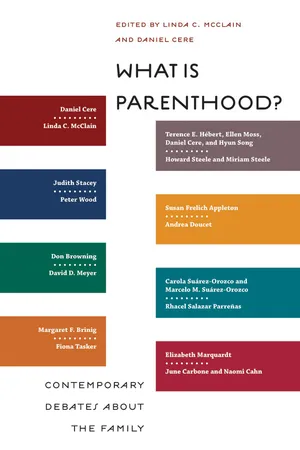
What Is Parenthood?
Contemporary Debates about the Family
- 405 pages
- English
- ePUB (mobile friendly)
- Available on iOS & Android
eBook - ePub
What Is Parenthood?
Contemporary Debates about the Family
About this book
Information
What Is Parenthood?
Proposing Two Models
CHAPTER ONE
Toward an Integrative Account of Parenthood
Attachment theory and evolutionary kinship theory offer powerful and comprehensive theoretical accounts of the complex domain of human parenthood. Attachment theory emerged as a contribution to evolutionary psychology, but these trajectories of research had drifted apart. In recent years there have been efforts to reconnect these fertile explanatory approaches. This chapter discusses developments in these fields, what they suggest about the complex nexus of kin relationships and primal attachments, and how these findings may resonate with integrative lines of argument. The final section discusses tensions between the diversity and integrative approaches to parenthood and their implications for law and policy.
Integrative Attachments
Plato’s Republic envisages a human society in which child care is fully disconnected from parenthood, allowing adult male and female progenitors to pursue their interests and careers freed from the burden of daily parental responsibilities. For Plato, the private (idion) realm of the familial is a dense domain filled with strong idiosyncratic passions and loyalties not easily ordered by the universal standards of justice.1 The Republic argues for the deconstruction of this private sphere and its reorganization on transparent principles of rational justice. The nepotism of familial relationships must be replaced by an extensive system of public institutions dedicated to child care and rearing.
Modern culture has been the site for numerous experiments attempting to realize some version of this Platonic project. One significant example is the Israeli kibbutz experiment. Two key objectives of the kibbutz project were, first, an attempt to loosen the connection between the breeding and nurturing dimensions of parenthood and, second, the promotion of gender equality in the division of labor. Shepher and Tiger’s classic study Women in the Kibbutz documents the diverse ways in which this experiment seemed to run up against entrenched features of human bonding. Despite the centrality of these child-rearing arrangements to the communal experiment, kibbutzim women demanded reversion to forms of mother-child attachment found in most, if not all, human societies.2
Jewish maternal resistance to this experiment in comprehensive child care could look to an influential body of research for support. Attachment theory has emerged as one of the most influential theories in contemporary psychology. Bowlby’s early research on the disastrous effects of fragmented institutionalized child care led to a new awareness of the decisive importance of close attachment bonds for child development.3 Ainsworth’s fieldwork in Uganda underscored the cross-cultural significance of this emerging body of theory.4 Decades later the legacy of Romania’s institutionalized child care regime provided tragic data for extensive research into the traumatic impact of severe attachment deprivation and evidence for many of the basic claims of attachment theory.5
Attachment theory has its critics. One regular line of critique argues that attachment theory is an ideological paradigm that reflects the concerns of Western middle-class parenting culture.6 However, an increasing body of interdisciplinary evidence points to the cross-cultural patterns of attachment. Primatological studies have underscored the applicability of attachment theory to non-human primates. The evidence points to the validity of a thick core of claims in attachment theory including the following:
1. the universal need of infants to become attached to a primary caregiver;7
2. the high degree of maternal sensitivity to an infant’s attachment signals;8
3. elevated and enduring patterns of infant attachment behavior and maternal sensitivity in the higher primates;9
4. the high degree of infant sensitivity to changes in psychosocial attachments;10
5. the biological, hormonal, genetic, and epigenetic dimensions of social bonding;11
6. the significance of attachment security for competencies in cognitive, emotional, and social development;12
7. cross-cultural evidence for similar patterns of secure, insecure, and disorganized attachments;13 and
8. the correlation of childhood attachment disorders to a number of adolescent and adult psychopathologies.14
A powerful set of research techniques have begun to uncover the biochemical interactions involved in maternal-infant attachments and the processes that regulate gene expression in the early development of infants.15 This research has linked attachment theory to a system of gene regulation known as epigenetics.16 Maternal-infant attachment bonds trigger epigenetic changes that initiate “long-term developmental effects lasting into childhood.”17
There is a growing scientific consensus that early attachment bonds have long-term consequences across the life span.18 Low attachment bonds result in heightened startle and defense responses, more intense responses to stress, and early, increased sexual activity—response patterns suitable to hostile unpredictable environments. Secure bonds result in a capacity for more explorative responses to novelty, lower levels of stress, and slower sexual development—traits suited to stable environments that offer diverse resources and opportunities.19 Because attachment patterns typically reappear in future pair-bonding and parenting styles of these secure or insecure infants, they can, and regularly do, have a transgenerational impact. The impact of a mother’s high or low attachment patterns is passed on to her daughters, shaping their future maternal responses. In short, patterns of parent-infant attachments are biologically encoded at the epigenetic level with long-term significance for adult attachments and, possibly, for their offspring.20
As evidence accumulated, Bowlby concluded that the formation of secure attachments occurs across the human life span.21 According to Zeifman and Hazan, secure childhood bonds predispose individuals to develop stable attachments in adult relationships. Long-term pair-bonds anchor familial stability, enhance mutual support and parental collaboration, and tend to be associated with more secure attachments to the offspring of these pair-bonds. Individuals who have experienced stable attachments are more likely to adopt the committed long-term mating strategies important to reproductive success.22
Attachment theory’s success in highlighting the crucial importance of attachment for human development, and the new discoveries into the biological mechanisms of attachment theory, raise some serious concerns. The social web of care for children emerges as the first and most fundamental developmental challenge for human relationships. This research has implications for law and public policy. There appears to be significant convergence on a substantive set of principles across lines of debate on parenthood:
• first, that children have a basic right to close, secure attachments with primary caregivers;
• second, that adults who are in relationships of parental responsibility for children have a duty to respond to their basic attachment needs;
• third, that society and the state should work to provide social, economic, and institutional contexts that facilitate and support, rather than erode or undermine, the capacity of adult caregivers to meet the basic attachment needs of children;
• fourth, there is a need to work toward the elimination of forms of child care that contribute to serious attachment deprivation.
Michael Rutter notes that attachment theory has already played a significant role in a number of major policy developments. Its findings contributed to the turn from institutionalized orphanages as the first-choice solution for children who have lost connection to parental caregivers. It has also contributed to changes in hospital practices dealing with children in situations of extended care.23
However, beyond these areas of convergence on some core principles and practices, there would be disagreement. To highlight the fluidity and elasticity of parenting arrangements, proponents of diversity emphasize the performative or functional character of attachment bonds. In this view, quality attachments are the result of good parenting practices. Performance is not tied to particular maternal or paternal kin-connected bonds. Adoptive parents, stepparents, foster parents, or same-sex caregivers should be able to perform the caregiving functions required to meet children’s attachment needs.24 Diversity proponents argue that the processes of attachment observed in secure mother-child bonds could also be provided by other consistent caregiving adults genetically unrelated to the child.25 Highlighting the central significance of a particular form of parental attachment such as the “maternal-child” bond amounts to a form of essentialism that constrains the range of parenting possibilities and throws certain forms of parenting under a cloud of suspicion.
The integrative approach, in contrast, would have fewer reservations about highlighting the salience of particular parental bonds for the attachment needs of children. For example, it would be more willing to entertain evidence from primatology, evolutionary psychology, and attachment theory that points to the near-universal role of maternal-child ties as the primary attachment bond. Evolutionary psychology argues that across species females are far more likely than males to care for, invest in, and bond with their offspring.26 As they move through gestation and birth, biological mothers are hormonally primed for parental sensitivity, investment, and attachment in ways that other adults are not.27 These factors nudged Bowlby to suggest that the “elementary social unit” of our evolutionary development is the mother-child bond—and perhaps uterine bonds with her daughter’s children (allomaternal)—rather than the co-parental bond.28
In contrast, Sarah Hrdy’s anthropological account of maternal caregiving seems supportive of a diversity line of argument.29 She highlights the complexity of kinship systems and the significance of “fictive” or “manufactured” kinship and emphasizes “the advantages of casting the net of kinship as widely as possible.”30 She questions the significance of genetic relationship for parental attachment.31 Hrdy shares the Dutch primatologist Frans De Waal’s fascination with the free-flowing mating and parenting styles of primates like the bonobos and the marmosets. Both scholars find these intensely promiscuous, sexually energized and good-natured primates far more attractive as fellow travelers in ...
Table of contents
- Cover Page
- Title Page
- Copyright Page
- Contents
- Acknowledgments
- Introduction
- Part I: What Is Parenthood? Proposing Two Models
- Part II: Institutions Is Parenthood Separable from Marriage (or Couplehood) When It Comes to Fostering Child Well-Being?
- Part III: Rights What Rights Are at Stake? How Should the Rights of Adults and Children Shape the Law of Parenthood?
- Part IV: Child Outcomes and Forms of Parenthood: Does One Model Produce, on Average, Better Outcomes for Children? For Society?
- Part V: Attachment (How Much) Does Biology Matter?
- Part VI: Gender Equality, Gender Difference, and Parenthood: Are There Gender Differences in Parenting? Should Difference Make a Difference?
- Part VII: Globalization and Parenthood: How Do Family Immigration and Transnational Parenting Shape Parenthood? How Should They Inform Debates over Parenthood?
- Part VIII: Now What? Given Current Indicators, Can the “Toothpaste Go Back in the Tube”? Should It?
- Epilogue
- About the Contributors
- Index
Trusted by 375,005 students
Access to over 1.5 million titles for a fair monthly price.
Study more efficiently using our study tools.
Frequently asked questions
Yes, you can cancel anytime from the Subscription tab in your account settings on the Perlego website. Your subscription will stay active until the end of your current billing period. Learn how to cancel your subscription
No, books cannot be downloaded as external files, such as PDFs, for use outside of Perlego. However, you can download books within the Perlego app for offline reading on mobile or tablet. Learn how to download books offline
Perlego offers two plans: Essential and Complete
- Essential is ideal for learners and professionals who enjoy exploring a wide range of subjects. Access the Essential Library with 800,000+ trusted titles and best-sellers across business, personal growth, and the humanities. Includes unlimited reading time and Standard Read Aloud voice.
- Complete: Perfect for advanced learners and researchers needing full, unrestricted access. Unlock 1.5M+ books across hundreds of subjects, including academic and specialized titles. The Complete Plan also includes advanced features like Premium Read Aloud and Research Assistant.
We are an online textbook subscription service, where you can get access to an entire online library for less than the price of a single book per month. With over 1.5 million books across 990+ topics, we’ve got you covered! Learn about our mission
Look out for the read-aloud symbol on your next book to see if you can listen to it. The read-aloud tool reads text aloud for you, highlighting the text as it is being read. You can pause it, speed it up and slow it down. Learn more about Read Aloud
Yes! You can use the Perlego app on both iOS and Android devices to read anytime, anywhere — even offline. Perfect for commutes or when you’re on the go.
Please note we cannot support devices running on iOS 13 and Android 7 or earlier. Learn more about using the app
Please note we cannot support devices running on iOS 13 and Android 7 or earlier. Learn more about using the app
Yes, you can access What Is Parenthood? by Linda C. McClain,Daniel Cere, Linda C. McClain, Daniel Cere in PDF and/or ePUB format, as well as other popular books in Law & Law Theory & Practice. We have over 1.5 million books available in our catalogue for you to explore.