An illuminating exercise that challenges the reader's beliefs about the justice system
A police trooper inspects a car during a routine traffic stop and finds a vast cache of weapons, complete with automatic rifles, thousands of rounds of ammunition, and black ski masks-a veritable bank robber's kit. Should the men in the car be charged? If so, with what?
A son neglects to care for his elderly mother, whose emaciated form is discovered shortly before she dies a painful death. Is the son's neglect punishable, and if so how?
A career con man writes one bad check too many and is sentenced to life in prison-for a check in the amount of $129.75. Is this just?
A thief steals a backpack, only to find it contains a terrorist bomb. He alerts the police and saves lives, transforming himself from petty criminal to national hero.
These are just a few of the many provocative cases that Paul Robinson presents and unravels in Would You Convict?
Judging crimes and meting out punishment has long been an informal national pasttime. High-profile crimes or particularly brutal ones invariably prompt endless debate, in newspapers, on television, in coffee shops, and on front porches. Our very nature inclines us to be armchair judges, freely waving our metaphorical gavels and opining as to the innocence or guilt-and suitable punishment-of alleged criminals.
Confronting this impulse, Paul Robinson here presents a series of unusual episodes that not only challenged the law, but that defy a facile or knee-jerk verdict. Narrating the facts in compelling, but detached detail, Robinson invites readers to sentence the transgressor (or not), before revealing the final outcome of the case.
The cases described in Would You Convict? engage, shock, even repel. Without a doubt, they will challenge you and your belief system. And the way in which juries and judges have resolved them will almost certainly surprise you.
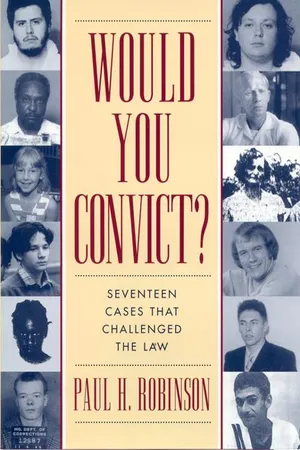
- 329 pages
- English
- ePUB (mobile friendly)
- Available on iOS & Android
eBook - ePub
About this book
Trusted by 375,005 students
Access to over 1.5 million titles for a fair monthly price.
Study more efficiently using our study tools.
Information
1
Punishing Intent, Harm, or Dangerousness?
WHAT SHOULD THE criminal law focus on when it assigns punishment? A person’s mental state? (What was the person’s purpose? Were the conduct and its consequences intentional or accidental?) Whether there was actual harm? (Did the harm or evil defined by the offense actually occur, or did the person just intend or risk it?) Whether the person is dangerous? (Was this offense an aberration of character, or, if released, will the person commit another offense?) Are all these factors—intent, harm, and dangerousness—relevant? If so, how and when? What effect should they have? And how do they relate to one another?
The three cases that follow ask you for your answer to these questions, and sketch the law’s answers. They also reveal some serious inconsistencies in the law’s response, serious enough to suggest that what is needed is a rethinking of the nature and goals of modern criminal law.
ARE EVIL INTENTIONS A CRIME?
On a night in late October 1993, Sergeant Ian Grimes is patrolling in an unmarked car in Glendale, a suburb northwest of Los Angeles. A Thunderbird squeals its tires as it pulls out of a gas station and speeds north on Pacific Avenue toward the Ventura Freeway. Grimes gives chase and pulls the car over, for speeding, before it reaches the freeway on-ramp. He approaches the passenger side and talks to the driver through the passenger window. The driver gives the name “Dennis Franks,” but has no license, claiming he left it at home. In response to Grimes’s questioning, the driver seems confused about his home address. The passenger explains that the car belongs to the driver’s mother, but Grimes has already learned over his radio that it is a rental car from the airport. He directs the driver to step out and stand at the right rear of the car, where he can see both men as he talks further to them. Both are big. The driver is six feet, 210 pounds; the passenger, six feet, 340 pounds.

Left : Larry Eugene Phillips. (Archive Photos)

Right: Emil Matasareanu. (Archive Photos)
The driver stands in an odd way as he talks, holding his body at an angle. He claims not to be armed, but Grimes realizes the man’s odd stance is to make his shirt hang over and hide a nine-millimeter Glock 17 in his waistband. Grimes takes the weapon and backs up, taking cover behind a nearby planter on the sidewalk. The driver won’t respond to Grimes’s commands, nor for a moment will the passenger. Finally, Grimes hears a “clonk,” which turns out to be the passenger dropping a Glock that he was holding. The passenger puts his hands out the window and Grimes holds the two in that position until backup arrives.
A search of the car reveals the following:
• one Norinco folding stock, semiautomatic rifle
• one MAK 90 wood-stock, semiautomatic rifle
• one Springfield Armory .45 pistol
• one Colt .45 pistol
• 1,649 rounds of 7.62 x 39 mm ammo, most loaded into 40-round magazines, taped three-together
• three seventy-five-round drum magazines loaded with 7.62 x 39 mm ammo
• 967 rounds of 9 x 19 mm JHP ammo
• 357 rounds of .45 JHP ammo
• six smoke bombs
• two improvised explosive devices
• one gas mask
• two sets of National Body Armor Level III-A vests
• two 200-channel, portable, programmable scanners with ear-pieces
• sunglasses, gloves, wigs, ski masks, stopwatch
• two spray cans of gray Studio Hair Color
• three different California automobile license plates
• $1,620 cash
The driver initially refuses to answer questions, but is subsequently identified as twenty-three-year-old Larry Eugene Phillips. The passenger is twenty-seven-year-old Emil Dechebal Matasareanu.
At the station, the men explain their load of weapons by telling police they are on their way to a shooting range in the Angeles National Forest known as “Kentucky.” It is just before Halloween, “Devil’s Night.” The disguises and other material may be needed for a Halloween party after the shooting range.

Top The Glendale Police Department and bomb squad investigate the red Ford Thunderbird. (Gene Blevins, Los Angeles Daily News)

Top Two semiautomatic assault rifles found in the trunk of the red Ford Thunderbird that Larry Phillips was driving. (Gene Blevins, Los Angeles Daily News)

Bottom: 200-channel programmable police scanners and gloves found by Sergeant Ian Grimes and the Glendale Police Department. (Gene Blevins, Los Angeles Daily News)

Evidence room at the Glendale Police Department where the contents of the red Ford Thunderbird were laid out. (Gene Blevins, Los Angeles Daily News)
The police, and later the prosecutors, have little doubt the police have stumbled onto two robbers on their way to a job. The arsenal and supplies are a classic “bank robbery kit.”
The two men are probably liable for at least some weapons offenses. (Their assault rifles are not at the time illegal in California.) Should the two also be held criminally liable for attempted robbery? If so, what amount of punishment would you impose for attempted robbery?
| no liability |  |
| liability but no punishment | |
| 1 day | |
| 2 weeks | |
| 2 months | |
| 6 months | |
| 1 year | |
| 3 years | |
| 7 years | |
| 15 years | |
| 30 years | |
| life imprisonment | |
| death | |
(In answering this and similar liability questions throughout the book, if you would impose a punishment other than imprisonment—a fine or community service—translate that sentence into a term of imprisonment of equivalent punitive bite, in order to allow easier comparison of assigned punishments.)
People’s Intuitions of Justice
Few people are likely to believe Phillips’s story that the two are on their way to a shooting range and then a Halloween party. Homemade explosives? Police scanners? Stopwatch and gloves? It doesn’t fit. And unless they are going to be shooting at each other at the party, why bulletproof vests? Clearly these folks are up to something bad. That the items together make what the experts call a “bank robbery kit” only confirms the suspicion.
At the same time, most people faced with these facts seem hesitant to hold Phillips liable for attempted robbery or conspiracy to rob. Rob what? Where? When? We know nothing about what the two specifically intend. Another concern is how real the intention is. Even if the two had a plan, would they really have done it, or is this a Walter Mitty pair who has watched too many television shows? Was their intention sufficiently formed and resolute that they really would have gone ahead with a robbery if they had gotten to a bank or whatever their target was?
Even if the intent to rob was clear, people typically have a sense that a person must do enough toward committing the offense for it to count as a crime. Bad intention may be enough for sin, in a religious sense, but criminal liability requires sufficient conduct toward the offense.
In one Mississippi case, a burglar was caught with a list in his pocket of items needed for the burglary, in an envelope conveniently labeled “Preparations for a Burglary.” Assume Phillips had such a “Preparations for a Robbery” envelope, so his intention was clear. Would it make this case clear, or would we still have some concern that these two would-be robbers still have not done enough to make a crime? They have raised strong suspicion, but has it matured into proof of a crime?
Several hundred people have been given the facts of this case (and all the cases in this book) and been asked to sentence the defendant using the same scale that you were given above. Here is how the people in the survey sentenced Phillips:
| no liability | 59% |
| liability but no punishment | 3% |
| 1 day | — |
| 2 weeks | — |
| 2 months | 1% |
| 6 months | 2% |
| 1 year | 7% |
| 3 years | 19% |
| 7 years | 4% |
| 15 years | 4% |
| 30 years | — |
| life imprisonment | — |
| death | — |
| Mean = 2.4 weeks. |
Even on such suspicious facts, 59 percent of the people would not impose liability for attempted robbery.
The Law’s Rules
The intuitions of this majority match the law’s high requirements. The law requires proof of both an intention to commit the offense beyond a reasonable doubt and sufficient conduct toward commission of the offense. The facts of this case—carrying a robbery kit and giving a doubtful explanation—do not present a strong case for attempt liability.
Jurisdictions disagree as to how much conduct is enough. Some require that the person be in “dangerous proximity” of committing the offense—that he present an imminent threat. Others require only that the person has taken a “substantial step” toward its commission. Most of the legal requirements for minimum conduct are vague, like these two. Thus, when juries are given legal instructions, they probably just express their own intuitive sense of how much is enough.
Why such intention and minimum conduct requirements for criminal liability? Our intuitive notions of justice typically don’t see thinking bad thoughts, or even acting on them in a preliminary way, as sufficient to be criminal. Most people seem to feel that punishment is deserved only when, first, the intention is sufficiently developed and firm and, second, the person has come sufficiently close to committing the offense.
Background
Larry Eugene Phillips, born on September 9, 1970, gets his first exposure to the life of crime on his sixth birthday, when the FBI knocks on the door of the family home in Denver. Before Larry’s eyes, they arrest his father, Larry, Sr., who has been a fugitive from a Colorado prison since his son’s birth. A few years later Larry’s mother, Dorothy Clay, finalizes a divorce and moves with her son to a suburb of Los Angeles. His mother is no stranger to crime, once serving ten years for drug possession and stabbing a prison guard. At the age of nineteen, Phillips gets arrested for the first time after stealing four hundred dollars from a Sears store in Alhambra, California.
Phillips and Emil Dechebal Matasareanu meet in 1989 and quickly become friends. They both enjoy weapons and like to go shooting together. Although four years the younger, Phillips, controlling and manipulative, becomes the duo’s leader. “You can’t imagine how manipulative my brother was,” explains Phillips’s half-brother later. “He tried to break your mind down and then build it up again so that you would become one of his crew.”
Phillips, a clean-shaven bodybuilder, dreams incessantly of wealth, fantasizing about spending one hundred-dollar bills by the handful. He idolizes the ...
Table of contents
- Cover Page
- Title Page
- Copyright Page
- Contents
- Acknowledgments
- Prologue
- 1 Punishing Intent, Harm, or Dangerousness?
- 2 Knowing the Law’s Commands
- 3 Can Committing a Crime Be Doing the Right Thing?
- 4 Can Doing the Wrong Thing Ever Be Blameless?
- 5 Martyrs for Our Safety
- Epilogue
- Appendix: Governing Law, Then and Now
- Index
- About the Author
- Footnotes
Frequently asked questions
Yes, you can cancel anytime from the Subscription tab in your account settings on the Perlego website. Your subscription will stay active until the end of your current billing period. Learn how to cancel your subscription
No, books cannot be downloaded as external files, such as PDFs, for use outside of Perlego. However, you can download books within the Perlego app for offline reading on mobile or tablet. Learn how to download books offline
Perlego offers two plans: Essential and Complete
- Essential is ideal for learners and professionals who enjoy exploring a wide range of subjects. Access the Essential Library with 800,000+ trusted titles and best-sellers across business, personal growth, and the humanities. Includes unlimited reading time and Standard Read Aloud voice.
- Complete: Perfect for advanced learners and researchers needing full, unrestricted access. Unlock 1.5M+ books across hundreds of subjects, including academic and specialized titles. The Complete Plan also includes advanced features like Premium Read Aloud and Research Assistant.
We are an online textbook subscription service, where you can get access to an entire online library for less than the price of a single book per month. With over 1.5 million books across 990+ topics, we’ve got you covered! Learn about our mission
Look out for the read-aloud symbol on your next book to see if you can listen to it. The read-aloud tool reads text aloud for you, highlighting the text as it is being read. You can pause it, speed it up and slow it down. Learn more about Read Aloud
Yes! You can use the Perlego app on both iOS and Android devices to read anytime, anywhere — even offline. Perfect for commutes or when you’re on the go.
Please note we cannot support devices running on iOS 13 and Android 7 or earlier. Learn more about using the app
Please note we cannot support devices running on iOS 13 and Android 7 or earlier. Learn more about using the app
Yes, you can access Would You Convict? by Paul H. Robinson in PDF and/or ePUB format, as well as other popular books in Law & Law Theory & Practice. We have over 1.5 million books available in our catalogue for you to explore.