2009 Choice Outstanding Academic Title
The ultra-Orthodox yeshiva, or Jewish seminary, is a space reserved for men, and for a focus on religious ideals. Fundamentalist forms of piety are usually believed to be quite resistant to change. In Yeshiva Fundamentalism, Nurit Stadler uncovers surprising evidence that firmly religious and pious young men of this community are seeking to change their institutions to incorporate several key dimensions of the secular world: a redefinition of masculinity along with a transformation of the family, and participation in civic society through the labor market, the army, and the construction of organizations that aid terror victims. In their private thoughts and sometimes public actions, they are resisting the demands placed on them to reject all aspects of the secular world.
Because women are not allowed in the yeshiva setting, Stadler’s research methods had to be creative. She invented a way to simulate yeshiva learning with young yeshiva men by first studying with an informant to learn key religious texts, often having to do with family life, sexuality, or participation in the larger society. This informant then invited students over to discuss these texts with Stadler and himself outside of the yeshiva setting. This strategy enabled Stadler to gain access to aspects of yeshiva life in which a woman is usually unable to participate, and to hear “unofficial” thoughts and reactions which would have been suppressed had the interviews taken place within the yeshiva.
Yeshiva Fundamentalism provides an intriguing — and at times surprising — glimpse inside the all-male world of the ultra-orthodox yeshivas in Israel, while providing insights relevant to the larger context of transformations of fundamentalism worldwide. While there has been much research into how contemporary feminism has influenced the study of fundamentalist groups worldwide, little work has focused on ultra-Orthodox men’s desires to change, as Stadler does here, showing how fundamentalist men are themselves involved in the formulation of new meanings of piety, gender, modernity and relations with the Israeli state.
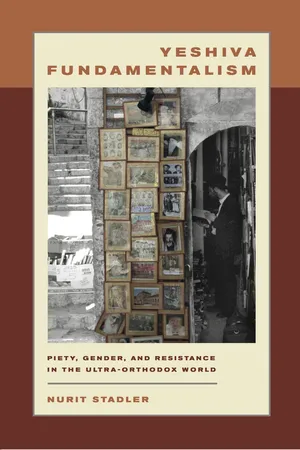
eBook - ePub
Yeshiva Fundamentalism
Piety, Gender, and Resistance in the Ultra-Orthodox World
- 224 pages
- English
- ePUB (mobile friendly)
- Available on iOS & Android
eBook - ePub
About this book
Information
Topic
Theology & ReligionSubtopic
Jewish Theology1
Introduction
Redefining Male Piety and Fundamentalism
As a result of and in response to the challenges of modernity, male piety is now being reconsidered and reconstructed in the fundamentalist world. Piety has always been at the heart of religion and is expressed in a variety of ways: through abstinence and mourning, with a selective self-disciplined faithfulness, or via sexual renunciation or zealous attachment, all of which are ways of preparing the body to receive the spirit of God (Brown 1988, 68). Piety also is at the center of modern religiosity, especially as performed by fundamentalist groups. The encounter between religion and modernity, however, raises questions about the unique nature of piety in the context of modern religious experience. How is it shaped, institutionalized, or transformed?
Students of fundamentalism usually describe models of piety as monolithic, especially the strict fundamentalist forms of men’s piety, which are usually regarded as holding power and thus as being static. Piety is often portrayed in the scholarly literature as a collection of religious practices used to protect and maintain the group’s boundaries (Almond, Appleby, and Sivan 2003; Eisenstadt 2000; Marty and Appleby 1991). Throughout this book, I argue that piety is not a fixed model, that instead it is always shifting and constantly being revised, reinterpreted, and contested by the members of the fundamentalist group. To my surprise, while analyzing piety, I found that those who are seen as the strictest and most prestigious models of piety are often the ones who hold the most powerful positions in the community, who are most likely to resist accepted forms of piety and to try to change its nature. How is it, I wondered, that members of a fundamentalist elite would want to undermine their own position of superiority? While refracting various images of the religious persona, the characteristics of this piety—its configuration, power, and defiant nature—also reveal the possibilities of changing the structure of religious society and its politics.
In the fundamentalist world, piety is composed mainly of devotion and self-restraint. The presence of these qualities in a person, either a man or a woman, leads the devotee to try to reclaim those spaces that have been or are in danger of being secularized and modernized. Underlying this pietistic activity is the assumption that the world has entered a final period of moral, religious, and ethical decline and that the secular world, always a source of danger, is now a greater threat than ever. In the fundamentalist view, piety, with its mastering body regime, is the only force capable of changing or restraining the secular and heretical nature of the world and thus perhaps of ensuring its future, if not present, redemption.
Fundamentalist leaders also use piety as an ideological motive to convince members to become active, albeit with almost no visible rewards. Indeed, piety is a political tool, used by fundamentalist authorities to control the enclave and its boundaries, as well as members’ relations with the state, politics, and civil society (Almond, Appleby, and Sivan 2003, 17; Sprinzak 1993). In order to persuade people to join and work for the group, the moral ideology must be all-embracing, implemented in all spheres of its members’ lives by creating a politics that persuades them that they are part of the “chosen.” This ideology defines devotees as elected by God, chosen to fulfill his missions on earth, for which all others are too frail, pitiful, and wretched. The “outside” is thereby polluted and demonized, whereas the “inside” is constantly purified by the sacred work of pious men and women (Harding 2000). The concept of piety in contemporary fundamentalism blends the traditional features of devotion, asceticism, and awe (see Valantasis 1995) with the latest applications of communication, technology, science, and consumerism and with postmodern notions of the representation of the self.
Sociologists studying fundamentalism contend that fundamentalist groups consist of educated, text-based, intellectual elite men, who are accepted in their communities as virtuosos of the canon (Antoun 2001, 3; Riesebrodt 1993, 9). These men transmit ideas to the new generations in special institutions, and their duty is to use piety as a defense against the outer world. In sum, piety is a set of techniques used to constitute a model of the docile devotee, usually a man, to regulate members’ bodies, to form restrictions, and to enforce rules. Power and status are protected by these valorized devotees who are constantly performing, defending the sanctity of the group. Trained and impressed with the stamp of proper desire, selfhood, masculinity, morality, and knowledge, the pious fundamentalist is conditioned to aspire to transcendental qualities, which safeguard him from the corrupt world and, by extension, safeguard the entire community.
Most scholars see piety as a model of moral perfection, an authoritative requirement to be accepted without criticism or challenge (Antoun 2001; Emerson and Hartman 2006; Lawrence 1989; Riesebrodt 1993). In this book, however, I suggest an alternative view. I argue that piety is not only learned, used, protected, and reinforced by fundamentalists but that it is also critiqued and reshaped by individuals and, over time, by generations. Moreover, those fundamentalist figures who embody the highest level of piety in the group and whose dominant position would seem to lead them to protect and reproduce the sources of sacred power sources are precisely the self-reflective agents who are constantly refining and critiquing their own religious paradigms. At certain moments, elite devotees challenge the very nature and validity of what is considered sacred in their culture. This critique involves a change in not only what is experienced as sacred but also in the very meaning of the sacred order (Demerath 1999, 1).
Piety and devotion are not merely parts of a system protecting and defending its own boundaries; they also are a paradigm of active resistance, revision, and the incorporation of otherness. Thus, devotees worship and accept the sacred and, at the same time, rearticulate its very meanings, structures, and boundaries. Fundamentalism is not, as many see it, necessarily static just because it is conservative; instead, it presents an innovative challenge to orthodoxy on its own grounds, and it is the somewhat unpredictable growing point of religiosity. Therefore, we should not be too surprised that in its challenges to the accepted foundations of piety, fundamentalism encourages devotees to consider new possibilities of the sacred. In doing so, fundamentalism deals with the roots of the idea of the sacred, sometimes risking transgression and at other times yielding new religious orientations.
Revealing the dynamic nature of piety in fundamentalist experience and uncovering its new meanings—especially its implications for masculinity and power—is at the heart of this book. These ideas both question the hegemonic view of male fundamentalist piety as static and explore the creation of alternatives to the model of pious masculinity. Indeed, revealing the contemporary change in piety allows us to rethink how fundamentalism has shifted the core of religious performance and institutions over time and shows how the idea of the sacred is being contested by a new generation of devotees in their constant negotiation with modernity, the state, civil society, and other institutions and apparatuses, to create new forms of piety.
The fundamentalist group on which I focus in this book is the Jewish, ultra-Orthodox, Haredi community in Israel or, more specifically, the male yeshiva culture. This is an enclave culture that is interacting with other worlds while remaining self-contained and in which many of the transactions in and the transformation of fundamentalism and piety take place. At the Haredi study hall, students are taught to become virtuous through the expert study of the Talmud and its commentaries. Indeed, Torah studies in the yeshiva are considered a value on which the continuity and survival of the Jewish people depend in both a spiritual and a physical sense (Friedman 1993, 184). In Haredi culture the yeshiva—that is, a seminary for higher Talmudic learning—is an institution exclusively for men. Men who excel in yeshiva studies become rabbis, adjudicators, and scholars; members of the elite; and authority figures in their worlds (Heilman 1983, 1).
The yeshiva men I interviewed for this book use the word Haredi to distinguish themselves from other Orthodox Jews. The Hebrew term Haredi (or the plural, Haredim), meaning “those who fear or tremble,” appears in Isaiah 66:5: “Hear the word of the Lord, you who tremble at His word” (cited in Heilman and Friedman 1991a, 198). To specify their religious devotion, these students also use the Hebrew term ben Torah—literally “son of the Torah” or the “disciple of the wise” (Talmid hackham), the true pious man (see Selengut 1994, 236)—to stress that they are fulfilling the truest male piety.
When I first became interested in the Haredi yeshiva world, I realized that although it posed enormous difficulties for research, it contained near-laboratory conditions for uncovering the workings of male piety in fundamentalism. In order to explore this world, I needed to examine the members’ various experiences and stories and then to analyze the meaning of their experiences from different perspectives, observing the manner in which they oppose and reshape piety.
As this book demonstrates, even though the official leaders of the yeshiva world have attempted to establish a religiosity that reinforces particular models of piety and purity within a certain apprehension of the sacred, modernity has made inroads into the yeshiva world, affecting these time-honored models and shifting the understanding of the sacred. We look at how different modern features have altered these modes of yeshiva religiosity. By analyzing the specific characteristic of yeshiva fundamentalism in Israel, I show that the traditional type of fundamentalism, based on male asceticism and the devotional study of texts, is currently being contested.
I further contend that the new generation of yeshiva students, despite being expected to defend the enclave, is rebelling against the main principles set by the rabbis to govern their interaction with the secular world around them. This is part of the wider development of an “oppositional culture” of young Haredi men who chafe at the limitations that the older constructions of yeshiva masculinity in Israel have imposed on them. I show how they are actively seeking a religious model through which to incorporate, rather than oppose, some of the models offered by secular Israeli society. I demonstrate that these men, although assured of their power and status, are resisting the traditional model of piety, especially the other-worldly orientations of their forefathers, and are redefining the basic meanings of the sacred. To replace this model, they are suggesting a this-worldly orientation, more politically and physically active, taken from military images of the Israeli combat soldier, Jewish/Zionist heroism, voluntarism, and active forms of citizenry, especially those connected with terrorism and care for the dead and the wounded. In their search for a new religiosity, yeshiva students are trying to incorporate several dimensions of secular, national models: they are redefining masculinity, “Israeliness,” and family relations; participating in civil society through the labor market and the military, setting up voluntary social aid organizations; and offering services in their unique areas of expertise for the public beyond their own community. These new features, derived from ongoing pressures such as constant war, terrorist attacks, factional politics, and economic burdens, are being incorporated in a manner acceptable to the community, thereby necessitating a new formulation of fundamentalism and power.
While the details may differ from one fundamentalist group to another, the presence today of these kinds of dynamic forces is not unique to Israeli yeshiva students but can be found in fundamentalist groups around the world. Fundamentalism thus has become a comparative theoretical tool used by scholars to explain a variety of religious experiences, including Hindu nationalism, Shi’ite Iranian revolutionaries, evangelical Christians in the United States, radical Egyptian Sunnis, Sikh militants in India, and Sri Lankan Buddhist fighter monks, all of which can be examined using the same analytical framework (Almond, Appleby, and Sivan 2003; Juergensmeyer 2000; Obeyesekere 1995). As Marty and Appleby (1991) argue, a comparative analysis of these trends allows an in-depth look into particular traits, similarities, and differences among distinct radical religious platforms and among expressions or religious resurgences that appear to share similar models of reaction to the values of modernity. Their exploration here, I hope, will also serve as methodological tool for further research of fundamentalist communities in general.
Varieties of Fundamentalist Piety
Over the last two decades, anthropologists and sociologists of religion have focused on the ways in which fundamentalist religions have absorbed modern ideas and practices (Ammerman 1987, 2005; Davidman 1991; Deeb 2006; Mahmood 2005). Scholars have analyzed the resurgence of fundamentalism worldwide since the late 1970s and early 1980s, studying processes of conversion, devotion, disaffection, and the social organization of fundamentalist communities (Almond, Appleby, and Sivan 2003; Ammerman 1987; Antoun 1989, 2001; Beeman 2001; Bruce 2000; Hervieu-Léger 2000; Kepel 2002; Riesebrodt 1993). Within a few years, however, it became clear that although fundamentalism appeared to be monolithic, nonliberal, and entirely traditional, it actually is, and always was, in dialogue with and affected by the larger culture in which it exists. Fundamentalism’s antagonistic stance toward secular and Western liberal traditions makes them its defining other, which must be incorporated in order to be opposed. In turn, this positioning has influenced major changes in the beliefs and practices of these conservative religious groups.
The word fundamentalism dates back to an early-twentieth-century American religious movement, which took its name from The Fundamentals: A Testimony of the Truth, a twelve-volume work published between 1901 and 1915 by a group of Protestant laymen. This movement was part of the tradition of evangelical revivalism that inspired the Great Awakening of the early nineteenth century. The term fundamentalism originally was applied only to the beliefs and practices of Christian sects, but it expanded to include similar ideas and behavior in other religions and is currently used to describe several modern religious expressions (Eisenstadt 2000, 83; Lehmann 1998; Stolow 2004, 110). The context and features of modernity, especially secular state education, the mass media, and technology, seem, both individually and collectively, to contain distinctive inclinations toward religious fundamentalism. Accordingly, the fundamentalist phenomenon can be explained as a product of the contradictory pressures of modernity and a surprising series of reactions: secularization led to religious revivalism; the consolidation of feminist ideologies caused a backlash against modesty and family-based ideologies; the rise of secular education brought with it the cultivation of the religious ethos; and technology and free access to knowledge seem to have led to religious confinement and censorship.
The term fundamentalism in the modern Jewish context may offer a better understanding of the exclusiveness (historically as well as culturally) and differences of present-day Jewish movements. The scholarly literature on Jewish fundamentalism recognizes three groups: The ultranational Gush Emunim (bloc of the faithful), the Lubavitch-Hasidic or Habad movement, and the Haredi community (Aran 1991, 1993; Friedman 1994; Heilman 1994, 1995; Ravitzky 1994; Soloveitchik 1994a; Stadler 2005). These groups are distinguished from conservative and reformist trends in Judaism, the Haredi Mizrahi (Sephardi), and the charismatic or New Age Haredim (Breslaw and others), as well as from Haredi communities in other historical periods. Scholars (Cromer 1993, 164; Friedman 1987, 1995a; Heilman and Friedman 1991b) dealing with Haredi fundamentalism have defined the community in Israel as having four dimensions: resistance to modernity, scripturalism, the massive institution building of fundamentalist institutions in Israel, and separatism.
The first dimension of fundamentalism is what Shmuel Eisenstadt calls the “modernity” of these groups (1995, 259, 2000). Even though fundamentalist movements oppose modernity (Marty and Appleby 1991, ix), they are the inevitable product of it (Ammerman 1987). Modernity, especially the modern liberal state, is commonly seen as the symbol of the outside and of evil forces. Although Israel is officially a Jewish state, its governmental system is constructed as Zionist and secular, which is a cause for rejection and resistance by ultra-Orthodox believers. Nonetheless, the existence of Israel’s Haredi community in its current form depends on the nation to protect it and provide for it materially, and it demands these rights as a minority in a liberal state.
Past and current leaders of the Haredi community, such as Abraham Isaiah Karlitz and Elazar Menachem Shach (Caplan 2007, 77, 69), provided believers with a set of religious, pietistic strategies by which to protect their religious identities and culture in these modern surroundings. This fundamentalism rejects or disregards modernity by using religious reasoning to explicate history and tradition as well as contemporary reality. Although Haredi historical discourse reflects historical and mythical events in the life of the secular state as well as the Jewish nation, it uses a different causality.
First, fundamentalists perceive their faith as a link in a glorious unbroken tradition beginning with the earliest prophets and practitioners of the faith. Haredim, especially Ashkenazim, feel this most poignantly because of the Holocaust. They consider themselves a remnant of the glory of European Orthodox Jewry and its only continuation in the present, custodians of a tradition that, because it was once nearly lost, must be kept alive at all costs. Modern culture, the antithesis and nemesis of that world and of the Western lifestyle in general, is strongly condemned. Like Muslim and Christian fundamentalists, Haredim do not permit abortion and homosexuality and actively oppose them.
As other fundamentalist groups have done, Haredim have constructed their unique identity by means of a selective retrieval of doctrines, religious symbols, and beliefs. The sacred texts—the Torah, the Qur’an, or the Bible—all are accepted by their adherents as being of divine origin (Almond, Appleby, and Sivan 2003, 96). This acceptance is known as scripturalism, which is the second dimension of fundamentalism (Antoun 2001). These symbols and meanings are selected from a sacred imaginary past and are used by devotees to respond to what they perceive as challenging, troubling times. Fundamentalists purposely select specific elements from their traditional sacred texts to incorporate in their future plans, visions, and fantasies. According to Talal Asad (2003, 11), in fundamentalist imagery the scriptures are used to establish and authorize a particular interpretation or view and to empower a particular authority.
By selecting certain elements of tradition, fundamentalists try to remake the world according to their own goals and desires. For example, currently in the yeshiva world, the commandment in Deuteronomy 6:7 to study Torah “when you sit at home and when you walk abroad” has been given absolute centrality. That is, this commandment orders all male members to join the yeshiva as part of belonging to the community and its legacy.
In the Lithuanian Israeli yeshivas, this obligation is underscored by symbols drawn from their imaginary or invented cultural and traditional past, used especially by the rational school of the gaon (genius) of Vilna, Rabbi Elijah Ben Solomon, and his disciple Rabbi Hayyim of Volozhin. This use of tradition to legitimize participation contrasts with the historical account of the European tradition. Among eastern European Jewish communities in...
Table of contents
- Cover Page
- Title Page
- Copyright Page
- Contents
- Dedication
- Acknowledgments
- Preface
- 1 Introduction
- 2 Yeshiva Fundamentalism in Israel’s Haredi Community
- 3 On the Edge of Transgression
- 4 Challenges to the Fundamentalist Denunciation of Work
- 5 The Idealization of Soldiers’ Masculinity
- 6 The Domestication of Masculine Piety
- 7 A Case Study
- 8 Conclusion
- Notes
- References
- Index
- About the Author
Trusted by 375,005 students
Access to over 1.5 million titles for a fair monthly price.
Study more efficiently using our study tools.
Frequently asked questions
Yes, you can cancel anytime from the Subscription tab in your account settings on the Perlego website. Your subscription will stay active until the end of your current billing period. Learn how to cancel your subscription
No, books cannot be downloaded as external files, such as PDFs, for use outside of Perlego. However, you can download books within the Perlego app for offline reading on mobile or tablet. Learn how to download books offline
Perlego offers two plans: Essential and Complete
- Essential is ideal for learners and professionals who enjoy exploring a wide range of subjects. Access the Essential Library with 800,000+ trusted titles and best-sellers across business, personal growth, and the humanities. Includes unlimited reading time and Standard Read Aloud voice.
- Complete: Perfect for advanced learners and researchers needing full, unrestricted access. Unlock 1.5M+ books across hundreds of subjects, including academic and specialized titles. The Complete Plan also includes advanced features like Premium Read Aloud and Research Assistant.
We are an online textbook subscription service, where you can get access to an entire online library for less than the price of a single book per month. With over 1.5 million books across 990+ topics, we’ve got you covered! Learn about our mission
Look out for the read-aloud symbol on your next book to see if you can listen to it. The read-aloud tool reads text aloud for you, highlighting the text as it is being read. You can pause it, speed it up and slow it down. Learn more about Read Aloud
Yes! You can use the Perlego app on both iOS and Android devices to read anytime, anywhere — even offline. Perfect for commutes or when you’re on the go.
Please note we cannot support devices running on iOS 13 and Android 7 or earlier. Learn more about using the app
Please note we cannot support devices running on iOS 13 and Android 7 or earlier. Learn more about using the app
Yes, you can access Yeshiva Fundamentalism by Nurit Stadler in PDF and/or ePUB format, as well as other popular books in Theology & Religion & Jewish Theology. We have over 1.5 million books available in our catalogue for you to explore.