Addresses the politics of immigration, in the everyday lives of one community
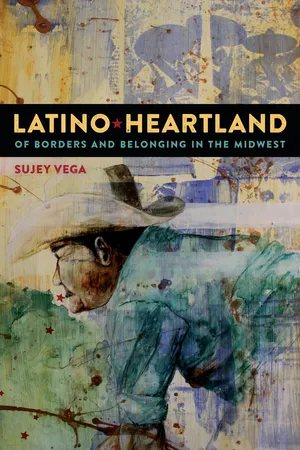
National immigration debates have thrust both opponents of immigration and immigrant rights supporters into the news. But what happens once the rallies end and the banners come down? What is daily life like for Latinos who have been presented nationally as "terrorists, drug smugglers, alien gangs, and violent criminals"? Latino Heartland offers an ethnography of the Latino and non-Latino residents of a small Indiana town, showing how national debate pitted neighbor against neighbor—and the strategies some used to combat such animosity. It conveys the lived impact of divisive political rhetoric on immigration and how race, gender, class, and ethnicity inform community belonging in the twenty-first century.
Latino Heartland illuminates how community membership was determined yet simultaneously re-made by those struggling to widen the scope of who was imagined as a legitimate resident citizen of this Midwestern space. The volume draws on interviews with Latinos—both new immigrants and long-standing U.S. citizens—and whites, as well as African Americans, to provide a sense of the racial dynamics in play as immigrants asserted their right to belong to the community. Latino Hoosiers asserted a right to redefine what belonging meant within their homes, at their spaces of worship, and in the public eye. Through daily acts of ethnic belonging, Spanish-speaking residents navigated their own sense of community that did not require that they abandon their difference just to be accepted.
In Latino Heartland, Sujey Vega addresses the politics of immigration, showing us how increasingly diverse towns can work toward embracing their complexity.
- 304 pages
- English
- ePUB (mobile friendly)
- Available on iOS & Android
eBook - ePub
About this book
Information
Topic
SozialwissenschaftenSubtopic
Kultur- & Sozialanthropologie1
Recuerdos de Lafayette
The Making and Forgetting of the Past in Central Indiana
There is the most serious task of determining not what history is . . . but how history works.
—Michel-Rolph Troullot, Silencing the Past
Though it was dark and cold outside St. Boniface Catholic Church, the warmth and enthusiasm of Latino parishioners illuminated the sanctuary space with pre-dawn festivities to Our Lady of Guadalupe. At 3:00 A.M. on December 12, 2006 the Spanish choir began the events with Las Mañanitas.1 After a few alabanzas, or traditional hymns, a Norteño band joined in with its accordion, drums, and unique sounds that melded secular music with faithful veneration. By 5:00 A.M., an Indianapolis mariachi band trumpeted in the mass to a sanctuary space at maximum capacity. At the altar, brown paper mounds, cacti, rocks, and flowers created a replica of the landscapes of Tepeyac, Mexico, where the Virgin Mary first appeared to an indigenous man. Walking into the church building on that morning, one could hear the sounds of Mexican music summoning Mexican Catholics to celebrate this holy day. Violins, trumpets, and guitars rang out in inspirational melody as parishioners sang church hymns and popular Mexican songs rewritten for this special occasion. Songs like Amor eterno, Gema, Cielito Lindo, and La Guadalupana, and chants of “¡A la bio, a la bao, a la bim bom ba. La Virgen, La Virgen ra ra ra!” reverberated across pillars and vaulted cathedral ceilings.2 In addition to the music and celebration of mass, an interpretive dance performed by a Mexican youth group recognized the indigenous component to this commemoration. Plumed headdresses bounced up and down the aisles accompanied by the beat of a drum and the jingles of their bell-clad ankles.3 Families and individuals, all gathered on that morning spiritually, culturally, and physically, prepared to observe this deeply Catholic Mexican holiday. Hundreds of Mexican parishioners filled the Lafayette church space and worshiped their particular form of ethno-Catholicism.4 Notably, the ethnic religiosity practiced in 2006 paralleled that of German immigrants in the same space a century earlier.
By 2006, walls originally intended for German worship became christened by Spanish prayers, Mexican music, and neo-indigenous performance. Founded by German Catholics who were seeking to preserve their particular religious identity, St. Boniface was established in 1853 as a sanctuary for religious, linguistic, and ethnic traditions. The German congregation named the sanctuary St. Boniface in honor of a monk known for converting Germanic tribes. Now, in the twenty-first century, St. Boniface hosted the celebrations of the Virgin of Guadalupe, herself credited with converting Mexico’s indigenous communities. The parallels did not end there. Like Mexican immigrants, Germans spent the first sixty-five years of the parish speaking their native tongue and teaching it to their children. Regrettably, this history is not always recognized in popular national narratives that position European immigrants as rapidly assimilated. This romantic, if inaccurate, reconstruction of the past effectively silenced opportunities for comparative parallels between earlier Germans and present-day Latino families in the public imaginary.
At the height of the 2006 immigration debate, letters to the editor in the local newspaper narrated accounts of European assimilation that strategically challenged contemporary Latinos living in Indiana. In an effort to target those who spoke Spanish and proudly displayed their ethnic heritage, letter writers discursively set up an idealistic past where their immigrant ancestors legally arrived in and assimilated to this country. For instance, in May 2006 a letter writer proclaimed, “What did we do with the Polish, German, French, Italian, Russian, etc. immigrants. My ancestors were immigrants and they learned. I speak English and I do not celebrate the ‘old’ country’s holidays.” A few weeks later, a letter headlined “Grandpa spoke English, obeyed law” explained precisely how family lore replaced experiential knowledge of actual relatives. As this excerpt of the letter indicates, the result of this imagining constructed a past disjointed from the present.
My grandfather immigrated to the U.S. from Germany. He had done so legally. Although I never knew him (he passed away the year I was born), one of the few stories I have been told of him was that he became a U.S. citizen and did not teach his family the German language. . . . Anyone wanting to live in this country should feel the same as my grandfather. If you don’t want to follow our laws, customs and particularly our language, then feel free to go back to your own country. I, for one, do not want my freedoms, my language, etc., controlled by someone who is here illegally. (June 11, 2006)
Conflating the use of Spanish with unsanctioned entry, the letter set up a dyad of belonging that included earlier immigrants and excluded contemporary immigrants. This “us versus them” positioning disavowed Mexican and the larger Latino population from belonging to his (the letter writer’s) imagined national and local community (Anderson 1991). Of course, absent from this politics of belonging were the race-based privileges that provided European immigrants a path toward citizenship even if they too arrived through unsanctioned entry points (Sadowski-Smith 2008). Moreover, much-celebrated assimilation tales actually obscured the practices of maintaining ethnic identity, home languages, cultural traditions, and transnational networks among earlier European immigrants.
Appreciating how history was discursively used to establish legitimacy against present-day immigrants, I searched the archives and historical texts to understand what life was actually like in Lafayette’s past. Peeling away the layers of history unearthed experiences concealed by distance, time, and all-too-convenient narratives. Seemingly imagined as a homogeneous space of romantic frontier settlement and industrial modernity, the reality of central Indiana expands beyond European ingenuity for commerce and trade. Bringing to the fore the social stratification of this Wabash River valley, this chapter examines the manner in which people of color and immigrants were remembered throughout Indiana’s cycles of settlement and how their positioning affected contemporary notions of belonging. Through a deeper, critical eye at the historical record, I engage the narratives associated with American Indians, Black residents, European immigrants, and even the KKK in the making and forgetting of a Hoosier identity. Most notably, the Klan’s early-twentieth-century rhetoric of “100 percent Americanism” provided disturbing parallels to contemporary anti-immigrant messages in 2006.
Within this paradigm of understanding the present through the past, I position early Latino, primarily Mexican, settlers as part and parcel of this community history. Too often relegated as “new” communities, places like Lafayette have had a longstanding Latino presence. Though certainly smaller than the influx of Latino arrivals in the 1990s, Lafayette’s Latino “pioneers” reached as far back as the 1950s. It was the memories of one of these long-established Latino residents that truly influenced this chapter’s focus on memory-making and constructions of self. Hilda, recalling her arrival in Lafayette in the 1960s at the age of two, said that her life journey had taken her as far away as Alaska and even back to Mexico for a few years. Given these multiple spaces of residence, I asked Hilda why she returned to Lafayette after being in so many other places since her childhood in Indiana, she responded, “Yo aquí me siento como que aquí es mi casa, como que aquí es mi tierra. Mis primeros recuerdos son de Lafayette. Aquí es donde empecé a crecer” [I feel that my home is here, that this is my homeland. My first memories are of Lafayette. Here is where I was raised]. Hilda identified with Lafayette and claimed a unique hometown experience; still, her memories were not validated in simplistic renderings of a Lafyatte past that excluded her family’s early contributions. Ironically, Hilda’s feelings of home and belonging were similar to the feelings of those who trafficked in the rhetoric of exclusion against contemporary immigrants. The recuerdos, or memories of Lafayette, were multilayered and needed to be unpacked precisely because these pasts were often used to pit residents of Lafyaette against one another, residents who otherwise lived on the same city blocks and simultaneously created a sense of home in this midwestern landscape.
Presumed to be new arrivals without legal or historical residency, Latino residents faced a battle for acceptance. Displaying selective narratives of the past kept Latinos out of the collective imaginary and sharpened comparisons with “worthy” assimilated European forebears. Tales of past immigrants positioned them as honorable, loyal pioneers and simultaneously discounted undocumented immigrants, and those racially associated with them, as criminals and cultural threats. The juxtaposition not only erased a century and a half of Mexican residency in the United States but also perpetuated a system of whiteness that privileged and sanitized European ancestry. As Guillermo Gómez-Peña states, “The U.S. suffers from a severe case of amnesia. In its obsessive quest to ‘construct the future,’ it tends to forget or erase the past” (1989: 22). This pathology of forgetting afflicted the way individuals framed one another in Indiana. Whether purposeful or unconscious, the concealment of critical pasts splintered the population and impeded opportunities for comparative dialogues. Descendants of ethnic immigrants or Black residents who experienced discrimination lacked the wherewithal to critically reflect on the xenophobia present in twenty-first-century Indiana. Notable exceptions included individuals like Pastor Walker. Born and raised in central Indiana, Pastor Walker had spent his entire life working in and ministering to places throughout the state. By 2006 he was head pastor at one of Lafayette’s historically Black churches, a local institution for well over a century. Disappointed by members of his congregation and the general public who adopted an anti-immigrant stance, Pastor Walker was frustrated when he explained, “But most people are not students of history, they’re students of the thirty-second sound bite and don’t have a clue. . . . Sometimes civil disobedience is a necessary thing for justice. Well, how do you think we started this country? A doggone Boston Tea Party rebelling against a doggone king and an authoritarian rule. We forget. They [American revolutionaries] were all criminals.” Pastor Walker referred to the Revolutionary War to highlight the parallels between undocumented immigrants and historic U.S. figures both fighting unjust authoritarian rule. Rather than blindly defend a defective immigration system, he tirelessly encouraged people within his congregation and several community organizations to acknowledge their intertwined histories as a means of engaging one another.5 Comparing immigration reform to the fight against the British Empire and civil rights–era clashes, Pastor Walker located immigration activists within a national precedence of resistance. Indeed, immigrant activists typified a long history of revolutionaries fighting for the right to be recognized as contributing members of society.
The late Michel-Rolph Trouillot (1995) prolifically articulated that there was a critical distinction between “what happened” and “what is said to have happened” in the historical record. Unfortunately, the distinction between what happened and what is said to have happened is not so easily teased apart in the public imaginary. We may never know what truly happened in the past, but the sustained assemblage of particular narratives as historical truisms must be unpacked for what they miss, or for what is being conveniently erased. In central Indiana, partial accounts of the past framed how Latinos could be perceived and denied belonging in the twenty-first century. Parallels with earlier generations could have provided empathy and understanding; instead, renderings of assimilated ancestors supported the demonization of Lafayette’s newest arrivals as separate and apart from previous immigrant residents. Seeking distance from the latest denigrated group in society meant conveniently erasing past ethnicity, unlawful settlement, or one’s own exploitation. Indeed, this is not new in the United States. According to George Lipsitz (1998), the specter of race has historically pushed individuals into ignoring personal injustices in order to consolidate their privilege or invest in the dominant White category. The process of becoming White, however, had to be restricted in order for it to have power over those who could never be White.6 While certain individuals could start to claim whiteness, racialized Others became relegated to socially and legally impaired subcategories. Thus, White privilege relied on omissions of what happened that were conveniently supplanted by manufactured narratives of what is said to have happened in order to sustain a system of inequality. The emphasis here is not simply on the erasure or creation of history but on how this act of forgetting elicits a particular response. Trouillot asserted the performative qualities of history by recognizing that there was something being done in the remembering or forgetting the past. Looking to not just what history is but how it works leads us away from a fight over positivist approaches and suggests a deeper critical eye toward what is being done with history, how history-making works toward certain ends.
The exclusion of specific uncomfortable details reveal much about what a community chooses to remember and how that choice alters life for individuals years after the first exclusion occurs. In the popular history of the United States, ghosts from Native massacres, land grabs, human enslavement, and ethnic persecution become displaced by stories of pioneering triumph, self-reliance, and assimilation. These stories of the past reverberate into contemporary feelings of entitlement for those whose forebears have been rescued. Conversely, forgetting details of marginalized communities suppresses their contributions and promotes even further silences. Harnessing the power to silence controls the narrative and determines how subsequent tales can be spun to maintain privilege. Forgetting, or ignoring, historic moments meant that contemporary anxieties about immigrant intrusion in the twenty-first century could overlook analogous examples of settler colonialism, illegitimate occupation, xenophobia, and ethnic immigrant resistance that muddied the argument against Latino immigrants. Thus, exploring the public history of Lafayette situated how pastness operated in present-day conceptualizations of belonging. Memories of the past could have created possibilities of empathy had they been allowed to surface; instead, idealized constructions of inherited belonging aroused feelings of animosity.
In 2006, multiple references to history shaped everyday discourses of citizenship and belonging to central Indiana. In the newspapers and online commentary sections, some residents deployed specific stories to sharpen the critique against undocumented or unassimilated Latino families. Even seemingly innocuous traces to the past scattered in preservation efforts of neighborhoods, battlegrounds, museums, names of places, and local lore shaped communal narratives of belonging and historical entitlement to the Midwest. For example, the myth of the vanishing Indian played an extraordinary role in placing European claims on local spaces. With the erasure of Native peoples, lore about pioneering families and brave “founders” could be utilized (Buss 2011). Even if Lafayette residents did not frequent museums or read about the past, area festivals or historic neighborhoods preserved who could be associated with legitimate belonging. To account for the written and experienced historical narratives of belonging, I looked to archives, history texts, newspaper stories, public celebrations, and vocalized allusions to the past. Placing these multiple accounts in dialogue provided a larger picture of the way the past informed contemporary visions of community and legitimacy in Lafayette. This chapter begins by looking at what the public imaginary overlooks, an established Latino presence in central Indiana that extended back into the mid–twentieth century. Recognizing Latinos within this geographic space in the 1950s and 1960s combats renderings that called into question the legitimate residency of this population. Still, twenty-first-century moments of Othering and denied acceptance must be contextualized much earlier than those of the twentieth century. The following sections present a more traditional chronological trajectory. For instance, the assertion of legitimate White presence is set against the constructions of a Native Other. In a state called Indiana, these musings of Indians revealed how residents saw themselves in the making or erasing of this region’s first settlers. Moving toward Indiana’s antebellum era, the next section follows the tension of that state’s role in slavery, abolitionism, and the construction of White benevolence in its historical record. This White benevolence became critical in composing the idealized European immigrant and later White resident whose thorny relationship with the Ku Klux Klan was creatively amended in the public imaginary. I showcase how the popularized collective history summoned during the 2006 immigration debate, read against strategic omissions, was layered with problematic distortions.
Retracing Los primeros Mexicanos en Lafayette
I sat in Alicia’s living room, looking through treasured albums of her initial years in central Indiana. Pictures of baptisms, first communions, birthday parties, and Christmas celebrations displayed a virtual living history of these families’ interrelationships and how they began to count on one another for spiritual and social support. Then Alicia’s hair was teased in a classic 1980s style while holding her goddaughter asleep in her arms above the St. Boniface baptismal font. Now a grandmother, Alicia proudly showed me pictures of her adult children, whom I now knew as parents themselves. Her only daughter’s quinceañeara, one of the first in Lafayette, was particularly memorable because now, a decade later, she was pregnant with her second child. Pictures of her three sons and their birthday parties were throughout. Alicia laughed, recalling how she had had to make their piñatas because no one sold them locally during those years. Now in her custom-made home, Alicia looked at her younger self, almost as if to reassure herself that it had all been worth it. Trying times met with exuberant celebrations in the photographic chronicles of this early Latino community. With each page, she recalled different stories, different moments of survival. The time when the priest kicked them out of the parish, the inquietud [anxiety] of her husband starting his own car business while still working a full-time job, the barn fire that killed what few animals they had on their rural Indiana property, the family laughing, crying, struggling, and surviving. Pictures of religious and secular celebrations recorded Alicia’s established family and sense of home in Lafayette.
Decades before twenty-first-century immigration debates turned the national gaze onto Mexican immigrants, “new” communities throughout the nation were already engaged in building belonging in spaces previously unfamiliar with a Latino presence. The considerable increase in Spanish-speaking Lafayette residents during the 1990s altered the landscape and garnered the attention of White residents who turned to unsubstantiated rumors to explain the growth. For example, a running narrative throughout the town placed sole responsibility on one employer rumored to have placed a billboard on the U.S.–Mexican border to entice undocumented immigrants to Lafayette. This story was related to me on multip...
Table of contents
- Cover
- Title Page
- Copyright Page
- Dedication
- Contents
- Preface: Pioneering Ownership of Greater Lafayette
- Introduction: Bienvenidos a Hoosierlandia: Asserting Ethnic Belonging at the “Crossroads of America”
- 1. Recuerdos de Lafayette: The Making and Forgetting of the Past in Central Indiana
- 2. Kneading Home: Creating Community While Navigating Borders
- 3. Written Otherings: Policing Community at the “Crossroads of America”
- 4. Clashes at the Crossroads: The Impact of Microaggressions and Other Otherings in Daily Life
- 5. “United We Are Stronger”: Clarifying Everyday Encounters with Belonging
- Conclusion: The Politics of Belonging Wages On: How State-Based Legislation Affects Community in Indiana
- Notes
- Bibliography
- Index
- About the Author
Trusted by 375,005 students
Access to over 1.5 million titles for a fair monthly price.
Study more efficiently using our study tools.
Frequently asked questions
Yes, you can cancel anytime from the Subscription tab in your account settings on the Perlego website. Your subscription will stay active until the end of your current billing period. Learn how to cancel your subscription
No, books cannot be downloaded as external files, such as PDFs, for use outside of Perlego. However, you can download books within the Perlego app for offline reading on mobile or tablet. Learn how to download books offline
Perlego offers two plans: Essential and Complete
- Essential is ideal for learners and professionals who enjoy exploring a wide range of subjects. Access the Essential Library with 800,000+ trusted titles and best-sellers across business, personal growth, and the humanities. Includes unlimited reading time and Standard Read Aloud voice.
- Complete: Perfect for advanced learners and researchers needing full, unrestricted access. Unlock 1.5M+ books across hundreds of subjects, including academic and specialized titles. The Complete Plan also includes advanced features like Premium Read Aloud and Research Assistant.
We are an online textbook subscription service, where you can get access to an entire online library for less than the price of a single book per month. With over 1.5 million books across 990+ topics, we’ve got you covered! Learn about our mission
Look out for the read-aloud symbol on your next book to see if you can listen to it. The read-aloud tool reads text aloud for you, highlighting the text as it is being read. You can pause it, speed it up and slow it down. Learn more about Read Aloud
Yes! You can use the Perlego app on both iOS and Android devices to read anytime, anywhere — even offline. Perfect for commutes or when you’re on the go.
Please note we cannot support devices running on iOS 13 and Android 7 or earlier. Learn more about using the app
Please note we cannot support devices running on iOS 13 and Android 7 or earlier. Learn more about using the app
Yes, you can access Latino Heartland by Sujey Vega in PDF and/or ePUB format, as well as other popular books in Sozialwissenschaften & Kultur- & Sozialanthropologie. We have over 1.5 million books available in our catalogue for you to explore.