At the birth of the United States, African Americans were excluded from the newly-formed Republic and its churches, which saw them as savage rather than citizen and as heathen rather than Christian. Denied civil access to the basic rights granted to others, African Americans have developed their own sacred traditions and their own civil discourses. As part of this effort, African American intellectuals offered interpretations of the Bible which were radically different and often fundamentally oppositional to those of many of their white counterparts. By imagining a freedom unconstrained, their work charted a broader and, perhaps, a more genuinely American identity. In Pillars of Cloud and Fire, Herbert Robinson Marbury offers a comprehensive survey of African American biblical interpretation.
Each chapter in this compelling volume moves chronologically, from the antebellum period and the Civil War through to the Harlem Renaissance, the civil rights movement, the black power movement, and the Obama era, to offer a historical context for the interpretative activity of that time and to analyze its effect in transforming black social reality. For African American thinkers such as Absalom Jones, David Walker, Zora Neale Hurston, Frances E. W. Harper, Adam Clayton Powell, and Martin Luther King, Jr., the exodus story became the language-world through which freedom both in its sacred resonance and its civil formation found expression. This tradition, Marbury argues, has much to teach us in a world where fundamentalisms have become synonymous with “authentic” religious expression and American identity. For African American biblical interpreters, to be American and to be Christian was always to be open and oriented toward freedom.
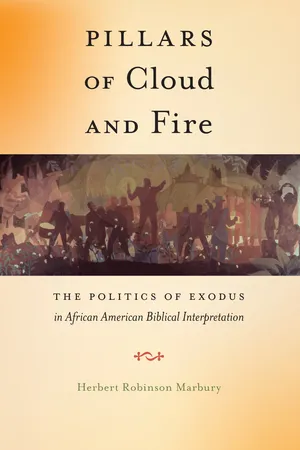
eBook - ePub
Pillars of Cloud and Fire
The Politics of Exodus in African American Biblical Interpretation
- 272 pages
- English
- ePUB (mobile friendly)
- Available on iOS & Android
eBook - ePub
Pillars of Cloud and Fire
The Politics of Exodus in African American Biblical Interpretation
About this book
Information
1
Exodus: Israelite Deliverance and Antebellum Hope
The cry of the Israelites has now come to me; I have also seen how the Egyptians oppress them. So come, I will send you to Pharaoh to bring my people, the Israelites, out of Egypt.
—Exodus 3:9–10
The book of Exodus tells the Bible’s ancient story of a people’s slavery and their struggle for emancipation. In the early nineteenth century, many communities took the Bible’s story of slavery and emancipation and made it black people’s story of faith. Anguished black souls, both enslaved and free, angry and hopeful, adopted it as their own. In brush harbors and tall steeple churches, they preached its message. In cotton fields and choir lofts alike, they glorified its vision of justice in spirituals. And everywhere, they prayed to realize its emancipatory hope. Among that chorus arose two voices from two of the largest, most politically active, and financially viable free black populations in the nation. From the reservoir of black religious imagination, these two voices summoned this ancient, archetypal narrative of slavery and freedom. With it, they told their own people’s story. In Philadelphia, Absalom Jones climbed from slavery to become a pillar of the community and the father of black Episcopalians. In 1808 he preached his celebrated “Thanksgiving Sermon” on Exodus 3. With a mild-mannered disposition that belied his burning indignation, he articulated the politics and aspirations of the black Philadelphia community that had formed him. While others at that time spoke differently, Jones was optimistic about the possibilities for African American life in the first decade of the nineteenth century.
Two decades later in Boston, David Walker, a clothing merchant who had emigrated from the South, took up the same book of Exodus and fired off his strident Appeal to the Coloured Citizens of the World. Its message was urgent; its tone was defiant. News of the pamphlet’s contents ignited so much fear throughout slaveholding states that southern planters offered a price for his head. Jones and Walker were among the earliest to deploy the exodus narrative to articulate black struggles against repression. Their politics and interpretations differed so radically that neither would have had much regard for the other. Yet both would come to the same exodus narrative to express their shared emancipatory hope.
The Black Problem and the Philadelphia Experiment
In 1684, slavery came to Philadelphia when the Bristol firm’s ship Isabella docked at the city’s port. In its hold, 150 Africans lay chained.1 On the whole, such events were normal occurrences along North America’s Atlantic coast. But Philadelphia was the City of Brotherly Love. In 1681, when William Penn received the charter for the territory that would become Pennsylvania, he hoped to establish it as a haven for persecuted Quakers. Writing about the land grant, he vowed, “I would not abuse His love, nor act unworthy of His providence, and so defile what came to me clean.”2 Penn dreamed of a society where Quaker values of love and justice would guide the colony’s ethos. He named its capital—Philadelphia, City of Brotherly Love—to be a beacon for the territory. That dream ended the day the Isabella arrived. By week’s end, the city’s approximately 1,000 residents had purchased the entire cargo of human chattel.3 Thereafter, white Philadelphians were caught between two competing priorities: the anti-slavery commitments entailed in their Quaker heritage and their appetite for human chattel. Over the next century, two wars, shifts in the economy, a politically robust free black community, and a coalition comprised of Quakers and other abolitionists, including the Philadelphia Abolition Society, worked to end slavery in the City of Brotherly Love. The 1780 Abolition Law mandating the gradual manumission of enslaved Africans had all but ended the institution in Philadelphia by 1800. Of the 6,381 blacks in the city, only fifty-five remained enslaved. The 1810 census showed that out of the black population of 9,656 persons, only three were held in slavery.4
For the Philadelphia Abolition Society, the Society of Friends, and other white abolitionists, the end of slavery in the city meant that the Philadelphia Experiment had been a success. Their work depended upon the efforts of abolitionists such as Anthony Benezet, a Huguenot who published a series of anti-slavery pamphlets beginning in 1759 and continuing until his death in 1784. After establishing a school for the instruction of black children, Benezet argued publicly that they were not intellectually inferior to white children.5 Others such as Benjamin Rush, a Presbyterian physician, and Thomas Paine, who later wrote Common Sense, aimed pointed critiques at the hypocrisy of slaveholders in America who demanded freedom from Britain.6 In 1787, the Philadelphia Abolition Society, touting its good work to its British counterpart, the London Society for the Abolition of the Slave Trade, reported that men and women emerging from slavery could indeed be “industrious, orderly, and of moral deportment.”7
Despite emancipation, however, black Philadelphians continued to suffer racial hostilities. The Commonwealth of Pennsylvania enacted new laws suppressing their freedoms. Often, local authorities manumitted persons only to force them into decades of indentured servitude. Nonetheless, the free black community of Philadelphia knew that, as the subjects of the Philadelphia Experiment, the hopes and possibilities of sisters and brothers still chafing under the yoke of chattel slavery rested in part on their ability to ensure the Experiment’s continued success.
For most white Philadelphians, the Experiment’s success was not a fait accompli; its status always remained contingent upon the free black community’s behavior at that particular time, a situation black Philadelphians understood all too well. From 1726 until 1780, the colonial assembly’s “Act for the Regulation of Negroes in the Province” checked their freedom. Channeling the prejudices of their constituents, the legislators made the spirit of the Act clear in its disparaging preamble; “Whereas, free Negroes are an idle and slothful people and often prove burdensome to the neighborhood and afford ill examples to other Negroes.”8 It meant that free black Philadelphians lived under constant suspicion and the regulating gaze of their white counterparts. Among its provisions, the Act levied fines for free black persons who harbored those escaping enslavement, required slaveholders to post a bond with the county if they released a person held in slavery, and fined them if they allowed any enslaved person to “hire out his own time.”9 Free black persons were always subject to enslavement, since the act empowered magistrates to bind out annually black persons of “slothful” behavior to work for whites. Black women were subject to this provision until the age of twenty-one, while black men remained subject until the age of twenty-four.10 When any law was broken, one person’s minor infraction cast doubt upon the entire black community. Every day, free black Philadelphians knew their behavior would be used to judge the character of the entire race, slave and free. Furthermore, they had little recourse to address the insults and injuries they received as a part of daily life. Black Philadelphians lived with a mitigated freedom. But for them, such freedom was not too heavy a burden if it meant that the Philadelphia Experiment might be replicated in other cities throughout the new Republic. They believed—as had those children of slavery who preceded them and adopted the exodus story—that perhaps one day, all of their sisters and brothers would be free.
Absalom Jones: Pillar of Cloud as Pillar of the Community
Growing up in Philadelphia’s black community, Absalom Jones understood its social world and its political economy configured by slavery and freedom, education and illiteracy, wealth and poverty, and enfranchisement and marginalization. His response to the challenges facing its newly freed members took the form of a “pillar of cloud.” Jones’s politics proceeded by advertising a diversion, namely, his willingness to fit within the social and racial strictures of Philadelphia’s social world. His display, a mastery of the moral and civic virtues prized by his community, masked his efforts to free enslaved Africans and build wealth and political capital among the city’s black residents. With this politics, he believed that he could raise his station and that of others without agitation.
Jones developed the components of his politics organically. From the beginning, Calvinist virtues shaped Absalom Jones’s world.11 The social options available to him reinforced the ultimate economic and theological significance of work as a spiritual discipline rationalized into a system.12 Born in 1746 in Sussex, Delaware, Absalom Jones, along with his mother and siblings, was held in slavery by Benjamin Wynkoop, a wealthy planter from a prominent Dutch family. Wynkoop’s Calvinist leanings and strong ties to the Episcopal Church would influence the young Absalom. As a child, Absalom worked in the Wynkoop home. He taught himself to read using books that he purchased by saving the occasional pennies he received in tips.13 Absalom probably did not share Wynkoop’s Calvinist understanding that his work, frugality, book purchases, and achieved literacy were signs assuring his salvation. Nevertheless, deploying some portion of his labor for his own benefit rather than for the slave system at such an early age must have been gratifying. Moreover, to be a literate black child in the mid-eighteenth century only magnified the importance of his achievement because Absalom had permanently raised his own social status.
In 1762, Wynkoop traded his quiet, rural Delaware planter’s life to become a merchant in Philadelphia. That year, without regard for the family, he sold Absalom’s mother, sisters, and brothers, but took the fifteen-year-old Absalom to Philadelphia. In the city, Absalom had ample opportunity to run away and to lose himself in densely populated black Philadelphia neighborhoods. However, the prospects for a boy to provide for his safety and other basic necessities on his own in the unfamiliar urban world were almost as dismal as under the slave system. Moreover, there would have been little chance of reuniting with his mother and siblings since escaping meant crossing state lines. Even more difficult, passing himself off as a free person at such a young age would have been virtually impossible. Instead, the maturing Absalom Jones employed the lessons he had learned as a child. He had seen Wynkoop’s devotion to his mercantile vocation and how his shrewd business acumen led to financial security. For Wynkoop, these rewards were material signs of his status as one of the Elect. While one could neither know nor affect one’s status in the world to come, one’s success in this world was indicative of one’s status among the Elect. Success in this world was not assurance of salvation, but it was one among many signs. Thus, Calvinists were not to enjoy the natural fruits of such success. Rather, frugality, moderation, and temperance emerged as virtues. Jones’s work would return for him signs of salvation as well.
However, Jones, like many other blacks held in chattel slavery, followed Gronniosaw and interpreted the silence differently. Salvation for them was polyvalent; it meant emancipation here and life with Christ in the world to come. At least for the next sixteen years, Jones labored in Wynkoop’s store beyond the time imposed by his enslavement, saving the money he earned.14 In 1770, Jones married Mary King and, by continuing to labor beyond his enslavement, he purchased her freedom eight years after their marriage. Working another six years, he saved enough to secure his own freedom.15 By 1779, Jones had amassed enough wealth to purchase property in Philadelphia’s southern Dock Ward. His neighbors included Cyrus Griffen, a delegate to the Continental Congress from Virginia, and Thomas Mekean, chief justice of Pennsylvania.16
Jones’s Calvinist political ethics accounted not only for his financial position, but also for his survival and subsequent rise to prominence amid an increasingly racially polarized city. He blended with the social landscape as a cloud blends with the sky. Jones survived by performing a mastery of exemplary citizenship. Succinctly put, Jones modeled the “orderliness, industry, and moral deportment” that the Philadelphia Experiment demanded of the free black community. He understood well the black community’s vulnerability to violent forms of white backlash. The end of slavery in Philadelphia had not brought the long hoped-for Jubilee. When the legislature repealed the 1726 Act, it only rendered more visible the smoldering hatred and fear of the small number of free black residents. As their numbers grew, so did white fear. From 1780 to 1800, Philadelphia’s white population grew from 30,900 to 63,242.17 During the same period, its black population grew from 1,100 to 6,436.18 Whenever news of some small insurrection, individual act of resistance, or rebellion, such as the one that took place in Santa Domingo, frightened the white public, the Philadelphia Abolition Society made it a practice to warn the black community of its obligation “to do credit to yourselves, and to justify the friends and advocates of your colour in the eyes of the world.”19 Repeatedly, the Society held the black community accountable for the white backlash they experienced. On one occasion, the Society went so far as to issue rules admonishing the black community toward “churchgoing, educating the young, temperance, frugality, respectful behavior, and avoidance of ‘frolicking and amusements.’”20 In the politically charged environment, Jones believed that his survival depended upon his ability to perform these virtues idealized by the white public sphere—a mastery of exemplary citizenship. By showcasing these values, Jones believed he could leverage whatever spheres of power his society made available to him to achieve his political ends. First, this meant fitting in his place as prescribed by his social world and raising his station only by those means acceptable in the white public sphere. Second, Jones believed he could convince white Philadelphians, even those hostile toward blacks, that there was some mutual benefit in achieving those ends. At every opportunity Jones wore the mask that advertised these values as constituting not only his character but that of the black community as well.
Nine years before he preached his celebrated “Thanksgiving Sermon,” Jones petitioned Congress on December 30, 1799 to end slavery. He began with the following:
That, thankful to God, our Creator, and to the Government under which we live, for the blessings and benefits granted to us in the enjoyment of our natural right to liberty, and the protection of our persons and property from the oppression and violence which so great a number of like colour and national descent are subject to, we feel ourselves bound, from a sense of these blessings, to continue in our respective allotments, and to lead honest and peaceable lives rendering due submission unto the laws, and exciting and encouraging each other thereto, agreeable to the uniform advice of our friends of every denomination. 21
His opening sentence foregrounds the behaviors included in his “pillar of cloud” politics; they constitute his display of exemplary citizenship. By “lead[ing] honest and peaceable lives,” Jones signals his intent to fit in his place as an upstanding member of the Philadelphia community. By “render[ing] due submission unto the laws,” Jones commits to the role of citizen and the prevailing social order. By foregrounding or advertising this commitment to such a politics, Jones masks his community’s efforts toward achieving material, social, and political equality. His strategy intended to deflect racist reprisals that might be triggered by growing white resentment toward the free, but vulnerable, black community as they worked toward political and economic parity.
Jones had practiced such a politics throughout his life. Years earlier, he had re-imagined his dehumanizing relationship with Wynkoop, the man who profited from the sale of his mother and siblings. He decided to maintain the relationship as a necessary evil and even re-envisioned it as a potentiality from which he would amass the resources to free himself and build a family. Doing so required more than the discip...
Table of contents
- Cover
- Title Page
- Copyright Page
- Dedication
- Contents
- Preface: Locating the Project
- Acknowledgments
- Introduction
- 1. Exodus: Israelite Deliverance and Antebellum Hope
- 2. Exodus in the Wilderness: Making Bitter Water Sweet
- 3. Exodus and Hurston: Toward a Humanist Critique of Black Religion in the Harlem Renaissance
- 4. Exodus in the Civil Rights Era: Returning the Struggle to the Black Church
- 5. Exodus at the Intersection of the Black Power Movement and the Black Church
- Conclusion: Cloud, Fire, and Beyond
- Notes
- Bibliography
- Index of Names
- Index of Subjects
- About the Author
Trusted by 375,005 students
Access to over 1.5 million titles for a fair monthly price.
Study more efficiently using our study tools.
Frequently asked questions
Yes, you can cancel anytime from the Subscription tab in your account settings on the Perlego website. Your subscription will stay active until the end of your current billing period. Learn how to cancel your subscription
No, books cannot be downloaded as external files, such as PDFs, for use outside of Perlego. However, you can download books within the Perlego app for offline reading on mobile or tablet. Learn how to download books offline
Perlego offers two plans: Essential and Complete
- Essential is ideal for learners and professionals who enjoy exploring a wide range of subjects. Access the Essential Library with 800,000+ trusted titles and best-sellers across business, personal growth, and the humanities. Includes unlimited reading time and Standard Read Aloud voice.
- Complete: Perfect for advanced learners and researchers needing full, unrestricted access. Unlock 1.5M+ books across hundreds of subjects, including academic and specialized titles. The Complete Plan also includes advanced features like Premium Read Aloud and Research Assistant.
We are an online textbook subscription service, where you can get access to an entire online library for less than the price of a single book per month. With over 1.5 million books across 990+ topics, we’ve got you covered! Learn about our mission
Look out for the read-aloud symbol on your next book to see if you can listen to it. The read-aloud tool reads text aloud for you, highlighting the text as it is being read. You can pause it, speed it up and slow it down. Learn more about Read Aloud
Yes! You can use the Perlego app on both iOS and Android devices to read anytime, anywhere — even offline. Perfect for commutes or when you’re on the go.
Please note we cannot support devices running on iOS 13 and Android 7 or earlier. Learn more about using the app
Please note we cannot support devices running on iOS 13 and Android 7 or earlier. Learn more about using the app
Yes, you can access Pillars of Cloud and Fire by Herbert Robinson Marbury in PDF and/or ePUB format, as well as other popular books in Social Sciences & Biblical Criticism & Interpretation. We have over 1.5 million books available in our catalogue for you to explore.