The carceral experiences of women serving life sentences.
2017 Michigan Notable Book Selection presented by The Detroit Free Press
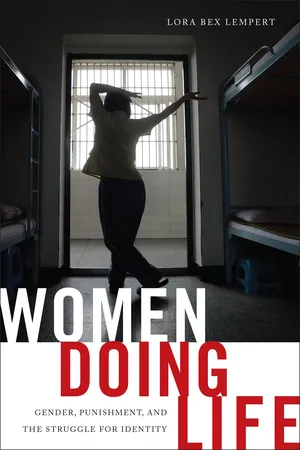
How do women – mothers, daughters, aunts, nieces and grandmothers – make sense of judgment to a lifetime behind bars? In Women Doing Life, Lora Bex Lempert presents a typology of the ways that life-sentenced women grow and self-actualize, resist prison definitions, reflect on and “own” their criminal acts, and ultimately create meaningful lives behind prison walls. Looking beyond the explosive headlines that often characterize these women as monsters, Lempert offers rare insight into this vulnerable, little studied population. Her gendered analysis considers the ways that women “do crime” differently than men and how they have qualitatively different experiences of imprisonment than their male counterparts. Through in-depth interviews with 72 women serving life sentences in Michigan, Lempert brings these women back into the public arena, drawing analytical attention to their complicated, contradictory, and yet compelling lives.
Women Doing Life focuses particular attention on how women cope with their no-exit sentences and explores how their lifetime imprisonment catalyzes personal reflection, accountability for choices, reconstruction of their stigmatized identities, and rebuilding of social bonds. Most of the women in her study reported childhoods in environments where violence and disorder were common; many were victims before they were offenders. Lempert vividly illustrates how, behind the prison gates, life-serving women can develop lives that are meaningful, capable and, oftentimes, even ordinary. Women Doing Life shows both the scope and the limit of human possibility available to women incarcerated for life.
- 320 pages
- English
- ePUB (mobile friendly)
- Available on iOS & Android
eBook - ePub
About this book
Information
1
The Life Imprisonment of Women in America
Gender, Punishment, and Agency
We’re criminals. We’re not part of society. We have no rights. Ilene Roberts
This is the lowest you can get besides death. Royal Tee
What I feel is not understood is that we have something to give. Even if it is in our little communities, we have something to give our families and the free world. Sandy
In the last four decades, the United States has become a more punitive society at every level of government and in all regions, supporting imprisonment without historical precedent or international parallel.1 With 5% of the world’s population, but 25% of its imprisoned citizens, the United States maintains the largest custodial infrastructure on the planet.2 This punishment American style has resulted in what criminologists Glenn Loury and Bruce Western call a “prison leviathan” and criminal justice policy expert Samuel Walker calls “an imprisonment orgy.”3
One third of all the incarcerated women in the world are in U.S. prisons.4 Although men constitute 93% of the U.S. prison population, the number of women under state and federal correctional authority is the fastest-growing segment of the U.S. prison population.5 Between 1980 and 2010 the population of incarcerated women increased 646%.6 In 2011 more than 1,400,000 women were under the supervision of the criminal-processing system,7 that is, on probation or parole, incarcerated, or subject to other forms of formal justice control.8 Race is significant in these incarcerations, as black non-Hispanic women are incarcerated at 2–3 times the rate of white women (129 vs. 51 per 100,000) and Latina women are incarcerated at 1.4 times the rate of white women (71 vs. 51 per 100,000), although, reflecting their higher percentage in the U.S. population, more white than black or Hispanic women are incarcerated.9 Age is also significant: About 60% of both white and black imprisoned females are age 39 or younger, as are 67% of Hispanic females.10 Additionally, many currently incarcerated women were single heads of households and mothers of dependent children prior to imprisonment.11
Prison populations, both male and female, have been increasing steadily while crime rates have fluctuated without any apparent relationship to the extensions of imprisonment.12 Recent reported declines in prison populations are largely an effect of the May 2011 Supreme Court decision requiring the State of California to reduce its prison population to 137.5% of design capacity within two years to alleviate overcrowded conditions that resulted in constitutionally inadequate medical and mental health.13 Because California incarcerates more people than any state except Texas, changes in California’s prison population have had national statistical implications.14
The dramatic increases in female imprisonment, the 646% increase,15 have not been a response to more violent female criminality as media constructions would have us believe. Women’s share of violent crime has remained more or less stable since the 1980s.16 There are, however, more female arrests now than in the past.17
Various scholars have offered explanations for these increases. Criminologist Barbara Owen argues that the more frequent and lengthier sentences imposed on women are a consequence of women’s economic marginalization and their limited avenues for survival as well as changes in the system that have resulted in more punitive responses to women’s involvement in drug-related crimes.18 Criminal justice theorists Meda Chesney-Lind and Lisa Pasko argue that longer sentences for women reflect a criminal-processing fervor to treat men and women “equally,” despite their asymmetrical involvement in criminal activity.19 This “equality with a vengeance” accounts, in large part, for the dramatic increases in female incarcerations. Additionally, they posit that the government’s War on Drugs has actually been a war on poor women of color, dramatically increasing the rates of imprisonment for women engaged in low levels of the drug trade.20 Sentencing Project Director Marc Mauer contends that as women have always represented a small share of people committing violent crimes, their numbers in prison would not have grown so dramatically between 1980 and 2010 had it not been for changes in drug enforcement policies and practices. Criminologists Darrell Steffensmeier and Jennifer Schwartz conceptualize these changes in crime prevention protocols as “widening the net,” that is, re-framing behaviors that were formerly misdemeanors and adjudicating them as felonies (e.g., shoplifting is a felony if the products are worth a particular amount and/or if the defendant has two or more prior shoplifting convictions).21 The overcharging by police and prosecutors, which results in increased female incarcerations, is more representative of changes in policing and criminal processing than in women’s violent behavior. Ashley Nellis, a criminal justice policy analyst, also argues that changes in legislation have increased the numbers of women in prison.22 She cites specific legislative expansions of the types of offenses leading to sentences for life without parole (LWOP); the wide range of habitual offender laws that focus on the persistence of criminality over the severity of the crimes, which result in life terms without chance for parole (e.g., the “three strikes” for shoplifting convictions); and more frequent criminal-processing decisions to sentence offenders to prison terms that extend beyond life expectancy. Samuel Walker summarizes the push factors in the alarming U.S. imprisonment escalation by contending that the effects of mandatory minimum sentences, truth in sentencing laws, restrictions on good time, and a punitive public attitude have resulted in the aforementioned “imprisonment orgy” that has disproportionately affected women.23
In 2009, 4,694 women were serving life sentences in the United States, 28.4% of them without possibility of parole. Of the latter group, 176 were female juveniles.24 These LW...
Table of contents
- Cover
- Title Page
- Copyright Page
- Dedication
- Contents
- Preface
- Acknowledgments
- 1. The Life Imprisonment of Women in America: Gender, Punishment, and Agency
- 2. Carmela: “Blurred Boundaries”
- 3. Beginning the Prison Journey
- 4. Ann and Crystal: Juvenile Lifers as “Minnows in a Shark Tank”
- 5. Actively Doing Life
- 6. Desiree: A Journey toward Self-Actualization
- 7. Correctional Officers or “Us” vs. “Them”: Preserving and Challenging the Binary
- 8. Eating the Life-Sentence Elephant: “One Day at a Time”
- 9. Candace: “God Is My Answer”
- 10. The Way Forward: Policy Solutions
- Notes
- References
- Index
- About the Author
Trusted by 375,005 students
Access to over 1.5 million titles for a fair monthly price.
Study more efficiently using our study tools.
Frequently asked questions
Yes, you can cancel anytime from the Subscription tab in your account settings on the Perlego website. Your subscription will stay active until the end of your current billing period. Learn how to cancel your subscription
No, books cannot be downloaded as external files, such as PDFs, for use outside of Perlego. However, you can download books within the Perlego app for offline reading on mobile or tablet. Learn how to download books offline
Perlego offers two plans: Essential and Complete
- Essential is ideal for learners and professionals who enjoy exploring a wide range of subjects. Access the Essential Library with 800,000+ trusted titles and best-sellers across business, personal growth, and the humanities. Includes unlimited reading time and Standard Read Aloud voice.
- Complete: Perfect for advanced learners and researchers needing full, unrestricted access. Unlock 1.5M+ books across hundreds of subjects, including academic and specialized titles. The Complete Plan also includes advanced features like Premium Read Aloud and Research Assistant.
We are an online textbook subscription service, where you can get access to an entire online library for less than the price of a single book per month. With over 1.5 million books across 990+ topics, we’ve got you covered! Learn about our mission
Look out for the read-aloud symbol on your next book to see if you can listen to it. The read-aloud tool reads text aloud for you, highlighting the text as it is being read. You can pause it, speed it up and slow it down. Learn more about Read Aloud
Yes! You can use the Perlego app on both iOS and Android devices to read anytime, anywhere — even offline. Perfect for commutes or when you’re on the go.
Please note we cannot support devices running on iOS 13 and Android 7 or earlier. Learn more about using the app
Please note we cannot support devices running on iOS 13 and Android 7 or earlier. Learn more about using the app
Yes, you can access Women Doing Life by Lora Bex Lempert in PDF and/or ePUB format, as well as other popular books in Social Sciences & Criminology. We have over 1.5 million books available in our catalogue for you to explore.