How reconsidering digital media and participatory cultures from the standpoint of disability allows for a full understanding of accessibility.
While digital media can offer many opportunities for civic and cultural participation, this technology is not equally easy for everyone to use. Hardware, software, and cultural expectations combine to make some technologies an easier fit for some bodies than for others. A YouTube video without closed captions or a social network site that is incompatible with a screen reader can restrict the access of users who are hard of hearing or visually impaired. Often, people with disabilities require accommodation, assistive technologies, or other forms of aid to make digital media accessible—useable—for them.
Restricted Access investigates digital media accessibility—the processes by which media is made usable by people with particular needs—and argues for the necessity of conceptualizing access in a way that will enable greater participation in all forms of mediated culture. Drawing on disability and cultural studies, Elizabeth Ellcessor uses an interrogatory framework based around issues of regulation, use, content, form, and experience to examine contemporary digital media. Through interviews with policy makers and accessibility professionals, popular culture and archival materials, and an ethnographic study of internet use by people with disabilities, Ellcessor reveals the assumptions that undergird contemporary technologies and participatory cultures. Restricted Access makes the crucial point that if digital media open up opportunities for individuals to create and participate, but that technology only facilitates the participation of those who are already privileged, then its progressive potential remains unrealized. Engagingly written with powerful examples, Ellcessor demonstrates the importance of alternate uses, marginalized voices, and invisible innovations in the context of disability identities to push us to rethink digital media accessibility.
eBook - ePub
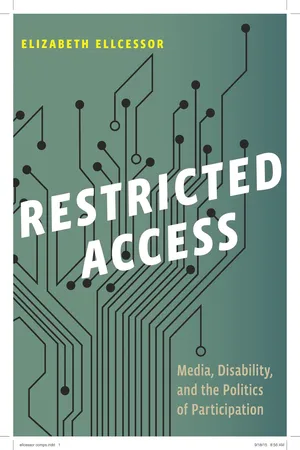
Restricted Access
Media, Disability, and the Politics of Participation
- 272 pages
- English
- ePUB (mobile friendly)
- Available on iOS & Android
eBook - ePub
About this book
Information
Topic
Ciencias socialesSubtopic
Derecho laboral y del empleo1
Regulating Digital Media Accessibility
#CaptionTHIS
In June 2012, d/Deaf and hard-of-hearing Twitter users called upon media producers to “#CaptionTHIS.” Using social media as a venue for protest, they demanded increased captioning of streaming video in a range of online contexts. The protest launched on June 6, 2012, with a video explaining arguments for online captioning (including legal regulations). Between the 6th and the 10th, there were more than 10,000 posts on Twitter employing the #CaptionTHIS hashtag.1
These activists did not rely upon any official definitions of accessibility but invoked their status as consumers of information and entertainment, employed the language of fairness and equal rights, and talked about their feelings in the face of inaccessible media. Adam Jarashow, who was one of the leaders of this event, recalled, “It dawned on me one day; people shouldn’t suffer like this, being denied their basic right to access. If this makes me feel like a second-class U.S. citizen, in no way anyone else should [sic] experience this barrier.”2 In this statement, Jarashow positions himself as both consumer and citizen, invoking the public value of equality and also drawing from the knowledge gained through his own experiences of frustration. Accessibility in this statement, and in the protest at large, is conceived of as a “right” that is not explicitly tied to laws but is invoked through a commonsense idea of fairness, of being treated “like everyone else.”
#CaptionTHIS tweets directly addressed media entities, including television networks and channels such as ABC News, CNN, Fox News, and Nickelodeon, as well as news organizations such as the Huffington Post, the New York Times, and the Washington Post; online video providers such as Amazon, Netflix, and Yahoo!; and conglomerates such as Vivendi and TimeWarner. In this way, the campaign relied upon individuals’ status as consumers, even as users asserted that they were outraged at “unfairness,” “inequality,” and the denial of their rights as citizens. Only a small portion of tweets attempted to target government officials, with most aimed directly at President Barack Obama. This blended activism of citizen-consumers has a long history in media activism3 and reflects the duality of access as simultaneously politically progressive and inflected with neoliberal values.
Most of the protest messages came from individuals and organizations fairly closely connected to d/Deaf culture and accessibility needs. Deaf activist organizations participated, including the National Association for the Deaf, and a number of accessibility organizations participated, including VITAC (a closed captioning provider), and Knowbility (an accessibility consulting group). Jarashow recalls that “we never had any doubt about how our message would be received by the deaf community. Of course our friends, allies, and anyone with hearing issues would appreciate better access.”4 However, he and his co-organizers were disappointed at the lack of response and media attention to the protest, as there was no sense that their needs and experiences were speaking back to the regulatory and institutional bodies that oversee digital media access.
The #CaptionTHIS protest demonstrates that closed captioning, despite its prevalence in the U.S. mediascape, is once again a site of regulatory uncertainty and activist concern. Though captioned television content was pioneered in the 1970s and gradually expanded through the 1980s and 1990s, the rise of digital media formats has thrown existing systems into disarray. First, the transition from televisual exhibition to online streaming meant that laws about closed captioning did not apply. The Telecommunications Act of 1996 required all new programs aired by “television video programming providers” to be captioned by 2006, and thereafter uncertainty arose around the legal status of streaming content and service providers. Second, the civil rights protections of the Americans with Disabilities Act had only recently been established as applicable to online media, with enforcement still pending. The legacies of activists, users, and innovators in closed captioning for broadcast media were all but forgotten as the digital context complicates and re-creates existing definitions and practices within governments and industries and among users themselves.
Disability similarly complicates existing conceptual and regulatory frameworks, particularly when it is understood not as a category of individual deficiency but as a social category that is inherently flexible and political in its meanings. Media regulations presume a relationship between industries, technologies, and a default abled user; when access is considered in relation to disability, numerous concerns that were otherwise invisible are often opened up. Although online streaming media enabled more on-demand access for many users,5 as shown in the case of #CaptionTHIS, it curtailed the access that d/Deaf and hard-of-hearing users had enjoyed to preceding media forms.
This chapter interrogates a range of regulatory contexts in which digital media accessibility has been defined, limited, extended, and authorized by both official and unofficial authorities. Forms of regulation explored include legal documents and processes, extralegal collaborative processes, industry standards and practices, social and community norms, and grassroots and activist perspectives. The captioning of online media emerges as a particularly useful case study for the ways in which digital media accessibility is subject to myriad regulatory forces and engaged in ongoing negotiations surrounding the rights of people with disabilities, the interests of regulatory bodies, and the neoliberal contexts in which media industries and audiences come into contact. What emerges is a persistent double bind. While the government has the advantage of enforcement, its regulatory requirements prevent the kinds of flexible, progressive understandings of disability that may create innovative accessibility solutions. Simultaneously, the flexible and nuanced approaches that industries and accessibility professionals can adopt do not carry the weight of enforcement. In the face of this stalemate, several different processes of self-regulation are coming to define accessibility for government personnel, industries, activists, and accessibility professionals alike.
Interrogating Regulation
In the “access kit” discussed in the Introduction to this book, regulation is the first of five categories through which one might study the vicissitudes of access to media. It is a conjectural space, useful for setting aside particular concerns in order to look at the ways in which access is produced via a range of policies, forms of enforcement, and cultural norms. Like each of the other categories in this kit, regulation is defined not by inflexible official structures or specific methods of study but by the following three questions and the contexts and methods needed to answer them:
- How is a medium, and access to it, defined, and by whom, in this case?
- What are the structures that limit or expand access in this case?
- What official and unofficial sources of power exert discursive authority?
These questions attempt to unearth the sources of power that produce and enforce ways of understanding and accessing a medium. These are often familiar sources of regulation, such as national laws, industry standards, international agreements, and various policies. But access to media is regulated by a wide variety of institutional and cultural forces, often through mechanisms that are informal, invisible, and individual.
Many sources of regulation operate through governmentality by which the functions of government in the management of populations are offloaded onto other institutions and, ultimately, onto individuals themselves. As theorized by French poststructuralist Michel Foucault, governmentality produces powerful results by encouraging self-regulation of one’s behavior and of one’s biopolitical life. Governmentality and biopower are provocative tools for analyzing the forms of power that surround disability, which is always a matter of bodily classification, self-management, and institutional governance of bodily norms and behaviors. Such forms of self-regulation support the project of neoliberalism,6 making it particularly productive in the study of industrial and professional practices. Feminist cultural theorist Rosalind Gill demonstrates that self-regulation is endemic to new media labor, in particular, as it lacks traditional institutional structures for the establishment and enforcement of professional norms. Instead, individual workers must manage their work and identities while producing their own conformance.7 Though self-regulation may be associated with the decline of the state, the rise of neoliberalism, and the expansion of consumerist and celebrity cultures, it may also constitute a progressive space of political negotiation and ethical behavior. Finally, self-regulation need not be individual but may be a collaborative practice, shared by a community.8
Even corporate contexts can be interpreted as local communities engaged in self-regulation, particularly when studied from the perspective of employees rather than executives. Internal industrial policies, or best practices, constitute a form of collective self-governance, augmented by corresponding social and cultural norms. Additionally, research may draw out “vernacular policy.”9 Unlike formal policies, vernacular policies are rules and norms of being enacted at the level of the individual, the family, the community, or the activist movement. Such practices and norms may exist in harmony with more official regulations or may emerge as counterdiscourses that challenge the regulatory actions of the powerful. The site of regulation is, simultaneously, a site of negotiation at which meanings, practices, and authority are involved in ongoing contestation. Media policy scholar Bill Kirkpatrick discusses this process in terms of policy translation, “involving metaphors of outcomes, constructions of community identity and power, and tensions between utopian and dystopian discourses.”10 Translation and negotiation offer alternatives to an overly simplistic notion of policy as deterministic; though policies may exist, in a variety of contexts, their effects are not always predictable. Through exploration of sources of policy, policy documents, and subsequent debate and practice, a fuller picture of regulation emerges in which the production and maintenance of particular norms may be understood as necessary to the operations of regulatory power.
Though governmentality signals a shift from the rule of law to the rule of the norm, this does not render the law irrelevant; instead, the law itself operates increasingly as a norm, alongside and in combination with other normative structures.11 Thus, the study of law and policy remains central to the site of regulation, as these documents, their development, and their implementation exert productive force upon the material and technological forms of media, as well as upon their industrial practices and possible uses. Just as technological artifacts have politics, or “arrangements of power and authority in human associations,”12 so too the processes of policy development that shape technologies’ meanings and uses are political engagements with various concepts, ideologies, and forms of governance. Laws, the process of their formation, the standards by which those laws are enforced, and court cases that interpret those laws collectively form a legal discourse around a medium and structure access in particular ways.
This chapter integrates theories of regulation, governmentality, and critical cultural policy studies in order to understand the construction of digital media accessibility as a specific discourse and field of practice and in order to trace the negotiation of these meanings by interested parties. This is made possible through reliance upon archival sources, U.S. legal and government documents, policy documents produced by industry and nonprofit organizations, social media content, ethnographic and interview research in a disability blogosphere, and interviews with professionals involved in digital media accessibility in various capacities.13
Legal Policies and Discourses of Digital Media Accessibility
Within the United States, legal sources for the regulation of digital media accessibility are located within civil rights, employment, and telecommunications law. Study of the legal corpus indicates that as a source of discursive authority, these official policies attempt to define disability, and accessibility, narrowly for the purpose of enforcement. In doing so, they struggle with the variability of disability as an experience or social construct. Laws therefore may find more success in direct regulation of consumer industries than in use of a civil rights model.
The first federal law to regulate digital media accessibility was Section 508 of the Rehabilitation Act of 1973, first passed in 1986. The Rehabilitation Act of 1973 was an employment nondiscrimination law pertaining to federal contexts. It offered the first legal definition of disability based upon a social, rather than medical, model of disability. Section 508, as amended by the Workforce Investment Act of 1998, required that employees and members of the public with disabilities “have access to and use of information and data that is comparable to the access to and use of the information and data” by peers who do not have disabilities.14 Congress established an enforcement plan by which the Federal Acquisition Regulations Council, the Office of Management and Budget, and the Architectural and Transportation Barriers Compliance Board (the Access Board), among other federal agencies, would write policies and directives that incorporated 508’s mandates. The Section 508 standards were revised and then published in final form in the Federal Register on December 21, 2000, and enforcement of the standards began on June 21, 2001.15
Because of the constraints of law, particularly the need to have clear standards for interpretation and enforcement, the scope of 508 was limited to a focus on employment in the federal sector and public access to federal information. Although the standards drew most of their web provisions from the Web Content Accessibility Guidelines (WCAG) 1.0, they also dropped some and added other provisions.16 Such changes were made because of the necessity of removing subjective judgments from legally enforceable standards; for instance, one WCAG 1.0 guideline stated that the color contrast of page elements must be “sufficient” to prevent difficulties, which was an impossible standard to enforce via legal structures. Beyond removing subjective elements, the 508 standards also confronted the impossibility of making technology equally accessible to all forms of disability simultaneously,17 leading to less emphasis on universal design and similar philosophies and resulting in the prioritization of visual disabilities in the final document.
For many involved with Section 508, accessible, in practice, means “in accordance with accessibility standards.” Though this seems circular, such a definition effectively reflects the necessity of definitional precision in legal regulations. Simultaneously, however, it glosses over the complexities brought on by the diversity of disabilities, needs, and practices that could be relevant to web accessibility, forcibly simplifying this domain in order to conform with the norms of legal language and enforcement. Yet, despite its emphasis on clarity for the purposes of enforcement, the web accessibility portion of Section 508 is enforced only through the option that employees and members of the public have to sue federal agencies for noncompliance. This puts the onus of enforcement on people with disabilities themselves and means that those agencies which have not been targeted by such suits may produce inaccessible content with few consequences. In this regard, it is similar to accessibility protections granted by the ADA: Legal regulation via antidiscrimination and civil rights measures requires definitional simplification but does not guarantee rapid compliance or meaningful social justice outcomes.
Perhaps as a result of the tensions between definitional simplicity and weak enforcement in Section 508, recent advances in legal regulation have focused on direct regulation of specific industries, rather than on digital media technologies and content more generally. The efficacy of such an approach is visible in the Telecommunications Act of 1996, which mandated closed captioning of television content and provision of TTY services for d/Deaf telephone users and ushered in a new era of compliance by regulating industries directly rather than by relying upon judicial enforcement.18 In 2006, it was announced that the standards for compliance with Section 255 of the Telecom Act, which mandates accessible features in telecommunication and mass media devices and service...
Table of contents
- Cover
- Title Page
- Copyright Page
- Contents
- Acknowledgments
- Introduction: Interrogating and Integrating Access
- 1. Regulating Digital Media Accessibility: #CaptionTHIS
- 2. You Already Know How to Use It: Technology, Disability, and Participation
- 3. Transformers: Accessibility, Style, and Adaptation
- 4. Content Warnings: Struggles over Meaning, Rights, and Equality
- 5. The Net Experience: Intersectional Identities and Cultural Accessibility
- Conclusion: Collaborative Futures
- Appendix: Ethnographic Research, Interviews, and Selected Blogs
- Notes
- Bibliography
- Index
- About the Author
Trusted by 375,005 students
Access to over 1.5 million titles for a fair monthly price.
Study more efficiently using our study tools.
Frequently asked questions
Yes, you can cancel anytime from the Subscription tab in your account settings on the Perlego website. Your subscription will stay active until the end of your current billing period. Learn how to cancel your subscription
No, books cannot be downloaded as external files, such as PDFs, for use outside of Perlego. However, you can download books within the Perlego app for offline reading on mobile or tablet. Learn how to download books offline
Perlego offers two plans: Essential and Complete
- Essential is ideal for learners and professionals who enjoy exploring a wide range of subjects. Access the Essential Library with 800,000+ trusted titles and best-sellers across business, personal growth, and the humanities. Includes unlimited reading time and Standard Read Aloud voice.
- Complete: Perfect for advanced learners and researchers needing full, unrestricted access. Unlock 1.5M+ books across hundreds of subjects, including academic and specialized titles. The Complete Plan also includes advanced features like Premium Read Aloud and Research Assistant.
We are an online textbook subscription service, where you can get access to an entire online library for less than the price of a single book per month. With over 1.5 million books across 990+ topics, we’ve got you covered! Learn about our mission
Look out for the read-aloud symbol on your next book to see if you can listen to it. The read-aloud tool reads text aloud for you, highlighting the text as it is being read. You can pause it, speed it up and slow it down. Learn more about Read Aloud
Yes! You can use the Perlego app on both iOS and Android devices to read anytime, anywhere — even offline. Perfect for commutes or when you’re on the go.
Please note we cannot support devices running on iOS 13 and Android 7 or earlier. Learn more about using the app
Please note we cannot support devices running on iOS 13 and Android 7 or earlier. Learn more about using the app
Yes, you can access Restricted Access by Elizabeth Ellcessor in PDF and/or ePUB format, as well as other popular books in Ciencias sociales & Derecho laboral y del empleo. We have over 1.5 million books available in our catalogue for you to explore.