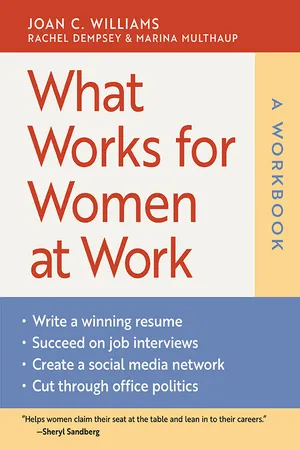
A workbook for women with practical tips, tricks, and strategies for succeeding in the workplace.
A companion to the highly successful What Works for Women at Work, this workbook offers women a hands-on guide filled with interactive exercises, self-diagnostic quizzes, and action-oriented strategies for building successful careers.
The Workbook helps women understand their work environments and experiences and move up the professional ladder. Readers will discover the four patterns of gender bias—Prove-It-Again, the Tightrope, the Maternal Wall, and the Tug of War—and they can use the toolkit to learn how to navigate the ways these patterns affect their careers. Williams and her co-authors also introduce the new concept of "Gender Judo," which involves doing a masculine thing in a feminine way, in order to avoid a backlash.
This interactive Workbook can help any working woman make better choices and offers specific advice on:·
- How to write a winning resume
- How to succeed on job interviews
- How to negotiate salary
- How to create a social media network
- How to create work-life balance
- How to cut through office politics
In addition, the best-selling What Works for Women at Work is now available in paperback. This book has already helped thousands of working women successfully navigate gender bias in the workplace. Praised by numerous publications for offering an innovative, practical, and down-to-earth approach, What Works for Women at Work is still the go-to guide for working women.
Chock full of insights, What Works for Women at Work: A Workbook will be an indispensable handbook for working women, providing the tools, the tips, and the tactics to get ahead.
eBook - ePub
What Works for Women at Work: A Workbook
- 256 pages
- English
- ePUB (mobile friendly)
- Available on iOS & Android
eBook - ePub
What Works for Women at Work: A Workbook
About this book
PART I
Get Over Yourself
You’ve learned about the four patterns of bias that—alas—affect many women on a daily basis. These patterns describe the bias that comes from outside of women, and you’ll learn creative solutions for combating these patterns.
But bias also comes from within women ourselves.
Diagnostic Quiz
(Check all that apply)
___1. Do you tend to present your ideas tentatively, using phrases like “Don’t you think …,” “I wonder if …,” or “I may be wrong but …,” rather than simply stating what you think?
___2. Do you tend to accept blame when something’s not your fault?
___3. Do you take on tasks like organizing the office holiday party because, well, you just like doing it?
___4. Do you, more than others on your team, volunteer to do the less glorious work in order to prove your value?
___5. Do you have different expectations of male than female bosses, notably by expecting the women to always be supportive?
___6. Do you criticize other women on the grounds that they are bitches or that they have “just turned into men”?
___7. Do you criticize other women on the grounds that they are pushovers or just suck up to the men or lack executive presence?
If you checked any of these, you need to ask yourself whether you yourself are participating in gender bias. You may not be. Chapters 1 through 4 will help you decide.
1
Overcoming Your Own Prove-It-Again! Bias
Stop Apologizing

Who wants to be the kind of jerk who refuses to apologize when she does something wrong?
That’s not the kind of apologizing we’re talking about here. Write down an example of a time when you apologized because you’d really messed up.
Now write down a time when you apologized just to make sure no one saw you as arrogant or as a general social lubricant, even though you had done nothing wrong, and no one had even hinted that. For example, in a context where someone else made a mistake or where it’s unclear who did so, you may have said, “I’m so sorry. I should have made it clear what time zone this was in.”
Can you see the difference? When you’ve done something wrong, apologizing is a signal of strength. It’s a signal that you have the self-knowledge to recognize that you’ve messed up, the maturity to own up to your mistake, and the confidence not to let one mistake undermine your sense that your contributions going forward still have value.
But if you keep apologizing as a general social lubricant, then people see you as someone who is worried, worried, worried that she does not bring value to the table. If you don’t believe in yourself, why should others believe in you?
Now go back to the time when you apologized even though you had done nothing wrong. How could you have handled the situation differently? First, identify the goal you were seeking to achieve by framing your contribution as an apology.
Some common reasons:
“I just didn’t want to come off as arrogant.” In other words, you were worried about backlash for not being sufficiently modest, self-effacing, and nice. Try this: the next time you’re tempted to apologize, just state your views in a direct way, with quiet confidence. What happened?
If you got pushback that sent the message that you are not allowed to present your views that way, then the bias is outside your head, not inside your head.
“I just thought I was being polite. But the other person so didn’t get it.” Research by sociolinguist Deborah Tannen shows that men and women tend to have quite different conversational patterns. Women’s default mode typically is “sharing troubles”: “listen to the bad thing I did.” “No, no, I did something much worse.” “Let me tell you about the time …” This ritualized form of self-abasement is a common way women bond.1
Men, not so much. Men’s default mode is a friendly one-upmanship where the goal is to avoid being in a one-down position. So when women come in offering self-deprecation, men sometimes just don’t get it. “What kind of a loser is she,” they ask themselves, “to be handing me the one-up position without competing for it?”
Maybe men’s default mode bugs you so much that you want to work in an environment where it’s not a factor. If that’s the way you feel, go for it. But that rules out a lot of jobs—many of them really good, desirable ones. So you may need to widen your repertoire to include men’s default mode as well as women’s.
“I had gotten feedback that I come on too strong, so I figured I had nothing to lose by softening it up a bit.” If you know that you command authority and are using apologies as a softener to avoid backlash—and it’s working—then keep on doing it. That’s gender judo.
Learn to Accept a Compliment
As women, we learn from a young age to deflect compliments. So think of a recent compliment and write it down.
What did you say in response (e.g., “I got lucky” or “It was really a team effort”)?
If you accepted it, congratulations! Way to own your success. If not, come up with three things you could have said to graciously accept the compliment and acknowledge your hard work (e.g., “Thanks. I worked really hard, so it’s great to see it paying off” or “Thanks. You’ve made my day”). Again, if you don’t value your contributions, others won’t either.

The next time someone gives you a compliment, don’t deflect it—accept it. Pushing praise aside can make it feel awkward to give you a compliment. Accepting it signals that you know your own worth and makes others acknowledge it as well.
Be Willing to Ask for a Promotion
Studies show that if there are nine requirements for promotion, women tend to wait until they have all nine.2 Men will ask for promotion much earlier: they are under gender pressures to prove they are “ambitious,” which is seen as a desirable trait in men (but sometimes suspect in women, alas!). This is a natural response by women to the unspoken reality that they may have to be twice as good to get half as far.
If the men are going for it, you need to, too. If you wait to be perfect, you’re going to be waiting forever, and in the meantime, you’ll be lagging behind others who are less qualified but more confident.
Consider the job you’d like to be promoted to. What are the requirements?
Which of these requirements do you have now?
Which don’t you have?
Now approach someone in your network at work—someone a little more senior would be perfect. Ask them whether it’s time for you to apply for that promotion. If they say no, ask what skills or experiences you need in order to get ready for the promotion. (If you have a question in your mind about whether you’ve asked the right person, ask someone else—but not more than three people. You can’t spend all of your political capital on any one thing.) Write down the results here:
Now go to your supervisor, and tell them that you are interested in being promoted and that you believe that you need the following skills in order to be ready. Ask whether they can give you opportunities to develop those skills, stressing that you want to be a team player but beli...
Table of contents
- Cover
- Title Page
- Copyright
- Dedication
- Contents
- Introduction: Four Patterns Working Women Need to Know
- Part I: Get Over Yourself
- Part II: Getting the Job You Want
- Part III: Networks
- Part IV: Navigating Workplace Politics
- Part V: Handling Difficult Conversations Successfully
- Part VI: Talking Across Race About Gender Bias
- Part VII: Leave or Stay?
- Part VIII: The Final Touches
- Conclusion
- Acknowledgments
- Notes
- Index
- About the Authors
Trusted by 375,005 students
Access to over 1.5 million titles for a fair monthly price.
Study more efficiently using our study tools.
Frequently asked questions
Yes, you can cancel anytime from the Subscription tab in your account settings on the Perlego website. Your subscription will stay active until the end of your current billing period. Learn how to cancel your subscription
No, books cannot be downloaded as external files, such as PDFs, for use outside of Perlego. However, you can download books within the Perlego app for offline reading on mobile or tablet. Learn how to download books offline
Perlego offers two plans: Essential and Complete
- Essential is ideal for learners and professionals who enjoy exploring a wide range of subjects. Access the Essential Library with 800,000+ trusted titles and best-sellers across business, personal growth, and the humanities. Includes unlimited reading time and Standard Read Aloud voice.
- Complete: Perfect for advanced learners and researchers needing full, unrestricted access. Unlock 1.5M+ books across hundreds of subjects, including academic and specialized titles. The Complete Plan also includes advanced features like Premium Read Aloud and Research Assistant.
We are an online textbook subscription service, where you can get access to an entire online library for less than the price of a single book per month. With over 1.5 million books across 990+ topics, we’ve got you covered! Learn about our mission
Look out for the read-aloud symbol on your next book to see if you can listen to it. The read-aloud tool reads text aloud for you, highlighting the text as it is being read. You can pause it, speed it up and slow it down. Learn more about Read Aloud
Yes! You can use the Perlego app on both iOS and Android devices to read anytime, anywhere — even offline. Perfect for commutes or when you’re on the go.
Please note we cannot support devices running on iOS 13 and Android 7 or earlier. Learn more about using the app
Please note we cannot support devices running on iOS 13 and Android 7 or earlier. Learn more about using the app
Yes, you can access What Works for Women at Work: A Workbook by Joan C. Williams,Rachel Dempsey,Marina Multhaup,Joan Williams in PDF and/or ePUB format, as well as other popular books in Education & Careers. We have over 1.5 million books available in our catalogue for you to explore.