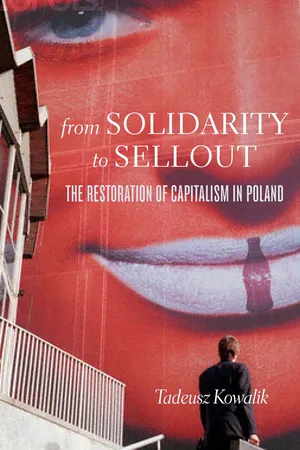
In the 1980s and 90s, renowned Polish economist Tadeusz Kowalik played a leading role in the Solidarity movement, struggling alongside workers for an alternative to "really-existing socialism" that was cooperative and controlled by the workers themselves. In the ensuing two decades, "really-existing" socialism has collapsed, capitalism has been restored, and Poland is now among the most unequal countries in the world. Kowalik asks, how could this happen in a country that once had the largest and most militant labor movement in Europe?
This book takes readers inside the debates within Solidarity, academic and intellectual circles, and the Communist Party over the future of Poland and competing visions of society. Kowalik argues that the failures of the Communist Party, combined with the power of the Catholic Church and interference from the United States, subverted efforts to build a cooperative and democratic economic order in the 1990s. Instead, Poland was subjected to a harsh return to the market, resulting in the wildly unequal distribution of the nation's productive property—often in the hands of former political rulers, who, along with foreign owners, constitute the new capitalist class. Kowalik aptly terms the transformation from command to market economy an epigone bourgeois revolution, and asks if a new social transformation is still possible in Poland.
- 270 pages
- English
- ePUB (mobile friendly)
- Available on iOS & Android
eBook - ePub
From Solidarity to Sellout
About this book
Information
PART ONE
Shock as Therapy
Sustainable development, and sustainable reform, are based on changes in ideas, interests, and coalitions. Let me repeat that such changes cannot be forced. Changes in ways of thinking often take time. That is why the approach to reform based on conditionality has largely failed. That is why the Bolshevik approach to changing society—forced changes from a revolutionary vanguard—has failed time and time again. The shock therapy approach to reform was no more successful than the Cultural Revolution [in China] and the Bolshevik Revolution.
—JOSEPH STIGLITZ, 2001
1. The Collapse of “Really Existing Socialism”
More and more I tend to believe that the system that came into being in Poland after the Second World War is a lost cause in historical terms. It must be replaced with another one which simply is efficient. The question is, however, can this be done by the same people who had built the existing system? I have true reservations about that.
—Mieczysław F. Rakowski,*
Dzienniki, December 11,1988
Dzienniki, December 11,1988
Alec Nove, the noted expert on the Russian and Soviet economies, once said, “The word ‘socialism’ is apt to produce strong feelings, of cynicism and hostility. It is the road to a future just society, or to serfdom. It is the next stage of an ineluctable historical process, or tragic aberration, a cul-de-sac, into which the deluded masses are drawn by power-hungry agitator-intellectuals.”1
It may come as a surprise to today’s reader that barely half a century ago, for many scholars and politicians, the superiority of socialism was unquestionable as a system that is not only more just but also more efficient than capitalism. This seemed to be obvious to John Putnam, the American author of the book The Modern Case for Socialism published in 1943. The table of contents gives an idea of the benefits that this system was supposed to bring: end unemployment; create hitherto unknown freedom; replace economic oligarchy with economic democracy; promote equality of opportunity, provide economic security for all; reduce inequality of income; create a free, democratic press, radio and cinema; eliminate the wastes of capitalist production, transport, marketing, commercial banks, and capital investment.2 In the individual chapters the author describes in detail the waste existing at that time in the U.S. economy in each of these domains.
Similar pledges were also made in the beginning by the Russian Bolsheviks. They turned out to be illusory, however, which can partly be explained by the lack of corroboration for the Marxist theory of historical sequence in which socialism is the next stage following (developed) capitalism.
Such an understanding of socialism, as simply the opposite of capitalism, has currently been abandoned by nearly all parties of the socialist left. This came as a consequence of the negative experiences of centrally planned economies, where state ownership was predominant, with the market playing a subordinate role, and also as a result of new achievements in economic theory.
Really existing socialism (usually referred to as communism) at first appeared to be an effective form of modernizing the economy, particularly industry. This was thought to be true for both the centralized forms of planning (above all in the USSR) and the self-management version of Yugoslav socialism. However, even though the high growth rate in Yugoslavia was impressive enough in the beginning, massive unemployment remained an unresolved problem. In both versions, state ownership led to an overgrowth of bureaucracy that stiffened the whole system, in turn making it impossible to proceed beyond an extensive form of industrialization. Yet, even from such a narrow point of view, real socialism as a substitute for capitalism could pass the test only in the first phase, and even then only to a limited extent. As Polish economist Włodzimierz Brus said:
Socialist modernization as we know it so far, seems to lack the capacity to generate a momentum of its own. Taking into account the relative backwardness of most of the countries in question, imitative development was to be expected for some time. But the degree of durability of imitation is extraordinary—except perhaps in the military sphere which we are not in a position to judge. More up-to-date technology—either imported or imitated in home production—must normally result in increased productivity; however, the modernization effect for the economy should be measured not by this result alone, but in the first place by the spill-over effect in spurring on home-grown technology and production innovation. This is hardly happening in the socialist countries, despite the supposed advantages in science and the education system, and in the abolition of commercial secrecy which was to ensure unhampered flow of information between fraternal firms, sectors and countries. Coupled with this is the inability to go deeper into structural modernization. Socialist countries have been relatively successful in developing traditional industries . . . but they have failed to show even a single case of leapfrogging into a comparatively new and promising field.3
The above reasoning was again repeated with the list of the “New Revolutionizing Products from the Period 1913-1957” presented by Hungarian economist and critic of command economies János Kornai.4 Out of the nearly eighty technological innovations made throughout the world, the USSR was cited in only three instances (housing heating, underground coal gasification, and prefabricated housing construction). To this list can be added the invention of the laser, but only on an equal footing with the United States. Among the other countries of the Soviet bloc, only Czechoslovakia could boast of one invention (Kaplan’s water turbines).* One cannot put the blame on scientists for this. According to the experts, as early as the 1920s Russian science was no worse than American science, while such disciplines as mathematics or physics were on a very high level even during Stalinist times. But the USSR’s technological backwardness became ever more marked during the last decade of the empire, when the achievements of the IT revolution were quickly spreading all over the world.
Within the Soviet bloc, growth began losing momentum soon after Khrushchev’s famous pledge from the early 1960s that the Soviet Union would catch up with the United States in per capita income within little more than a decade. The slowdown in growth affected the traditional branches of industry, and stagnation became more evident. In the 1970s and 1980s it became clear that apart from the military sector the economies of the socialist countries were not able to absorb and utilize the Western achievements of the IT revolution.
The stagnation phase merely confirmed the fall of the myth of the superiority of the Soviet model of social order over capitalism. The victorious Bolshevik Revolution of November 1917 had proclaimed the establishment of the worker-peasant state, which evoked much confusion throughout the world and in particular led to new divisions within the socialist movement. In fact, there were not that many workers in backward Russia. It would have made more sense to look for the revolution’s driving force among the peasants, who in the first years obtained nationalized landed property. The revolution quickly degenerated, as had been predicted by eminent activists of the socialist movement, such as Rosa Luxemburg and Karl Kautsky. The revolutionary terror of Lenin and Trotsky gave way to blind Stalinist terror, which applied the Soviet type of Marxism to legitimize the system (later, during Brezhnev’s times, called “really existing socialism”).
Today, the Soviet model is widely regarded as a historically unsuccessful road to economic development. However, such a general conclusion does not tell the whole story. At the beginning of the last decade, a survey was conducted with the question: “When was life easier—in communist Poland or today?” More than 50 percent of the respondents preferred the old system and only 11.5 percent the existing one.5 A similar trend can be observed in all post-communist countries. More than two-thirds of respondents have said that the system established in Poland after 1989 has had an unfavorable impact on their lives. Since that crucial year, more and more analysts are giving thought to both the advantages and disadvantages of the old system, recalling above all the existence of full employment and universal social security, even if of a low standard.*
Many socialists, Trotskyites, and social democrats have denied that this formation ever had any socialist character, going so far as to say that this was distorted or degenerated socialism. For a long time, however, it seemed that under favorable circumstances the system would evolve in the direction of democratic socialism. And the main obstacles to be overcome—according to the proponents of this theory—were not some imminent errors existing in the doctrine, but the obstinacy of the structured bureaucracy defending its own interests.
According to conservative economist Joseph Schumpeter, the Soviet Union came into being by a fluke. Yet this became an important historical fact in the formation of today’s world. However, the implementation of communism in Central Europe and a good part of Asia, as well as its radiation to Third World countries, was already no coincidence. The fact that such a system could last for seventy years also bespeaks its longevity, albeit its existence was based on the strength of an open and secret machine of repression. But repression itself is not enough to maintain power. The process leading to the downfall of socialism revealed that the machinery of repression becomes powerless if societies in their mass reject the existing system.
Without going into an analysis of the causes that ensured victory for the Bolsheviks, followed by the spread of the Soviet system model to other countries, I shall dwell instead on the main features of a socialist economy, especially those that led to the ultimate collapse of the system. An assessment of economic categories cannot overlook the fact that the USSR under communist rule quickly became a military power alongside the United States, with a solid industrial base. And if one takes into account not only the Soviet Union, but the entire bloc, one cannot deny the considerable popularity of the system, extending well beyond the handful of its direct beneficiaries within the party or the power structures.
The most important attribute of really existing socialism was the combination of closely centralized and hierarchical political authority with state ownership of means of production.* This gave the political authority nearly absolute control over the economy. The all-encompassing planning, often called command-distributive planning, was bureaucratic in nature. During the time of the first five-year plans, the economy was subordinated to the buildup of the heavy and armaments industries. So long as the focus was on only a few economic tasks, with the mobilization (by way of political means) of unused raw materials and human resources, initially also by means of coercion, the system seemed to be working with relative effectiveness. Naturally, throughout its duration, the socialist economy (perhaps with the exception of that of Yugoslavia) became a semi-war economy, in the words of socialist economist Oskar Lange,6 without much consideration given to the needs of consumers. Work was made compulsory not only in principle, but it was also regulated by commands.
Later, following the period of the heroic plans, with the formation of a system that Kornai7 calls classical, the state continued to determine the dimensions and directions of investment, as well as most prices and the interest rate. State actions also determined the general structure of consumption, and only within this framework did the state leave to the citizens the freedom to choose goods as well as their professions and place of work. The inflated economic plans gave rise to the trend of full employment, and often to employment overgrowth, which assuaged the social tensions resulting from the low efficiency of the economy. The “soft budget constraints” of enterprises (mainly the absence of a bankruptcy threat) were not conducive to cost reduction or to the introduction of innovation. In its various forms, the Soviet system was capable of evoking and mobilizing unused means of production (especially massive, open and hidden unemployment) and, thanks to this, of achieving a high national income growth rate. Even following correction of the much falsified official statistics, the GDP growth rate in the USSR was high during the first five-year plans. Poland’s economy also developed relatively quickly until the 1960s. With the progress of industrialization, as the economy grew more complex, the initially fairly good results of extensive industrial modernization began to give way to greater chaos. On the other hand, in countries that had been industrialized earlier, the system had poor results from the beginning. This was true for both Czechoslovakia and the German Democratic Republic.
There is much truth in the words of the British economist Joan Robinson that, contrary to the predictions of Karl Marx, real socialism turned out to be not a successor of capitalism but rather a substitute for its earlier phase. However, even in the countries that had witnessed a certain growth as a result of imposed industrialization, its costs were very high. Probably the biggest expansion and overgrowth was seen in the position of party and state bureaucracy, in the formation of an all-encompassing staff nomenklatura (the bureaucratic elite enjoying special privileges) that controlled nearly all walks of social, political and economic life (the Yugoslav dissident Milovan Djilas [1957] called it the “new class”).* It was this authority that precluded the necessary, and at times widely perceived and postulated, reforms, and also led to socialist reformers achieving much poorer results than they had expected. Often reformers became political hostages to the party and state machinery, devoid of any real power.
The Deceptive Calculations of Mikhail Gorbachev and Wojciech Jaruzelski
The increasingly bold reforms in the countries of Central Europe, especially in Hungary and Poland, mostly consisted of greater borrowing of systemic institutions from capitalism. While this did not adequately improve economic efficiency, it did serve to level out systemic differences. Brus called this “the progressing indeterminacy of socialism.”8 The process of implementing market elements into the economy led, at the same time, to the “commercialization” of the attitudes of the ruling elites and their loss of faith in the superiority of socialism, thereby to the erosion of any modernization mission. As soon as the most farsighted of the communist reformers began to realize that they would not be able to carry through more profound changes solely with the Party apparatus and state administration, they had to appeal to social groups beyond the party nomenklatura, which led to a change in the power status and finally to the collapse of the entire system.
The example of Mikhail Gorbachev is particularly illustrative and also dramatic. He understood the link of glasnost (openness) with perestroika (reconstruction). It was clear to him that without the support of broader public opinion he would not be able to break through the hard walls of resistance of the ruling bureaucracy. Gorbachev also believed in a “return to the sources,” in drawing on the powers of recovery from the revolutionary tradition. All of this aroused the hostility of the corrupt apparatchiks who were scared to death of criticism, and in consequence launched an uncontrolled process that ultimately led to the disintegration of the USSR and the breakdown of the system.
Notwithstanding the many differences, a similar fate was met in Poland by General Wojciech Jaruzelski, for many years minister of defense, in the 1980s the first secretary of the ruling party, and subsequently the prime minister. He did not want the downfall of the socialist system, aiming instead at overhauling the system with the participation of the democratic opposition, which ...
Table of contents
- Cover Page
- Title Page
- Copyright Page
- Content
- Acknowledgments
- Introduction
- Part One
- Part Two
- Part Three
- Chronology
- Bibliography
- Notes
Trusted by 375,005 students
Access to over 1.5 million titles for a fair monthly price.
Study more efficiently using our study tools.
Frequently asked questions
Yes, you can cancel anytime from the Subscription tab in your account settings on the Perlego website. Your subscription will stay active until the end of your current billing period. Learn how to cancel your subscription
No, books cannot be downloaded as external files, such as PDFs, for use outside of Perlego. However, you can download books within the Perlego app for offline reading on mobile or tablet. Learn how to download books offline
Perlego offers two plans: Essential and Complete
- Essential is ideal for learners and professionals who enjoy exploring a wide range of subjects. Access the Essential Library with 800,000+ trusted titles and best-sellers across business, personal growth, and the humanities. Includes unlimited reading time and Standard Read Aloud voice.
- Complete: Perfect for advanced learners and researchers needing full, unrestricted access. Unlock 1.5M+ books across hundreds of subjects, including academic and specialized titles. The Complete Plan also includes advanced features like Premium Read Aloud and Research Assistant.
We are an online textbook subscription service, where you can get access to an entire online library for less than the price of a single book per month. With over 1.5 million books across 990+ topics, we’ve got you covered! Learn about our mission
Look out for the read-aloud symbol on your next book to see if you can listen to it. The read-aloud tool reads text aloud for you, highlighting the text as it is being read. You can pause it, speed it up and slow it down. Learn more about Read Aloud
Yes! You can use the Perlego app on both iOS and Android devices to read anytime, anywhere — even offline. Perfect for commutes or when you’re on the go.
Please note we cannot support devices running on iOS 13 and Android 7 or earlier. Learn more about using the app
Please note we cannot support devices running on iOS 13 and Android 7 or earlier. Learn more about using the app
Yes, you can access From Solidarity to Sellout by Tadeusz Kowalik, Eliza Lewandowska in PDF and/or ePUB format, as well as other popular books in Economics & Political Economy. We have over 1.5 million books available in our catalogue for you to explore.