- 768 pages
- English
- ePUB (mobile friendly)
- Available on iOS & Android
eBook - ePub
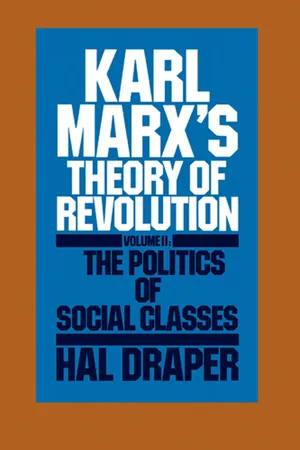
Karl Marx’s Theory of Revolution Vol. II
About this book
This is the second installment of Hal Draper's incomparable treatment of Marx's political theory, policy, and practice. In forceful and readable language, Draper ranges through the development of the thought of Marx and Engels on the role of classes in society. This series, Karl Marx's Theory of Revolution, represents an exhaustive and definitive treatment of Marx's political theory, policy, and practice. Marx and Engels paid continuing attention to a host of problems of revolution, in addition to constructing their "grand theory." All these political and social analyses are brought together in these volumes, as the author draws not only on the original writings of Marx and Engels but also on the sources that they used in formulating their ideas and the many commentaries on their published work. Draper's series is a massive and immensely valuable scholarly undertaking. The bibliography alone will stand as a rich resource for years to come. Yet despite the scholarly treatment, the writing is direct, forceful, and unpedantic throughout, and will appeal to the beginning student as much as the advanced reader.
Information
Subtopic
Storia mondialeI THE PROLETARIAT AND PROLETARIAN REVOLUTION
1 PATTERNS OF REVOLUTION
By 1843-1844 Marx had come to look on the proletariat as the moving force of the coming revolution. By the writing of The German Ideology Marx and Engels were quite clear that the revolution they advocated was a proletarian revolution. What did this mean to them, and what did it entail?
They spent the rest of their lives answering these questions; and by the same token it will take the rest of this work to present their answers. But we can usefully start with some basic aspects of Marx’s developed conceptions, especially in the borderland between terminology and idea.
1. REVOLUTION—SOCIAL AND POLITICAL
The word revolution is most commonly used as either a bogy or a banality, depending on whether it is seen as a sinister plot or reduced to a mere synonym for change. When the word becomes respectable, as ferocious words do when coopted, then not only is every detergent advertised as “new and revolutionary,” but every new political device is advertised as in tune with some fashionable “revolution,” such as the Revolution of Rising Expectations. More seriously, the word is also used historically to denote deep-going social change, as when the medieval invention of the horse collar is called an economic revolution, or in such terms as the Industrial Revolution. This is not said to object to such usages, but to differentiate them from those encountered in the framework of Marx’s theory.
In a more specific sense, a revolution is seen as a transfer of governmental power. But this still covers a host of ambiguities. Transfer of power from whom to whom, or from what to what? As popularly used, it may simply be a matter of a change in personnel: this set of colonels in the Government Palace instead of that set of politicians; the substitution of one clique or faction for another. The term is activated especially if directly forceful methods are used instead of constitutional forms. It may make no more difference than the substitution of one set of political manipulators for another by any other means—for example, by more or less corrupt elections, or even honest ones.
The case becomes more interesting if one faction represents not merely a different set of pockets or Swiss bank accounts, but a different stratum or group interest—even if still within the ruling class. Marx’s analysis of Bonapartism brought up many examples of this. Or, as we also saw in that analysis, the new wielders of political power may represent not a different social stratum of the ruling class but merely a different political policy, with or without a different ideological orientation. Or, perhaps most likely of all, both may be true: a different social stratum acts as the bearer of a different policy or ideology. Certainly the historical tendency is toward such a combination. But history exhibits various permutations within these boundaries, the boundaries being set by the range of possibilities for a given social system and its ruling class.
Within these boundaries, one very important type of difference may involve changes in political structure, in state forms. In modern history most of these cases involve shifts from more or less democratic state forms to antidemocratic ones (military dictatorship, fascism) or the other way round. It is such transformations in governmental forms that especially tend to get called revolutions. These are the most highly visible forms of transfers of governmental power. All of these involve political revolutions.
Political revolution, then, puts the emphasis on the changes in governmental leadership and forms, transformations in the superstructure. But if such a revolution involves a change in social stratum even within the ruling class, a social element is plainly entailed. Political revolutions run the gamut, from those involving almost no social side, to those with a very important social element, even if it is within the class boundaries we have assumed.
If these social boundaries are burst by the impact of the change, then we have a different sort of revolution, which is of special importance to Marx’s theory. As Marx explained to a Cologne jury in 1849: the development of insoluble contradictions within the society “prepares the way for social crises, which burst out in political revolutions.”1 The outcome is a revolution involving the transference of political power to a new class; and this change in ruling class tends to entail a basic change in the social system (mode of production). It is this kind of revolution which is most properly called a social revolution.
Unfortunately this does not end the terminological problem, as we weave our way through the voluminous literature that talks about revolution. If we decide to define social revolution as a basic transformation in the social system involving its class base, then it is apparent that such a sweeping change cannot be conceived as a mere act or event, but as a process, more or less extended in time. The transformation from capitalism to socialism is envisaged by Marx as such a historical process (as we shall see in Volume 4). Moreover, it is clear that in some cases in the past, social systems have changed basically, and classes have risen and fallen, in a secular movement of history which can be described as a social revolution—at least in historical retrospect, even though no one may have been aware that a revolution was going on.
It would be convenient if such a long-term or secular transformation in society, however achieved, had a tag of its own, so that one could discuss its relationship to other things called revolutions. There is no such agreed-on label; we must take the desperate recourse of inventing one. Let us call this a societal revolution, meaning that it denotes a change from one type of society to another, keeping in mind that for Marx’s theory a society is not simply a cultural but a socioeconomic whole.
We can now narrow our focus to what tends to be called a social revolution in Marx’s theory. It is most clearly used for a political revolution that expresses a social-revolutionizing drive toward the transference of state power to a new class. It is “a political revolution with a social soul,” in Marx’s earliest (1844) formulation.2 By the same token it points in the direction of a societal revolution, regardless of when changes in the social system actually begin to take place. It does this by establishing a new constellation of sociopolitical forces, with new historic potentialities. The societal revolution is the realization of these potentialities. “Every real revolution,” wrote Engels, “is a social one, in that it brings a new class to power and allows it to remodel society in its own image.”3
Our aim is not to make a hard-and-fast distinction between political revolutions and social revolutions but, if anything, the reverse: to recognize how often they are mingled in given revolutionary situations, so that the two elements must be distinguished by analysis. For, especially in modern times, revolutionary events tend to blend both in varying proportions. The purely political revolution, involving a change in factions only, is likely to be a mere palace revolution, that is, one in which the upset takes place only on top without drawing in any sector of the people as actors on the scene. It is increasingly limited to socially backward areas. The modern tendency is for political revolution, however narrowly initiated, to waken the elements of social revolution from dormancy or to raise them to new levels. Thus the relationship between political and social revolution is not static. All this has been true of bourgeois revolutions since the first stirrings of the bourgeoisie, and it will provide important background for our chapters on that subject (Chapters 7-10 below). In terms of Marx’s development, it was the revolution of 1848-1849 that was the proving ground.
For Marx, then, revolution is defined by the nature of the change involved, by sociopolitical relations. In the popular mind, where “the ruling ideas are the ideas of the ruling class,” and therefore in journalistic terms, revolution and revolutionary developments are seen primarily in terms of particular means: force and violence, as departures from the political methods prescribed by the established powers. We shall devote considerable attention, in Volume 3, to Marx’s conception of the relationship between social revolution and the means to effect it; suffice to say that the relationship emerges from a social historical analysis—it is not one of definition. Just as revolutionary change obviously did not always involve violent action ipso facto, so also violent outbreaks are by no means necessarily revolutionary, even if this term is stretched to include counterrevolutionary. Time and again, right up to today, it has taken violent methods (“revolutionary” actions in the eyes of the status quo) to gain simple reforms. Indeed, political revolution (of some limited sort) is not a rare road to social reforms. A related conception identifies revolution with the technique of the coup d’état: revolution suggests seizing the radio station, telephone exchange, local Winter Palace, and so on. This crude myth was by no means invented by Hollywood, which took it over from the respectable literature where it was already entrenched.
These ruling ideas about revolution are typically bourgeois conceptions, class-conditioned distortions of the social reality. They represent the other side of the coin of a ruling class’s built-in dread of revolutionary violence, on the one hand, and on the other, its unwillingness and inability to conceive of revolution as a social upheaval from below. A putsch by an armed gang is something it can handle, and also something it can dismiss as banditry or pathology; in neither case need it face the social reality of mass revolution, which often comes as a surprise. The definition of revolution in terms of means (violent, illegal) is a characteristic of bourgeois ideology just as much as its opposite, namely, the insistence that social change must be limited to nonviolent means. This bourgeois approach provides a spectrum from the most pacifistic reform to the most violent putschism; and no part of it has anything to do with Marx’s theory, which stands outside of this obsession with the dichotomy of violence or nonviolence.
The revolution that concerns Marx is defined by the nature of the social change it entails, by the class relationships in that change. It is a political revolution which is the immediate manifestation of a social revolution.
2. CLASS POLITICAL POWER
Proletarian revolution is, then, a short form for proletarian social revolution—transference of state power to a new ruling class, the proletariat.
This raises the problem of the class nature of the new political power. In principle this problem is no different from that of analyzing the class nature of any other political institutions, including those of the established society; this is what we discussed under the head of the theory of the state, in Volume 1. The difference is that in a revolutionary context everything is in flux, and does not meekly stand still for leisurely examination. The difficulties thus created are immense.
Marx offered no political formulas on this subject, nor could he do so. The totality of a social (class) analysis is at stake. Marx had to take up more than once the nature of given political movements that aspired to power or were moving to seize it. He had to analyze stated declarations, claimed intentions, programmatic documents, articulated ideologies and unarticulated biases, the correspondence of word and deed, objective socioeconomic linkages, and everything else bearing on the totality of the class configuration, not only at a given moment but over a period of experience. This refers us back to the social theory on which politics (including Marx’s politics) is based. Working this problem out in a concrete case tests a theory of society’s laws of motion.
The Communist Manifesto raised this problem in a discussion of what it called feudal socialism. Its interest lies in this: it identifies a type of “socialism” which conceals its real class character behind an appeal to the proletariat’s interests:
Owing to their historical position, it became the vocation of the aristocracies of France and England to write pamphlets against modern bourgeois society….
In order to arouse sympathy, the aristocracy were obliged to lose sight, apparently, of their own interests, and to formulate their indictment against the bourgeoisie in the interest of the exploited working class alone …
In this way arose feudal Socialism … half echo of the past, half menace of the future; at times, by its bitter, witty and incisive criticism, striking the bourgeoisie to the very heart’s core; but always ludicrous in its effect, through total incapacity to comprehend the march of modern history.
The problem of exposure is first solved with a flourish:
The aristocracy, in order to rally the people to them, waved the proletarian alms-bag in front for a banner. But the people, so often as it joined them, saw on their hindquarters the old feudal coats of arms,* and deserted with loud and irreverent laughter.4
But the section ends with a more concrete sociopolitical analysis of what betrays feudal socialism as antiproletarian. More important, we shall see in Chapter 9 below that Marx and Engels did in fact have to write a great deal more to analyze the nature of this alien socialism—alien to the proletariat as a class.
But analysis does not end the matter; the proof of the pudding is in the eating; the class nature of revolution is tested by what the new class in power does. Social revolution means that the new class in power does not limit itself to change within the framework of the old social system, but tends to put its new state power into basic conflict with the former ruling strata. And the conflict must be resolved more or less quickly in favor of the new or the old; the new political power must proceed to revolutionize the socioeconomic foundation, or else it will be destroyed by the rooted power of the latter. In either case, by revolution or counterrevolution, congruence will eventually be reestablished between the political and socioeconomic institutions.
The conflict may be seen by both sides only in embryo. This is what happened when, four months after the February revolution of 1848, the Paris workers rose up against the new republican regime. In the midst of these June Days, Marx wrote about the difference:
None of the innumerable revolutions of the French bourgeoisie since 1789 was an assault on order, for they left standing class rule, the slavery of the workers, the bourgeois order, no matter how often the political form of this rule and this slavery changed. June has impugned this order. Woe to June!5
Marx had to make this analysis in the flux of struggle. After all, the pr...
Table of contents
- Cover Page
- Title Page
- Copyright Page
- Dedication
- Contents
- Foreword
- Part I: The Proletariat and Proletarian Revolution
- Part II: Social Classes in Revolution
- Part III: Mixed-Class Elements
- Appendices
- Reference Notes
- Bibliography (Works Cited)
- Index
- List of Errata for Volume 1
- Footnote
Trusted by 375,005 students
Access to over 1.5 million titles for a fair monthly price.
Study more efficiently using our study tools.
Frequently asked questions
Yes, you can cancel anytime from the Subscription tab in your account settings on the Perlego website. Your subscription will stay active until the end of your current billing period. Learn how to cancel your subscription
No, books cannot be downloaded as external files, such as PDFs, for use outside of Perlego. However, you can download books within the Perlego app for offline reading on mobile or tablet. Learn how to download books offline
Perlego offers two plans: Essential and Complete
- Essential is ideal for learners and professionals who enjoy exploring a wide range of subjects. Access the Essential Library with 800,000+ trusted titles and best-sellers across business, personal growth, and the humanities. Includes unlimited reading time and Standard Read Aloud voice.
- Complete: Perfect for advanced learners and researchers needing full, unrestricted access. Unlock 1.5M+ books across hundreds of subjects, including academic and specialized titles. The Complete Plan also includes advanced features like Premium Read Aloud and Research Assistant.
We are an online textbook subscription service, where you can get access to an entire online library for less than the price of a single book per month. With over 1.5 million books across 990+ topics, we’ve got you covered! Learn about our mission
Look out for the read-aloud symbol on your next book to see if you can listen to it. The read-aloud tool reads text aloud for you, highlighting the text as it is being read. You can pause it, speed it up and slow it down. Learn more about Read Aloud
Yes! You can use the Perlego app on both iOS and Android devices to read anytime, anywhere — even offline. Perfect for commutes or when you’re on the go.
Please note we cannot support devices running on iOS 13 and Android 7 or earlier. Learn more about using the app
Please note we cannot support devices running on iOS 13 and Android 7 or earlier. Learn more about using the app
Yes, you can access Karl Marx’s Theory of Revolution Vol. II by Hal Draper in PDF and/or ePUB format, as well as other popular books in Politica e relazioni internazionali & Storia mondiale. We have over 1.5 million books available in our catalogue for you to explore.