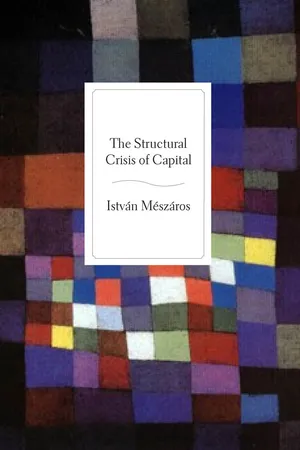
In this collection of trenchant essays and interviews, István Mészáros, the world's preeminent Marxist philosopher and winner of the 2008 Libertador Award for Critical Thought (the Bolivar Prize), lays bare the exploitative structure of modern capitalism. He argues with great power that the world's economies are on a social and ecological precipice, and that unless we take decisive action to radically transform our societies we will find ourselves thrust headfirst into barbarism and environmental catastrophe.
Mészáros, however, is no pessimist. He believes that the multiple crises of world capitalism will encourage the working class to demand center stage in the construction of a new system of production and distribution designed to meet human needs rather than serve the relentless pursuit of profit—a struggle which is already underway in places such as Venezuela. As John Bellamy Foster says in the foreword to this indispensable book, "Today the structural crisis of capital provides the historical setting for a new revolutionary movement for social emancipation in which developments normally taking centuries would flit by like phantoms in decades or even years. But the force for such necessary, vital change, remains with the people themselves, and rests on humanity's willingness to constitute itself as both subject and object of history, through the collective struggle to create a just and sustainable world. This, Mészáros insists, constitutes the unprecedented challenge and burden of our historical time."
- 218 pages
- English
- ePUB (mobile friendly)
- Available on iOS & Android
eBook - ePub
The Structural Crisis of Capital
About this book
Information
Topic
FilosofiaSubtopic
Filosofia politicaCHAPTER ONE
The Unfolding Crisis and the Relevance of Marx1
Some of you may have been present at our meeting, in May of this year, when I recalled what I said to Lucien Goldman in Paris a few months before France’s historic May 1968. In contrast to the then-prevailing perspective of “organized capitalism,” which was supposed to have successfully left behind the stage of “crisis capitalism”—a view prominently asserted by Herbert Marcuse and shared also by my dear friend Lucien Goldman—I insisted that, compared to the crisis we are actually heading for, the Great World Economic Crisis of 1929–1933 would look like the Vicar’s tea party.
In the last few weeks you have had a foretaste of what I had in mind, but no more than a foretaste. The structural crisis of the capital system as a whole, which we are experiencing in our time on an epochal scale, is bound to get considerably worse. It will become in due course much deeper, in the sense of invading not only the world of more or less parasitic global finance but also every single domain of our social, economic, and cultural life.
The obvious question we must now address concerns the nature of the globally unfolding crisis and the conditions required for its feasible resolution.
1. “CONFIDENCE” AND ITS DISAPPEARANCE
If you try to remember what you have heard endlessly repeated about the current crisis, one word stands out, overshadowing all of the other claimed diagnoses and corresponding remedies. That word is confidence. If we could get a ten pound note for every occasion when that magic word has been offered for public consumption in the last two weeks all over the world, not to mention its continued reassertion ever since, we would all be millionaires. Our only problem would be what to do with our suddenly acquired millions. For none of our banks, not even our recently nationalized banks—nationalized to the tune of no less than two-thirds of their capital assets—could supply the legendary confidence required for safe deposit or investment.
Our Prime Minister, Gordon Brown, presented us with the memorable phrase: “Confidence is the most precious thing.” I know the song—and probably most of us do—which tells us that: “Love is the most precious thing.” But confidence in capitalist banking being the most precious thing—that suggestion is utterly perverse! Nevertheless, the advocacy of this magic remedy now seems to be universal. It is repeated as if confidence could simply rain out of the sky or grow on trees.
Three days ago (on the 18th of October) the BBC’s flagship Sunday morning interview program, the Andrew Marr program, wheeled out a very distinguished elderly gentleman: Sir Brian Pitman, the former head of Lloyds Bank. They did not say when he headed that organization, but the way he spoke made it amply clear. For it transpired through his respectfully received answers that he might have been the head of Lloyds Bank well before the world economic crisis of 1929–33. He introduced a great conceptual innovation into the confidence discourse, saying that our troubles were all due to some overconfidence. And he immediately also demonstrated the meaning of “overconfidence,” by saying that there can be no serious problem today because the market always takes care of everything. Even if sometimes it has gone unexpectedly far down, later it always goes up again. So it will do so this time, and it will unfailingly go up again and again in the future. The present crisis should not be exaggerated, he said, because it is much less serious today than what we experienced way back in 1974. For in 1974 we had a three-day working week in Britain [introduced by the Conservative government to save energy during the miners’ strikes], and now we do not have it. And who could argue with that irrefutable fact?
2. A PSEUDO-HEGELIAN TRIAD
Thus, we now have the magic explanatory word of all our troubles not standing like an unhappy orphan, alone, but as part of something like a Fukuyamized pseudo-Hegelian triad: confidence, lack of confidence, and overconfidence. The only constituent missing from this magic explanatory discourse is the real foundation of our perilous banking and insurance system, which operates on the ground of self-serving confidence tricks that sooner or later are bound to be (and from time to time actually have been) found out.
In any case, all this talk about the absolute virtue of confidence in capitalist economic management is much like the explanation offered in Indian mythology about the supporting ground of the universe. In that ancient vision of the world, it is said that the universe is carried, most reassuringly, on the back of an elephant. No one should think of that as a difficulty. For the elephant is, even more reassuringly, supported on the back of the cosmic tortoise. But what holds up the cosmic tortoise? Don’t you dare ask such a question, lest you might be fed to the tigers of Bengal!
Luckily, perhaps, The Economist is a little bit more realistic in its assessment of the situation. In the context of our painful subject, the now-acknowledged worsening economic crisis, I am going to give you exact quotations, including some damning figures of capitalist failures that are no longer deniable, taken mainly from such well established and unabashedly class-conscious bourgeois newspapers as The Economist and The Sunday Times. I will quote them meticulously, word for word, not only because they are prominent in their field but also in order to fore-stall any accusation of left-wing bias and distortion.
Marx used to say that on the pages of The Economist the ruling class is “talking to itself.” Things have changed somewhat since those days. For now, even in the specialized field of economic expertise, the ruling class needs a mass circulation propaganda organ for the purpose of general mystification. In Marx’s lifetime, the ruling class had plenty of “confidence” and also a great deal of unchallenged “overconfidence.” But, under the present circumstances, The Economist—the self-righteous mouthpiece of the U.S.-dominated annual “Davos Jamboree”—concedes that the crisis we are facing today is concerned with the difficulties of “Saving the System,” according to the cover of its October 11, 2008 issue.
We can grant, of course, that nothing less than ‘saving the system’ (or not) is what happens to be at stake in our time, even if The Economist’s discussion of this problem is rather strange and contradictory. For in its usual way of trying to present its highly partisan position as an objectively balanced view, by using the formula of “on the one hand, but on the other hand,” The Economist always succeeds in reaching its desired conclusion in favor of the established order. Thus, The Economist asserts, in the principal lead article in its October 11 issue, that: “This week saw the first glimmer of a comprehensive global answer to the confidence gap.” Now, thankfully, the confidence gap, although reprehensible in itself, is expected to be remedied. This is all thanks to a somewhat mysterious ‘comprehensive global answer.’
More realistically, the London weekly also acknowledges in the same editorial article that: “The damage to the real economy is becoming apparent. In America consumer credit is now shrinking, and around 150,000 Americans lost their jobs in September, the most since 2003. Some industries are hurting badly: car sales are at their lowest level for 16 years as would-be buyers are unable to get credit. General Motors has temporarily shut some of its factories in Europe. Across the globe forward-looking indicators, such as surveys of purchasing managers, are horribly gloomy.” They do not say, though, that the confidence gap may have something to do with such facts.
Of course, an apology for the system must prevail in every article, even if it must be presented as the unquestionable word of pragmatic wisdom. In this sense, “saving the system” amounts to the journal’s totally uncritical identification with, and the uncontestable advocacy of, an unlimited economic rescue operation—to be accomplished by no means out of the customarily and dogmatically glorified market resources—in favor of the troubled capitalist system. Thus, even the most cherished and well-tried propaganda tenets (of a not only nonexistent but never in reality existent free market) can be now thrown overboard for the noble cause of “saving the system.” Accordingly, we are told by The Economist that: “The world economy is plainly in a poor shape, but it could get a lot worse. This is the time to put dogma and politics to one side and concentrate on pragmatic answers. That means more government intervention and co-operation in the short term than taxpayers, politicians or indeed free-market newspapers would normally like.”2
President George W. Bush has treated us to similar sermons. He told his television audience that normally and instinctively he is a believer in, and a passionate supporter of, the free market, but under the present exceptional circumstances he must think of other ways. He must begin to think under these exceptional circumstances, full stop. You cannot say that you have not been warned.
The sums involved in the recommended “pragmatic” solution, which advocates sweeping aside the “normal likings” of the “taxpayers and free market newspapers” (that is, the now advocated solution that means, in truth, the necessary submission of the great masses of the people to increasing tax burdens sooner or later) are literally astronomical. To quote The Economist again: “In little more than three weeks America’s government, all told, expanded its gross liabilities by more than $1 trillion—almost twice as much as the cost so far of the Iraq War.”3 “American and European banks will shed some $10 trillions of dollars.”4 “But history teaches an important lesson: that big banking crises are ultimately solved by throwing in large dollops of public money.”5
Tens of trillions of dollars of public money thrown in and justified in the name of the claimed important lesson of history, and of course in the service of the unchallengeable good cause of saving the system—that is certainly quite a dollop. No High Street ice-cream vendor could ever dream about such tsunami-size dollops. Not even in his worst nightmare.
In the course of last year alone, “The Economist’s food price index jumped by nearly 55%,”6 and “the food-price spike in late 2007 and early 2008 caused riots in some 30 countries.”7 Such facts reveal even more about the nature of the system, which now finds itself in ever deepening crisis. Can you think of a stronger indictment for a purportedly unsurpassable system of economic production and societal reproduction? At the height of its productive power, this system is producing a global food crisis and the suffering of countless millions all over the world. That is the nature of the system that is expected to be saved now at all costs.
How can one make some tangible sense out of all of the wasted trillions? Since we are talking about astronomical magnitudes, I addressed this question to a close friend who is a professor of astrophysics at London University. His answer was that I should point out that one trillion alone is roughly one hundred times the age of our universe. Now, the official figure for the American debt, which is regularly understated, amounts to more than ten trillion dollars. That is, one thousand times the age of our universe.
Let me quote a short passage from a Japanese publication. It reads:
How much speculative money is moving around the world? According to a Mitsubishi UFJ Securities analysis, the size of the global “real economy,” in which goods and services are produced and traded, is estimated at $48.1 trillion…. On the other hand, the size of the global “financial economy,” the total amount of stocks, securities, and deposits, adds up to $151.8 trillion. The financial economy thus has swollen to more than three times the size of the real economy, growing especially rapidly during the past two decades. The gap is as large as $100 trillion. An analyst involved in this estimation said that about half the amount, $50 trillion is scarcely necessary for the real economy. Fifty trillion dollars are worth well over 5,000 trillion yen, too big a number for me to actually comprehend.8
It is, indeed, very difficult even to comprehend, not to mention to justify, as our capital-apologetic politicians and bankers do, the astronomical sums of parasitic speculation accumulated to a magnitude corresponding to 500,000 times the age of our universe. If you wish to have another measure about the magnitude involved, just imagine an unlucky accountant from Roman times, who is asked nothing more than simply to chalk up on his blackboard the figure of 5,000 trillion yen, in Roman numerals. He would be in total despair. He simply could not do it. And even if he had at his disposal Arabic numerals, he would have needed as many as seventeen zeros after the number five in order to write down the figure in question.
The trouble is, though, that our well-heeled politicians and bankers seem to think only of the zeros, and not of their substantive linkages, when they present these problems for public consumption. And that approach cannot work indefinitely. One needs much more than zeros for getting out of the bottomless hole of the global indebtedness to which we are condemned by the system that they now want to save at all costs.
As a matter of fact, Gordon Brown’s newfound popularity has a great deal to do with zeros in more ways than one. His astonishing new popularity—which might well turn out to be rather ephemeral—was illustrated last week by the front-page newspaper headline: “From Zero to Hero.” The article in question suggested that our Prime Minister actually succeeded in saving the system. That is how he earned the high acclaim.
3. THE NATIONALIZATION OF CAPITALIST BANKRUPTCY
The reason why he was hailed in that way, as a hero, was because he invented a new variety of nationalizing capitalist bankruptcy, to be adopted with untroubled “free market conscience” by other countries as well. That made even George W. Bush feel less guilty about acting against his own proclaimed “passionate instinct” when he nationalized a huge dollop of U.S. capitalist bankruptcy, one single item of which—the liabilities of the giant mortgage companies of Fannie Mae and Freddie Mac—amounted to $5.4 trillion (that is to say, the sum required for eleven years of running the Iraq War).
The “pragmatic novelty”—as opposed to “dogma and politics” in the words of The Economist—of the recent nationalization of capitalist bankruptcy by New Labour is that the taxpayers get absolutely nothing (in other words, zero-zero-zero, as many times as you would like to write it down) for the immense sums of money invested in failed capitalist assets, including our two-thirds nationalized British banks. This kind of nationalization of capitalist bankruptcy is somewhat different from the earlier versions instituted after the Second World War when the Labour Party’s Clause 4—advocating the public control of the means of production—was still part of its Constitution. In 1945, the bankrupt sectors of the capitalist economy that were nationalized were transferred to state control. They were generously fattened up again from general taxation for the purpose of proper “privatization” in due course.
Even Conservative Prime Minister Edward Heath’s 1971 nationalization of the bankrupt Rolls Royce Company followed the same embarrassing pattern of state controlled and openly admitted nationalization. In our own day, however, the beauty of Gordon Brown’s solution is that it removes the embarrassment while multiplying manifold the billions invested in capitalist bankruptcy. Surely, that fully deserves his promotion “from zero to hero” as well as the highest accolade, “Saviour of the World,” conferred upon him by some other newspapers. All of this on account of Brown being satisfied with absolute zero in exchange for our—not his—generously dispensed billions. But can this kind of governmental remedy be considered a lasting solution to our problems, even on a short-term basis? Only a fool could believe that.
In truth, the recent measures adopted by our political and financial authorities only attended to one single aspect of the current crisis: the liquidity of the banks, mortgage, and insurance companies. And even that only to a very limited extent. In reality, the huge dollops thrown in represent no more than putting down a deposit, so to speak. Much more will be required in the future, as even the still unfolding di...
Table of contents
- Cover Page
- Title Page
- Copyright Page
- Contents
- Foreword
- Introduction: The Substance of the Crisis
- 1. The Unfolding Crisis and the Relevance of Marx
- 2. The Present Crisis
- 3. The Necessity of Social Control
- 4. Radical Politics and Transition to Socialism: Reflections on Marx’s Centenary
- 5. Bolívar and Chávez: The Spirit of Radical Determination
- 6. The Importance of Planning and Substantive Equality
- 7. A Structural Crisis of the System: January 2009 Interview in Socialist Review
- 8. The Tasks Ahead: March 2009 Interview in Debate Socialista
- Endnotes
- Index
Trusted by 375,005 students
Access to over 1.5 million titles for a fair monthly price.
Study more efficiently using our study tools.
Frequently asked questions
Yes, you can cancel anytime from the Subscription tab in your account settings on the Perlego website. Your subscription will stay active until the end of your current billing period. Learn how to cancel your subscription
No, books cannot be downloaded as external files, such as PDFs, for use outside of Perlego. However, you can download books within the Perlego app for offline reading on mobile or tablet. Learn how to download books offline
Perlego offers two plans: Essential and Complete
- Essential is ideal for learners and professionals who enjoy exploring a wide range of subjects. Access the Essential Library with 800,000+ trusted titles and best-sellers across business, personal growth, and the humanities. Includes unlimited reading time and Standard Read Aloud voice.
- Complete: Perfect for advanced learners and researchers needing full, unrestricted access. Unlock 1.5M+ books across hundreds of subjects, including academic and specialized titles. The Complete Plan also includes advanced features like Premium Read Aloud and Research Assistant.
We are an online textbook subscription service, where you can get access to an entire online library for less than the price of a single book per month. With over 1.5 million books across 990+ topics, we’ve got you covered! Learn about our mission
Look out for the read-aloud symbol on your next book to see if you can listen to it. The read-aloud tool reads text aloud for you, highlighting the text as it is being read. You can pause it, speed it up and slow it down. Learn more about Read Aloud
Yes! You can use the Perlego app on both iOS and Android devices to read anytime, anywhere — even offline. Perfect for commutes or when you’re on the go.
Please note we cannot support devices running on iOS 13 and Android 7 or earlier. Learn more about using the app
Please note we cannot support devices running on iOS 13 and Android 7 or earlier. Learn more about using the app
Yes, you can access The Structural Crisis of Capital by István Mészáros in PDF and/or ePUB format, as well as other popular books in Filosofia & Filosofia politica. We have over 1.5 million books available in our catalogue for you to explore.