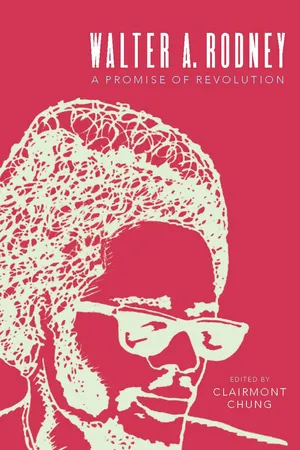
The life of the great Guyanese scholar and revolutionary Walter Rodney burned with a rare intensity. The son of working class parents, Rodney showed great academic promise and was awarded scholarships to the University of the West Indies in Jamaica and the School of African and Oriental Studies in London. He received his PhD from the latter at the age of twenty-four, and his thesis was published as A History of the Upper Guinea Coast, now a classic of African history. His most famous work, How Europe Underdeveloped Africa, is a mainstay of radical literature and anticipated the influential world systems theory of Immanuel Wallerstein.
Not content merely to study the world, Rodney turned to revolutionary politics in Jamaica, Tanzania, and in Guyana. In his homeland, he helped form the Working People's Alliance (WPA) and was a consistent voice for the oppressed and exploited. As Rodney became more popular, the threat of his revolutionary message stirred fears among the powerful in Guyana and throughout the Caribbean, and he was assassinated in 1980.
This book presents a moving and insightful portrait of Rodney through by the words of academics, writers, artists, and political activists who knew him intimately or felt his influence. These informal recollections and reflections demonstrate why Rodney is such a widely admired figure throughout the world, especially in poor countries and among oppressed peoples everywhere.
- 208 pages
- English
- ePUB (mobile friendly)
- Available on iOS & Android
eBook - ePub
About this book
Information
INTRODUCTION
1—Clairmont Chung
I was thirteen, in 1971, when Dave (not his real name) passed through my street and said he had something for me. The next day he brought new copies of Frantz Fanon’s Black Skin, White Masks,1 and an anthology, The Complete Works of Mao Tse Tung, volume 1.2 Dave had recently been deported from New York City. Occasionally, he would stop and talk. These were brief encounters on Main Street, just outside Tiger Bay in Georgetown, Guyana. He lived in Albouystown, South Georgetown, but used to visit someone in Tiger Bay.
I do not recall a lot of the details of the conversations, but I remember the books because Frantz Fanon added a dimension to my thinking that I never relinquished. Black Skin, White Masks, despite its simple title, was difficult. But I understood the main tenets on identity and neuroses that flow from oppression. The Mao volume was thick and difficult to traverse. I thought one day I would publish my own easy-to-read anthology. But those books led me to another by Fanon, The Wretched of the Earth, which I found easier. Dave and I must have talked about the Black Power movement in the United States. Dave dressed and looked like pictures I’d seen of Bobby Seale,3 H. Rap Brown,4 and the Soledad Brothers.5 Our meetings made me feel close to that movement. That same year, 1971, Walter Rodney published a tribute article to a Soledad Brother, “George Jackson: Black Revolutionary.”6 Much later, I realized that Dave most likely had encountered these books while in prison.7 I do not recall any talk about Walter Rodney.
Each week I visited the John F. Kennedy Library on Main Street. I wanted to know everything about America and African people in America, because that was where I was headed. Abroad, I had a chance at higher education. Guyana had no room for me, despite being the least geographically dense country in the world. I was not an academic standout. Even if I had applied myself, I would still probably need membership in the PNC to realize my full potential. Back then, members of the ruling People’s National Congress8 enjoyed first choice for state resources, which ranged from higher education to food.
This was a different Guyana from the 1950s (then British Guiana), the one in which Rodney came of age. The Cold War was still raging in 1971, as it was during Rodney’s coming of age, but gone were the earlier possibilities discussed by the political elite: multiracial unity against colonialism, race-blind distribution of resources, and increased rights for the working class. There were early signs of unrest, like the split in 1955 of the African minority from the People’s Progressive Party (PPP)9 to form the predominantly African PNC. But it was nothing like the racial violence that would characterize the early 1960s. Rodney was abroad by then. Instead, we saw the rise of partisan politics, race-conscious decision making at all levels, a negotiated independence, and the rise of the doctrine of paramountcy in the PNC to a national goal. Rodney had been sensitized to the basic principles regarding the rights of working people at a very early age. His father, Percival Rodney, an active member of the PPP, played a significant part in molding his worldview. His older brother, Edward, also contributed much then and up until Walter’s death. But the political situation into which Rodney would return in Guyana in the mid-1970s was very different, without the promise it once held. This was no shock to him. He had kept abreast of developments. Contributors to this volume like Rupert Roopnaraine and Robert Moore, in particular, help paint a clearer picture of this earlier period of Rodney’s life.
Dave and I never had a chance to discuss the books before he left. Later, we ran into each other on Fulton Street, in Brooklyn, New York. This was the early 1980s. We still wore our Afros, but the movement in the United States was long dormant. The leading figures were dead, locked up, or exiled. One of the leaders of that movement, Amiri Baraka, points out in his interview here: “They were then harassed and murdered and locked up, some still in prison all these years.”
Dave’s books were not my first exposure to the movement. I was aware of Malcolm X’s10 assassination and later Dr. King’s murder,11 the Kennedys,12 and Stokely Carmichael’s visit to Guyana in 1970. Carmichael was a student leader in the civil rights movement. He had marched with Dr. Martin Luther King, Jr. Carmichael would have been fresh from the Congress of Black Writers that Walter Rodney attended in Montreal in October 1968. After the Congress, Rodney was barred from reentering Jamaica and from his teaching job at the University of the West Indies in Mona. Carmichael was himself barred from several places, including England and his own home, Trinidad and Tobago. Another Congress attendee, Robert Hill, is included in these pages and recounts that time. Amiri Baraka was invited but did not attend the Congress due to some legal issues stemming from the Newark riots of 1967.
There is a shared history between that Congress, the ensuing student takeover at George William University in Montreal,13 and the mutiny in Trinidad.14 I followed the mutiny and the resulting treason trial in 1970. Rodney’s exclusion from Jamaica on his return from the Congress had precipitated the “Rodney Riots.”15 I wanted to but couldn’t attend Carmichael’s lecture. It was reserved for upper-class students—that is, the students in higher forms. My sister attended. I grilled her about it. She felt Carmichael had a problem explaining Black Power to Guyanese, given that the local conflict was between East Indians and Africans. Later I learned that, unlike Rodney, Carmichael had excluded East Indians from his definition.
That summer, after Carmichael’s visit, I read another novel that had a serious impact on my thinking and much later would help me in my understanding of Rodney. The Young Warriors by V. S. Reid was not part of the reading list at Queen’s College. It was the coming-of-age story of five teenage Maroon boys in eighteenth-century Jamaica. Surprisingly, the book was on the reading list for that other middle-class school, Bishops’ High School, which was the female equivalent of Queen’s College. Africans that escaped the plantations formed independent communities and were referred to as Maroons, runaways. On one of those lazy August days, stuck at home, probably being punished for something I didn’t do, I reluctantly started the book, which belonged to another sister. I finished it that day. I knew those boys were the boys I could be. I jumped straight out of my bed and stood up when Chief Phillip of Mountain Top, at a meeting of his war captains in the Council House, said, “Some of us may die. Maroons have never been afraid of dying. But we will never be dishonoured. Swear by your swords!” So began a long sojourn, off and on, into the dense forest of Caribbean history and Caribbean struggles for freedom.
Then, around 1974, I heard Bob Marley’s LP, Catch a Fire, for the first time. We seemed to walk differently afterward, with chest out and a swing of the torso with different levels of swing to suit the occasion. The same as after reading about Chief Phillip. But it was Marley’s Rastaman Vibration in 1976 that transformed me. I believe it transformed the whole region—the world. Rodney’s impact in the region was evident in Marley and the Wailers: a new consciousness. After expulsion from Jamaica, Rodney went to Tanzania. Issa Shivji covers some of that period here. Walter Rodney would have returned to Guyana from Tanzania by then, 1974–75.
We burned a hole through that Marley album in Bushman’s, a bar above the location where Walter Rodney and the Working People’s Alliance would later open their office, in Queen Street, Tiger Bay. Rodney and I never met. I attended St. Stephen’s Primary School as did he—at different times, of course. I also attended Queen’s College, as did he, but with significantly less notoriety.
Sometimes, I would see him drive by as I and the rest of the lonely souls, the street-corner regulars, stood watch at Cemetery Road and Freeman Street, which was the entrance to East La Penitence, South Georgetown. On that corner, the major events of world history were discussed, and some not so major. Sometimes others would point and say there goes Walter Rodney, but not much more. One afternoon, another corner-boy took me to the Rodneys’ home. He said there would be drumming and poetry. Rodney was out.
I visited the Tiger Bay office of the WPA. I passed by a few more times, but never saw Rodney. I learned a little more about him and his time in Jamaica. Some of the elders around Tiger Bay spoke about him. A few were founding members of the Movement Against Oppression (MAO), inactive by then but formed to address the rise in summary executions and other police violence against neighborhood youth. The number of executions that continued to grow through that entire period has not stopped, and remains uncounted and unaccounted today.
I left Guyana in 1978. I got to New York in 1979 and missed the period of civil rebellion that threatened to topple Forbes Burnham and the PNC regime. Some believe it succeeded. A lot of what is recorded here deepens our understanding of that period. But it’s much more than that. Rodney and the Working People’s Alliance, the party he helped found, led that rebellion. Then Rodney was assassinated in 1980. Before long, Maurice Bishop was executed in Grenada in 1983. Bishop led the New Jewel Movement (NJM) in Grenada and seized power from the repressive government of Eric Gairy in 1979. That same year, in Nicaragua, the Sandinistas led by Daniel Ortega overthrew the repressive dynasty of Anastasio Somoza. Progressive forces were advancing, but Bishop’s death shook me back to the reality, and made clear the real danger of pursuing a path of self-determination. Just like Rodney’s expulsion from Jamaica, the two deaths, of Rodney and Bishop, marked a turning point in progressive politics in the Caribbean but in the opposite direction. An attempt had been made on Bishop’s life just six days after Rodney’s death. A bomb exploded on a stage he was to share with other NJM leaders and killed three young women instead. It took them three more years.
I was living in Harlem by 1983, and attending meetings on Pan-African issues. “The Ladder,”16 at the corner of Adam Clayton Powell and Dr. Martin Luther King Jr. Boulevards, was still a popular, if not daily, attraction and Ed “Porkchop” Davis17 a popular speaker. It was not unusual to run into Dr. Ben-Jochannan18 or Elombe Brath19 on the street. The whole length of Dr. Martin Luther King Jr. Boulevard [125th Street] was a learning experience and captured by the title “University on the Corner of Lenox Avenue,” or UCLA.20 Lenox Avenue was by then Malcolm X Boulevard. It seemed no one could possibly know more African history than Dr. Ben or more about current affairs in Africa than Elombe Brath. All this was happening as the crack and cocaine epidemic consumed us in another kind of captivity.
Then there were the lectures at Convent Avenue Baptist Church on 145th Street in Harlem, the Free Your African Mind series, and other talks on campus. People like Dr. Van Sertima,21 Dr. Tony Martin,22 Dr. Scobie,23 and Dr. Jeffries24 came. Some would make references to Walter Rodney’s books and in particular How Europe Underdeveloped Africa. WPA activist Lincoln Van Sluytman on two occasions brought VHS tapes of Walter Rodney speaking. I don’t recall much detail of what Rodney said, but in some deep recess, something stuck: self-emancipation.
My early attempts to understand self-emancipation went very slowly. I understood that emancipation would come by our own hands. After all, Cuffy in Berbice,25 L’Ouverture26 forty years later, and captured Africans, the French, the Americans—people everywhere, it seemed—attempted at some level to emancipate themselves. What frustrated me about those attempts was the idea that something so right could actually fail and the idea of the right timing. How does one know the right time for revolution? The more I listened to Walter Rodney on self-emancipation and, in spite of his clarity on our history, the idea that we would spontaneously rise up and overcome our immediate confines sounded too biblical. I do not know if he would have conceived of such a confrontation as nonviolent. But he did say, in Guyana, that if we should reach that stage of violence, it would not be the fault of the people but that of those in power who failed to recognize the currents of history and foreclosed all other avenues of peaceful change. Marley joined the international debate with
Emancipate yourself from mental slavery
None but ourselves can free our minds
Have no fear in atomic energy
’Cause none of them can stop the time.27
None but ourselves can free our minds
Have no fear in atomic energy
’Cause none of them can stop the time.27
It was prophetic. But how would we know we were emancipated? What role does armed struggle play? Would the army cooperate and not open fire? History is littered with examples where the army chose the side of government, its benefactor, against the people. The incident at Kent State in May 1970 comes to mind, where the National Guard shot and killed four students. At Jackson State College ten days later, local police killed two students. The Detroit Rebellion in 1967 resulted in forty-three deaths and over four hundred wounded after the National Guard intervened. Newark, New Jersey, and Watts in Los Angeles were some of the major battles between the people and the state that resulted in similar numbers of deaths and substantial property damage.
Or would it be like those officers in 1970 Trinidad who refused to fire and instead considered the overthrow of Eric Williams’s People’s National Movement (PNM) government? After all, Rodney was himself victimized by the army and its generals in Guyana.
On August 18th, 2012, security forces in Linden, Guyana, killed three unarmed men protesting a plan to increase electricity rates. One of the signs in the ensuing protest read, “People’s Power No Dictator.” Walter was still alive. In May 2010 over seventy Jamaicans died (a disputed number believed to be much higher) as a result of an attempt by Jamaican soldiers and police to capture known drug lord Christopher “Dudus” Coke. In Guyana, it is believed that a few hundred, mostly young men of African descent, were killed in a war for drug and political turf initiated by drug lord Roger Khan. Both Dudus Coke of Jamaica and Roger Khan of Guyana are now in U. S. prisons. But more important, both alleged that they were working with the government in various activities including crime fighting. How does one respond to that level of terror? Do we respond with peaceful protest? We ought to know the lengths to which governments will go to eliminate threats and retain power.
In talk a given in January of 1981,28 C. L. R. James lamented Rodney’s death and seemed to decry something impetuous about Rodney. James was at the Montreal Congress of Black Writers in 1968, too. He was a mentor to Rodney. I wanted to jump to Rodney’s defense, because there was no guideline as to the right time to move, no known sign to indicate that it was time. James spoke like a prophet. Rodney needed to wait, and when the time was right, it would reveal itself. Incredible, I thought. A man held in such high esteem by so many, Rodney too, would say stuff like that. This Georgetown, Guyana, was not the bushes and creeks of Berbice. Where does one hide in the city? This was not the mountains of Jamaica and Haiti. James advises that in these circumstances, one leave the country and live in exile. In our interview included here, Rupert Roopnaraine likens James’s comments to that of a mourning father in pain on his son’s passing.
The prophetess of self-emancipation, Harriet Tubman, was much more decisive. She moved fearlessly and at great personal risk. A former captive and in danger of recapture while on a mission, she indicated she would have freed many more had they known they were slaves. She may have been the model for Rodney. She did not wait for any sign or major rebellion. Others who had the luxury of time and celebrity would debate the merits of revolutionary action and the means.
I decided to take another look at the old man, James, and came away feeling that no one knew as much as he about European contributions to history and philosophy. He located the notion of self-emancipation in Eur...
Table of contents
- Cover Page
- Title Page
- Copyright Page
- Contents
- Dedication
- Acknowledgments
- Abbreviations
- Biographical Timeline
- Preface
- 1. Introduction / Clairmont Chung
- 2. Robert “Bobby” Moore
- 3. Abyssinian Carto
- 4. Dr. Brenda Do Harris
- 5. Robert Hill
- 6. Amiri Baraka
- 7. Leith Mullings
- 8. Issa G. Shivji
- 9. Clive Yolande Thomas
- 10. Rupert Roopnaraine
- Contributors
- Notes
- Index
Trusted by 375,005 students
Access to over 1.5 million titles for a fair monthly price.
Study more efficiently using our study tools.
Frequently asked questions
Yes, you can cancel anytime from the Subscription tab in your account settings on the Perlego website. Your subscription will stay active until the end of your current billing period. Learn how to cancel your subscription
No, books cannot be downloaded as external files, such as PDFs, for use outside of Perlego. However, you can download books within the Perlego app for offline reading on mobile or tablet. Learn how to download books offline
Perlego offers two plans: Essential and Complete
- Essential is ideal for learners and professionals who enjoy exploring a wide range of subjects. Access the Essential Library with 800,000+ trusted titles and best-sellers across business, personal growth, and the humanities. Includes unlimited reading time and Standard Read Aloud voice.
- Complete: Perfect for advanced learners and researchers needing full, unrestricted access. Unlock 1.5M+ books across hundreds of subjects, including academic and specialized titles. The Complete Plan also includes advanced features like Premium Read Aloud and Research Assistant.
We are an online textbook subscription service, where you can get access to an entire online library for less than the price of a single book per month. With over 1.5 million books across 990+ topics, we’ve got you covered! Learn about our mission
Look out for the read-aloud symbol on your next book to see if you can listen to it. The read-aloud tool reads text aloud for you, highlighting the text as it is being read. You can pause it, speed it up and slow it down. Learn more about Read Aloud
Yes! You can use the Perlego app on both iOS and Android devices to read anytime, anywhere — even offline. Perfect for commutes or when you’re on the go.
Please note we cannot support devices running on iOS 13 and Android 7 or earlier. Learn more about using the app
Please note we cannot support devices running on iOS 13 and Android 7 or earlier. Learn more about using the app
Yes, you can access Walter Rodney by Clairmont Chung in PDF and/or ePUB format, as well as other popular books in Politics & International Relations & Political Biographies. We have over 1.5 million books available in our catalogue for you to explore.