In this fresh and provocative book, Anthony DiMaggio uses the war in Iraq and the United States confrontations with Iran as his touchstones to probe the sometimes fine line between news and propaganda. Using Antonio Gramsci's concept of hegemony and drawing upon the seminal works of Noam Chomsky, Edward Herman, and Robert McChesney, DiMaggio combines a rigorousempirical analysis and clear, lucid prose to enlighten readers about issues essential to the struggle for a critical media and a functioning democracy. If, as DiMaggio shows, our newspapers and television news programs play a decisive role in determining what we think, and if, as he demonstrates convincingly, what the media give us is largely propaganda that supports an oppressive and undemocratic status quo, then it is incumbent upon us to make sure that they are responsive to the majority and not just the powerful and privileged few.
eBook - ePub
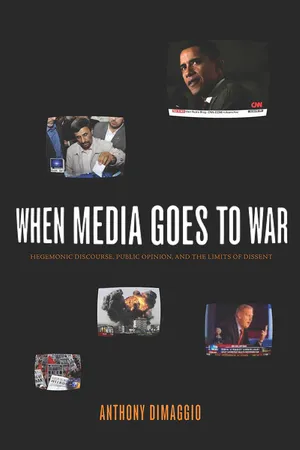
When Media Goes to War
Hegemonic Discourse, Public Opinion, and the Limits of Dissent
- 288 pages
- English
- ePUB (mobile friendly)
- Available on iOS & Android
eBook - ePub
When Media Goes to War
Hegemonic Discourse, Public Opinion, and the Limits of Dissent
About this book
Information
CHAPTER ONE
Withdrawal Pains: Iraq and the Politics of Media Deference
It makes no sense to tell the enemy when you plan to start withdrawing. All the terrorists would have to do is mark their calendars and gather their strength—and begin plotting how to overthrow the government and take control of the country of Iraq. I believe setting a deadline for withdrawal would demoralize the Iraqi people, would encourage killers across the broader Middle East, and send a signal that America will not keep its commitments. Setting a deadline for withdrawal is setting a date for failure—and that would be irresponsible.… Our troops are carrying out a new strategy [in Iraq].… The goal of this new strategy is to help the Iraqis secure their capital, so they can make progress toward reconciliation, and build a free nation that respects the rights of its people, upholds the rule of law, and fights extremists and radicals and killers alongside the United States in this war on terror.
—GEORGE W. BUSH, May 1, 2007
Nouri al-Maliki’s government will not survive because he has proven that he will not work with important elements of the Iraqi people. The Prime Minister is a tool for the Americans and people see that clearly.… We don’t have a democracy here, we have foreign occupation. The British have given up and they know they will be leaving Iraq soon. They are retreating because of the resistance they have faced.… The British have realized this is not a war they should be fighting or one they can win. The Mahdi army [the al-Sadr inspired Shia militia] has played an important role in that. The British put their soldiers in a dangerous position by sending them here but they also put the people in their own country in danger. They have made enemies among all Muslims and they now face attacks at home because of their war.
—MOQTADA AL SADR, August 19, 2007
There is no shortage of controversy on the issue of the United States’ withdrawal from Iraq.1 Officials such as former president George W. Bush argued passionately that the United States must remain in Iraq to fight terrorism, promote human rights, and prevent civil war. Enemies of the occupation such as Moqtada al-Sadr maintain that the United States and its allies increase instability in Iraq and alienate the Iraqi public.
Statements from al-Sadr and Bush demonstrate the intensity of the fight over Iraq withdrawal. Many American officials vehemently oppose withdrawal deadlines. In mid-2007, Democratic political leaders stressed the need for “success” in Iraq and refused to commit to any coherent timetable for complete withdrawal.2 President Barack Obama favors deescalation, not full withdrawal of troops, claiming that troops may remain in Iraq until the end of his first term or later.3 Conversely, the majority of Americans and Iraqis support a timetable for total withdrawal from Iraq.4 Moqtada al-Sadr’s opposition to the United States is shared by most Iraqis. Understanding the wide range of views on the occupation, however, does little to explain how these views are covered in the media systems of the United States and United Kingdom.
The invasion and occupation of Iraq is an issue of major importance. Major resources are allocated for the war effort by both countries, and there remains much congressional and parliamentary deliberation over this issue. The mass media play a crucial role in determining which voices are included in the public dialogue and which are neglected or excluded. Media influence how the debate over foreign policy is conducted by controlling what the public sees and hears.
Democratic theory posits that a wide-ranging debate is essential for the formulation of government policy. The mass media are supposed to present the largest diversity of views possible to educate citizens and political leaders regarding the nuances of political issues. Media independence (or lack thereof) from government can be measured by how media institutions treat controversial views that are not in line with the rhetoric of the Democratic and Republican parties.
Very few studies review American media reporting of international issues alongside the coverage of other countries. This chapter addresses the lack of comparative media research by examining reporting of Iraq in both the United States and United Kingdom. Only by making such comparisons between countries can one better understand the various ways in which news stories are framed, depending upon the national context in question. After undertaking this examination, I conclude that there remain dramatic differences between the British and American press in terms of their reliance on, and dissemination of, official propaganda.
DIVERGING VIEWS ON MEDIA DELIBERATION
Before we examine coverage of withdrawal from Iraq, it is important to discuss contemporary debates on mass media and its relationship with government and the American people. A number of critics argue that the media fails to hold political leaders accountable to the public. Attacking television, Internet, print, and radio alike, these critics frame media as overwhelmingly uniform in reporting foreign politics. Conversely, some speak more optimistically of an independent or “semi-independent press,” whereby media deliberation is balanced by covering competing voices in the Democratic and Republican parties. Supposedly, reporting of partisan disagreement is evidence that media adequately promote criticism of government.5 In contrast, those who speak of media propaganda stress that reporting must extend beyond the narrow confines of bipartisan debate for it to be independent.
A pertinent issue in media studies is the question: “Who deliberates?”6 How are important issues framed? How issues are framed influences not only public policymaking but also citizens’ everyday experiences.7 Robert Entman describes framing as the “process of selecting and highlighting some aspects of a perceived reality.”8 Murray Edelman discusses how the images of political leaders and political enemies are socially constructed to reinforce specific views at the expense of others.9 Edelman argues, “Audience interpretations [of news reports] … are manifestly constrained in some measure by what is reported, what is omitted, and perhaps most fundamentally, by the implications in news reports respecting limits upon the ability of citizens to influence policy.”10 “Agenda setting” studies examine the power of media to emphasize certain themes and concerns at the expense of others. Frank Baumgartner and Bryan Jones, for example, find a strong pro-business tone in reporting discussing economic and financial issues in the pesticide industry.11
Agenda-setting studies find that business and government sources tend to dominate news reporting. John Kingdon distinguishes between “visible and hidden participants” in the agenda-setting process. Visible actors include high-profile political leaders such as the president, federal appointees, members of Congress, media outlets, and political parties.12 Political and business leaders play a more prominent role in setting policy and in establishing the limits of public deliberation. The public plays, at best, a secondary role.
Studies also employ the concept of framing to examine the effects of media on audiences. Shanto Iyengar and Donald Kinder find strong evidence that the most commonly focused-upon “problems” in media content affect television viewers’ assessments of the nation’s most important issues.13 Michael Parenti argues that news frames tend to highlight orthodox economic and political views instead of unorthodox ones. News frames favor business over labor, government officials over protestors, and put more trust in American leaders over foreign ones.14
Some research in political science examines the political economy of the mass media.15 Charles Lindblom discusses the prevalence of “class indoctrination,” in which a “favored class” of people “successfully indoctrinate much of the entire population in certain of its own favored attitudes, beliefs, and volitions.” Indoctrination “by the most favored class is, of course, never a complete success.”16 This process is discussed at greater length in chapters 7 and 8.
Contemporary media scholars argue that criticisms of American foreign policy are most common when conflict emerges between the two parties. One prominent study analyzes debate over the use of torture in Iraq, demonstrating that criticisms of the United States for engaging in such behavior did not materialize in media coverage until after prominent political figures addressed the issue. The study looked specifically at how media were hesitant to use the word torture to discuss the United States’ actions at Abu Ghraib, since no major political leader was willing to use the word, whereas coverage later focused heavily on torture when Senator John McCain publicly took a stand against it in his 2005 efforts to outlaw the practice.17 Other studies of coverage of Vietnam, Iraq, and other American military efforts find t...
Table of contents
- Cover Page
- Title Page
- Copyright Page
- Contents
- Acknowledgments
- Introduction: Propaganda and the News in a Time of Terror
- 1. Withdrawal Pains: Iraq and the Politics of Media Deference
- 2. There Are no Protestors Here: Media Marginalizaition and the Antiwar Movement
- 3. Worthy and Unworthy Victims: the Politicization of Genocide and Human Rights in U.S. Foreign Policy
- 4. Journalistic Norms and Propaganda: Iraq and the War on Terror
- 5. Iran, Nuclear Weapons, and the Politics of Fear
- 6. Media, Globalization, and Violence: Views from Around the World
- 7. Public Rationality, Political Elitism, and Opposition to War
- 8. Media Effects on Public Opinion: Propaganda, Indoctrination, and Mass Resistance
- 9. Propaganda, Celebrity Gossip, and the Decline of News
- Postscript: Media Coverage in the Age of Obama
- Select Bibliography
- Notes
- Index
Trusted by 375,005 students
Access to over 1.5 million titles for a fair monthly price.
Study more efficiently using our study tools.
Frequently asked questions
Yes, you can cancel anytime from the Subscription tab in your account settings on the Perlego website. Your subscription will stay active until the end of your current billing period. Learn how to cancel your subscription
No, books cannot be downloaded as external files, such as PDFs, for use outside of Perlego. However, you can download books within the Perlego app for offline reading on mobile or tablet. Learn how to download books offline
Perlego offers two plans: Essential and Complete
- Essential is ideal for learners and professionals who enjoy exploring a wide range of subjects. Access the Essential Library with 800,000+ trusted titles and best-sellers across business, personal growth, and the humanities. Includes unlimited reading time and Standard Read Aloud voice.
- Complete: Perfect for advanced learners and researchers needing full, unrestricted access. Unlock 1.5M+ books across hundreds of subjects, including academic and specialized titles. The Complete Plan also includes advanced features like Premium Read Aloud and Research Assistant.
We are an online textbook subscription service, where you can get access to an entire online library for less than the price of a single book per month. With over 1.5 million books across 990+ topics, we’ve got you covered! Learn about our mission
Look out for the read-aloud symbol on your next book to see if you can listen to it. The read-aloud tool reads text aloud for you, highlighting the text as it is being read. You can pause it, speed it up and slow it down. Learn more about Read Aloud
Yes! You can use the Perlego app on both iOS and Android devices to read anytime, anywhere — even offline. Perfect for commutes or when you’re on the go.
Please note we cannot support devices running on iOS 13 and Android 7 or earlier. Learn more about using the app
Please note we cannot support devices running on iOS 13 and Android 7 or earlier. Learn more about using the app
Yes, you can access When Media Goes to War by Anthony DiMaggio in PDF and/or ePUB format, as well as other popular books in Ciencias sociales & Industria de medios y comunicaciones. We have over 1.5 million books available in our catalogue for you to explore.