- 420 pages
- English
- ePUB (mobile friendly)
- Available on iOS & Android
eBook - ePub
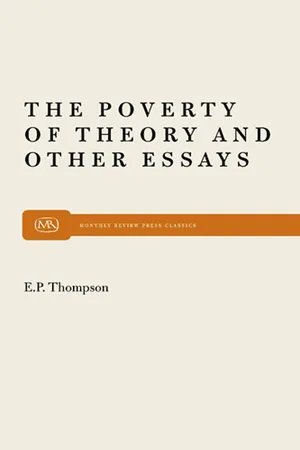
Poverty of Theory
About this book
This classic collection of essays by E.P. Thompson, one of England's most renowned socialist voices, remains a staple text in the history of Marxist theory. The bulk of the book is dedicated to Thompson's famous polemic against Louis Althusser and what he considers the reductionism and authoritarianism of Althusserian structuralism. In lively and erudite prose, Thompson argues for a self-critical and unapologetically humanist Marxist tradition. Also included are three essays of considerable importance to the development of the New Left.
Information
Topic
FilosofiaSubtopic
Filosofia politicaThe Poverty of Theory or An Orrery of Errors
“Disciples do own unto masters only a temporary belief and a suspension of their own judgement until they be fully instructed, and not an absolute resignation or perpetual captivity… So let great authors have their due, as time, which is the author of authors, be not deprived of his due, which is, further and further to discover truth.”
Francis Bacon
“Reason, or the ratio of all we have already known, is not the same that it shall be when we know more.”
William Blake
i
For some time, for many decades, the materialist conception of history—the first-born intellectual child of Marx and Engels—has been growing in self-confidence. As a mature practice (“historical materialism”) it is perhaps the strongest discipline deriving from the Marxist tradition. Even in my own lifetime as a historian—and in the work of my own compatriots—the advances have been considerable, and one had supposed these to be advances in knowledge.
This is not to say that this knowledge is finite, or subject to some “proof” of positivistic scientism. Nor is it to suppose that the advance has been unilinear and un-problematic. Sharp disagreements exist, and complex problems remain not only unsolved but scarcely even disclosed. It is possible that the very success of historical materialism as a practice has encouraged a conceptual lethargy which is now bringing down upon our heads its necessary revenge. And this is the more possible in those parts of the English-speaking world where a vigorous practice of historical materialism has been conducted within an inherited “empirical” idiom of discourse which is reproduced by strong educational and cultural traditions.1
All this is possible, even probable. Even so, the case should not be over-stated. For what a philosopher, who has only a casual acquaintance with historical practice, may glance at and then dismiss, with a ferocious scowl, as “empiricism”, may in fact be the result of arduous confrontations, pursued both in conceptual engagements (the definition of appropriate questions, the elaboration of hypotheses, and the exposure of ideological attributions in pre-existing historiography) and also in the interstices of historical method itself. And the Marxist historiography which now has an international presence has contributed significantly not only to its own self-criticism and maturation (in theoretical ways), but also to imposing (by repeated controversies, much arduous intellectual labour, and some polemic) its presence upon orthodox historiography: imposing (in Althusser’s sense) its own—or Marx’s—“problematic” upon significant areas of historical enquiry.
Engaged in these confrontations we had, I suppose, neglected our lines of theoretical supply. For in the moment when we seemed to be poised for further advances, we have been suddenly struck from the rear—and not from a rear of manifest “bourgeois ideology” but from a rear claiming to be more Marxist than Marx. From the quarter of Louis Althusser and his numerous followers there has been launched an unmeasured assault upon “historicism.” The advances of historical materialism, its supposed “knowledge”, have rested—it turns out—upon one slender and rotten epistemological pillar (“empiricism”); when Althusser submitted this pillar to a stern interrogation it shuddered and crumbled to dust; and the whole enterprise of historical materialism collapsed in ruins around it. Not only does it turn out that men have never “made their own history” at all (being only träger or vectors of ulterior structural determinations) but it is also revealed that the enterprise of historical materialism—the attainment of historical knowledge—has been misbegotten from the start, since “real” history is unknowable and cannot be said to exist. In the words of two post-Althusserians, whose merit it is to have carried Althusserian logic to its own reductio ad absurdam, “History is condemned by the nature of its object to empiricism.” But empiricism, as we know, is a disreputable manifestation of bourgeois ideology: “Despite the empiricist claims of historical practice the real object of history is inaccessible to knowledge.” It follows that:
Marxism, as a theoretical and a political practice, gains nothing from its association with historical writing and historical research. The study of history is not only scientifically but also politically valueless.2
The project to which many lifetimes, in successive generations, have been given is thus exposed as an illusion (if “innocent”) and something worse (if not). And yet historical materialists, of my own generation, have been slow to acknowledge their own abject exposure. They go on working in their old, reprobate ways. Some are too busy to have read the indictments entered against them, but those who have appear to have reacted in one of two ways. Many have glanced at the antagonist in a casual way, seeing it as a weird apparition, a freak of intellectual fashion, which, if they close their eyes, will in time go away. They may be right in the first assumption—that Althusserian “Marxism” is an intellectual freak—but it will not for that reason go away. Historians should know that freaks, if tolerated—and even flattered and fed—can show astonishing influence and longevity. (After all, to any rational mind, the greater part of the history of ideas is a history of freaks.) This particular freak (I will argue) has now lodged itself firmly in a particular social couche, the bourgeois lumpen-intelligentsia3: aspirant intellectuals, whose amateurish intellectual preparation disarms them before manifest absurdities and elementary philosophical blunders, and whose innocence in intellectual practice leaves them paralysed in the first web of scholastic argument which they encounter; and bourgeois, because while many of them would like to be “revolutionaries”, they are themselves the products of a particular “conjuncture” which has broken the circuits between intellectuality and practical experience (both in real political movements, and in the actual segregation imposed by contemporary institutional structures), and hence they are able to perform imaginary revolutionary psycho-dramas (in which each outbids the other in adopting ferocious verbal postures) while in fact falling back upon a very old tradition of bourgeois elitism for which Althusserian theory is exactly tailored. Whereas their forebears were political interventionists, they tend more often to be diversionists (enclosed and imprisoned within their own drama) or “internal emigrees.”4 Their practical importance remains, however considerable, in disorganising the constructive intellectual discourse of the Left, and in reproducing continually the elitist division between theory and practice. Maybe, if we suffer experiences sharp enough, the freak will eventually go away, and many of its devotees may be reclaimed for a serious political and intellectual movement. But it is time that we pushed it along the road.
The other reaction commonly found among historical materialists is more reprehensible—that of complicity. They glance at Althusserian Marxism and do not wholly understand it (nor like what they understand), but they accept it, as “a” Marxism. Philosophers cannot be expected to understand history (or anthropology, or literature, or sociology) but Althusser is a philosopher doing his own thing. And some conceptual rigour is no doubt necessary; perhaps even bits can be borrowed (“over-determination”, “instances”)? After all, we are all Marxists together. In this way, a sort of tacit compromise is negotiated, although most of the negotiation is made up of silence, and all the negotiation consists in ceding ground to Althusser. For Althusser has never offered compromise of any kind: and certainly not to “historicism”, “humanism” and “empiricism.”
This is reprehensible because it is theoretically unprincipled. Althusser and his acolytes challenge, centrally, historical materialism itself. They do not offer to modify it but to displace it. In exchange they offer an a-historical theoreticism which, at the first examination, discloses itself as idealism. How then is it possible for these two to co-exist within one single tradition? Either a very extraordinary mutation has been taking place, in the last few years, in the Marxist tradition: or that tradition is now breaking apart into two—or several—parts. What is being threatened—what is now actively rejected—is the entire tradition of substantive Marxist historical and political analysis, and its accumulating (if provisional) knowledge. And if (as I suppose) Althusserian Marxism is not only an idealism but has many of the attributes of a theology, then what is at issue, within the Marxist tradition, is the defence of reason itself.
ii
I will offer at the outset a map of where I mean to go, since there will inevitably be certain detours, and the doubling back upon my own tracks. I shall direct my central attention to Althusser—and to the critical formative texts, For Marx and Reading Capital—and will not spend time over his numerous progeny. It is true that many of these disown their master, and that others are influenced only in certain areas of their thought. But I hope that some of my general arguments (in particular on “empiricism” and “moralism”) may be taken to include them also. I apologise for this neglect; but life is too short to follow (for example) Hindess and Hirst to every one of their theoreticist lairs. Nor shall I take up the lists against a more formidable opponent, Poulantzas, who—with Althusser—repeatedly fails to understand the historical categories (of class, ideology, etc.) employed by Marx. Another time, perhaps. Let us stay now with the Aristotle of the new Marxist idealism.
I will argue the following propositions, and examine them in sequence. 1) Althusser’s epistemology is derivative from a limited kind of academic learning-process, and has no general validity; 2) As a result he has no category (or way of handling) “experience” (or social being’s impingement upon social consciousness); hence he falsifies the “dialogue” with empirical evidence inherent in knowledge-production, and in Marx’s own practice, and thereby falls continually into modes of thought designated in the Marxist tradition as “idealist”; 3) In particular he confuses the necessary empirical dialogue with empiricism, and consistently misrepresents (in the most naive ways) the practice of historical materialism (including Marx’s own practice); 4) The resultant critique of “historicism” is at certain points identical to the specifically anti-Marxist critique of historicism (as represented by Popper), although the authors derive from this opposite conclusions.
This argument will take us some way on our road. I will then propose: 5) Althusser’s structuralism is a structuralism of stasis, departing from Marx’s own historical method; 6) Hence Althusser’s conceptual universe has no adequate categories to explain contradiction or change—or class struggle; 7) These critical weaknesses explain why Althusser must be silent (or evasive) as to other important categories, among them “economic” and “needs”; 8) From which it follows that Althusser (and his progeny) find themselves unable to handle, except in the most abstract and theoretic way, questions of value, culture—and political theory.
When these elementary propositions have been established (or, as Althusser will have it, “proved”) we may then stand back from the whole elaborate and sophistical structure. We may even attempt another kind of “reading” of his words. And, if we are not exhausted, we may propose some questions of a different kind: how has this extraordinary fracture occurred in the Marxist tradition? How are we to understand Althusserian structuralism, not in its self-evaluation as “science”, but as ideology? What were the specific conditions for the genesis and maturation of this ideology and its rapid replication in the West? And what is the political significance of this unmeasured assault upon historical materialism?
iii
I commence my argument at a manifest disadvantage. Few spectacles would be more ludicrous than that of an English historian—and, moreover, one manifestly self-incriminated of empirical practices—attempting to offer epistemological correction to a rigorous Parisian philosopher.
I can sense, as I stare at the paper before me, the shadowy faces of an expectant audience, scarcely able to conceal their rising mirth. I don’t intend to gratify them. I don’t understand Althusser’s propositions as to the relation between the “real world” and “knowledge”, and therefore I can’t expose myself in a discussion of them.
It’s true that I’ve tried to understand them. Throughout For Marx the question as to how these “raw materials” from the real world arrive in the laboratory of theoretical practice (to be processed according to Generalities I, II and III) cries out for some answer. But the opportunity for disclosure is passed by. Turning to Reading Capital we learn, with rising excitement, that now, at last, an answer will be given. Instead, we are offered anti-climax. We first endure some tedium and more exasperation, as a ritual commination against “empiricism” is conducted; even a mind without philosophic rigour cannot overlook the fact that Althusser continually confuses and conflates the empirical mode (or techniques) of investigation with the quite different ideological formation, empiricism, and, moreover, simplifies his own polemics by caricaturing even this “empiricism”, and ascribing to it, indiscriminately and erroneously, “essentialist” procedures of abstraction.5 But at length, after fifty pages, we arrive at—what?
We can say, then, that the mechanism of production of the knowledge effect lies in the mechanism which underlies the action of the forms of order in the scientific discourse of the proof. (R.C. 67)
Thirty-three words. And then silence.
If I understand these words, then I find them disgraceful. For we have been led all this way only to be offered a re-statement, in new terms, of the original question. Knowledge effects arrive, in the form of “raw materials” (Generalities I, which are already artefacts of culture, with more or less ideological impurity), obediently as “the scientific discourse of the proof” demands. I must explain my objection: and, first, what my objection is not.
I don’t object to the fact that Althusser offers no “guarantees” as to an identity between the “real” object and its conceptual representation. One would expect any such formal guarantee to be of doubtful efficacy: even a casual acquaintance with philosophy suggests that such guarantees have a short term of validity and contain many clauses in small print which exonerate the guarantor from liability. Nor do I object to the fact that Althusser has abandoned the weary ground of attempting to elucidate a one-to-one correspondence between this “real” material event or object and that perception/intuition/sense-impression/concept. It would, perhaps, have been more honest if he had frankly confessed that, in doing so, he was also abandoning certain of Lenin’s propositions in Materialism and Empirio-Criticism—but for the least syllable of Lenin he professes a religious awe.6 And he certainly might have confessed that, in shifting his ground, he was following and not setting philosophical fashion.
In the old days (one supposes) when the philosopher, labouring by lamp-light in his study, came to this point in his argument, he set down his pen, and looked around for an object in the real world to interrogate. Very commonly that object was the nearest one to hand: his writing-table. “Table,” he said, “how do I know that you exist, and, if you do, how do I know that my concept, table, represents your real existence?” The table would look back without blinking, and interrogate the philosopher in its turn. It was an exacting exchange, and according to which one was the victor in the confrontation, the philosopher would inscribe himself as idealist or a materialist. Or so one must suppose from the frequency with which tables appear. Today the philosopher interrogates instead the word: a pre-given linguistic artefact, with an indistinct social genesis and with a history.
And here I begin to find terms for my objection. It is, first, that Althusser interrogates this word (or this “raw material” or this “knowledge effect”) too briefly. It exists only to be worked up by theoretical practice (Generality II) to structural conceptualisation or concrete knowledge (Generality III). Althusser is as curt with linguistics and with the sociology of knowledge as he is with history or anthropology. His raw material (object of knowledge) is an inert, pliant kind of stuff, with neither inertia nor energies of its own, awaiting passively its manufacture into knowledge. It may contain gross ideological impurities, to be sure, but these may be purged in the alembic of theoretical practice.
Second, this raw material appears to present itself for processing as discrete mental events (“facts”, idées reçus, commonplace concepts): and it also presents itself with discretion. Now I don’t wish to j...
Table of contents
- Cover page
- Title page
- Copyright Page
- Contents
- Foreword
- The Poverty of Theory or An Orrery of Errors (1978)
- Outside the Whale (1960)
- The Peculiarities of the English (1965)
- An Open Letter to Leszek Kolakowski (1973)
- A Note on the Texts
- Footnotes
Trusted by 375,005 students
Access to over 1.5 million titles for a fair monthly price.
Study more efficiently using our study tools.
Frequently asked questions
Yes, you can cancel anytime from the Subscription tab in your account settings on the Perlego website. Your subscription will stay active until the end of your current billing period. Learn how to cancel your subscription
No, books cannot be downloaded as external files, such as PDFs, for use outside of Perlego. However, you can download books within the Perlego app for offline reading on mobile or tablet. Learn how to download books offline
Perlego offers two plans: Essential and Complete
- Essential is ideal for learners and professionals who enjoy exploring a wide range of subjects. Access the Essential Library with 800,000+ trusted titles and best-sellers across business, personal growth, and the humanities. Includes unlimited reading time and Standard Read Aloud voice.
- Complete: Perfect for advanced learners and researchers needing full, unrestricted access. Unlock 1.5M+ books across hundreds of subjects, including academic and specialized titles. The Complete Plan also includes advanced features like Premium Read Aloud and Research Assistant.
We are an online textbook subscription service, where you can get access to an entire online library for less than the price of a single book per month. With over 1.5 million books across 990+ topics, we’ve got you covered! Learn about our mission
Look out for the read-aloud symbol on your next book to see if you can listen to it. The read-aloud tool reads text aloud for you, highlighting the text as it is being read. You can pause it, speed it up and slow it down. Learn more about Read Aloud
Yes! You can use the Perlego app on both iOS and Android devices to read anytime, anywhere — even offline. Perfect for commutes or when you’re on the go.
Please note we cannot support devices running on iOS 13 and Android 7 or earlier. Learn more about using the app
Please note we cannot support devices running on iOS 13 and Android 7 or earlier. Learn more about using the app
Yes, you can access Poverty of Theory by E. P. P. Thompson in PDF and/or ePUB format, as well as other popular books in Filosofia & Filosofia politica. We have over 1.5 million books available in our catalogue for you to explore.